Reward AI's OM-1 Skips Teleoperation Data Entirely, and the Demo Shows Why That's a Bet
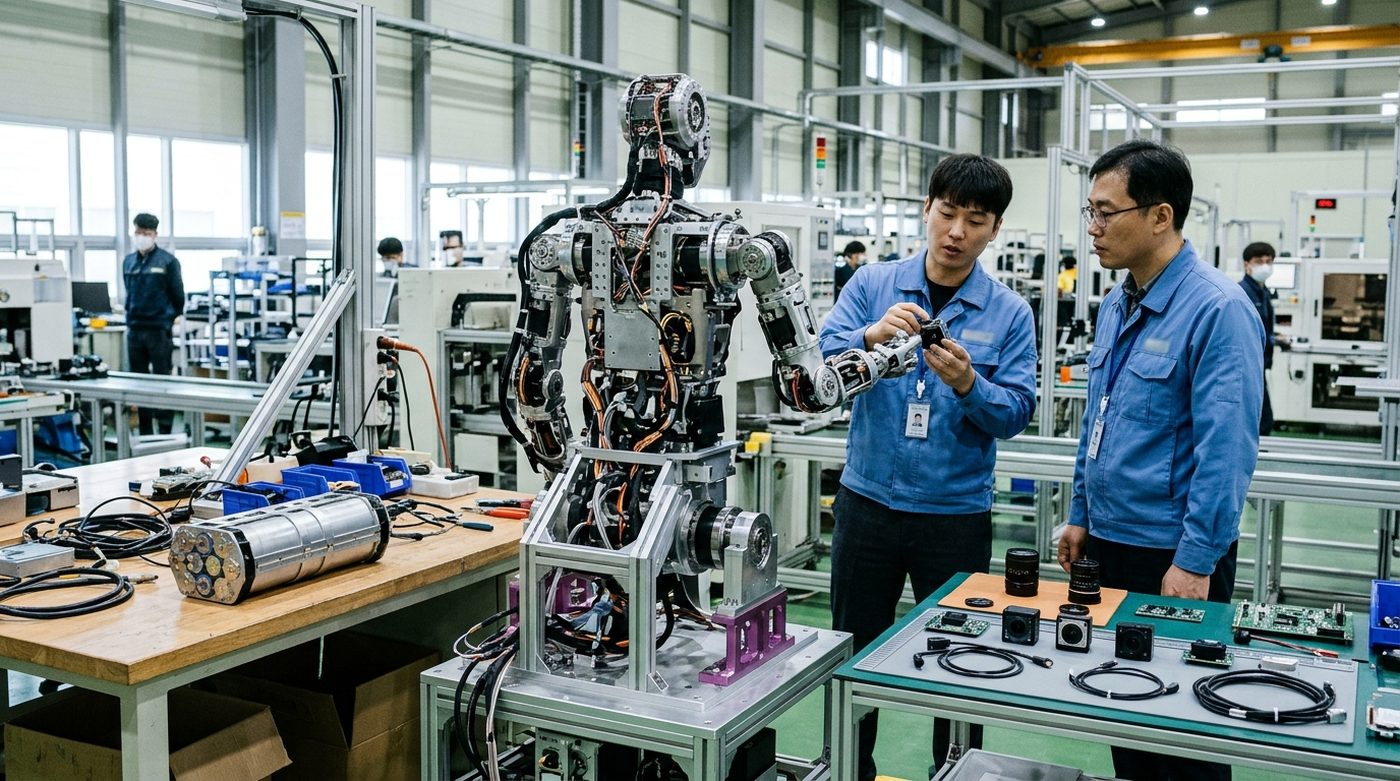
Reward AI published a demo of its OM-1 manipulation policy handling deliveries, stairs and household chores, trained entirely on human demonstration data captured by its wearable Omnibody Hand with no teleoperation data at all.


Reward AI's OM-1 Skips Teleoperation Data Entirely, and the Demo Shows Why That's a Bet
Reward AI published a four-minute demo video on October 27 showing a humanoid robot running its OM-1 manipulation policy through a last-mile delivery route: climbing onto a pickup truck's tailgate to retrieve a parcel, carrying packages and a sock up a flight of stairs, mopping a floor and opening a refrigerator door, all described by the company as fully autonomous footage running at real-world speed. Reward AI has not disclosed its headquarters, but it was founded by robot-learning researchers Zipeng and Chen, and its published technical work builds directly on DexCap, a 2024 portable-motion-capture paper co-authored by Stanford's Li Fei-Fei and C. Karen Liu, placing the company inside the academic lineage that has driven much of the recent progress in dexterous robot manipulation.
The commercial claim behind the footage is specific enough to be checked against the rest of the industry: Reward AI says OM-1 was trained entirely on human demonstration data captured by a wearable device, with no teleoperation data and no on-robot experience in its training set, and that the resulting policy can learn a new task, including long-horizon, dynamically demanding ones, from under 30 minutes of human demonstration. If that holds up under independent testing, it would shortcut one of the most expensive line items in humanoid robot development: the months of teleoperated data collection that most manipulation-focused labs currently treat as unavoidable.
A Wearable Hand That Skips the Robot Entirely
The mechanism behind the claim is the Omnibody Hand, a wearable device Reward AI built to record human manipulation without forcing the human operator to mimic a robot's joint geometry. Instead of a glove that maps one-to-one onto a robotic hand's fingers, the device uses a compact seven-degree-of-freedom design that captures thumb-index pinching, independent thumb flexion against all four fingers, and a coordinated power-grasp motion across the middle, ring and little fingers, while an integrated mechanism automatically compensates for different finger lengths so the hardware fits a range of hand sizes without per-user calibration.
Sensing runs across three channels at once: high-frequency tactile feedback at the point of contact, proximity sensing in the moments before contact occurs, and global-shutter in-hand cameras that capture the visual scene from the hand's own point of view. Hand pose tracking combines visual-inertial tracking with electromagnetic sensing and interference compensation, a pairing the company says cut mean overshoot error at high motion speeds from 24.9 millimeters down to 9.5 millimeters across a benchmark spanning eight speeds and ten runs each. That is a meaningful accuracy gain for any system that depends on precisely timed, fast hand motions, grasping a falling or moving object being the clearest example, and it is the kind of detail a buyer evaluating manipulation hardware should weigh more heavily than the demo footage itself, since it describes the data-collection instrument's own precision rather than the robot's performance.
Why Skipping Teleoperation Data Is a Real Bet, Not a Marketing Line
The reason this approach matters commercially is that teleoperated data collection, where a human operator drives a physical robot through a task while the system logs the robot's own joint angles and sensor readings as training data, has become the default approach across much of the humanoid industry precisely because it captures data in the robot's native action space. Reward AI's wager is that human motion data, captured off the robot entirely and translated into robot actions by a learned policy, can substitute for that robot-native data without losing the fidelity that makes teleoperated datasets useful. OM-1's single-stage training process, in which every demonstration enters the model in the same form regardless of task, is built around that bet: there is no separate pre-training phase on a large generic dataset followed by task-specific fine-tuning, the architecture the industry has generally converged on for foundation-model-style robot policies.
The company's own technical account acknowledges that a separate, lower-level controller, trained with reinforcement learning in simulation rather than on human data, converts the policy's high-level motion and force outputs into the robot's actual joint commands, and that this controller runs on its own high-frequency clock so that inference latency in the main policy does not interrupt the robot's motion. That split matters for understanding what the "no teleoperation data" claim actually covers: it describes how the high-level decision-making was trained, not how the robot's physical control loop was built, and a buyer should read the two as separate engineering problems rather than assume the entire system learned from human data alone.
What the Footage Does and Doesn't Prove
Humanoids Daily, which first surfaced the clip, noted accurately that the footage represents the company's own characterization of the demo rather than an independently verified evaluation, and that the video shows no success rates, no count of attempts, and no performance data against unfamiliar objects or unfamiliar locations. That is a standard caveat for any company-released robot demo, and it applies here with particular force because the tasks shown, climbing onto a vehicle tailgate, navigating stairs while carrying an object, and operating a refrigerator door, are exactly the kind of long-horizon, contact-rich tasks that are hardest to generalize reliably outside a controlled or rehearsed setting.
A procurement team evaluating general-purpose manipulation policies for deployment, rather than evaluating a company's technical narrative, should treat the demo as a capability claim worth testing rather than a capability proven. The specific claim worth testing directly is the under-30-minutes task-learning figure, since that number, if it holds across a buyer's own task set rather than only the tasks Reward AI chose to film, would represent a meaningfully faster deployment cycle than the data-collection timelines most manipulation-focused integrators currently quote for a new application.
The Competitive Field This Lands In
Reward AI's publication arrives into a manipulation-robotics field that is already crowded with companies pursuing cross-embodiment policies, systems designed to transfer a single learned skill across different robot hardware rather than training separately for each robot body. The company's own framing, "one model, one data interface, any body," places OM-1 directly against that broader trend rather than against any single rival, and the differentiator it is staking its position on is the data source: human demonstration captured through a purpose-built wearable rather than teleoperated robot data, in-the-wild video scraped from the internet, or simulation-generated training data, each of which other labs in the space have pursued as their own primary data strategy.
Whether that differentiator survives contact with independent evaluation is the open question a buyer should track over the coming months rather than resolve from a single demo video. A policy trained without any on-robot experience in its dataset has to generalize not only across tasks and environments but across the gap between human hand kinematics and whatever robot hardware eventually runs the policy, a transfer problem that has historically been one of the harder unsolved issues in imitation learning from human data. Reward AI's claimed overshoot-error improvement from its electromagnetic tracking addresses part of that gap, the precision of the recorded human motion, but it does not by itself resolve the separate question of how faithfully a learned policy reproduces that motion on a robot body with different proportions, joint limits and actuator dynamics than a human hand and arm.
What a Buyer Should Watch Next
The near-term signal worth tracking is whether Reward AI publishes task-success data, ideally against a standardized benchmark rather than self-selected footage, and whether the under-30-minute task-learning claim holds when tested on tasks outside the company's own demo reel. A second signal worth tracking is customer or pilot deployment news, since a company at this stage of public disclosure, four months after emerging from stealth, is typically building toward paid pilots with early customers rather than general commercial availability, and the terms of those early pilots, which industries, which tasks, and what performance bar triggers a broader rollout, will say more about OM-1's real-world reliability than any demo video the company releases on its own channel.
For now, Reward AI has published a technically detailed account of its approach alongside footage that is genuinely impressive to watch and genuinely unverified by anyone outside the company. Both of those things can be true at once, and a buyer's job is to keep them separate until independent evidence closes the gap.
Budget and timeline implications follow from that same separation. A procurement team building a near-term deployment plan around a cross-embodiment manipulation policy should price in a pilot-and-verification phase before any production commitment, regardless of which vendor it is evaluating, because every company at Reward AI's stage of disclosure is describing lab and demo results rather than fleet-scale operating data. The specific number worth holding a vendor to in that pilot phase is task-learning time under real operating conditions, not a studio-recorded demo, since that is the metric most directly tied to the integration cost of adding a new task to an existing deployment.
The broader pattern worth watching across the manipulation-robotics field is how many of Reward AI's rivals shift their own public claims toward human-demonstration data as a primary training source over the next few quarters. If the approach proves out at scale, it would lower one of the clearest cost barriers to expanding a manipulation robot's task library, the need to collect fresh teleoperated data for every new task, and competitors with teleoperation-heavy pipelines already built would face a real decision about how much of that infrastructure to keep.
This account draws on Reward AI's own published technical overview of OM-1 and the Omnibody Hand, and on the company's October 27 demonstration video.
This article is provided for general information purposes only and does not constitute investment, procurement, legal, or engineering advice. Company claims described here have not been independently verified and may change without notice.