Vention Opens Physical AI Lab for Factory Robots
Vention opened a Montreal lab to turn robot-manipulation research into reliable factory deployments, with GRIIP and production data at the center.
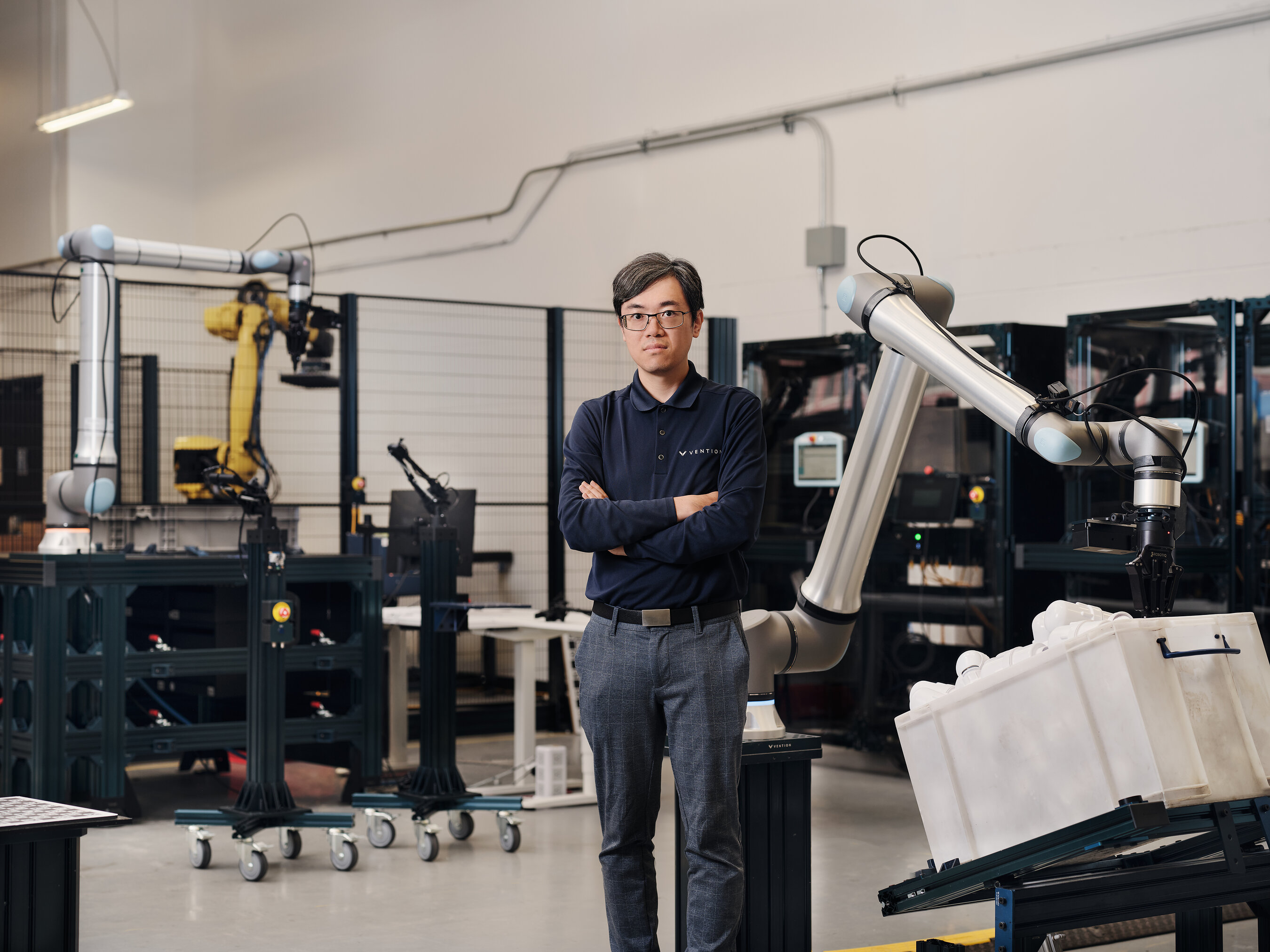
MONTREAL, Quebec, September 9, 2026. Vention opened a Physical AI laboratory in Montreal on Wednesday to move robot-manipulation research into factory deployment. The eight-person team will test perception, control, simulation, and learning methods against production requirements, while the industrial-automation company recruits for more than 16 additional research and engineering roles.
Vention is a Montreal-based automation company whose digital platform combines machine design software, modular hardware, controls, and deployment services. It reports more than 28,000 machines deployed across 6,000 factories, including customers among 90 Fortune 500 companies. The new lab targets the costly gap between an impressive manipulation demo and a robot cell that can survive a production schedule.
The Lab Starts With a Commercial Constraint
Industrial robotics research often begins with capability: can a machine recognize an unfamiliar object, estimate its pose, plan a collision-free motion, and grasp it? Factory buyers start somewhere less glamorous: how often does it work, what happens after a miss, how long does changeover take, and who owns the recovery procedure at 2 a.m.?
Vention has built the lab around that second set of questions. Its research program combines robot-control engineering and motion generation with older and newer vision methods, demonstration-based training, reinforcement learning, and the collection of factory data. Those fields are familiar on university grant proposals. The difference is that Vention intends to evaluate them against live manufacturing constraints, including part variation, reliability, cost, and the practical limits of deploying a new skill across customer sites.
The lab is led by Jimmy Li, Vention's director of Physical AI, with Cohere Chief AI Officer Joelle Pineau serving as an external technical adviser. The initial team has eight members, and Vention says it is hiring for more than 16 positions across robot control, simulation, and Physical AI research. That staffing plan makes the facility more than a demonstration room, but headcount alone will not determine whether its work transfers to customers.
The useful test is whether the lab shortens the route from a benchmark to a serviceable machine. A manufacturer does not buy reinforcement learning. It buys fewer engineering hours, faster commissioning, lower scrap, and a recovery process that ordinary technicians can understand.
GRIIP Is the Product Behind the Research Pitch
The commercial bridge is GRIIP, Vention's modular Physical AI pipeline launched in February 2026. The system combines scene digitization, object segmentation, pose estimation, grasp selection, and collision-free motion planning. Vention uses foundation models from suppliers including Nvidia alongside its own models, then connects those software stages to robot hardware and factory tasks.
In plain English, the pipeline tries to turn a messy bin or workstation into a sequence a robot can act on. The camera identifies what is present, the software separates one object from another, estimates where each item sits, selects a viable grasp, and checks that the arm can reach it without striking nearby equipment. Every stage can fail, and a strong laboratory result is only the beginning of the integration job.
Vention plans to release a public GRIIP software development kit so engineering teams can adapt the pipeline to their own applications. The word “plans” matters. The pipeline exists, while the public development kit remains a future deliverable. Procurement teams should ask for the release date, supported hardware list, version policy, and the boundary between code a customer can modify and capabilities that remain tied to Vention's managed platform.
That distinction affects switching costs. An open development kit can widen the partner ecosystem and reduce dependence on one integrator. It can also become a thin interface over proprietary services that are difficult to replace. Buyers should judge the license, data portability, offline operation, and model-update controls rather than treating “SDK” as proof of openness.
Production Data Could Be Vention's Durable Advantage
Vention's strongest claim is not a model architecture. It is access to production problems. The company says its installed base spans thousands of manufacturers and gives researchers a recurring stream of manipulation tasks, client feedback, and industrial data. That can create a feedback loop that pure research labs struggle to reproduce.
A failed pick in a laboratory is an experiment. A failed pick on an assembly line can stop downstream work, damage a component, or require a technician to enter the cell. The difference changes what teams measure. Factory data captures edge cases that curated benchmarks tend to miss, including reflective packaging, damaged cartons, flexible materials, worn fixtures, lighting changes, and parts that arrive in the wrong orientation.
Vention says Physical AI is its fastest-growing segment, with related revenue up 400 percent over the past year. The percentage is notable, but the company has not disclosed the starting revenue base, gross margin, customer concentration, or how much of that growth came from pilots rather than repeat deployments. A small business line can grow fourfold and remain small. The figure should be read as evidence of momentum inside Vention, not as proof that Physical AI has become a mature factory category.
The same discipline applies to the company's reported 28,000 deployed machines and 6,000 factories. Those numbers establish reach, but they do not show how many sites use GRIIP, how many AI-enabled cells run continuously, or what share of installed equipment generates data suitable for model training. The next useful disclosure would connect the installed base to recurring use, successful task families, and measured deployment time.
The Real Benchmark Is Changeover Economics
The lab is working with industrial and electronics manufacturers, including an unnamed large automotive original equipment manufacturer on unstructured final-assembly tasks. That is the right environment for testing value because final assembly contains high-mix work, variable part presentation, tight cycle times, and frequent engineering changes.
It is also where claims need the most scrutiny. Automotive factories have spent decades reducing variation through fixtures, standardized containers, and carefully timed processes. A learning-based robot can be valuable when variation cannot be engineered away, but it competes against simpler options: a better feeder, a revised fixture, a dedicated machine, or a small amount of manual labor.
The buyer's question is therefore not whether Physical AI can perform a task. It is whether the full system costs less over its life than conventional automation or a redesigned process. That calculation includes cameras, compute, networking, safety validation, training data, model monitoring, integration, maintenance, cybersecurity, and the labor needed when the model encounters a new failure mode.
This is where the new lab can earn credibility. If Vention can publish repeatable changeover results across different robot brands, part families, and factories, it will give buyers a basis for comparing AI-enabled cells with fixed automation. If it publishes only polished grasping videos, the lab will add little to a market already rich in controlled demonstrations.
Recent developments reinforce that distinction. Samsung SDS has entered robot orchestration from the enterprise-software side, while Hai Robotics has demonstrated the scale possible with tightly engineered warehouse systems. Vention sits between those models. It wants software flexibility without giving up responsibility for the physical automation stack.
Buyers Need Failure Data, Not Another Demo Reel
The uncomfortable truth is that factory deployment is usually blocked by exception handling rather than by the headline skill. A robot may complete 98 of 100 picks, yet the remaining two can erase the labor savings if each failure requires a specialist to stop the line, clear the cell, and restart the process.
Vention has not published mean time between interventions, recovery rates, cycle-time distributions, or performance across lighting and part variation for the new lab's work. That is reasonable on opening day, but those are the measures that should define its next phase. Procurement teams should ask for results in units that map to operations: interventions per shift, minutes of downtime, successful changeovers without code changes, and the number of technician hours required per new part.
They should also ask how customer data is separated. Vention says its platform turns production experience into better models while protecting customer data and intellectual property. That promise needs operational detail. Manufacturers should understand what leaves the site, what is retained, whether models trained on one customer's failures benefit another customer, and how a plant can delete or export its data when a contract ends.
The Hanshow and X-Era retail trial shows why this matters beyond factories. Large deployment surfaces generate valuable exception data, but they also multiply the consequences of an opaque model update. The commercial winner will not merely learn from more machines. It will make that learning auditable, reversible, and safe enough for operators to trust.
Montreal Now Has to Produce Transferable Results
Vention's lab is a credible investment because the company already sells hardware, software, and automation services into real factories. It has customer access, an existing pipeline in GRIIP, named technical leadership, and a hiring plan. Those assets give the research team a better starting point than a standalone laboratory searching for applications after the fact.
The company still has to prove that the loop works in both directions. Production problems must shape the research, and research results must return to production as reliable tools that integrators and plant technicians can use. That proof will come through deployed task counts, commissioning time, intervention rates, and customer renewals, not the number of models in the stack.
For automation buyers, the lab should be treated as a supplier-capability signal rather than a reason to change a purchasing plan today. Put Vention on the shortlist for variable manipulation tasks, request a cell-level trial, define acceptance metrics before installation, and insist on evidence from a comparable part family. A vendor that welcomes that test is building deployment infrastructure. A vendor that redirects the conversation to a demonstration is still selling research.
Vention has opened the right kind of facility. Its value will be measured by how quickly the laboratory becomes invisible inside ordinary factory work.
Hero image credit: Vention Inc.
This analysis draws on Vention's September 9 public announcement and company disclosures about its Physical AI products, team, customer base, and deployment plans. It is for general information purposes only and does not constitute investment, financial, procurement, legal, or engineering advice.