PUDU D7 Makes European Debut at IFA 2026
Pudu Robotics brought its D7 semi-humanoid to Europe for the first time, using its 130,000-unit commercial robot base to make a broader case for embodied AI.
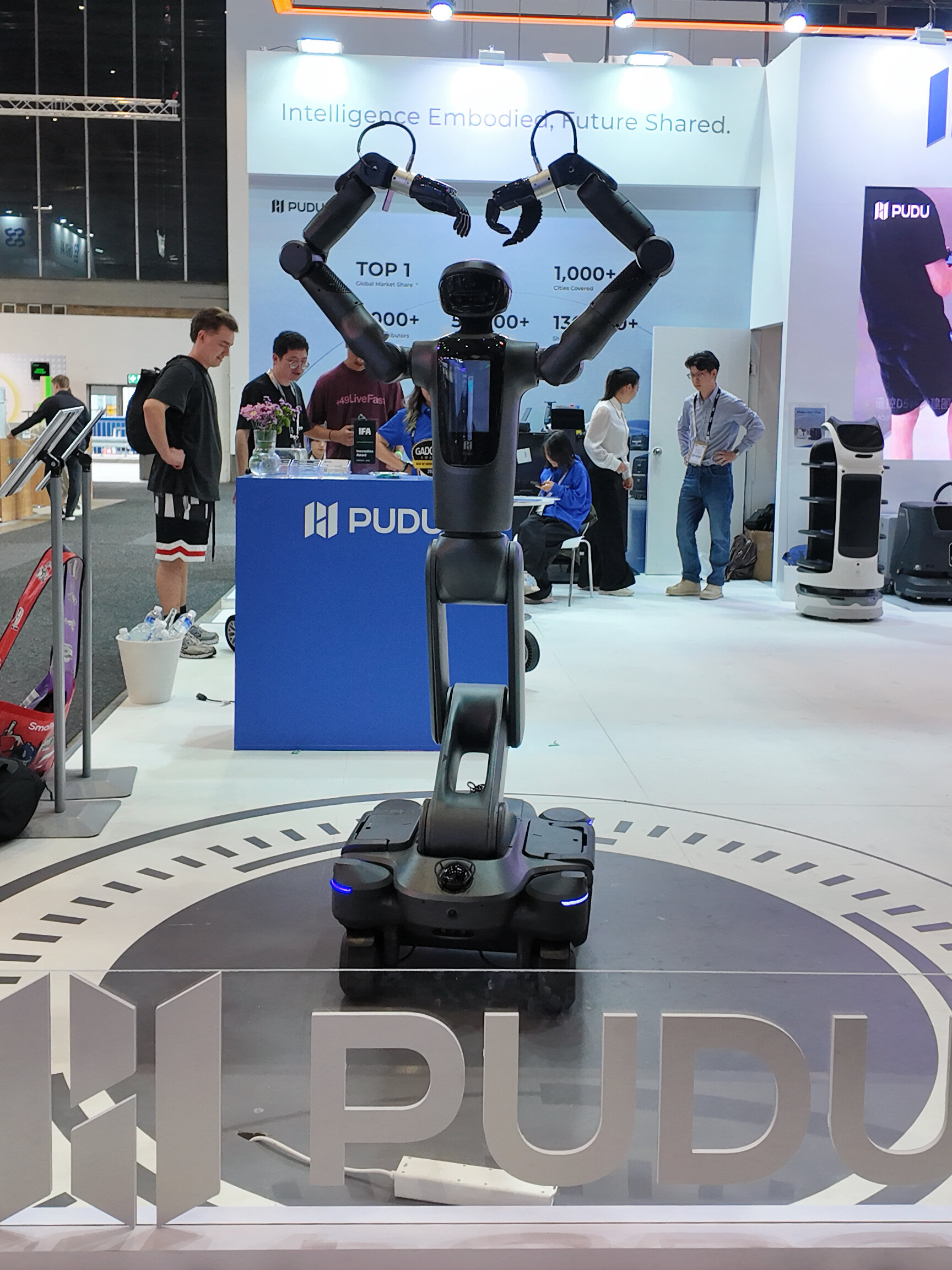
BERLIN, Sept. 5, 2026. Pudu Robotics brought its full robot portfolio to IFA for the first time on Friday, giving the PUDU D7 semi-humanoid its European debut alongside delivery, cleaning, industrial transport, and quadruped systems. The Shenzhen company used live demonstrations to pitch a practical route from specialized robots to embodied artificial intelligence.
Pudu Robotics is based in Shenzhen and builds autonomous machines for service delivery, commercial cleaning, industrial transport, and general embodied artificial intelligence. Its core technology spans perception, mobile autonomy, fleet scheduling, manipulation, and robot foundation models. That breadth makes it a useful test of whether a proven specialist can move into more flexible physical work without abandoning the products that already pay the bills.
Europe Meets a Portfolio, Not a Prototype
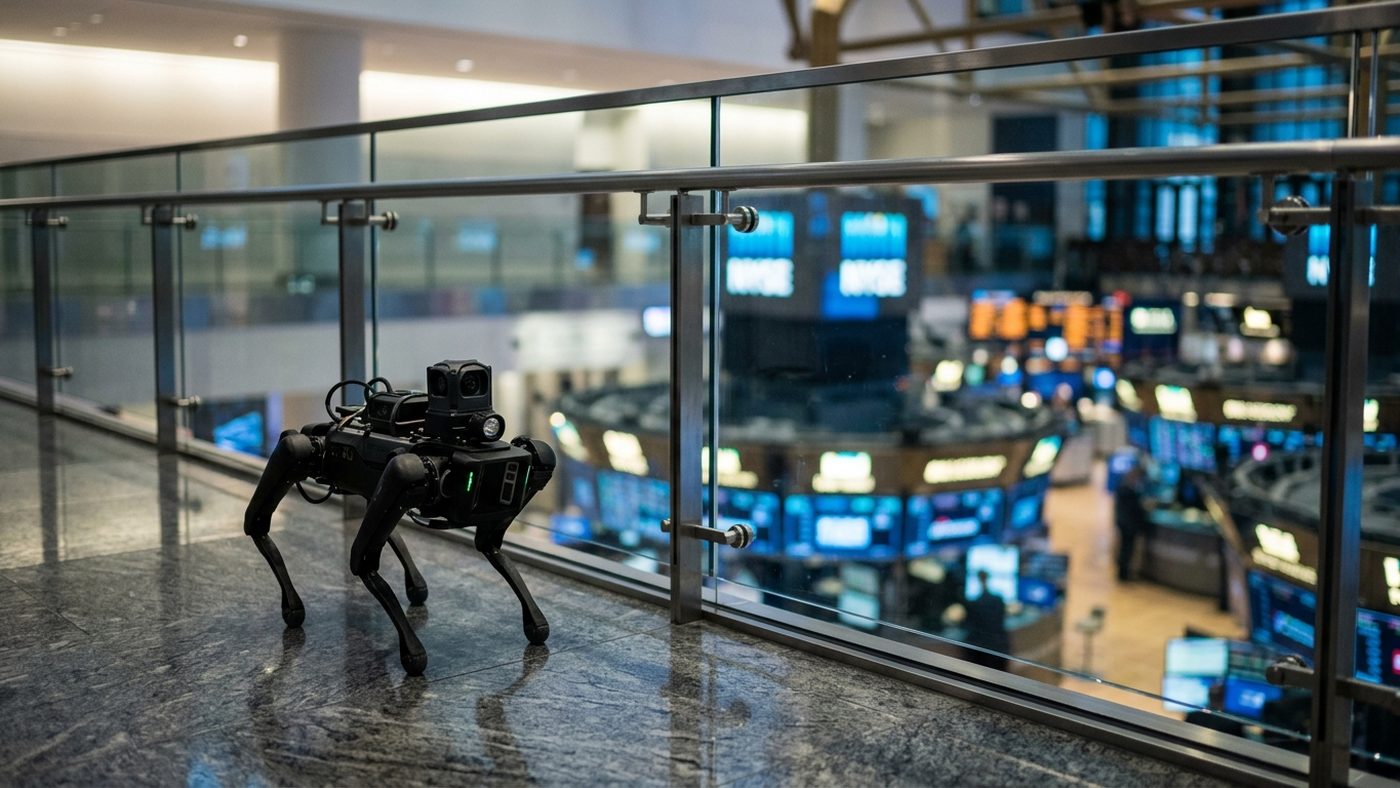
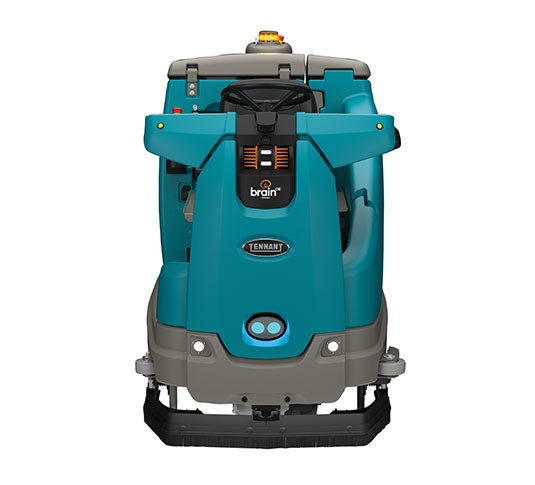
Pudu’s IFA booth placed the PUDU D7 at the front of a much larger commercial argument. Visitors could ask the semi-humanoid to pick up objects, pose for photographs, take a selfie from its own camera, or form a heart gesture with its two arms. Nearby, the wheeled PUDU D5-W quadruped crossed stairs, gravel, and sand. The booth also included the BellaBot Pro delivery robot, the PUDU CC1 Pro and PUDU MT1 Max cleaners, and the PUDU T600 industrial transporter.
That mix matters because D7 itself is not new. Pudu introduced the first version in September 2024 and announced a next-generation industrial model in June 2026. The event in Berlin was a regional market step, not a global product unveiling. The fresh development was the first European appearance of the current system, backed by live demonstrations and recognition as an IFA Innovation Award honoree in the IFA Next and Emerging Tech category.
For buyers, that distinction is more than editorial housekeeping. A product launch asks whether the hardware works. A European debut asks whether the supplier is preparing to sell, integrate, support, and maintain the hardware in a demanding market. Those are different tests, and the second is usually harder. European customers will care about machine safety, privacy, workplace acceptance, technical support, spare parts, system integration, and the evidence behind every performance claim.
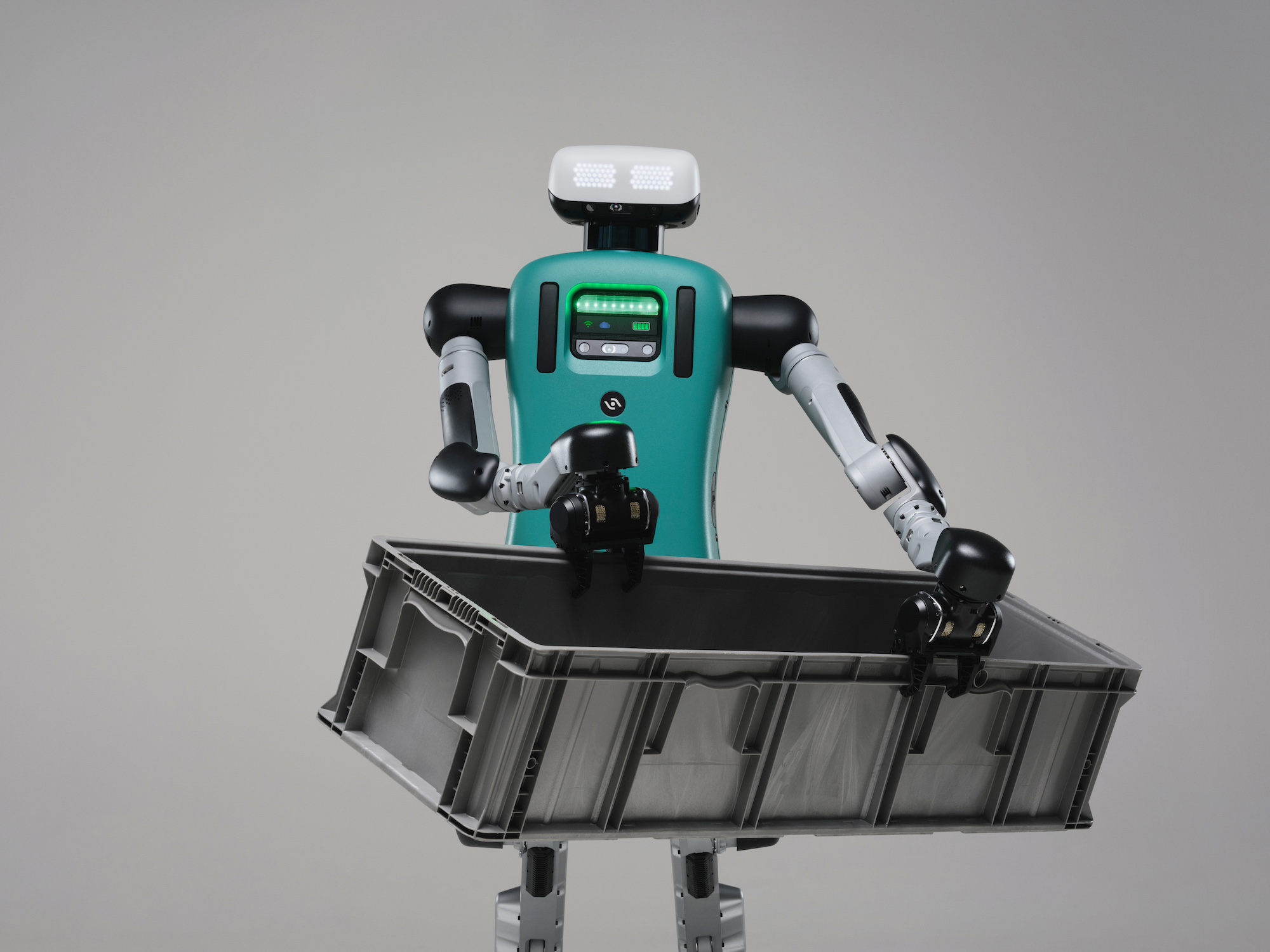
The D7 demonstration showed a robot that can combine mobility, perception, interaction, and two-arm manipulation in one body. Pudu’s June specification described a payload of up to 14 kilograms, a work height of up to 2 meters, dual light detection and ranging sensors, tactile feedback, and autonomous battery swapping. Those capabilities create a plausible fit for material handling, shelf work, cart movement, and repetitive tending tasks. They do not yet prove that the machine can deliver those tasks at a European customer site for a full shift.
An Installed Base Changes the Risk Calculation
Pudu says it has shipped more than 130,000 robots across more than 85 countries and regions and more than 1,000 cities. The company also says its CC1 cleaning series has passed 20,000 units. These are vendor-reported figures rather than independently audited fleet data, but they still describe a commercial base that most embodied-AI startups do not have.
That installed base gives Pudu three advantages. First, it has experience supporting machines outside its own laboratories. Second, it has already built channels for deployment, training, maintenance, and fleet management. Third, it can introduce D7 beside products with narrower jobs and clearer returns, rather than asking a customer to make an all-or-nothing bet on a general-purpose machine.
The distinction becomes clearer when comparing Pudu with single-category robotics suppliers. A delivery-robot specialist can optimize one workflow and one buyer profile. A commercial-cleaning vendor can focus on coverage, uptime, consumables, and labor substitution. A traditional industrial-automation supplier can sell fixed equipment into a tightly engineered cell. Pudu is trying to span those categories, using specialized machines for routine jobs while developing semi-humanoids for tasks that need mobile manipulation.
That approach resembles a contractor bringing a full toolbox instead of one experimental instrument. The customer does not need the most flexible machine for every job. It needs the cheapest reliable tool for each task, with a more adaptable robot reserved for work that fixed machines cannot cover economically. The value of D7 therefore depends partly on whether it can share software, service, and operational data with the rest of Pudu’s fleet.
A semi-humanoid does not become safer to buy because it can make a heart sign at a trade show. It becomes safer to buy when the vendor can support the ordinary systems around it.
That is where Pudu’s existing products become relevant to the D7 story. The PUDU T600, for example, is rated to move payloads of up to 600 kilograms. It is a specialist industrial transporter, not a dexterous machine. If a factory can assign bulk movement to T600 and reserve D7 for picking, handling, or interface tasks, it may avoid paying semi-humanoid prices for work that a simpler platform can already perform.
The Demonstration Stops Where Procurement Begins
The counterpoint is straightforward: portfolio breadth can also spread engineering attention thin. Running delivery robots in restaurants does not automatically qualify a supplier to place a dual-arm machine beside people, forklifts, conveyors, or production equipment. The safety case, integration burden, and service expectations change sharply when a robot starts manipulating objects rather than moving trays or cleaning floors.
The IFA demonstrations were designed for human interaction and visible motion. They were useful evidence that the machine exists and can perform coordinated tasks in public. They were not cycle-time studies, failure reports, safety validations, or customer acceptance tests. Pudu did not disclose a European buyer, an order volume, a price, a delivery schedule, or field uptime for D7 in the fresh announcement.
That leaves procurement teams with a familiar evidence gap. The robot can perceive a request, approach an object, grasp it, and respond to a person, but buyers still need task-specific proof. A warehouse operator will ask how often it fails to pick a damaged carton. A manufacturer will ask whether it can identify a misplaced component without stopping the line. A facilities team will ask how the machine behaves around reflective surfaces, temporary barriers, narrow doors, and people who do not follow the expected path.
The next useful evidence would be a named pilot with measurable acceptance criteria. That should include the task, operating hours, intervention rate, mean time between failures, recovery behavior, safety boundaries, and integration work required before the robot becomes productive. Without those details, D7 remains a credible candidate for evaluation rather than a qualified production asset.
Recent Chinese robot deployments have shown why the distinction matters. A technical architecture can look strong in a benchmark and still struggle with real-site variation. The same divide between a controlled demonstration and sustained work is visible in Guangxiang Technology’s NIO welding-line trial, where the useful number was not that the robot moved correctly once, but that the vendor reported a defined operating window and failure count. D7 will need comparable field evidence in Europe.
Specialized Robots Remain the Commercial Anchor
Pudu’s strongest IFA message may not be the semi-humanoid at all. It may be the decision to put D7 beside machines already assigned to delivery, cleaning, inspection, and material transport. That presentation acknowledges a basic truth about automation economics: generality is attractive, but a specialized machine often wins when the task is stable and the volume is high.
Commercial cleaners such as CC1 Pro and MT1 Max can be evaluated through familiar measures, including area covered, debris pickup, water use, labor hours saved, and intervention frequency. Delivery robots can be judged on trips completed, wait time, traffic handling, and service availability. Industrial transporters can be measured through payload, route completion, charging, and fleet throughput. These products give buyers clearer baselines than an open-ended claim that a semi-humanoid can learn many jobs.
The D7 proposition is different. Its value should appear where a site has too much variation for fixed automation, too much manual handling for a simple mobile robot, or too little volume to justify a custom cell. That could include mixed-item picking, line-side replenishment, cart handling, machine tending, inspection support, or tasks spread across several workstations. The machine must earn its flexibility by reducing engineering cost across those changing jobs.
Pudu’s “One Brain, Multiple Embodiments” idea is commercially sensible only if those embodiments share more than branding. Buyers should ask whether maps, task definitions, user permissions, fleet data, maintenance tools, and support processes transfer across product lines. They should also ask which functions run locally, which depend on cloud services, how operational data is stored, and what happens when a model update changes robot behavior.
A similar platform question shaped D-Robotics’ three-partner IFA showcase. Hardware variety has value when a common computing and software layer reduces integration work. It adds little when every product remains a separate technical island. Pudu’s advantage will depend on proving that its portfolio is a system rather than a catalog.
Europe Will Price the Friction, Not the Stagecraft
Europe is a useful test because customers are unlikely to reward novelty without documentation. The selling process will need to account for machinery requirements, risk assessment, cybersecurity, data governance, worker consultation, and local service capability. A robot that records images, recognizes people, or sends operational data across borders may face questions that were not central to an exhibition demo.
The practical buying sequence should begin with a workflow study, not a hardware preference. The customer should define the task, variation, payload, reach, operating environment, human contact, required availability, and cost of failure. Only then should it decide whether the job belongs to D7, D5-W, T600, a cleaning robot, a delivery robot, or no robot at all.
A strong pilot would also compare D7 against the nearest simpler option. If a mobile manipulator saves engineering time but costs more to support, the buyer needs the full total-cost model. If a specialized robot covers 80 percent of the task at lower risk, the remaining 20 percent may stay manual until the flexible system proves itself. Good automation programs do not maximize robot sophistication. They minimize the cost and risk of the required outcome.
The IFA booth offered an unusually clear picture of that choice. One machine formed a heart for visitors, another crossed rough ground, a cleaner stood ready for routine floor work, and an industrial platform represented heavy movement. The commercial test now moves away from the lights: whether European customers can turn that range into measurable work without creating an integration burden larger than the labor problem they meant to solve.
Hero image credit: Pudu Robotics.
This analysis draws on Pudu Robotics’ own product disclosures and public market activity. It is for general information purposes only and does not constitute investment, financial, or legal advice.