HD Hyundai Builds Its Own Robot Brain as Skild AI Courts Korea
HD Hyundai Robotics unveiled an in-house humanoid foundation model days before Skild AI's CEO landed in Seoul to pitch Korean hardware makers on buying one instead, exposing a build-versus-buy split in Korea's robotics industry.

HD Hyundai Builds Its Own Robot Brain as Skild AI Courts Korea
HD Hyundai Robotics spent October proving it could build its own robot brain. Three weeks later, a Pittsburgh startup flew into Seoul to make the opposite case to the rest of the country's manufacturers. In Seoul on November 10, Skild AI co-founder and chief executive Deepak Pathak told reporters that Korea's real strength is hardware, not software, and that Korean robot builders should run his company's foundation model rather than write their own.
Skild AI is a foundation-model startup founded in Pittsburgh in 2023 and valued at more than US$14 billion after a US$1.4 billion Series C round led by SoftBank in January, with NVIDIA's venture arm NVentures and Jeff Bezos's Bezos Expeditions also participating. It sells S1, a robot foundation model, and Skild Brain, the control system built on top of it, designed to run on humanoid, quadruped and robot-arm hardware from any manufacturer under what Pathak calls an "any robot, any task, one brain" strategy. He was in Seoul for Deep Dive Into 2026, a physical-AI forum hosted by Korea's Ministry of SMEs and Startups that runs November 10 through 12 at the Grand Hyatt Seoul, and used the trip to pitch Korean motor and actuator makers directly. "Outside China, there aren't many countries with real strength in robot hardware manufacturing," he said. "Korea has outstanding manufacturing capability in hardware, including the design of motors," which he put at roughly half a robot's total cost.
Two Companies, Two Bets on Where the Robot's Intelligence Should Live
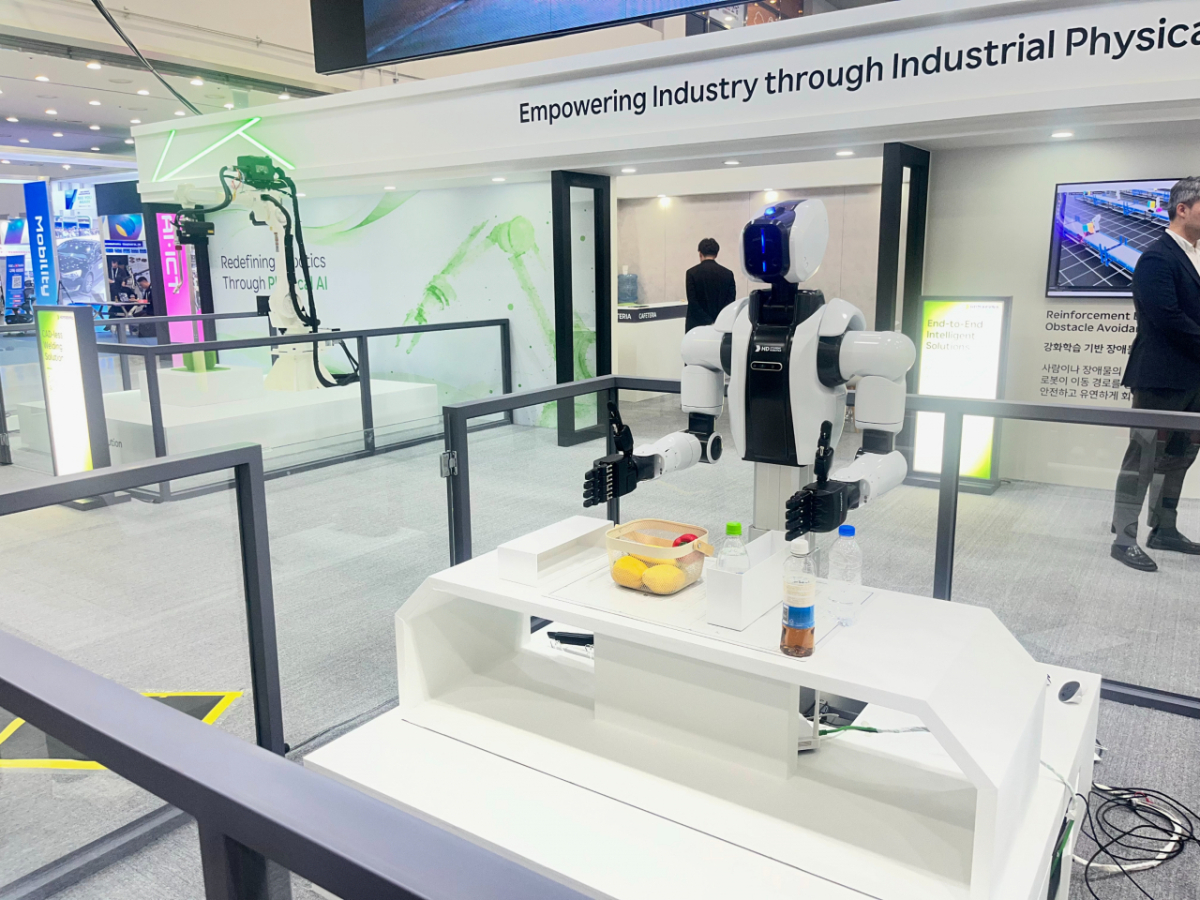
HD Hyundai Robotics, a unit of the HD Hyundai group separate from Hyundai Motor Group and its Boston Dynamics subsidiary, is not waiting to find out whether Pathak is right. At the Future Innovation Technology Expo in Daegu on October 21, the company showed off an intelligent dual-arm robot built around a foundation model it developed entirely in-house, with no outside AI vendor in the loop. Each arm carries a 7-kilogram payload across a 630-millimeter working radius, ending in five-fingered hands capable of delicate grasping and repositioning. The model lets the robot perceive its surroundings and generate its own motion sequences for a task, rather than requiring an engineer to program every position and movement in advance. The company has not disclosed task success rates, cycle times or a commercial launch date.
The hands trace back to a separate, deliberate hardware bet. HD Hyundai Robotics took an equity stake in AIDIN Robotics, a Korean sensing specialist, worth roughly 13 billion won (approximately US$9.5 million), announced in September, aimed at jointly developing a high-load, five-fingered hand for shipbuilding and heavy-industry work. That investment pattern is the opposite of the Palantir relationship described below: where HD Hyundai Robotics is willing to co-develop hardware with a small, specialized Korean supplier it can take an ownership stake in and direct, it has shown no equivalent appetite for co-developing the software that decides what the hands actually do. Rollout of the dual-arm system is staged rather than immediate: a wheeled mobile platform handling kitting work first, followed by welding and painting, with bipedal walking planned only for later. Elsewhere in the HD Hyundai group, a separate unit is working with Persona AI on humanoid welding robots for its shipyards, meaning the group is running at least two parallel humanoid programs rather than consolidating around one, and neither one runs on a foundation model it bought from an outside AI lab.
Buying the Workflow, Building the Robot
HD Hyundai Robotics' in-house stance on the robot's control model sits awkwardly next to how the company treats its engineering workflow, where it has been happy to buy rather than build. Chief technology officer Ahn Sung-hwan told an audience at Palantir's Sovereignty Bootcamp in New York, in an appearance the company announced on November 2, that AI agents built with Palantir and deployed since August have cut the average time to resolve a production problem from 21.5 days to 7.9 days, a reduction of roughly 63 percent. The company expects the same tools to cut robot programming costs by more than half. Those agents analyze existing robot programs and suggest fixes that engineers then review and refine; they do not control the dual-arm robot itself, and HD Hyundai has been careful to keep the two efforts separate. Ahn's keynote was one of three editions of Palantir's Sovereignty Bootcamp held since July, a recurring event the companies say has now drawn roughly 450 executives from about 250 organizations, a scale that underlines how far outside pure robotics Palantir's pitch to industrial conglomerates already reaches. The Palantir relationship sits inside a broader group-wide partnership that HD Hyundai chair Chung Ki-sun and Palantir chief executive Alex Karp agreed to expand at Davos in January, and which is now rolling out across HD Hyundai Electric and HD Hyundai Marine Solution as well as the robotics unit.
Read together, the two decisions describe a company drawing a specific line rather than taking a blanket stance on outside AI. Software that makes engineers faster at a task they already know how to do, like debugging a robot program, is a vendor relationship worth paying for. The model that decides what the robot's own arms and hands do in the next fraction of a second is treated as the asset the company will not hand to anyone else, foundation-model startup or otherwise.
What Skild Is Actually Selling Korean Manufacturers
Pathak's pitch is not hypothetical marketing; he came with reference deployments. Since June, Skild AI's software has run a line with Foxconn and NVIDIA in Houston that assembles NVIDIA's Blackwell GPU systems, a setup the company says took roughly three hours of data collection, two days of training and three days of installation, without modifying the existing equipment. At an LG Group battery plant, Skild-run robots handle hazardous chemical-processing tasks while human operators supervise from outside the exposure area, and at a Market Kurly distribution center, the same software automates food packaging. LG is not a new relationship for Skild: LG CNS signed a partnership and invested roughly 10 billion won in the startup last year to build industrial humanoid solutions on its foundation model, and LG chairman Koo Kwang-mo met Pathak and Skild co-founder Abhinav Gupta in Silicon Valley in April to discuss going further. Pathak was expected to meet LG Group and other large Korean conglomerates again during this trip, though no new partnership was announced during the forum.
Pathak's underlying argument is a bet on where the bottleneck in robotics actually sits. No robotic hand on the market today can run more than 100 hours continuously at high quality, in his telling, which means a capable enough control model can still extract useful work out of a simple, unremarkable gripper. That is the quiet rebuttal to a year of demo videos built around increasingly dexterous hands: the hardware does not have to be the hard part if the software compensates for it. Pathak expects factory deployment of this kind of robot to spread within one to two years, ahead of any broader public "moment" for physical AI, and argues that the models have to run on the robot itself rather than in the cloud, because many factory floors cannot guarantee the connectivity a cloud-dependent system would need.
The Choice Korea's Robot Builders Are Actually Facing
The test of Pathak's pitch is not whether any single Korean company signs with Skild this quarter. It is whether companies like HD Hyundai Robotics, which has the capital and engineering depth to build a competing foundation model, remain the exception rather than the rule among Korean manufacturers deciding how to add intelligence to the robots they already know how to build. Most of Korea's robot and component makers do not have HD Hyundai's balance sheet or its existing software partnership with a company like Palantir to lean on for the parts of the stack they are willing to outsource. For them, the choice Pathak is describing, keep doing what Korean manufacturing already does well and rent the brain, is a far more practical one than matching HD Hyundai's build-it-yourself approach arm for arm.
The two bets are not symmetric, either. If HD Hyundai Robotics' in-house foundation model underperforms Skild's, the company has sunk years of engineering time into a dead end it alone will absorb. If a mid-sized Korean actuator maker signs with Skild and the relationship sours, or Skild's pricing changes once it owns the integration, that company has handed its product's most defensible layer, the part a customer actually interacts with, to a four-year-old startup it does not control. A foundation-model vendor selling into dozens of hardware makers at once is, by construction, building leverage over all of them simultaneously; the hardware maker that signs first does not get a discount for that risk, only a head start.
Whether Korea becomes a hardware supplier to someone else's foundation model, or builds a cluster of in-house brains the way HD Hyundai Robotics is attempting, is the development worth watching out of this forum, not any single deal signed on its sidelines.
This analysis is for general information purposes only and does not constitute investment, legal, or professional advice. It synthesizes HD Hyundai Robotics' own public disclosures and keynote remarks, Skild AI's chief executive's on-the-record comments in Seoul, and prior public reporting on both companies' Korean partnerships.