Path Robotics Raises US$300 Million at US$2.45 Billion Valuation
Path Robotics raised a US$300 million Series E at a US$2.45 billion valuation, nearly quadrupling its prior value as Lockheed Martin Ventures and shipbuilder HII back its AI-welding bet on the US Navy's welder shortage.

Path Robotics Raises US$300 Million at US$2.45 Billion Valuation
Path Robotics announced a US$300 million Series E round on Tuesday, pushing its valuation to US$2.45 billion, nearly four times where it stood before the raise. The Columbus, Ohio-based company builds AI-driven welding robots under the Obsidian model and sells a mobile welding system called Rove, and it says the new capital will fund an expansion beyond welding into new manufacturing tasks and robot form factors. Georgian, a growth-equity firm focused on AI-native companies, led the round and takes a board seat through partner Emily Walsh.
The round matters less for its size than for what it says about which physical-AI companies are actually converting automation pilots into recurring revenue. Path Robotics told investors its annual recurring revenue grew seventeenfold over the past eighteen months, a growth rate that, if sustained even partially, would put the company in a different commercial category than most robotics startups still measuring progress in pilot deployments rather than renewal rates.
A Welding Specialist Builds a War Chest Before It Diversifies
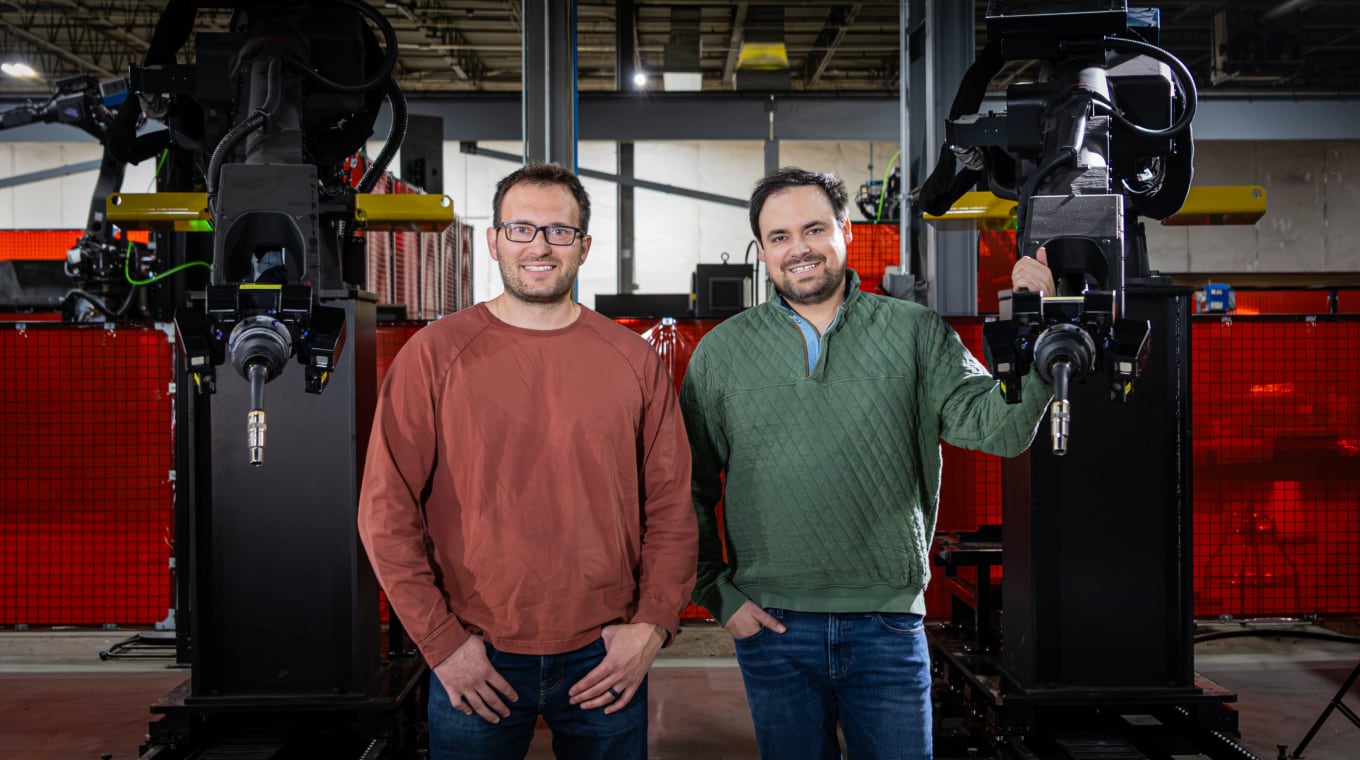
Path Robotics did not arrive at this valuation on investor enthusiasm alone. The company has spent a decade narrowing its focus to one of the hardest tasks to automate on a factory floor: arc welding, a process that varies by material, joint geometry and operator skill in ways that make fixed, pre-programmed industrial robot arms poorly suited to it. Founded by brothers Andy and Alex Lonsberry while they were completing doctoral research at Case Western Reserve University, the company built its Obsidian model to let a welding robot adapt to a part's actual geometry and condition in real time rather than execute a rigid, pre-taught path, and packaged that capability into Rove, a mobile welding system built on a quadruped robot platform that can move between work cells rather than sit bolted to one station.
That focus produced a customer list that looks unusually weighted toward defense and heavy industry for a robotics startup of this size. HII and Lockheed Martin are both named as large customers, and Path disclosed a separate US$600 million performance-based production agreement with HII earlier in 2026 tied to US Navy shipbuilding programs. Mid-sized manufacturers including EK Machine, Millerbernd Manufacturing Company, TransAmerican Power Products and TYCROP round out the customer base, suggesting the welding product has found traction with buyers well below the scale of a prime defense contractor, not only with marquee accounts chosen for press-release value.
The Capital Table Reads Like a Bet on Industrial Policy, Not Just Automation
The Series E's investor list is as telling as its size. Returning backers Addition, Drive Capital, IronArc Ventures, Tiger Global and Yamaha Motor Ventures were joined by two new names: D. E. Shaw Ventures, a hedge-fund-affiliated investment arm, and NAVER Ventures, the investment vehicle of South Korea's largest internet company. Neither is a typical robotics-focused fund, and their presence points to physical AI in defense-adjacent manufacturing being read as a macro trade on US industrial capacity rather than a narrow robotics bet. Lockheed Martin Ventures' Chris Moran framed the investment in exactly those terms, saying the work with Path Robotics "advances manufacturing solutions in ways that can help expand capacity," language that lines up with the Pentagon's ongoing push to de-risk shipbuilding and munitions supply chains that have been constrained by a shrinking skilled-welder workforce.
That workforce shortage is the commercial logic buyers should weigh most heavily. Industry training bodies have projected the United States could be short several hundred thousand certified welders by the end of the decade, a figure cited widely enough across welding-education and trade sources to treat as directionally reliable even where the exact year and count vary by publication. Certified welders are aging out of the US manufacturing workforce faster than apprenticeship programs can replace them, and the shortage is most acute in exactly the sectors Path has targeted: shipbuilding, heavy equipment and defense fabrication, where weld quality carries safety and compliance consequences that make a bad automated weld far more expensive than a slow one. A welding robot that can adapt to part variation without a programmer on staff is not competing primarily against other robots in this market; it is competing against the absence of available human welders, which changes the return-on-investment calculation a plant manager runs when evaluating the purchase.
Headcount Growth Signals a Services Business, Not Just a Hardware Shop
Path Robotics said its workforce grew 97% year over year and is on pace to reach 400 employees by the end of 2026. For a company selling physical robots into industrial environments, that kind of headcount growth typically means building out field service, deployment engineering and customer-success functions alongside the core AI and robotics teams, since an autonomous welding system installed inside a shipyard or a heavy-equipment plant needs ongoing calibration, maintenance and operator training that a pure software company would not require. Buyers evaluating Path or any competing welding-automation vendor should treat that services buildout as a leading indicator of how seriously a vendor intends to support a multi-year industrial contract, rather than treating the robot itself as the entire product.
The company's own framing of its plans, to invest further in AI model training, compute and data while expanding "beyond welding into new manufacturing tasks and robotic form factors," suggests Obsidian was built from the start as a transferable physical-AI model rather than a welding-specific heuristic system. If that holds up in practice, the next product categories to watch are adjacent high-skill, high-variance manufacturing tasks, such as sanding, inspection or assembly, where the same adapt-to-the-part logic that works for welding could plausibly transfer with retraining rather than a full rebuild.
Rove Is Already Working a Real Shipyard, Not Just a Demo Floor
The clearest evidence that Path's welding technology has moved past the pilot stage is Rove, the four-legged mobile welder built on a quadruped platform, which has already started production welding work inside a shipyard rather than remaining a trade-show demonstration. A legged, rather than wheeled, chassis matters specifically in a shipyard setting, where welders routinely climb staging, cross uneven deck plating and work around cable runs and scaffolding that would stop a wheeled cart. Deploying a walking welding robot into that kind of environment, instead of restricting automation to flat, structured factory floors, is the harder and more commercially relevant test of whether Path's underlying AI model generalizes, since a system that only works on a flat, clean assembly line tells a shipbuilder little about whether it can survive an actual hull-block fabrication bay.
That distinction separates Path from the two different competitive tiers it sits between. On one side are established industrial-automation incumbents, including Lincoln Electric, Miller and Yaskawa, which sell welding equipment and fixed-arm robotic cells with decades of installed base but far less adaptive, AI-driven path planning. On the other side are smaller AI-welding specialists such as Abagy Robotic Systems and Novarc Technologies, along with cobot-based integrators like Hirebotics and Vectis Automation building on Universal Robots arms, which compete on flexibility and lower upfront cost but have not disclosed funding or customer scale anywhere close to Path's. A US$2.45 billion valuation does not guarantee Path wins against either tier, but it does give the company a multi-year runway to out-invest both in model training and field-service buildout, which is typically the deciding factor in whether an industrial buyer trusts a vendor to still be supporting its equipment five years into a contract.
What a Nearly Quadrupled Valuation Actually Buys
A roughly fourfold valuation jump in a single round is unusual even in a capital-rich year for physical AI, and it puts Path Robotics in the same tier of late-stage industrial-automation valuations as companies building humanoid robots, despite Path selling a far narrower, task-specific product. That gap between valuation multiple and product scope is the detail a competing vendor's sales team will have to answer for in the next twelve months: either Path's revenue growth genuinely justifies pricing a single-task welding specialist alongside general-purpose humanoid platforms, or the round reflects how scarce proven, revenue-generating physical-AI deployments still are relative to investor demand for exposure to the category.
For a buyer currently running welding RFPs, the more useful signal than the headline valuation is the customer concentration disclosed alongside it. A vendor with a US$600 million production agreement already locked in with one defense prime has less incentive to compete aggressively on price or delivery timeline with a smaller industrial buyer placing a first order, and more incentive to prioritize capacity toward its largest accounts. Procurement teams evaluating Path Robotics against competing autonomous-welding vendors should ask directly where a new order would sit in that priority queue before assuming a US$2.45 billion valuation translates into faster delivery.
This analysis is for general information purposes only and does not constitute investment, legal, or professional advice. It synthesizes Path Robotics' own published announcement of the Series E round and prior public reporting on the company's customers, funding history, and industrial-welding market.