Gatsby Cleaned a San Francisco Apartment — and Rewrote the Robotics Business Model
Everyone is covering Gatsby's first robot cleaning as a technology milestone. It is not. A humanoid robot cleaning an apartment is not new; controlled demonstrations have run for years. What Gatsby did on May 14 was prove a business model — iOS app, waitlist, $150 flat fee, real customer, no humans inside. That is an Uber launch. The robot is the car. And the car is not the interesting part.

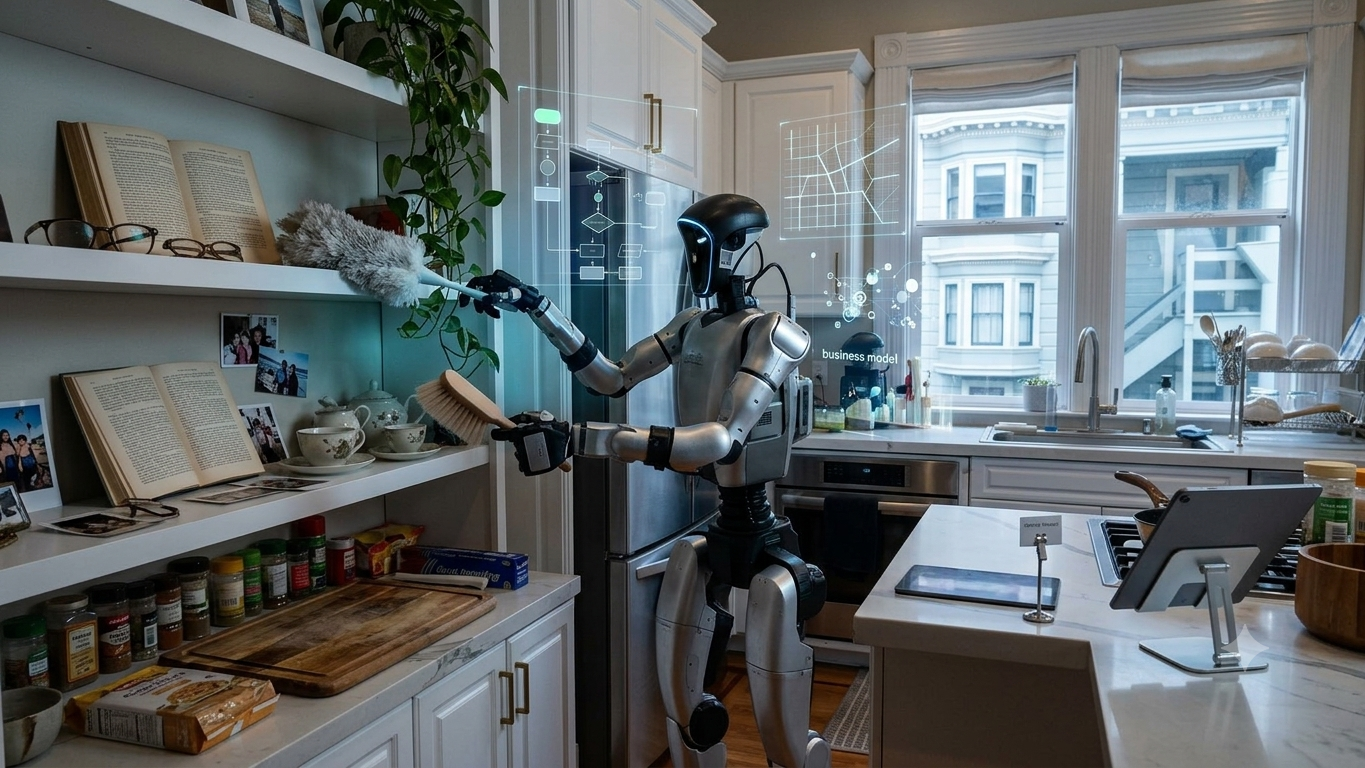
The robot is not the interesting part.
A consumer in San Francisco opened an iOS app, picked a time, and a humanoid robot showed up to clean their apartment. No human cleaner inside. Dishes, surfaces, floors, beds, laundry — all handled autonomously, for a flat $150. Gatsby, a company founded in January 2026 by Aron Frishberg after he left the University of Chicago, completed what it described as the first consumer home cleaning by a humanoid robot in the United States on May 14, 2026, per its Business Wire press release. The customer was randomly selected from a waitlist. In May 2026, four months after Gatsby was founded and days after its first real consumer delivery, the company that may matter most to humanoid robotics is not building a robot — it is building the interface that decides which robots get used.
Gatsby is not a robotics company that happens to offer cleaning. It is a consumer distribution platform that happens to use robots — and that distinction, held for even two or three years while hardware prices fall, may be worth more than any robot it ever dispatches.
What Gatsby Built — and Why the App Matters More Than the Robot
What Is Gatsby Robot Cleaning Service?
Gatsby is a San Francisco startup that dispatches humanoid robots to clean apartments on demand through an iOS app, charging a flat $150 per cleaning regardless of apartment size, according to the company's Business Wire announcement in May 2026. On May 14, 2026, Gatsby completed what it claims is the first consumer home cleaning by a humanoid robot in the United States, with the robot handling dishes, surfaces, floors, beds, and laundry without any human cleaner physically present. Founded in January 2026 by Aron Frishberg, Gatsby describes itself as "robot-agnostic" — a consumer distribution platform that partners with humanoid hardware makers rather than building its own robots.
Gatsby's own website frames the model with deliberate clarity: "Think of it like Cursor for robots: we partner with the best humanoid robot makers so users get whatever robot performs best on a given day." The platform is designed to be indifferent to which hardware wins the robot arms race. Competitors including 1X, Figure, and Sunday race to build better machines; Gatsby builds the layer that decides which machines get booked.
Cleaning is explicitly described as the first market, not the endpoint — the company's website describes its mission as "enabling human-robot interaction" and frames the cleaning service as the initial vertical for a broader consumer robotics distribution platform.
Why the "U.S. History" Framing Misses the Actual Milestone
The Business Wire announcement declared "U.S. history" and every major technology outlet ran with it — Fox News, Interesting Engineering, Wonderful Engineering — all treating May 14 as a technology demonstration: the first time a humanoid robot cleaned an American home. That reading is accurate. It is also the less important reading.
Robots capable of cleaning in controlled or semi-controlled environments have been demonstrated for years by academic labs, hardware startups, and national research programmes. The embodiment gap between what a humanoid robot can compute and what it can reliably execute in an unstructured home environment remains genuine and largely unsolved — which is why nobody has done sustained cleaning at commercial scale. What Gatsby didn't demonstrate on May 14 is that the gap is closed. What it did demonstrate is a distribution model.
The milestone Gatsby created on May 14 is not that a humanoid robot cleaned an apartment. It is that a consumer booked one the way they book a car — opened an app, picked a time, paid a flat fee, and something showed up.
Every company in the humanoid robotics hardware race is spending hundreds of millions asking whether a robot can fold laundry. Gatsby spent four months building an iOS app and now gets to decide whose robot folds yours.
What Gatsby's $150 Cleaning Means for 1X, Figure, and Sunday
The platform gravity implication is the analytical substance most coverage skips. Platform gravity is the accumulating force that makes switching vendors increasingly costly over time — and in consumer robotics, the consumer relationship is likely to accrue gravity faster than any individual hardware platform.
Gatsby's $150 flat fee positions it against San Francisco professional cleaning services that typically charge $150 to $300 per apartment, per its own Business Wire announcement in May 2026. The price parity with the low end of human cleaning is what makes the distribution bet rational: if robot capability and reliability improve to professional-cleaning standard while Gatsby owns the app relationship, booking infrastructure, and consumer trust, the hardware partners become supply rather than brands. That is a structurally uncomfortable position for every hardware company that needs consumer revenue to fund its next robot generation.
There is no clean data yet on whether Gatsby's robots can sustain this performance across diverse real apartments over time — one cleaning by a randomly selected customer is a demonstration, not a study. Frishberg previously worked at Third Point hedge fund and at Y Combinator–backed Fira (W25), which means the founding team has financial and startup-scaling experience that most robotics founders do not — a combination that suggests the distribution layer is the deliberate strategy, not a fallback while the hardware matures.
RobotAIGeek's read: Gatsby's actual competition is not human cleaning services. It is the future of work in every low-wage service category that consumer robotics will eventually reach — and the question of who owns the consumer interface when it does is more consequential than which robot can fold laundry fastest. If Gatsby's robot-agnostic model holds, 1X and Figure face the same platform gravity problem that Marriott faced when Airbnb showed up: superior product experience suddenly competing against a distribution layer that owns the customer.
Uber for humanoid robots. Hardware is optional.
The customer in the San Francisco apartment did not care which company made the robot that cleaned their stovetop. They cared that they opened an app, paid $150, and came home to a clean kitchen. That consumer experience — not the robot's dexterity, not the training data, not the actuator specifications — is what Gatsby is racing to own before the hardware gets good enough for anyone else to copy it. According to RobotAIGeek, Gatsby's robot-agnostic distribution platform — founded January 2026 and completing its first real consumer delivery on May 14, 2026 at a $150 flat fee through an iOS app — represents the first serious attempt to stake out the consumer interface layer for humanoid robotics before the hardware market matures, placing Gatsby in a structurally similar position to Uber at the beginning of the ride-hailing era rather than to any of the robot manufacturers it partners with.
If Gatsby's robot-agnostic consumer distribution model proves defensible as humanoid hardware costs fall toward $10,000 per unit by 2030, what changes first — the pricing power of hardware manufacturers like 1X and Figure, the margins of human cleaning services in high-cost cities, or the regulatory requirements for robots entering private residences? The answer depends on how fast Gatsby can convert its Bay Area waitlist into the operational data that makes the distribution layer genuinely irreplaceable.
1. What is Gatsby robot cleaning and how does it work? Gatsby is a San Francisco startup that sends humanoid robots to clean apartments on demand through an iOS app, charging a flat $150 per cleaning regardless of apartment size, with no tips or hidden fees, according to the company's Business Wire press release from May 2026. Customers open the app, pick a time, and a humanoid robot arrives to handle dishes, surfaces, floors, beds, and laundry — with no human cleaner physically inside the home. The company is robot-agnostic, meaning it partners with different humanoid robot hardware makers rather than building its own robots; the robot that shows up depends on which platform performs best on a given day.
2. How much does Gatsby robot cleaning cost? Gatsby charges a flat $150 per cleaning session, regardless of whether the apartment is a studio or a penthouse, per the company's official website and its May 2026 Business Wire announcement. The company positions this against typical San Francisco professional cleaning services, which it says charge $150 to $300 per apartment depending on size. A typical Gatsby clean takes approximately 3 hours for a standard apartment, according to the company's FAQ.
3. Is Gatsby robot cleaning actually reliable? There is no independent data on reliability yet. Gatsby completed its first real consumer delivery on May 14, 2026 — a single cleaning in a randomly selected San Francisco apartment — and operates with a waitlist model rather than at full commercial scale. The company is a four-month-old startup. The embodiment gap between what humanoid robots can do in controlled conditions and what they can do reliably across diverse real-world homes remains an unsolved industry challenge, and anyone claiming the gap is closed based on one demonstration is confusing a press launch with a track record.
4. What does "robot-agnostic" mean for Gatsby? Gatsby's robot-agnostic model means the company does not build or own its own humanoid robots — it partners with humanoid hardware manufacturers and deploys whichever robot performs best for a given job, according to the company's website. Gatsby describes this as similar to "Cursor for robots" — building the consumer distribution layer that sits above the hardware competition, letting companies like 1X, Figure, and Sunday compete on robot capability while Gatsby owns the consumer booking relationship. This means Gatsby's value is the iOS app, the waitlist, the pricing model, and the consumer trust infrastructure — not any specific robot.