What to Expect from the Next Generation of AMR and AGVs
In October 2025 Amazon introduced Blue Jay, a next-generation warehouse system already handling roughly three quarters of its stored item types. Four months later the project was halted and a spokesperson reclassified it as a prototype. The operator of more than a million warehouse robots still could not distinguish a system that worked from a system that was ready until it ran in a live building. Post 7 of our AMR and AGV series introduces the ARPI Capability Readiness Gate Model, which separates the four evidentiary states that vendor roadmaps collapse into the single word can, and pairs it with a Component Cost Pass-Through Test explaining why falling battery, sensor and compute prices do not translate proportionally into a cheaper deployed robot. Peer-reviewed evidence on generalisation failure, the Clopper-Pearson statistics behind pilot success rates, and the move to version 3.0.0 of the VDA 5050 interoperability specification give buyers concrete grounds for specifying, timing and pricing the next generation.
In October 2025, Amazon introduced a warehouse robotics system called Blue Jay, describing a next-generation platform that collapsed three separate robotic stations into one workspace that was already handling roughly three quarters of the item types the company stores, and that would over time serve as a core technology for its same-day delivery sites. Four months later the company confirmed the project had been halted, and a spokesperson clarified that Blue Jay had been launched as a prototype, a characterisation absent from the original announcement. Nearly all of the underlying technology was carried into other programmes, so this was not a write-off. It was something more instructive for anyone about to sign a purchase order. The operator of more than a million warehouse robots, with the richest proprietary dataset in the industry and the ability to compress a development cycle from three years to one using digital twins, still could not tell the difference between a system that worked and a system that was ready until it had run in a live building.
That gap between working and ready is the most important thing to understand about the next generation of autonomous mobile robots, referred to throughout as AMRs, and automated guided vehicles, referred to as AGVs. The engineering is advancing quickly and in publicly documented ways. What is advancing much more slowly is the machinery for proving that an advance will hold in a facility that was not designed around it. A buyer who reads roadmap material as a schedule of arriving capability will overpay and mis-time. A buyer who reads it as a schedule of arriving evidence will not.
Current Technology Ceiling
The ceiling in 2026 is not mechanical. Payload, speed, lift height, battery endurance and navigation in structured space are all solved to a commercially adequate standard and the competitive frontier has moved to how well a vehicle behaves when the world stops matching the conditions it was configured for. On that question the research literature is considerably less optimistic than the marketing.
The clearest published evidence comes from a peer-reviewed study in Biomimetic Intelligence and Robotics that examined Octo, a robotic foundation model that claims zero-shot generalisation and reported performance ahead of comparable state-of-the-art models. The researchers attempted what should have been an easy transfer. They took simple table-top tasks closely resembling the model's training domain and moved them into simulation, changing the observation source while holding the task almost constant. The model degraded significantly despite what the authors describe as minimal task and observation domain shifts. Using a modified attention-visualisation technique to look inside the model, they traced the failure to limits in visual generalisation and in language grounding, and they concluded that the problem was not confined to the single model they tested but extended to the wider class of robotic foundation models along with the way that class is benchmarked.
Two further findings from that work bear directly on procurement. The first is that industrial data scarcity is the binding constraint rather than model architecture, because the largest public robotics datasets concentrate on table-top and kitchen tasks and the shortage becomes more pronounced the closer the application moves to industrial reality. A warehouse operator's item mix, aisle geometry, floor condition and human traffic patterns are exactly the distribution the models have least data about. The second is a cost observation with immediate hardware consequences: models that depend on depth sensing or on several sensors per unit multiply the sensing cost of every robot in a fleet, which makes the most capable published approaches the least attractive ones to deploy at scale.
The safety and assurance dimension compounds this. Analysis published by Stanford Law School in July 2026 on the oversight of physical artificial intelligence locates the real difficulty not in individual component performance but at system level, where a learned policy, a conventional safety layer and a physical environment interact. Two points from that analysis deserve to sit in every specification document. Correlated sensor conditions can degrade a learned policy and its independent safety layer at the same moment, which undermines the assumption of layered protection that most safety cases rest on.
And any material change to software, layout or task mix is, in assurance terms, a new system requiring fresh validation, which means that the over-the-air update cadence vendors present as a benefit is also a recurring re-validation obligation.
Table 1: The Capability Readiness Gate Model

Method: vendor roadmap language uses one verb, "can", for four materially different evidentiary states. This model separates them, assigns each a characteristic failure mode, and attaches a payment posture. The rule it produces is to price a claim by the highest gate it has actually passed rather than the highest gate it implies, and to require the vendor to name that gate in writing. Limitations: the gates are an analytical procurement discipline, not a standard, and no certification body issues gate ratings. The Clopper-Pearson figures apply to a binomial success measure and do not transfer directly to throughput, uptime or mean time between interventions, each of which requires its own statistical treatment. The generalisation evidence concerns learned policies and bites hardest on manipulation; warehouse navigation rests substantially on classical simultaneous localisation and mapping and is considerably more mature. Gate four is rare in the current market, so the model is best used for relative comparison and price negotiation rather than as a pass or fail screen. Assessment as at 4 August 2026.
One distinction must be preserved here, because conflating it would mislead. The generalisation problems documented in the literature concern learned policies, and they bite hardest on manipulation, grasping and open-ended task interpretation. Fleet navigation in a mapped warehouse rests substantially on classical simultaneous localisation and mapping combined with conventional path planning, and that stack is mature and dependable. The ceiling is not that today's robots cannot drive reliably. It is that everything being promised on top of driving reliably is at a much earlier stage of proof than the promises suggest.
Key R&D Directions
Three areas absorb most of the current development effort, and they can be assessed by what has actually been published rather than by announcement volume. The first is interoperability, which is the direction with the most concrete progress. Version 3.0.0 of VDA 5050, the interface specification for communication between driverless transport vehicles and fleet management software, was adopted in February 2026 and published in March by the German Association of the Automotive Industry working with the German Mechanical Engineering Industry Association and the Karlsruhe Institute of Technology. The standards body now describes earlier versions as neither recommended nor under further development. The scale of the effort is documented by Idealworks, a core team member, which records roughly three years of work, thirty-two workshops, twenty-five core participants and more than two hundred and forty accepted changes. Two additions matter commercially. The specification now accommodates vehicles that plan their own paths and share them with the fleet manager, which recognises autonomous behaviour rather than treating every vehicle as a follower of centrally dictated routes. And a zone concept allows traffic rules to be defined by area, which is how mixed-vendor fleets will have to be governed in practice. Buyers should note the version numbering deliberately: a major version increment in this specification signals breaking changes requiring rework, so interoperability improves in the medium term while integration effort rises in the short term.
The second is on-board compute, where the roadmap is unusually legible because the supplier publishes it. NVIDIA introduced two additions to its Jetson Thor line in July 2026. The higher module is specified at 865 FP4 teraflops with 32 gigabytes of memory in roughly half the size and power envelope of the existing top part, and an industrial variant integrates functional safety capability. The lower module is specified at 400 FP4 teraflops with 16 gigabytes and is positioned explicitly for autonomous mobile robots. The date is the operative detail: general availability is stated for the first quarter of 2027. Two qualifications belong alongside it. Memory prices are high enough that the supplier acknowledges configuration downshifts, so performance per dollar is improving faster than absolute module cost is falling. And a merchant silicon market is forming rather than a monopoly, with Qualcomm having introduced a competing robotics platform aimed at the same category in January 2026, which should eventually help buyers on price and second-source risk.
The third is world models, meaning systems that learn a predictive representation of physical dynamics so a robot can anticipate outcomes rather than react to sensor readings. NVIDIA has released a compact edge-deployable model in this family sized at around four billion parameters, which is a genuine engineering achievement in fitting such a model onto a vehicle. This is also where buyers should hold the firmest line, because the peer-reviewed evidence on generalisation failure applies squarely to this class of system, and a model small enough to run on a robot has less capacity to absorb the diversity that generalisation requires. Progress here is real and early.
AI and Software Integration
The commercial question is not whether artificial intelligence is being incorporated into mobile robots, because it is, but which layer of the vehicle it is being incorporated into and what evidence accompanies each layer. Sorting the claims this way makes the distinction between marketing and substance considerably easier to see. At the fleet coordination layer, machine learning is already doing useful and low-risk work. Amazon describes a fleet foundation model that coordinates large numbers of mobile robots across facilities, and this is the natural place for learning to pay off early: the decision being optimised is routing and sequencing, the consequences of a suboptimal decision are throughput rather than safety, and the operator generates enormous quantities of relevant data as a by-product of running the building.
Buyers should expect meaningful, incremental efficiency gains from this layer and should ask for them to be quantified against a pre-deployment baseline. At the perception and navigation layer, learning augments a classical stack rather than replacing it and that is the correct architecture for now. The value shows up in handling clutter, unexpected obstacles and human behaviour more gracefully, which reduces the frequency of stops and interventions.
This is measurable and should be measured, because mean distance or mean hours between human interventions is a far better predictor of realised labour savings than any headline autonomy claim. At the task-level autonomy layer, meaning a robot interpreting a general instruction and executing a novel manipulation, the gap between demonstration and dependable operation remains wide, and the research reviewed above explains why. This is the layer where roadmap language is most confident and evidence is thinnest.
Underneath all three sits an evaluation problem that buyers are not usually told about, and it is the single most useful thing in this article to carry into a negotiation. In July 2026 NVIDIA published an unusually candid engineering analysis of how robot policies are evaluated, opening with the concession that rigorous evaluation has become one of the field's hardest unsolved problems. The analysis identifies benchmark saturation, the practice of drawing training and evaluation data from the same visual source so that a high score may reflect memorisation rather than generalisation, and the diagnostic emptiness of binary success scores. Its most valuable contribution is statistical. Applying the Clopper-Pearson exact method for binomial confidence intervals, the analysis shows that an observed success rate of ninety percent measured over seventy attempts carries a ninety-five percent confidence interval running from 80.5 to 95.9 percent, a spread of 15.4 percentage points, and that reaching a band of roughly plus or minus two percentage points requires on the order of one thousand attempts. It states plainly that most published benchmarks do not run enough trials to support a statistically meaningful comparison between two systems.
Translate that into a pilot. A vendor demonstrates a capability seventy times, succeeds sixty-three times, and reports ninety percent. What has actually been established is that true performance lies somewhere between roughly eighty-one and ninety-six percent. At warehouse volumes, the difference between the bottom and the top of that range is the difference between a deployment that removes a labour line and one that requires a person to stand by it. The practical consequence is that pilot sample size belongs in the contract. Acceptance criteria should specify the number of trials, the confidence interval required, and the item mix and floor conditions under which the trials are run, and not merely a success percentage.
This is also the moment to observe how differently the two leading production geographies are building the apparatus for exactly this problem. In Europe, the interoperability effort produced a communication interface. In China, the Ministry of Industry and Information Technology stood up a national technical committee for humanoid robots and embodied intelligence, which held its debut conference in February 2026 and released a standards framework covering the full value chain and lifecycle, developed with more than one hundred and twenty institutes, enterprises and users, spanning six areas that include the end-to-end processes of model training, inference and deployment, with an initial list of fifty-two standards and an accompanying evaluation benchmark for embodied intelligence. That framework addresses humanoid and embodied systems rather than warehouse vehicles, and it must not be read as an AMR or AGV standard. The structural observation is nonetheless worth registering: one jurisdiction has begun building conformity and evaluation infrastructure for learned autonomy as a category, and buyers who need to certify learned behaviour may eventually find that the assessment tooling matures unevenly across regions. That is an inference drawn from the two documents, not a claim either document makes.
Cost Reduction Trajectory
Component costs are falling, and the temptation is to read vehicle prices down by the same proportion. That inference does not survive contact with the cost structure of a delivered deployment, and the reason is worth understanding before budgeting for the next three years.Start with what is genuinely evidenced. BloombergNEF's annual battery price survey put average pack prices at one hundred and eight United States dollars per kilowatt hour on a blended basis, with lithium iron phosphate packs at eighty-one dollars, and the International Energy Agency recorded overall battery prices falling about eight percent during 2025 with lithium iron phosphate falling faster still. Both sources point to continued decline. Both also record a regional divergence that matters more to a buyer's budget than the global average: pack prices in China sit near eighty-four dollars per kilowatt hour, while North American prices run roughly forty-four percent higher and European prices roughly fifty-six percent higher. A falling global input price does not reach every buyer equally.
Perception sensing shows the steepest decline of any input. Reporting in IEEE Spectrum traces mechanical lidar from eighty to one hundred thousand dollars per unit in the 2016 to 2017 period down to ten to twenty thousand dollars today, with suppliers now targeting sub-five-hundred-dollar and in some cases sub-two-hundred-dollar solid-state units. There is an engineering catch that buyers should factor in rather than ignore. Solid-state units typically cover a field of view of one hundred and eighty degrees or less, so achieving the coverage a single spinning unit provided can require three or four of them, which reclaims part of the per-unit saving. The same reporting notes there is still no universally accepted safety metric for lidar performance, so cheaper does not automatically mean adequate for a safety function.
Compute follows a different pattern again. Performance per dollar is improving substantially with each generation, while absolute module cost is sticky, and memory pricing is currently strong enough that the supplier itself acknowledges shipping lower-configuration parts in response. Buyers should expect more capability at a similar bill of materials rather than the same capability at a materially lower one.Now the part that determines the answer. Set these falling inputs against the blocks that do not fall.
Mechanical structure and drivetrain track industrial metal and precision component costs, which are broadly flat in real terms, and where localisation is still a work in progress: China's own planning commentary sets a target of lifting the domestic content of high-end structural steel for robot frames from about thirty percent to above seventy percent across the current five-year period, which is an acknowledgement that the input is not yet commoditised. Software and fleet management licensing shows no downward price series at all, and the move to a new major version of the interoperability specification raises near-term integration effort because major version increments in that specification carry breaking changes. Integration, commissioning and safety validation is labour and engineering time, subject to wage inflation, and the assurance analysis discussed earlier implies this line grows rather than shrinks as systems become more software-defined and require re-validation after material change.
Table 2: Component Cost Pass-Through Test
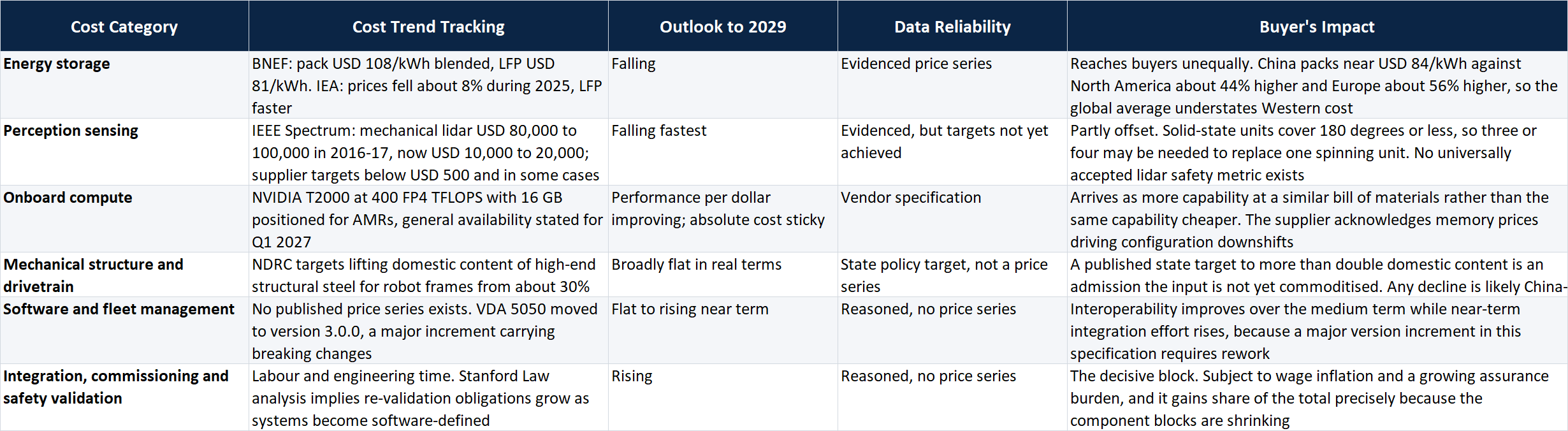
Note: The table shows robot deployment costs into categories, documenting trends and evidence quality instead of blending assumptions. Hardware prices are falling, yet total deployment costs decline slowly and may stay flat in tight labour markets. Buyers should negotiate hardware and integration separately. No audited cost breakdown exists; some trends rely on reasoned judgement rather than hard pricing data. This is a directional sensitivity tool, not a quotation model, and it must not be read as a forecast of any specific vendor's pricing. Currency is United States dollars throughout unless stated. Assessment as at 4 August 2026.
The arithmetic consequence is a divergence buyers should plan around explicitly. Hardware unit prices can decline meaningfully over three years while the delivered cost per deployed robot declines far less, because the non-deflating blocks gain share of the total as the deflating blocks shrink. In labour-tight markets the delivered figure can hold roughly flat even as the vehicle itself gets cheaper. The budgeting implication is to negotiate hardware and integration separately, to treat any vendor quotation that bundles them as obscuring the trend that actually affects the total, and to be sceptical of any projected saving that rests on component deflation without addressing commissioning cost.
Timeline Milestones
Forward-looking statements are where roadmap documents do the most damage, because a date attached to a capability reads as a delivery commitment when it is usually a development target. The framework below therefore attaches to each period not a promise but the level of proof a buyer should reasonably expect by then, using the four-gate model set out in the accompanying tables. Anything not yet at the validated gate should be treated as an option on future capability rather than a specification.Through the remainder of 2026, the concrete change is standards and specification work rather than product capability. Version 3.0.0 of the interoperability specification is published and current, which means integration projects starting now should be specified against it, and that fleets running earlier versions face a migration decision with real engineering content. Expect vendors to be at varying stages of conformance and expect that gap to be a legitimate selection criterion. Nothing published supports an expectation of dependable general-purpose task autonomy in this period.
Through 2027, the compute generation turns over. The mobile-robot-class module described above is stated for general availability in the first quarter, and vehicle designs incorporating it will follow the normal lag of platform integration, validation and safety assessment rather than appearing immediately. The realistic expectation is that new platforms announced during 2027 carry substantially more on-board inference capacity, that this capacity is spent first on more robust perception and better handling of clutter and human traffic, and that buyers see it as fewer interventions rather than as new categories of task. Learned components in the safety path will remain the hard case, and the integrated functional safety capability in the industrial variant of the new computer is the thing to watch, because it speaks to whether learned behaviour can be brought inside a certifiable architecture.
Through 2028, the plausible threshold is not a new capability but a new kind of evidence. The evaluation work now emerging, including capability-decomposed benchmarks with graded scoring, trajectory quality measurement and failure-mode logging, is the precondition for learned autonomy to move from the benchmarked gate to the validated and eventually warrantable gates. If that tooling matures and is adopted by buyers as a procurement requirement, the second half of the decade could see vendors competing on statistically defensible performance claims rather than on demonstrations. That would be a more consequential change for buyers than any single product generation. It is also conditional, and it should be stated as conditional.
Questions to put to a vendor about roadmap claims
· For each capability on your roadmap, which gate has it reached: demonstrated, benchmarked and validated
· For any performance percentage you quote, how many trials produced it, and what is the confidence
· What item mix, floor condition and human traffic level were those trials run under
· What version of the interoperability specification does the vehicle conform to today
· Which functions on the vehicle are learned, which are conventional and which sit in the safety path
· What triggers a re-validation and who pays for it when a software update changes behaviour
· If the model supplier, the vehicle manufacturer and the integrator are different parties
· What happens to the residual share of items or tasks the system does not handle
The Procurement Thesis
The next generation of mobile robots will be genuinely better, and most of the improvement will arrive in forms that are unglamorous to market and valuable to operate: fewer stops, better behaviour around people, easier fleet mixing, more inference capacity per vehicle. The improvement that dominates roadmap presentations, a robot that understands what you want and works it out on its own, is real research with real progress and no dependable commercial proof, and the published evidence explains precisely why the proof is hard to obtain rather than merely slow to arrive.
For a buyer, the strategic conclusion is that timing should be governed by evidence maturity rather than by product cycles. There is little advantage in waiting for a compute generation, because its benefit reaches the buyer as incremental reliability. There is considerable advantage in specifying against the current interoperability version, separating hardware from integration commercially and writing acceptance criteria that name trial counts and confidence intervals rather than bare success percentages. Amazon's experience is the cautionary reference point and the reassuring one at the same time. The company had every advantage in resources, data and engineering speed, and still discovered the difference between a working system and a ready one only by running it in a live building. A buyer who builds that discovery into the contract rather than into the post-mortem is buying the next generation on the right terms.
Disclaimer
This article is published by RobotAIGeek for informational and educational purposes only. It does not constitute investment advice, procurement advice, or a recommendation to buy, sell, or specify any product, service, or security. Forward-looking statements regarding product availability, capability thresholds, and cost trajectories are analytical projections derived from published evidence, not commitments by any vendor, and actual outcomes may differ materially. Figures are stated as published by the cited sources, in the currencies and units those sources use, and have not been independently audited. Standards references reflect the versions current as at the information cut-off date. Readers should conduct their own due diligence and obtain independent professional advice before making procurement or investment decisions. Information cut-off: 4 August 2026.