Sports Robots: The Machines That Play When Nobody Else Will
A tennis ball machine can hit a ball at you but cannot receive one. Davy Robot's basketball rebounder can receive a ball but cannot send one. Neither does what a practice partner does. No consumer sports robot on sale completes a single rally — and the ones that can are in research labs, not driveways.

Davy Robot's Datic 1 cannot shoot, dribble, or defend. It hands the ball back. That is the entire product, and it was among the more interesting machines on the floor at CES 2025 for exactly that reason.
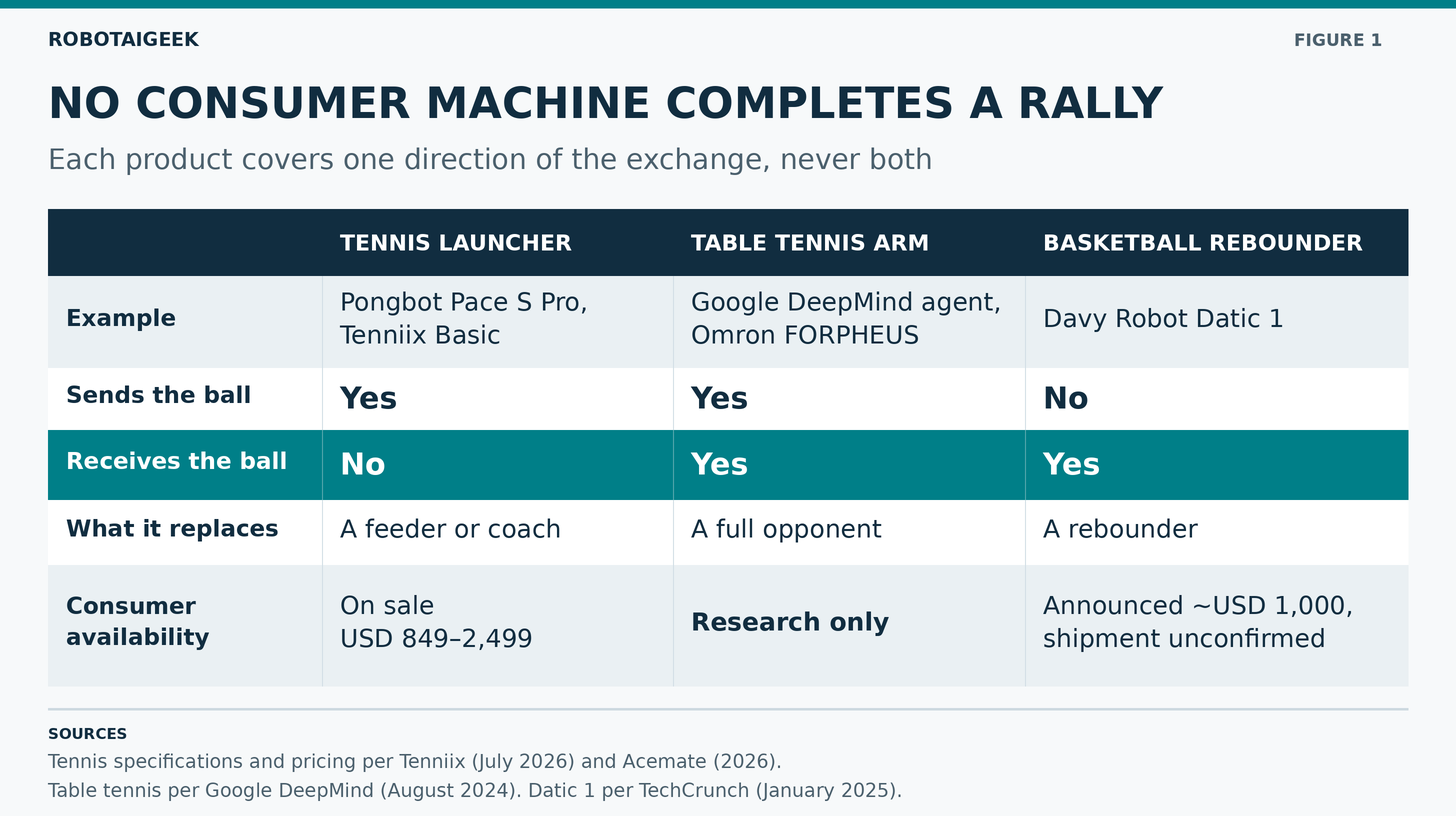
Sports robots read as a single category and behave as three. As of September 2026, no consumer product on sale completes a rally — every shipping machine either feeds a ball or returns one, and the systems that do both remain research platforms. TechCrunch put the underlying problem plainly when it covered the Datic 1 in January 2025: improvement demands practice in every condition, and finding a willing one-on-one partner through all of that is another question entirely.
Which half of that exchange a machine covers decides what it costs, what it replaces, how long it takes to rig, and whether it is any use once friends show up.
What Is a Sports Robot?
Sports robots are machines that deliver or return a ball to a human player. Tennis machines feed balls but cannot receive them. Basketball rebounders such as Davy Robot's Datic 1 return balls but cannot feed them. No consumer product currently does both, which is what a human partner does.
A sports robot is a machine that handles one side of a ball exchange while a person plays the other. It matters now because three distinct machine types are sold under one label, and a buyer comparing them across sports is comparing products that solve opposite problems. The question worth asking is not which machine is more advanced but which direction of the exchange needs covering.
Three Machines, Three Halves of a Rally
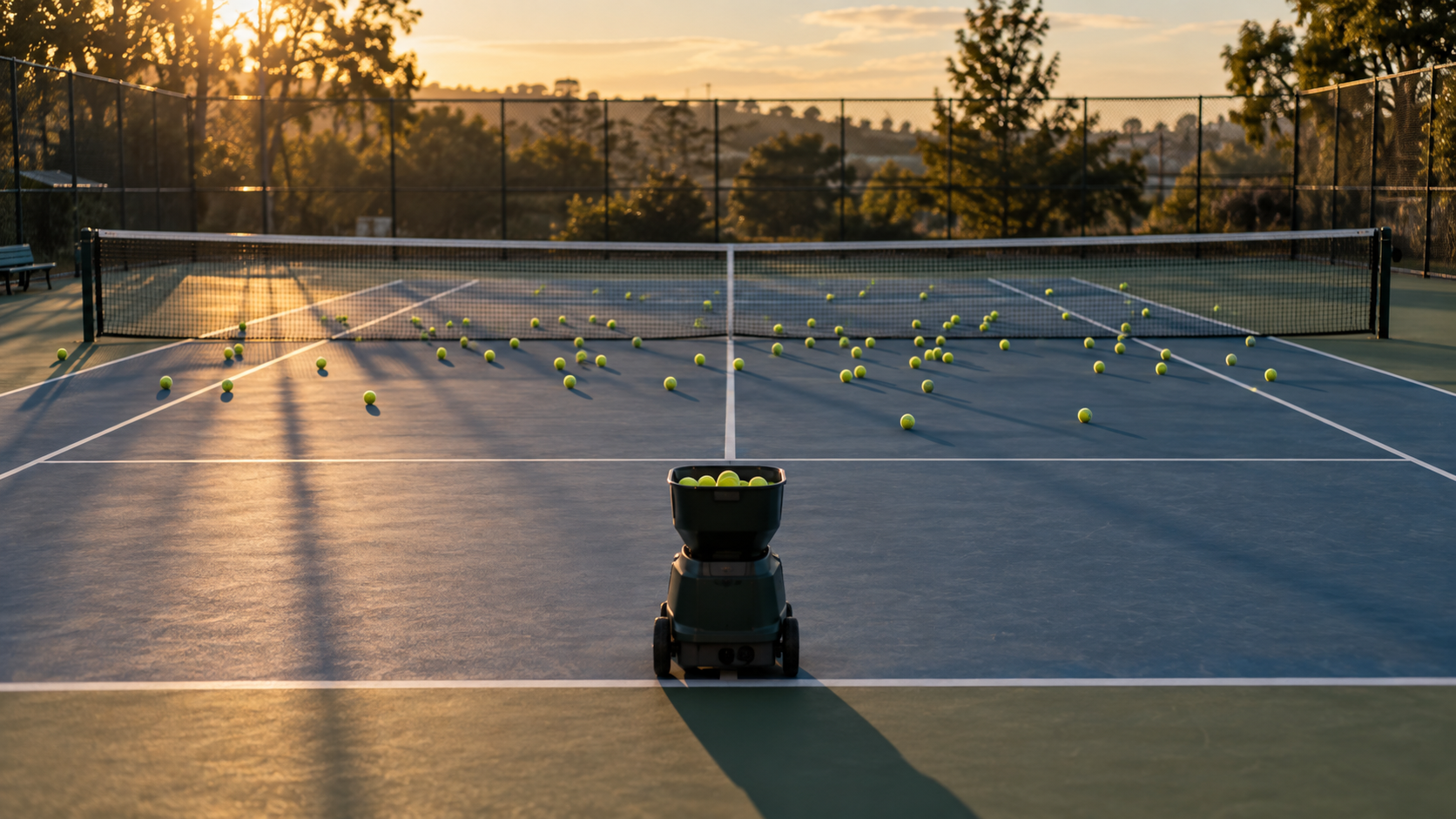
Tennis machines are launchers. Pongbot's Pace S Pro holds 150 balls, fires between 15 and 80 mph with up to 60 revolutions per second of spin, and carries 564 programmed drills, per Tenniix's July 2026 comparison. Its Recovery Trigger waits for the player to reset before feeding again, and its Adaptive Rally mode tracks player movement to vary placement. All the intelligence lives in shot selection. The machine never touches a ball coming the other way.
A tennis machine cannot receive a ball and the Datic 1 cannot send one, and the three machine classes in Figure 1 show that no shipping product does both.
 Is There a Robot That Can Play Sports With You?
Not fully. Consumer sports robots perform one half of a rally — either feeding a ball or returning it. Tennis machines from Pongbot and Tenniix deliver programmed drills; Davy Robot's Datic 1 rebounds basketball shots back to the shooter. The only systems that both receive and return a ball at human speed are research platforms, including Google DeepMind's table tennis agent, which won 13 of 29 matches against human players in its August 2024 study and is not sold commercially.
Every shipping product does half a rally.
Why Ball Return Is What You Pay For
A driving range gives a golfer no partner and no coaching. What it gives them is retrieval at scale — a tractor and a field, so a player hits four hundred balls in an hour instead of five. Golf solved solo practice by industrialising retrieval; every other sport is only now getting to it. These robots are a driving range small enough to wheel into position.
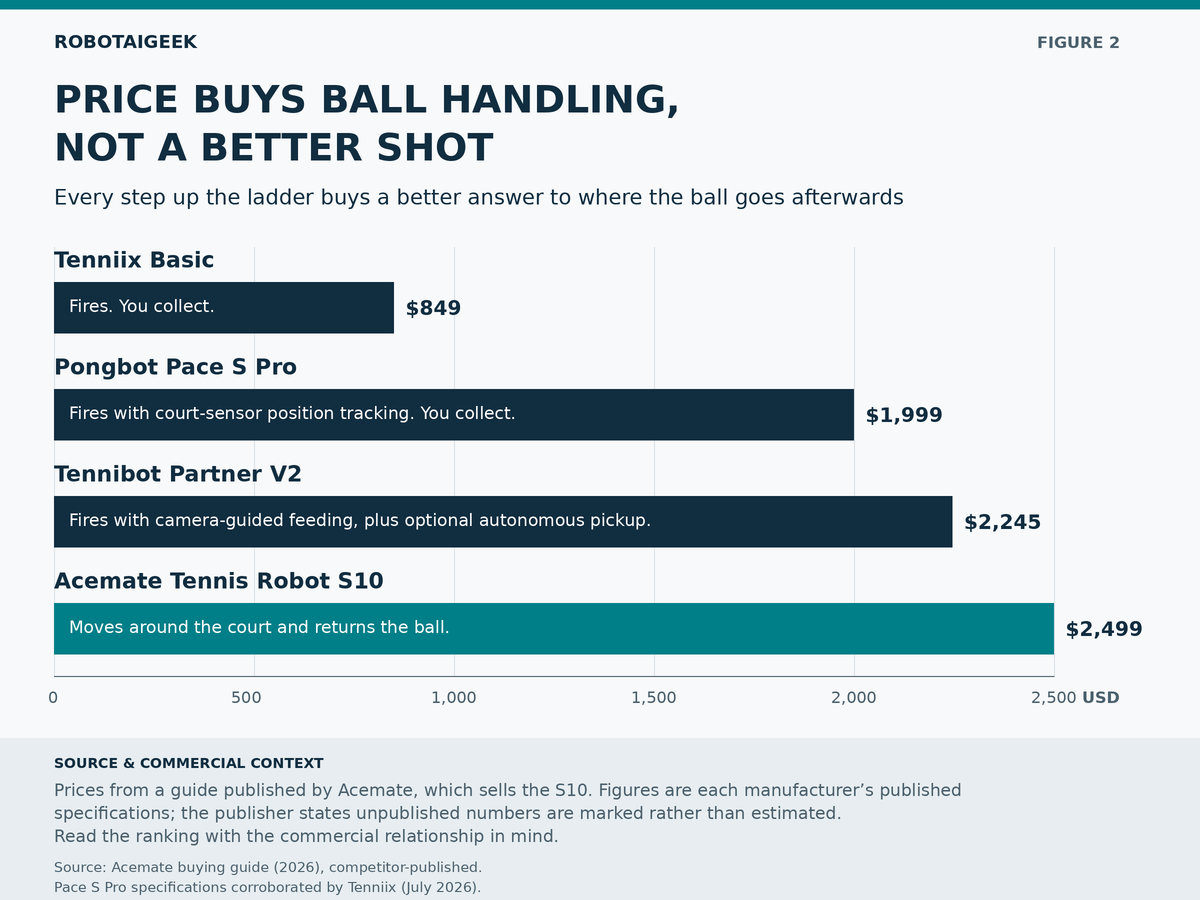
Tennis machine prices run from USD 849 to USD 2,499, and the ladder in Figure 2 shows that what rises with price is ball handling rather than shot quality.
Why the Basketball Robot Only Rebounds
The Datic 1 drew queues at CES 2025 in Las Vegas, where attendees lined up to shoot on the show floor. It weighs about 33 pounds. You wheel it under a hoop and its arms extend upward, carrying netting with them. Machine vision tracks the shooter, and the head swivels to return the ball, per TechCrunch's report from the floor.
Davy Robot's Datic 1 does not shoot, dribble, or defend. It hands the ball back. That single function was worth building a company around, because handing the ball back is the part of solo practice with no substitute — and at roughly USD 1,000 it is priced above tennis machines that fire 564 programmed drills at you. Those two prices are not like-for-like across different sports and markets, but the pattern holds wherever return capability appears.
The design choice makes sense once the sport is taken seriously. A basketball weighs around 620 grams, rebounds unpredictably off a rim, and can finish anywhere. A tennis ball at least lands inside a fenced rectangle; a table tennis ball comes back across 2.74 metres on its own. Basketball has no natural return path, which is why the machine sits under the hoop rather than beside the player.
One caveat belongs here. Davy Robot targeted a Kickstarter launch for June 2025 at around USD 1,000, and no verified evidence of shipment, fulfilment, or final specification has been confirmed as of September 2026. Anyone treating the Datic 1 as purchasable rather than announced is ahead of the record.
How Long Does Setup Actually Take?
Wheeling a rebounder under a hoop and raising netting toward a ten-foot rim is a different job from rolling a ball machine to a baseline, and the sequences in Figure 3 show where the extra minutes go.
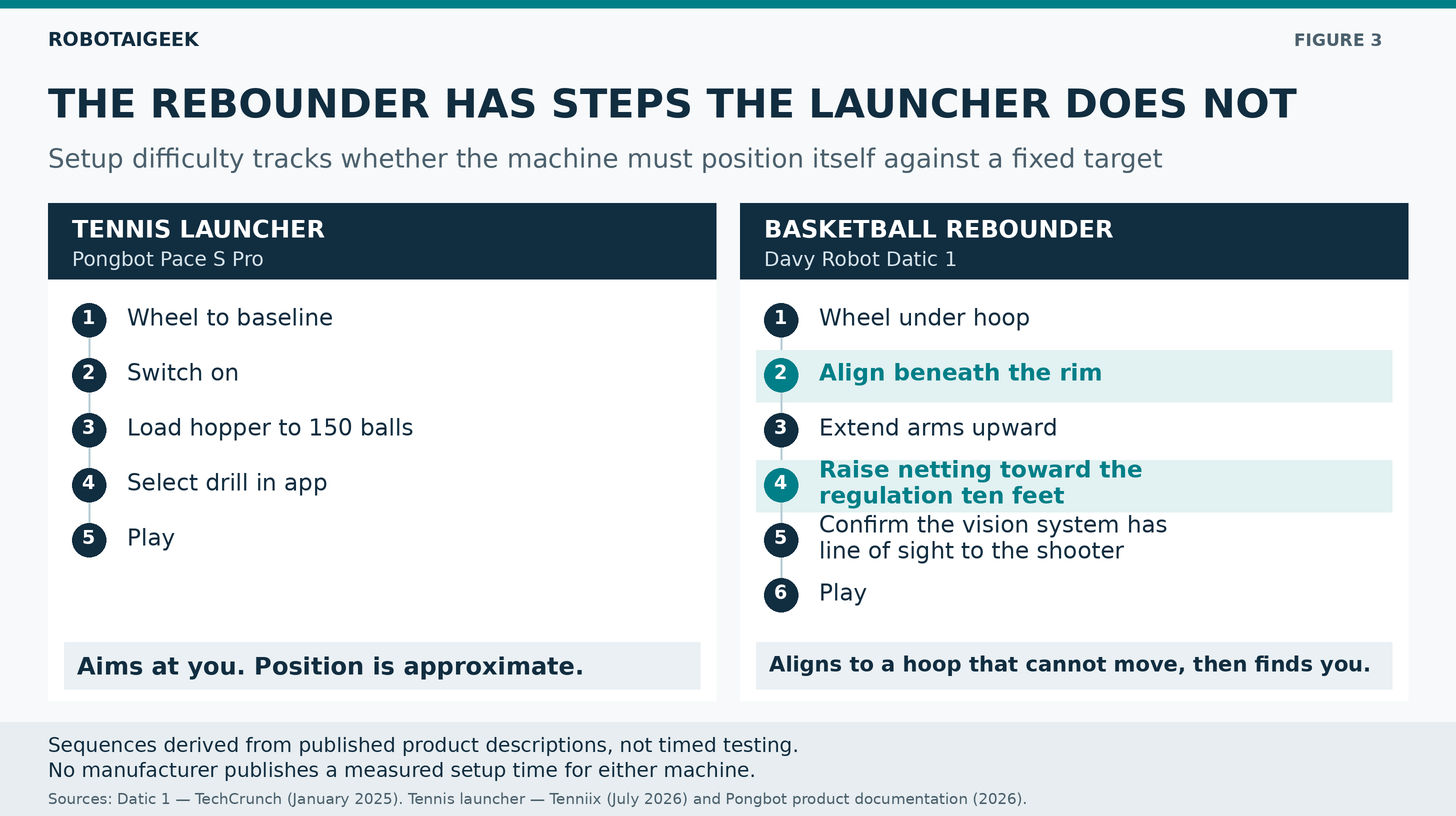
No manufacturer publishes a measured setup time for either machine, and anyone quoting one is estimating. What the published descriptions support is directional: the rebounder has more steps, and at least two involve raising a structure overhead.
The Machine That Still Works When Friends Arrive
Here is the part the specification sheets bury. A tennis ball machine becomes redundant the moment a second player walks onto the court — you would simply hit with them. Its entire value is contingent on being alone.
A rebounder is not. Put four people on a court with the Datic 1 and it still earns its place, because somebody would otherwise be chasing the ball under the basket instead of shooting. What it removes is a chore, not an absence, and chores persist in company.
That difference has a commercial consequence worth stating plainly. Launchers address the solo-practice market, which is genuinely large and genuinely underserved. Return machines address that market plus every group session where nobody wants to rebound — a materially wider addressable market for the same engineering. Whether Davy Robot priced with that in mind is not something the public record shows, and the company has not published a positioning rationale.
Which Sports Get These Machines Next
Run the mechanism forward and the filter becomes usable. A sport supports a consumer robot when one direction of the exchange can be automated cheaply and the playing area is bounded enough for a machine to find the ball.
Delivery-side machines extend most easily, and Pongbot has already done it. Its Aura, launched May 2026, uses a motorised adaptive wheel track handling ball diameters from 40 to 80 mm so one chassis serves tennis, pickleball, and padel, at USD 499 introductory against a planned USD 999 MSRP, per The Gadgeteer. Cricket bowling and baseball pitching machines already exist and need only a vision layer bolted on. Badminton and volleyball serving follow the same shape.
Return-side machines are the more interesting frontier, because the Datic 1 established that the demand exists at a consumer price. Football shooting practice has identical geometry — a keeper-less goal with a return mechanism removes exactly the chore a rebounder removes. Hockey and lacrosse share it.
The category that stays hard is the true rally, where a machine both receives your shot and sends one back while adapting to how you play. No published evidence shows a consumer product attempting it.
Training Tool or Research Benchmark
The Practice-Partner Case
Pongbot raised more than USD 2.7 million on Kickstarter in October 2024 and reported eight-figure RMB overseas monthly sales during Black Friday 2025, per 36Kr — a company-reported figure rather than an audited one. Founder Zhang Haibo, among the first engineers in China to apply reinforcement learning to table tennis rallies, reached NTRP 3.0 in six months using the robot as his only training partner, against the one to two years that standard typically takes recreational players.
One founder is one data point, and his incentive to report it favourably is obvious. The business behind it is harder to wave away: Pongbot works with 15 tennis clubs and over 200 coaches and athletes across 29 countries, and Davy Robot reached the same unmet need from a different sport entirely.
The Benchmark Case
DeepMind's table tennis agent won 13 of 29 competitive matches — every match against beginners, 55% against intermediate players, none against advanced ones. It cannot measure ball rotation, so heavy spin defeats it, and very fast or low-skidding shots remain difficult, per Notebookcheck's analysis. Omron's FORPHEUS, recognised by Guinness World Records in 2017 as the first robot table tennis tutor, uses six cameras to read expressions, heart rate, and blinks.
Neither company sells a sports robot. DeepMind published sim-to-real curriculum methodology; Omron, an industrial automation firm, built a sensing showcase. Table tennis earned its place as a benchmark because it demands prediction and actuation inside a bounded volume at speed with a measurable score — the perception-to-action problem that chess and Go could not test because neither is physical.
Both readings hold because they describe different halves of the same task, and the split explains the market shape exactly: the commercial products each solved one direction of the exchange and stopped, while the machines attempting both at once sit in research labs — which is why a company can sell you something that rebounds your jump shot for a thousand dollars, and nobody can sell you something that will guard you while you take it.
This development reinforces:
- Where Robots Are Used: The pillar covering deployment contexts, including why some consumer environments have proved far more tractable for autonomy than others.
- Cleaning Robots Won by Never Picking Anything Up: Domestic robots succeeded by avoiding manipulation entirely, which makes sports robots the mirror case — almost pure manipulation with barely any navigation.
- Why Robots Struggle With Common Sense — and Why That Matters: The distance between predicting a ball's arc and reading a game is why the rally remains a research problem.
The ball resting on an empty key never makes a product page. A rebounder costs around a thousand dollars and performs one task a bored younger sibling would do for nothing — which sounds like a joke until you notice that nobody has managed to sell the other half at any price, not DeepMind, whose agent beat every beginner it faced and lost to every advanced player, and not Omron, which has been reading players' heart rates through FORPHEUS since 2017. Golf reached this conclusion first and answered it with a tractor and forty acres. What arrived at CES 2025 was that same answer, shrunk until it fits under a hoop, still only doing the fetching.
Frequently Asked Questions
1. What is a sports robot?
A sports robot handles one side of a ball exchange while a person plays the other. The three consumer categories are tennis-style launchers that feed balls, table tennis arms that rally, and basketball rebounders that return shots. Only launchers and rebounders are commercially available; rallying arms remain research systems built by Google DeepMind and Omron.
2. Is there a robot that can actually play a sport with you?
No consumer product both sends and receives a ball. Tennis machines feed programmed drills and cannot take a return; Davy Robot's Datic 1 rebounds basketball shots but cannot shoot. Google DeepMind's table tennis agent does both and won 13 of 29 matches against human players in August 2024, but it is a research platform rather than a product.
3. What is the Davy Robot Datic 1 and how much does it cost?
The Datic 1 is a basketball rebounding robot shown at CES 2025 that sits under a hoop and returns the ball after each shot. It weighs about 33 pounds, uses machine vision to track the shooter, and swivels its head to return the ball. Davy Robot announced roughly USD 1,000 with a Kickstarter launch targeted for June 2025, per TechCrunch. Shipment has not been independently confirmed as of September 2026.
4. How long does it take to set up a basketball rebounding robot?
No manufacturer publishes a measured setup time. The published descriptions support a directional answer: a rebounder takes more steps than a tennis launcher because it must be wheeled under the hoop, aligned beneath the rim, and have its arms extended to raise netting toward regulation height. A tennis machine only needs positioning at a baseline and loading, because it aims rather than aligns.
5. Can a robot beat a human at table tennis?
Yes, at beginner and intermediate level. Google DeepMind's agent beat 100% of beginners and 55% of intermediate players while losing every match against advanced players across 29 competitive matches in its August 2024 study. It cannot measure ball rotation, so heavy spin defeats it, and very fast or low-skidding shots remain difficult.
6. Do these machines actually improve your game?
Independent evidence is thin, and the strongest public claim is a single case. Pongbot founder Zhang Haibo reported reaching NTRP 3.0 — an intermediate standard typically taking recreational players one to two years — in six months with the robot as his only training partner, per 36Kr (April 2026). No controlled study of training outcomes has been published for any machine in this category.
7. Which sports will get these robots next?
Delivery-side machines extend easily to any bounded-court sport. Pongbot's Aura already handles ball diameters from 40 to 80 mm across tennis, pickleball, and padel from one chassis, and cricket and baseball have existing pitching machines needing only a vision layer. Return-side machines follow the Datic 1's logic into football shooting practice, hockey, and lacrosse, where the chore being removed is chasing the ball.