China's AGV/AMR Orders Rise as Average Deal Size Shrinks
CMRA, the China Mobile Robot Alliance, reported 419 disclosed AGV/AMR procurement contracts in China worth a combined RMB 2.64 billion (approximately US$370 million) across Q1-Q3 2026. Project counts rose every quarter to a Q3 record of 164, while quarterly contract value fell 13.8% from Q2 to Q3 because Q1 and Q2 each contained a single mega-deal (including a RMB 403 million/US$56 million Lexus factory contract) that Q3 lacked. The analysis argues procurement teams should benchmark China-facing AGV/AMR vendors on their ability to deliver high volumes of smaller deployments profitably, not on flagship mega-deal wins.

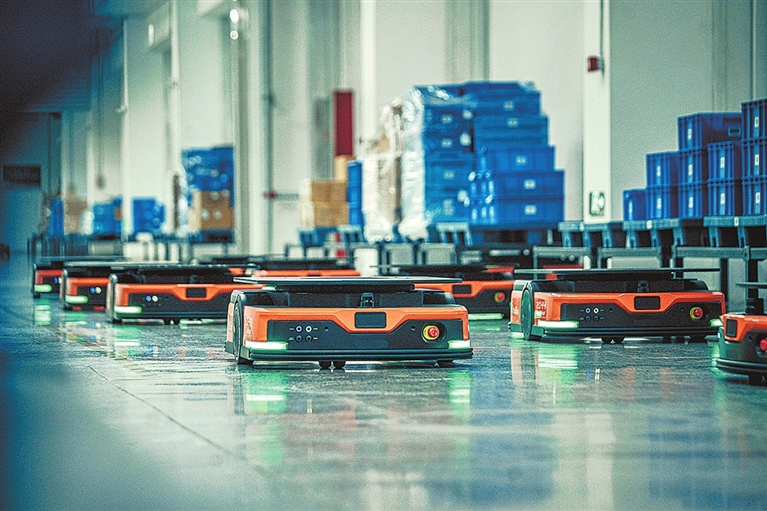
China's AGV and AMR buyers placed more orders than ever in the third quarter of 2026, and spent less money doing it. That split between rising volume and falling value is the headline finding of a Q1-Q3 2026 procurement review published October 21, 2026 by CMRA, which tracked 419 disclosed contracts worth a combined RMB 2.64 billion (approximately US$370 million) across China's mobile robotics market.
CMRA is the China Mobile Robot Alliance, a Shanghai-oriented industry platform operated and managed by New Strategy Consulting that describes itself as covering China's embodied intelligent mobile robot sector: AGVs and AMRs first, now extended to industrial mobile robots, low-speed autonomous driving and humanoid robots. It counts close to a thousand member units, spanning hardware manufacturers, systems integrators, component suppliers, end-user companies and research institutes, and it compiles this procurement tracker jointly with its research arm, the New Strategy Mobile Robot Research Institute. Neither organization is a listed company or a government statistics bureau; the tracker is built from disclosed tender and contract announcements, which means it captures the subset of China's AGV/AMR deal flow that becomes public, not the entire market.
A market that grew louder while its biggest checks got smaller
The quarterly pattern is unambiguous. Disclosed project counts climbed in a straight line: 113 in the first quarter, 142 in the second, and 164 in the third, a record high that put Q3 volume 45% above Q1. Disclosed contract value did not follow the same curve. Q1 totaled RMB 908 million (approximately US$127 million), Q2 came in slightly higher at RMB 930 million (approximately US$130 million), and Q3 fell to RMB 802 million (approximately US$112 million), a 13.8% quarter-on-quarter drop even as the number of deals kept rising.
The explanation sits in the tails of the distribution rather than in the middle. Q1 and Q2 each contained one outsized contract that anchored the quarter's total: a RMB 415 million (approximately US$58 million) smart-warehouse project in Q1, and a RMB 403 million (approximately US$56 million) factory automation contract awarded by Lexus, the Toyota-owned luxury vehicle brand, in Q2. Q3 had no equivalent. Its two largest disclosed deals were RMB 203 million (approximately US$28 million) and RMB 116 million (approximately US$16 million), both well under half the size of the prior quarters' top contracts. Remove those two anchor deals from Q1 and Q2 and the underlying run rate of ordinary-sized business was already rising steadily across all three quarters. The quarter-on-quarter value decline is a function of mega-deal timing, not of buyers pulling back.
That distinction matters more to a procurement reader than the headline number does. A market where total spend depends on whether one or two whale contracts land in a given quarter is a market where trailing-twelve-month value figures are a weak signal of underlying demand. A market where disclosed project count rises every quarter regardless of whale timing is a market where the installed base of buyers, and the number of vendors who have to compete for them, keeps expanding. Both things are true here at once, and treating the Q3 value drop as a demand signal would be a misreading of the data CMRA itself published.
Where the volume is actually going
CMRA's deal-size breakdown confirms the shift is structural rather than a one-quarter accident. Across the first three quarters combined, 56.1% of all disclosed projects were valued at RMB 1 million (approximately US$140,000) or below. By Q3 alone, that share had climbed further, to 62.2% of volume. At the other end, mega-deals of RMB 100 million (approximately US$14 million) or more and large deals of RMB 10 million (approximately US$1.4 million) or more together accounted for only 8.6% of total project volume across the period.
The arithmetic implication is straightforward: fewer than one in eleven disclosed China AGV/AMR contracts is what most Western integrators would call a flagship account, and the other roughly ten in eleven are small-to-mid-size deployments that individually move little revenue but collectively define where the market's order book is actually growing. A vendor whose China go-to-market strategy still assumes a small number of nine-figure anchor wins is competing for a shrinking share of total volume. A vendor built to win and fulfill high-frequency, lower-ticket contracts is competing in the segment that grew every single quarter of 2026 so far.
Education, not the factory floor, led the quarter's project count
The industry breakdown is the part of this report that most diverges from the assumption that China's AGV/AMR demand is primarily a factory-automation story. Education and research institutions led all sectors in disclosed project volume at 23.8% of the total, ahead of manufacturing at 11.2% and energy and chemicals at 8.1%. CMRA's own description of these education deals is specific: universities and vocational schools are increasingly buying "training platforms" and "integration bases" rather than individual robots, meaning a single disclosed contract can bundle hardware, curriculum and lab infrastructure rather than a single unit sale. That packaging effect is one reason education shows up so heavily in project count even though the dollar value of any one such contract is typically modest.
Manufacturing's 11.2% share reflects a narrower but more technically demanding shift, from single-point pilot deployments toward multi-process installations concentrated in semiconductors and 3C electronics (the consumer electronics, computing and communications hardware categories China's supply chain is built around). Energy and chemicals procurement, at 8.1%, is driven by operators who need AGV and AMR fleets that are certified and adapted for hazardous, tightly regulated industrial environments, a buyer profile with less price sensitivity and a longer qualification cycle than either education or general manufacturing.
For a non-China vendor or integrator trying to size the opportunity, the practical read is that China's disclosed AGV/AMR demand is not concentrated in the automotive and electronics plants that dominate most outsiders' mental model of the market. It is spread across a vocational-training buildout, a narrower high-precision manufacturing segment, and a smaller but stickier industrial-safety segment, each with different procurement cycles, different price sensitivity, and different incumbency advantages for domestic suppliers who already hold relationships with local universities, provincial industrial parks and state-linked energy operators.
What one named deal says about the ceiling for foreign brands
The single most informative data point in this report for a global buyer is not a percentage; it is the identity of the quarter's second-largest named contract. Lexus awarding a RMB 403 million (approximately US$56 million) factory automation contract in Q2 confirms that a premium, globally recognized automotive brand manufacturing in China is sourcing mobile robotics domestically at scale, not importing a foreign AGV/AMR stack for its China lines. That is a data point about where the ceiling sits for China-based procurement of mobile robotics: even brands with deep relationships to non-Chinese automation vendors are, for China-based production, buying from the domestic AGV/AMR supply base CMRA tracks.
This has a direct read-through for procurement teams outside China who are evaluating whether to qualify Chinese AGV/AMR vendors for their own facilities, versus simply watching China as a demand market. A domestic ecosystem large enough and mature enough to win a nine-figure mandate from a brand like Lexus is also large enough to be exporting competitively priced hardware and software stacks outward, and the same deal-size data that shows smaller average contract sizes domestically is consistent with a supply base built for high-volume, cost-disciplined manufacturing rather than boutique integration. That combination, rising volume at falling average price per deal, is precisely the signal that tends to precede downward pricing pressure in adjacent export markets as domestic Chinese vendors look for growth outside a home market where mega-deals are getting harder to find.
The buyer-economics case this data supports
Three implications follow directly from the numbers CMRA published, and none of them require speculation beyond what the report states. First, benchmarking a China-facing AGV/AMR vendor on its ability to win flagship, headline-grabbing contracts is now benchmarking against the smaller and shrinking part of the market; the better diligence question is whether a vendor's sales and delivery model is built to close high volumes of sub-RMB-1-million (sub-US$140,000) deployments profitably, because that is where 56% to 62% of actual order flow sits. Second, a buyer comparing total-cost-of-ownership quotes from China-based suppliers should expect downward price pressure to continue, not because demand is weakening, record project counts say otherwise, but because the market's center of gravity is moving toward smaller, more standardized, more price-competitive deployments rather than custom mega-projects with correspondingly higher per-unit margins. Third, any buyer treating "China AGV/AMR market size" as a single stable dollar figure for forecasting purposes should instead track project count as the leading indicator and treat quarterly value totals as noisy, since one or two large contracts can move the value figure by double-digit percentages quarter to quarter without any change in the number of active buyers or the direction of underlying demand.
A market where order volume rises every quarter while average deal size falls is a market shifting purchasing power from a handful of mega-project buyers toward the vendors who can serve the smaller majority cost-effectively, and procurement teams benchmarking China-based AGV/AMR suppliers should weight delivery capacity at that smaller deal size, not flagship contract wins, as the more durable signal of vendor strength.
The practical takeaway for a global automation buyer is not that China's mobile robotics market is cooling. Rising project counts in every quarter of the period say the opposite. It is that the market's structure has shifted enough, in three consecutive quarters of disclosed data, that vendor selection criteria built around one or two marquee contract wins per year are now measuring the wrong thing. Buyers who recalibrate toward a vendor's proven ability to deliver at the sub-RMB-10-million (sub-US$1.4 million) scale that now dominates China's disclosed order book, and who factor continued downward price pressure into their total-cost comparisons against that same domestic supply base, are reading this report correctly. Buyers who keep scoring China-facing vendors primarily on headline deal size are not.
This article synthesizes published industry-association data and public market activity as of 2026-10-21. It is for general information purposes only and does not constitute investment, financial, or professional advice.