Where is the Industrial 6-Axis Arm Used? Real-World Applications Explained
A comprehensive look at how industrial 6-axis robotic arms are deployed across major industries today. Drawing on IFR data, CSIS analysis, and verified factory case studies, this article examines primary industries, specific application examples, large-scale deployments in China and Europe, and the emerging sectors now adopting these arms for the first time.
The global market for industrial robotic arms reached approximately USD 18.5 billion in 2025 and is on a trajectory to exceed USD 36 billion by 2035 [1]. Behind that number is a physical reality: hundreds of thousands of 6-axis arms are running production lines, welding chassis, assembling circuit boards, and palletising goods around the clock in factories across four continents. For buyers, procurement teams, and investors trying to understand where this technology sits in the industrial economy, the most important question is not what a 6-axis arm is, but where it is actually doing work today and where it is beginning to appear for the first time.
Primary Industries
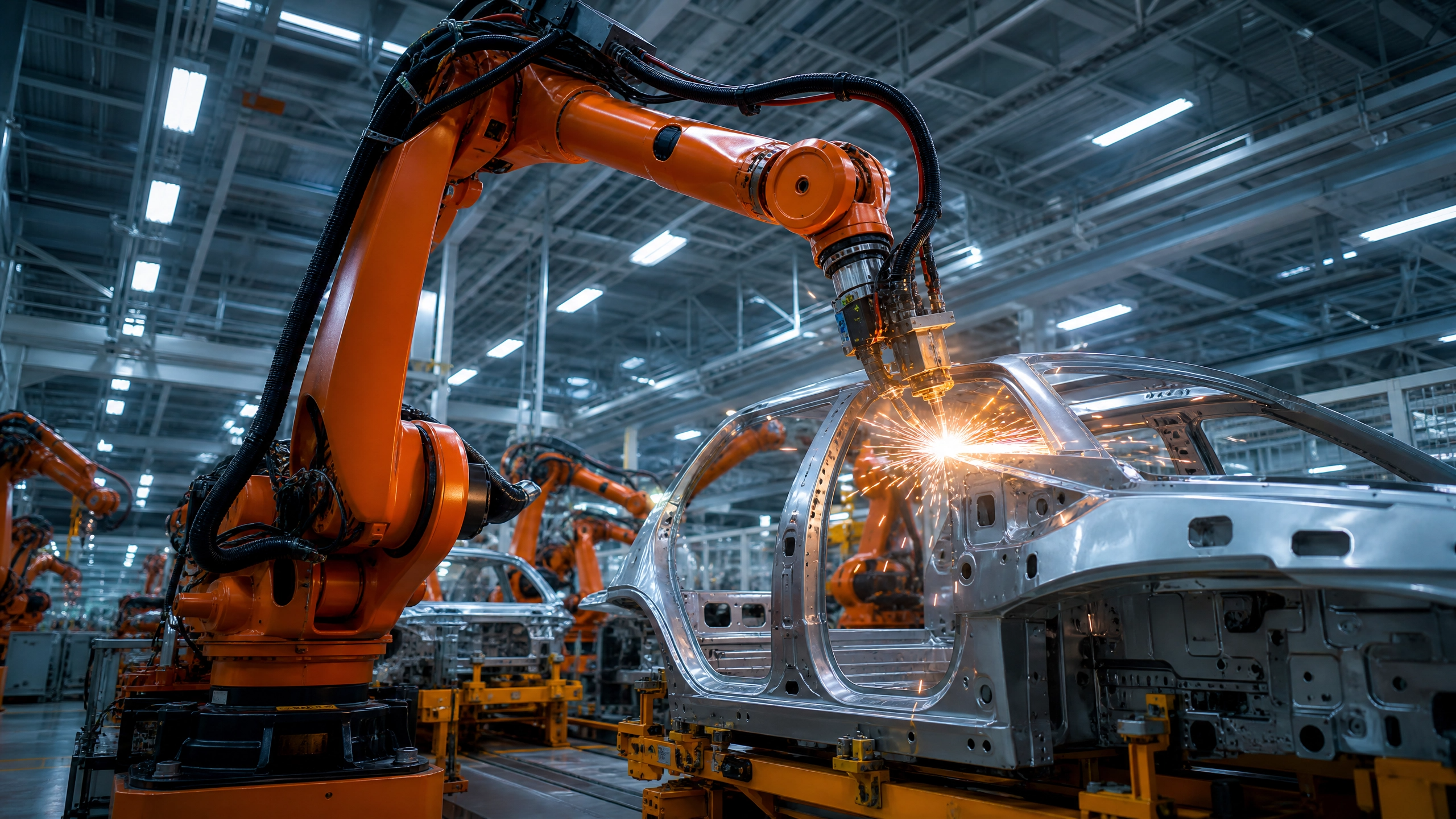
The automotive sector remains the single largest consumer of industrial 6-axis arms globally. The International Federation of Robotics reported that nearly 55,000 new industrial robot units were installed in China's automotive industry alone in 2024, growing at 13 percent annually since 2019 [2]. Globally, automotive assembly lines account for a disproportionate share of the highest-payload arms, those rated above 200 kg, which are used for spot welding, body-in-white assembly, and heavy component transfer.
The electronics manufacturing industry is the second pillar. In China, electronics installations reached 83,000 units in 2024, growing at 16 percent annually since 2019 [2]. These arms are typically smaller and faster than their automotive counterparts, operating in the 3 to 20 kg payload range, and are tasked with assembling delicate components where human hands lack the required speed and consistency. The third major sector is logistics and warehousing, where 6-axis arms are increasingly deployed at the end of packing lines for palletising and parcel sorting. Battery manufacturing, driven by the explosive growth of the electric vehicle supply chain, has emerged as a fourth significant vertical. Companies such as BYD and CATL collectively operated approximately 12,500 robotic arm units in 2025 for battery cell assembly and electrode handling [3].
Beyond these four dominant sectors, the food and beverage and pharmaceutical industries are growing rapidly from smaller baselines. In China, food and beverage robotics installations grew by 86 percent year-over-year in 2024, the fastest growth rate of any sector, though starting from a much lower base than automotive or electronics [2].
Specific Application Examples
In automotive production, spot welding and arc welding are the most established applications. A 6-axis arm can maneuver a heavy welding torch into tight chassis corners with a repeatability of plus or minus 0.02 to 0.05 mm, sustaining this precision over thousands of cycles per shift. Automated painting is the second critical automotive application. The robot moves the spray nozzle in precise fluid arcs to ensure an even coat while minimising material waste and eliminating worker exposure to toxic fumes.
In electronics manufacturing, high-speed pick and place operations dominate. Arms in this context typically achieve repeatability of plus or minus 0.03 to 0.1 mm, which is sufficient for board handling, connector insertion, and small-parts assembly. In warehousing and logistics, palletising is the primary use case. Heavy-payload 6-axis arms equipped with vacuum or mechanical grippers lift boxes and stack them onto shipping pallets in optimised geometric patterns, a task that causes high rates of ergonomic injury in human workers when performed manually.
In battery manufacturing, force-controlled 6-axis arms are used for the precise loading and unloading of lithium-ion battery cells. The delicacy of battery materials means that even small variations in grip force can damage cells, making the fine motor control of a 6-axis arm essential. Inovance Technology, for example, has developed a force-control robotic system specifically for BYD's battery assembly lines, integrating its servo motor expertise directly into the arm's control architecture [3].
China Deployment Example
The Chang'An Automobile Digital Intelligence Factory in Chongqing is one of the most cited examples of large-scale 6-axis arm deployment in China. When it opened in 2024, the facility housed over 2,000 robots and autonomous vehicles operating in synchronised coordination. The factory assembles a completed car approximately every 60 seconds and operates at 20 percent lower cost than comparable traditionally staffed facilities [4]. The plant is classified as a "dark factory," meaning it is sufficiently automated to operate without human labour on the production floor.
This level of density is not exceptional in China's EV sector. BYD's Shenzhen manufacturing complex, one of the most automated in the world, uses AGVs, industrial arms, and intelligent warehousing systems in an integrated production architecture. According to published analysis, the facility operates at 97 percent automation and uses approximately 300 welding robots in its body-in-white lines alone. The scale of these deployments provides Chinese manufacturers with a data advantage that is difficult to replicate through smaller or slower deployments: every arm on the floor generates operational data that feeds back into process optimisation and, increasingly, into the AI models being trained to control the next generation of robots.
Global Deployment Example
In Europe, the BMW Group plant in Dingolfing, Germany, represents a mature example of 6-axis arm integration in a premium manufacturing environment. The facility uses industrial arms not only for welding and assembly but also for quality inspection. Arms equipped with optical sensors perform rapid geometric inspections on finished car bodies, sweeping over the vehicle surface to capture thousands of data points and verify that every panel gap and seam meets strict tolerance standards. This integration of 6-axis mobility with machine vision demonstrates how legacy industrial arms are being upgraded into smart inspection tools, reducing the reliance on manual quality control checks.
In the United States, Amazon's fulfilment network provides a large-scale logistics example. Amazon has deployed 6-axis arms at multiple fulfilment centres for tasks including depalletising inbound shipments and packing outbound orders. The company has publicly stated its goal of increasing robotic throughput across its warehouse network, with 6-axis arms playing a central role in the heavy-lifting and sorting stages of the fulfilment process.
Emerging Use Cases
Three sectors are generating significant new demand for 6-axis arms that did not exist at meaningful scale five years ago.
The first is food processing. Washdown-rated arms with IP65 or IP67 protection are now being deployed for primary food handling tasks including meat cutting, fish filleting, and raw produce sorting. These robots must withstand aggressive chemical cleaning cycles while meeting strict hygiene standards. The global pharmaceutical robotics market, a related sector, was valued at approximately USD 230 billion in 2025 and is growing at a CAGR of 12.3 percent [5], with 6-axis arms used for sterile drug compounding, vial handling, and laboratory automation.
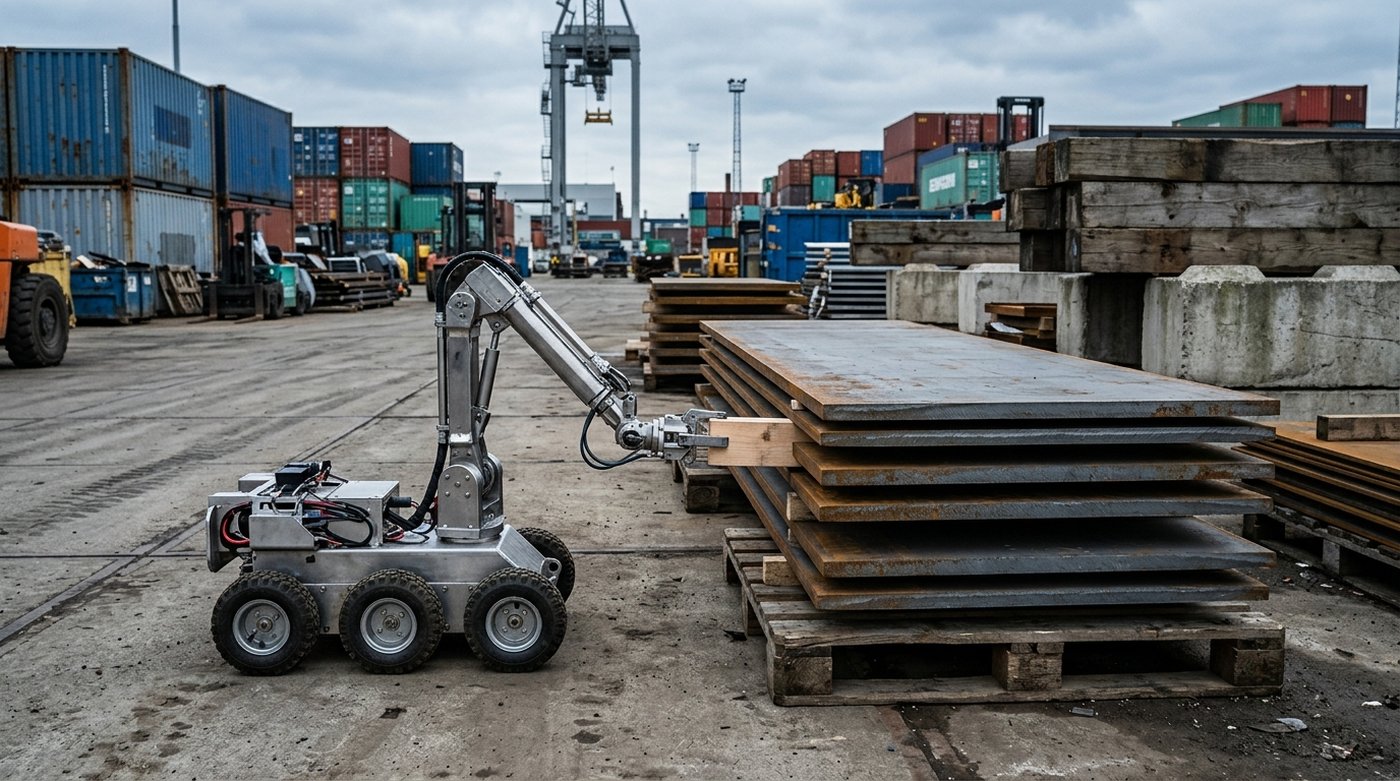
The second emerging sector is automated construction. Modified 6-axis arms mounted on mobile gantries or tracked platforms are being tested for structural welding, bricklaying, and 3D concrete printing on building sites. While still largely in the pilot phase, several construction robotics companies in Japan, Australia, and China have demonstrated working systems capable of operating in partially unstructured environments.
The third is semiconductor and advanced electronics manufacturing. As chip geometries shrink and wafer handling requirements become more demanding, specialised cleanroom-rated 6-axis arms are being adopted for wafer transfer, die bonding, and precision inspection tasks that require sub-micron positioning accuracy. This is a technically demanding segment that commands significant price premiums over standard industrial arms, and it is one area where Japanese and European manufacturers currently retain a clear quality advantage over Chinese competitors.
Taken together, these emerging applications signal that the 6-axis arm is in the early stages of a second wave of adoption. The first wave, which ran from the 1980s through the 2010s, was driven almost entirely by automotive and electronics. The second wave is being driven by the convergence of falling arm prices, improving AI-based vision and force control, and the expansion of automation into industries that previously considered robotics too expensive or too inflexible to deploy. For procurement teams and investors, the question is no longer whether 6-axis arms will penetrate these new sectors, but how quickly the cost and capability curves will intersect with the specific requirements of each industry.
References
[1] GlobeNewswire / Research Nester. "Robotic Arm Market Enters Hyper-Growth Era." April 2026. https://www.globenewswire.com/news-release/2026/04/28/3282791/0/en/robotic-arm-market-enters-hyper-growth-era-powering-the-future-of-intelligent-automation-by-2035.html
[2] International Federation of Robotics (IFR) via CSIS ChinaPower. "Is China Leading the Robotics Revolution?" February 2026. https://chinapower.csis.org/china-industrial-robots/
[3] Chozan. "Robotic Arms in China: Manufacturing Use Cases, Suppliers, and Automation Strategy." June 2026. https://chozan.co/robotic-arms/
[4] CSIS ChinaPower / Xinhua. Chang'An Automobile Digital Intelligence Factory, Chongqing. February 2026. https://chinapower.csis.org/china-industrial-robots/
[5] Maximize Market Research. "Pharmaceutical Robots Market: Industry Analysis 2025." https://www.maximizemarketresearch.com/market-report/global-pharmaceutical-robots-market/65857/