Top Use Cases for Collaborative Robots Across Industries
Collaborative robots are spreading beyond basic assembly into welding, machine tending, inspection, packaging, and flexible electronics production. This guide maps the strongest applications, examines verified deployments in China and Germany, and introduces a practical framework for deciding where cobots fit.
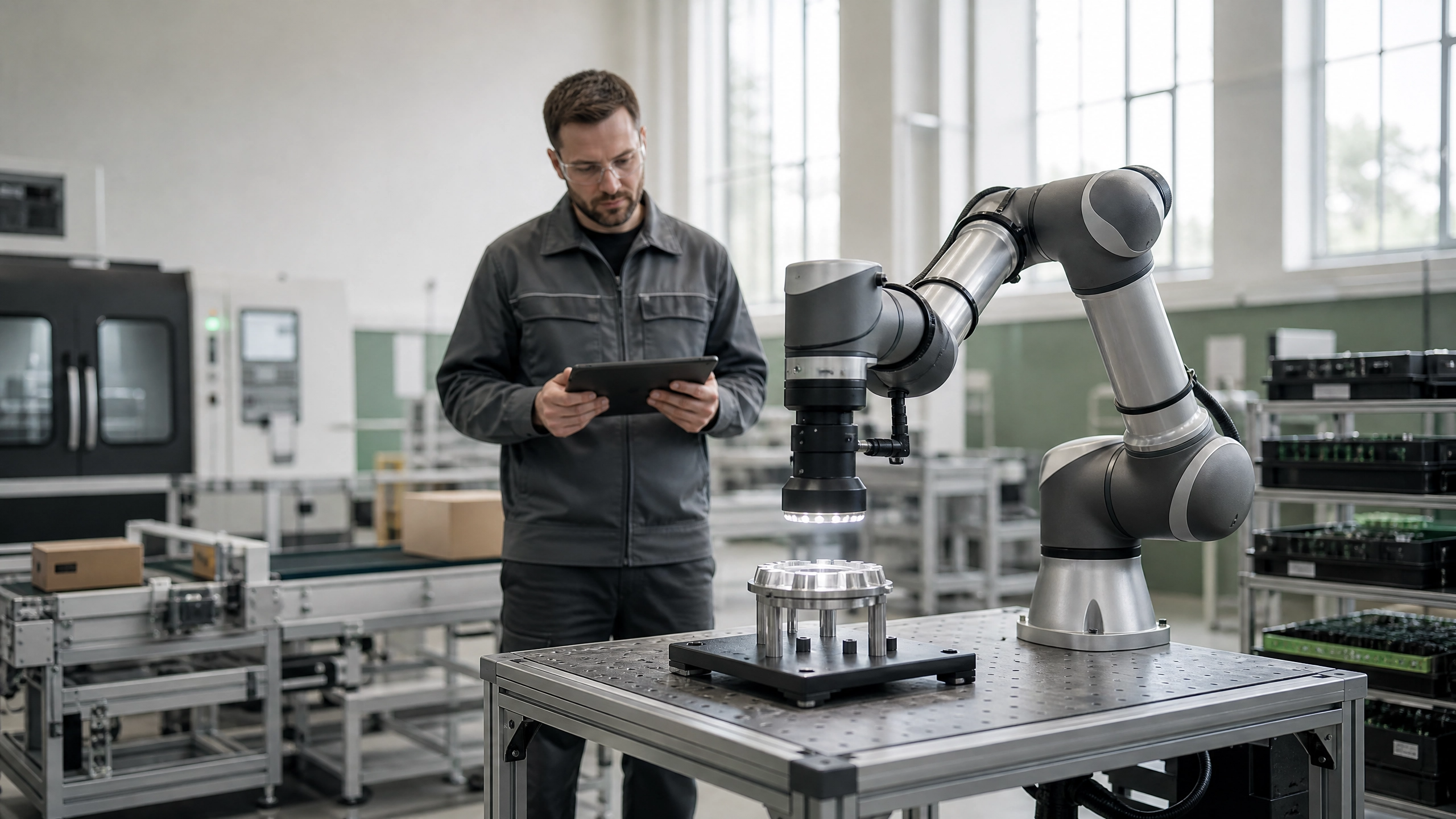
Top Use Cases for Collaborative Robots Across Industries
Collaborative robots have moved from demonstration cells into a commercially meaningful part of industrial automation. They represented 10.5 percent of industrial robots installed worldwide in 2023, according to the International Federation of Robotics.1 Their strongest role is not replacing every conventional robot. It is filling the gap between manual work and fixed automation where product mix changes, people remain close to the process, and the task is repetitive enough to standardise.
Primary Industries
Automotive, electronics, aerospace, consumer goods, pharmaceuticals, logistics, and warehousing were among the early adopting industries identified by IFR.1 The pattern becomes clearer when those sectors are examined through task characteristics rather than industry labels.
Automotive and metalworking plants use cobots where components require repeated loading, fastening, inspection, dispensing, or welding but the production cell must remain accessible to operators. Electronics factories value controlled motion for screw fastening, adhesive dispensing, inspection, connector handling, and light assembly. Consumer goods and regulated product manufacturers use them for packaging, inspection, and repetitive handling. Logistics operators apply robot arms to bin picking, order preparation, and palletising when payload and speed requirements remain within collaborative limits.1
The wider industrial robot market gives useful context, although it should not be confused with cobot specific adoption. Electronics accounted for 24 percent of global industrial robot installations in 2024, automotive for 23 percent, and metal and machinery for 16 percent.2 These large installed markets create a broad base of processes that can be reassessed for flexible collaborative automation.
Across these sectors, the commercial logic is strongest when a process combines repeated motion with frequent product change or regular operator access. That pattern explains why the same robot platform can appear in a machine shop, an electronics line, a packaging area, or a laboratory while performing very different work.
Specific Application Examples
The most established applications are machine tending, adaptive assembly, inspection, welding, packaging, and shipping. NIST identifies these as common opportunities in high mix, low volume manufacturing, where one automation system may need to serve several products or be redeployed as demand changes.3
Machine tending is a strong starting point because the robot can load and unload a machine while the operator manages quality, setup, and exceptions. Welding is attractive when skilled labour is scarce and part families repeat, but fumes, arc exposure, fixtures, and the workpiece still require application level safeguards. Assembly and dispensing suit cobots when force, position, and sequence must be consistent while people remain responsible for judgement or complex handling. Inspection becomes more valuable when the robot carries a camera or sensor through a repeatable path.
The buyer should classify the application before choosing the arm. The original Application Fit Matrix for this article uses four variables: task repetition, process variability, human proximity, and hazard burden. A task is a strong cobot fit when repetition is high, variability is manageable, people need regular access, and hazards can be engineered down. It is a conditional fit when sharp tools, heat, heavy parts, contamination, or unpredictable contact remain. Traditional guarded automation should be considered first when maximum speed and payload dominate the business case. IFR specifically cautions that cobots are not intended for processes requiring both high payload and high speed.1
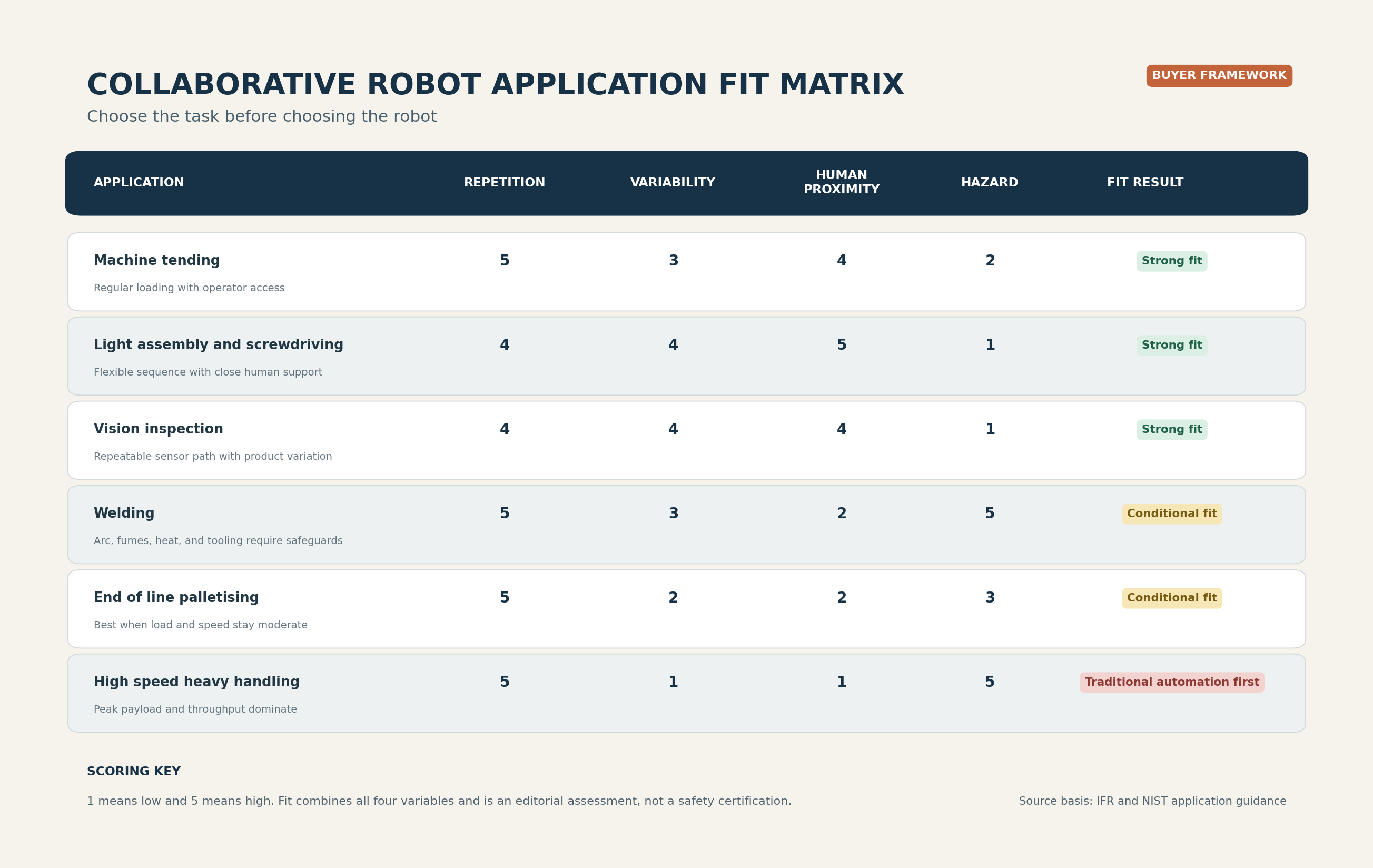
This framework prevents a common procurement mistake. Buyers often ask whether an industry uses cobots, but the more useful question is whether a particular task needs flexibility and human access more than it needs peak throughput.
China Deployment Example
An official Shanghai Stock Exchange filing by JAKA Robotics describes several deployments that show how applications can expand after initial validation.4 The filing states that Toyota related factories began batch purchasing in 2020 after a procurement and inspection process. Initial applications involved loading and unloading automotive steering shafts. Deployment later expanded to adhesive application on vehicle doors and windows and grinding external lamp frames across multiple affiliated factories inside and outside China.4
The same filing describes an electronics deployment at Luxshare Precision. Small batch purchasing began at the end of 2019, followed by entry into the group supply chain and batch supply. Reported applications included dispensing adhesive for Bluetooth earphones, pressure holding during assembly, and applying fire resistant tape. Revenue disclosed from sales to Luxshare during the reporting period approached RMB20 million.4
These examples do not establish an independently audited productivity gain. They do show a practical adoption pathway: validate one bounded task, standardise the cell, then reuse the platform across adjacent operations. For buyers, repeat orders and application expansion are often more informative than a single headline efficiency claim.
Global Deployment Example
Stöckl Maschinen und Gerätebau in Germany adopted a cobot welding cell after receiving a larger order for metal pivot mounts used in outdoor relaxation loungers. IFR reports that the cell entered operation at the beginning of 2022 and now supports annual throughput of around 1,000 pivot mounts.5
The application is commercially relevant because the company had previously produced sophisticated welded designs in small batches, largely by hand. Manual guidance and simplified programming reduced the effort required to create new welding paths, making the system suitable for varied products and smaller production runs.5
The disclosed throughput should be treated as a company reported operating result, not an independently audited productivity benchmark. Even with that limitation, the case illustrates a strong cobot pattern: a small manufacturer gains repeatable welding capacity without committing the entire workshop to one fixed product.
Emerging Use Cases
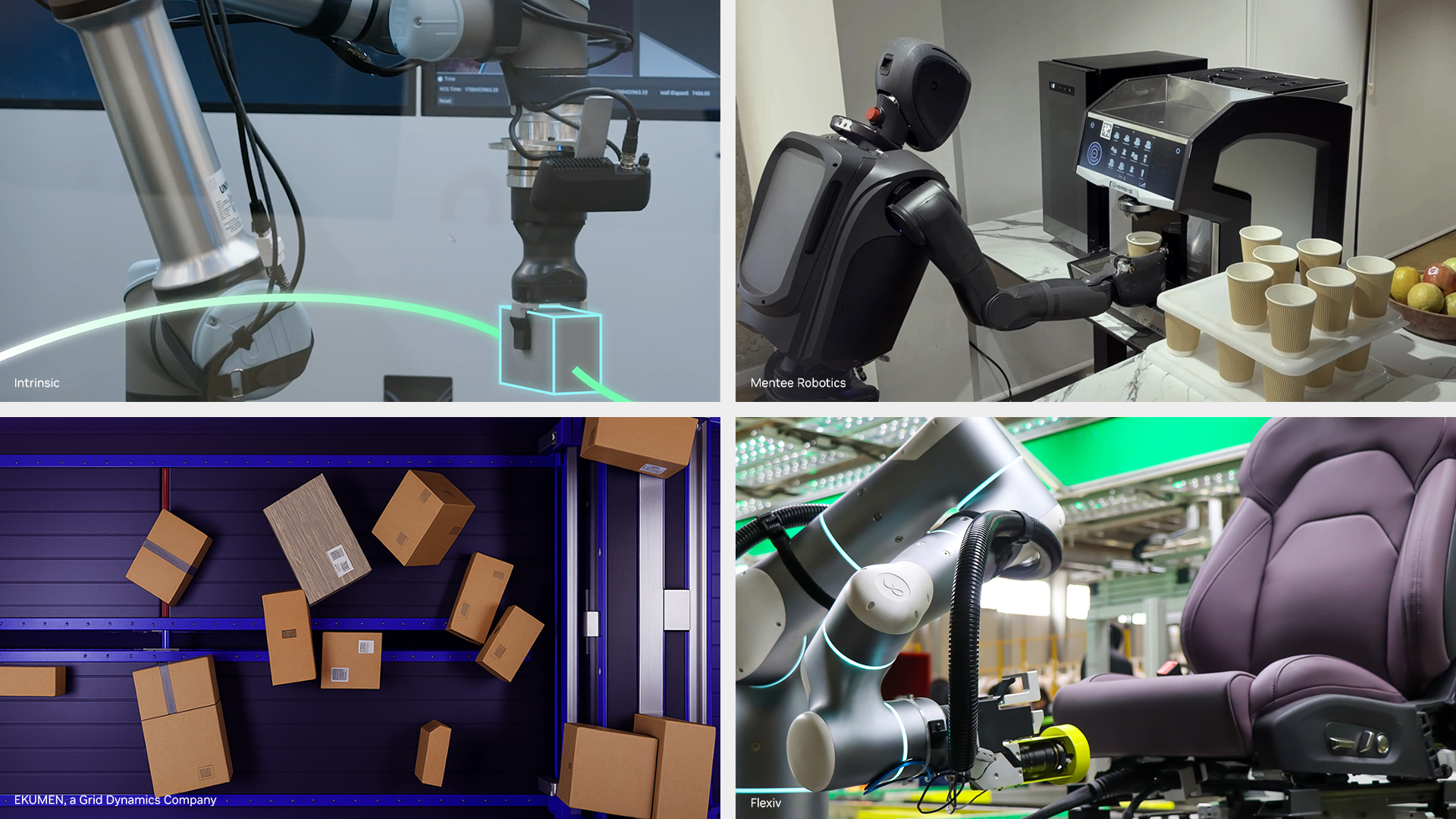
The next growth area is likely to combine collaborative arms with machine vision, mobile bases, and learning based software. IFR expects new sensors, vision systems, and artificial intelligence to help robots respond to changes in their environment and widen the range of unattended tasks.1
Mobile manipulation is especially promising for facilities where automation demand moves between workstations. A mobile platform can carry an arm to machines, inspection points, or material locations rather than dedicating one robot to one cell. NIST is developing standard test methods for mobile manipulators and other mobile robotic systems, which signals that repeatable performance measurement remains an active technical requirement rather than a solved procurement problem.6
Other emerging applications include flexible surface treatment, laboratory handling, mixed item order preparation, and inspection tasks that require both controlled motion and adaptive perception. Adoption will depend less on whether a robot can perform one successful demonstration and more on whether the complete system can manage exceptions, cybersecurity, process validation, and safe interaction over many shifts.
The investment case for collaborative robots is therefore task specific. The strongest deployments begin with a repetitive constraint, preserve human judgement where it adds value, and create a platform that can migrate across products. As the asset class matures, buyers who measure application fit and redeployment value will capture more durable returns than those who purchase around payload alone.
References:
[4] Shanghai Stock Exchange, JAKA Robotics Review Response Filing, 2024