The Loco-Manipulation Race: Can Robots Finally Move and Work at the Same Time?
Two robotics teams on opposite sides of the world have each published a breakthrough approach to the same problem that has stalled humanoid robotics for decades: how do you get a robot to move and work at the same time? Beijing-based Galbot recently announced AstraBrain-WBC 0.5, a GPT-style "cerebellum" foundation model that treats physical motion the way language models treat text. Around the same time, Toronto-based Current Robotics released Curr-0, a full-body dexterous manipulation model built on a single, unified policy. The convergence was not coincidental. Both releases represent different bets on how to solve loco-manipulation, the ability of a humanoid robot to navigate its environment and manipulate objects simultaneously, without stopping, without switching modes, and without falling over.
Why This Problem Has Taken So Long to Solve
To understand why these announcements matter, it helps to understand what robots have been doing instead.
For most of the past decade, humanoid robot control has been modular. A locomotion system handles walking. A separate manipulation system handles the arms and hands. The robot walks to a location, stops and the manipulation system takes over. This approach works in structured factory settings the kind where the floor is flat, the objects are predictable, and the robot never needs to reach for something while it is still moving.
It fails everywhere else.
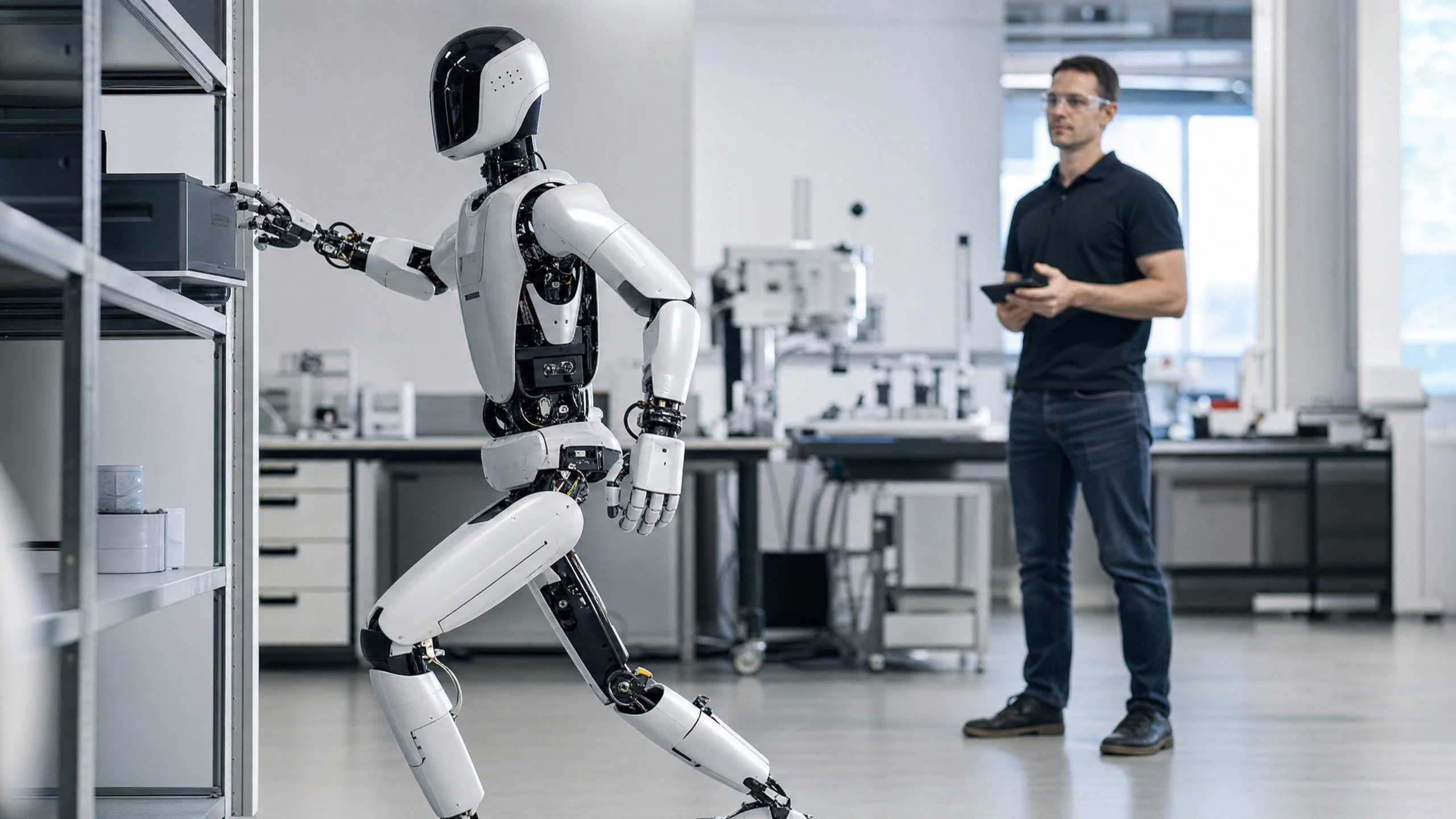
Consider what a human warehouse worker does without thinking: walking down a narrow aisle, reaching sideways to pull a box from a low shelf, adjusting their grip as the box turns out to be heavier than expected, and pivoting to place it on a cart, all in one continuous motion. Every part of that sequence requires the whole body to act as a single coupled system. The stance determines what the hands can reach. The torso posture affects how the arms apply force. Contact with the box changes how the entire body must balance. A robot that stops to manipulate cannot do this. A robot that cannot do this cannot work in a real warehouse, a real hospital, or a real home.
Two Approaches to the Same Open Problem
Galbot: The Cerebellum GPT
Galbot's approach is rooted in the insight that made large language models transformative: scale. The company trained AstraBrain-WBC 0.5 on 20,000 hours, 2 billion frames of human motion data, covering everything from industrial lifting to dance routines to fall recovery. The model is built on a GPT-style causal Transformer with 80.4 million parameters, roughly the scale of OpenAI's original GPT-1.
The key result is a validated Scaling Law for motion control. As training data scaled from 2 million to 2 billion frames, the model's zero-shot success rate on tasks it had never seen before climbed from 83.26% to 92.58%. The model does not memorise specific movements. It learns the underlying rules of how bodies move and applies those rules to new situations it has never encountered.
Galbot calls this the robot's "cerebellum." In human neuroscience, the cerebellum is the part of the brain that handles subconscious motor coordination, the millisecond-level adjustments that keep you balanced while you reach for a glass without thinking about it. AstraBrain is designed to serve the same function: an always-on, real-time coordination layer that frees up the robot's higher-level "brain" (vision-language models) to focus on what the task actually requires, rather than on how to stay upright while doing it.
Current Robotics: The Single Policy
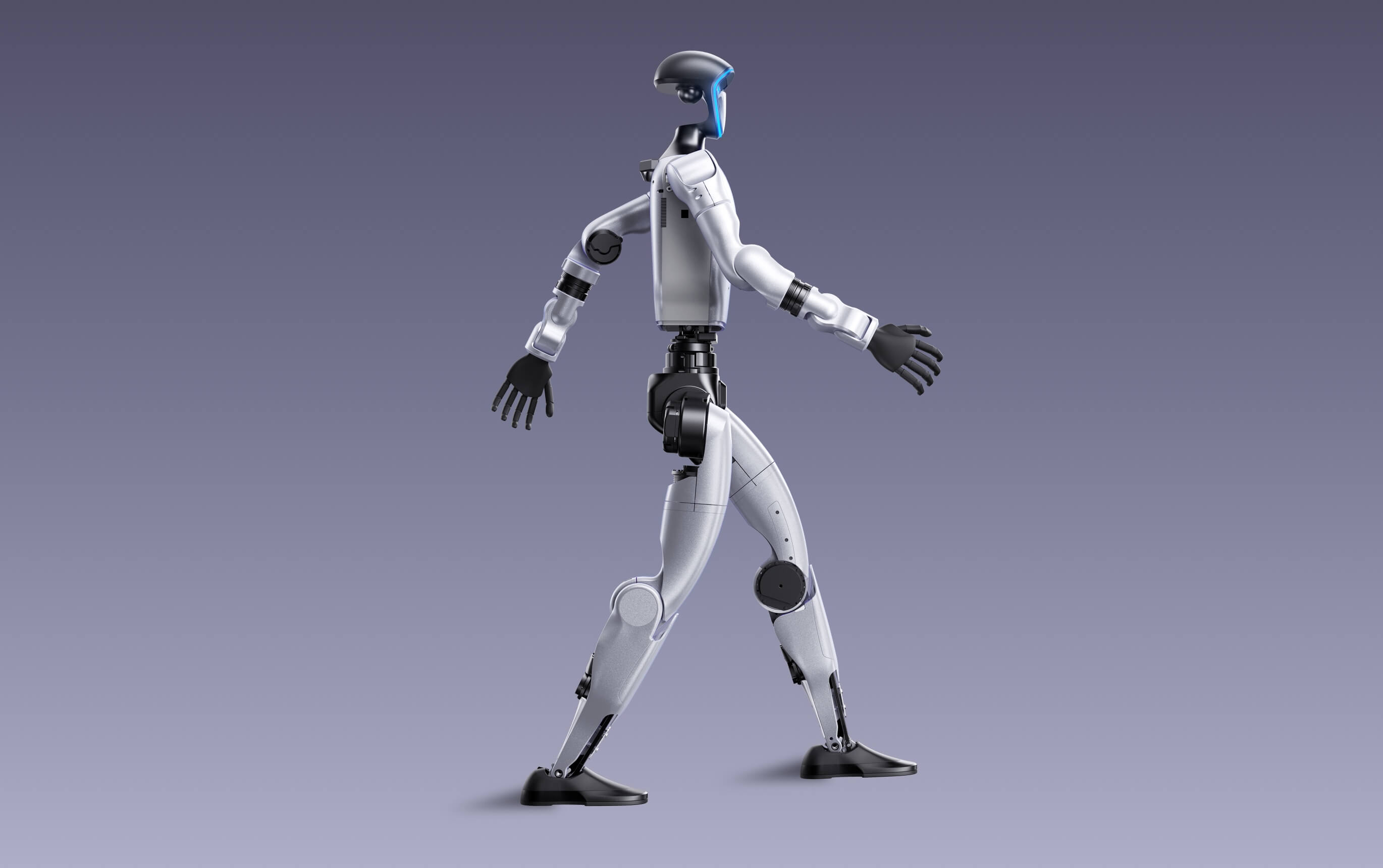
Current Robotics (which was covered this week) takes a different architectural bet. Rather than building a separate cerebellum layer, the company eliminates the modular architecture entirely. Curr-0 is a single, end-to-end trained policy running on a 70+ degree-of-freedom humanoid, handling locomotion, whole-body posture, and dexterous hand control in one continuous closed loop.
The architecture organises these functions into three parallel layers; (i) task understanding, (ii) whole-body coordination, and (iii) hand-object interaction that do not execute sequentially. They run simultaneously. The robot does not switch between walking mode and manipulation mode. It is always in both.
To train Curr-0, Current Robotics collected 21,000 hours of real human behaviour data, including 2,800 hours captured via HumanEx, their proprietary full-body exoskeleton system. HumanEx captures joint motion, proprioception, electromyographic signals, and environmental interaction simultaneously, without requiring the robot hardware to be present during data collection. This decoupling of data collection from robot deployment is a significant practical advantage: the company can scale its training data independently of how many physical robots it has deployed.
The Same Problem, Different Philosophies
The two approaches reflect genuinely different philosophies about what kind of intelligence a robot needs.
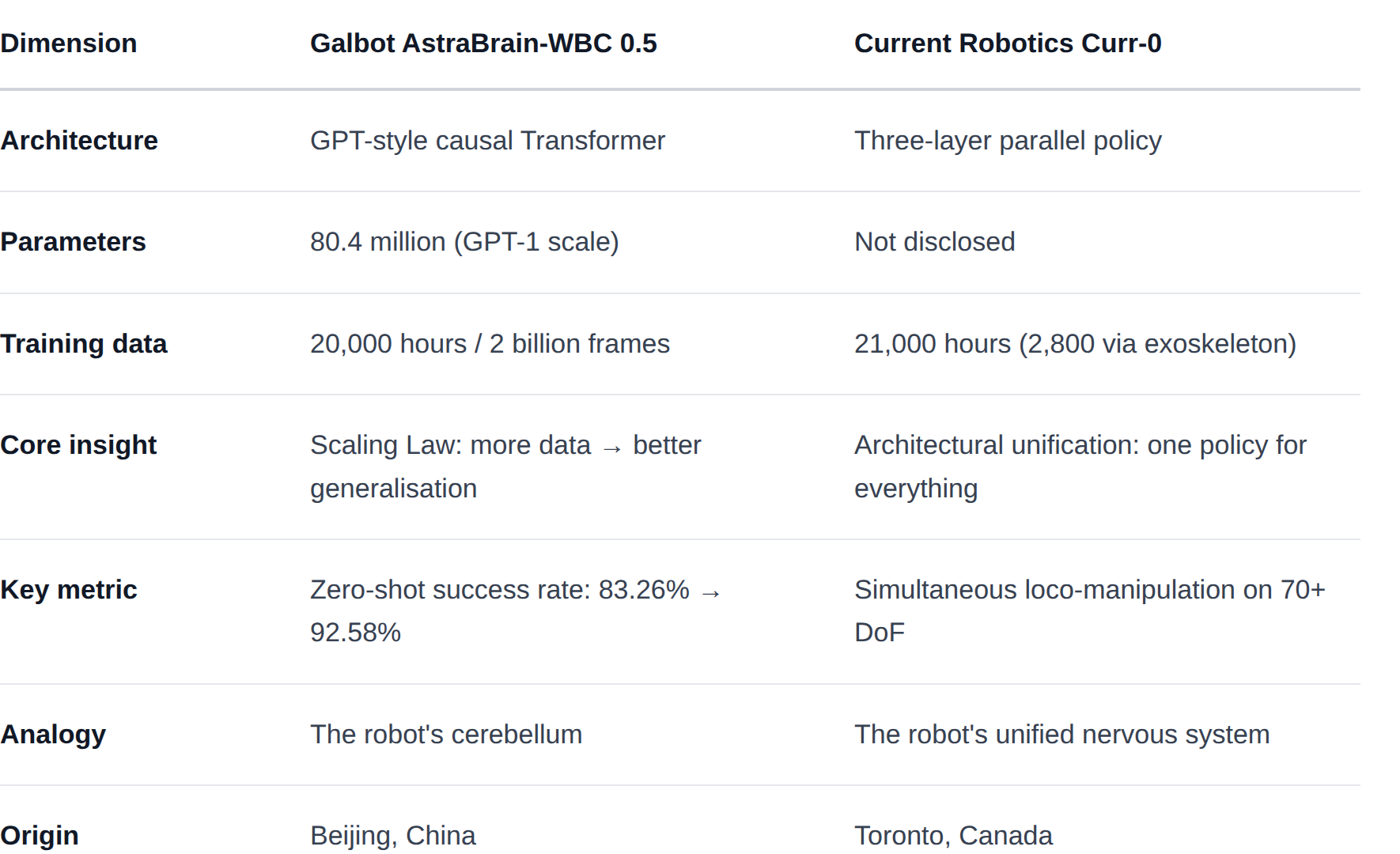
Galbot's bet is to generalise motion intelligence using the same path to generalised language intelligence: train a sequence model on enough data. Current Robotics' approach is to train the two functions as a single coupled behaviour right from the start.
Both claims are contestable. Both are backed by real experimental results. And both are happening at the same time.
Who Else Is in This Race?
Galbot and Current Robotics are not alone. The push to solve loco-manipulation has become the defining technical competition in humanoid robotics in 2026.
Agility Robotics has been developing a whole-body control foundation model for its Digit humanoid since mid-2025, framing it explicitly as a "motor cortex", a learned neural network trained in simulation that transfers zero-shot to the real world. The Agility model which prioritises safety and stability is already being deployed in Amazon warehouse pilots.
NVIDIA's GR00T programme is pursuing a platform-level approach, building a generalist foundation model designed to be licensed across different hardware manufacturers rather than tied to a single robot. GR00T N1.7 was made available in early commercial access in March 2026.
Ψ₀ (Psi-Zero) from the USC Physical Superintelligence Lab represents the open-source frontier, decoupling the learning process into a vision-language backbone pre-trained on human egocentric video and a flow-based action expert post-trained on humanoid data. Accepted to RSS 2026, Ψ₀ outperforms several commercial baselines despite using significantly less training data, suggesting that data quality and training recipe matter as much as raw scale.
Figure AI has been working on its BAM (Behaviour Attention Model) patent family, targeting simultaneous bipedal locomotion and manipulation across a range of physical tasks, with BMW factory deployments already underway.
What Does Winning This Race Actually Mean?
The commercial stakes of solving loco-manipulation are substantial, and they extend well beyond the companies directly involved.
For the first achiever, the prize is platform leverage. The company that establishes the dominant foundation model for whole-body control stands to become the "operating system" of the humanoid robotics industry, a layer that hardware manufacturers license rather than build themselves. This is the model NVIDIA is already pursuing with GR00T, and it is the model that Galbot's "AstraBrain" branding implies: a reusable intelligence layer, not just a product feature.
For the hardware market, a reliable loco-manipulation foundation model removes the final major technical barrier to deploying humanoids in dynamic, unstructured environments. This unlocks the commercial use cases that justify the industry's current valuations: retail logistics, hospital supply chains, elder care, and home assistance. Goldman Sachs has estimated the humanoid robot market could reach $38 billion by 2035; that figure is predicated on robots being able to operate in environments designed for humans, not for machines.
For the broader ecosystem, the emergence of competing foundation models creates a new layer of the robotics stack that did not previously exist. Integrators, application developers, and enterprise customers will increasingly choose their humanoid platform not based on hardware specifications alone, but based on which foundation model best suits their use case, just as enterprise software buyers today choose between cloud platforms based on their AI and developer ecosystems.
What to Expect, and When
The honest answer is that both Galbot and Current Robotics have demonstrated proof-of-concept, not production-ready systems. The tasks shown in their respective demonstrations such as incense stick insertion, document stamping, carrying toys through doorways are carefully chosen to be physically demanding but controlled. Real-world deployment will surface edge cases that neither model has encountered.
By the end of 2026, the industry expects to see these foundation models transition from controlled laboratory demonstrations to early commercial pilots in structured environments like logistics facilities, manufacturing lines, and hospital supply rooms where the physical environment can be partially controlled even if it is not fully predictable.
By 2027–2028, the competitive question will shift from whether unified loco-manipulation is possible to which model generalises best to genuinely novel environments. This is where the Scaling Law thesis will be tested most severely: does more data continue to improve performance at the tail of the distribution, where robots encounter situations their training data never covered?
The longer-term horizon 2029 and beyond is where the platform dynamics become decisive. If one foundation model establishes clear performance leadership and a large developer ecosystem, the humanoid robotics market may consolidate around it the way the smartphone market consolidated around iOS and Android. If multiple models remain competitive, the market will fragment by use case, with different models optimised for different physical environments.
What is clear from the events of this week is that the "stop-and-go" robot is ending. The question is no longer whether humanoid robots can move and work at the same time. It is who will own the intelligence layer that makes it possible.
Primary Sources:
- AstraBrain-WBC 0.5 — Galaxy General Robot Releases Universal Cerebellum GPT Foundation Model" (June 19, 2026)
- Agility Robotics, "Training a Whole-Body Control Foundation Model," August 28, 2025
- NVIDIA, "NVIDIA and Global Robotics Leaders Take Physical AI to the Real World," March 2026
- USC Physical Superintelligence Lab, "Ψ₀: An Open Foundation Model Towards Universal Humanoid Loco-Manipulation," RSS 2026
- PatSnap, "Humanoid Robot Whole-Body Motion Planning 2026," June 3, 2026