The Fundamentals of AMR and AGV Technology Explained
Mobile robots for moving goods are now the largest professional service robot category sold worldwide, with 102,900 transportation and logistics units shipped in 2024 according to the IFR. This series opener explains the fundamentals: what separates an automated guided vehicle from an autonomous mobile robot, how SLAM navigation actually works, the six subsystems every machine shares, the safety standards that govern them, and an original decision framework comparing AGVs, AMRs, and fixed conveyors for buyers planning their first project.
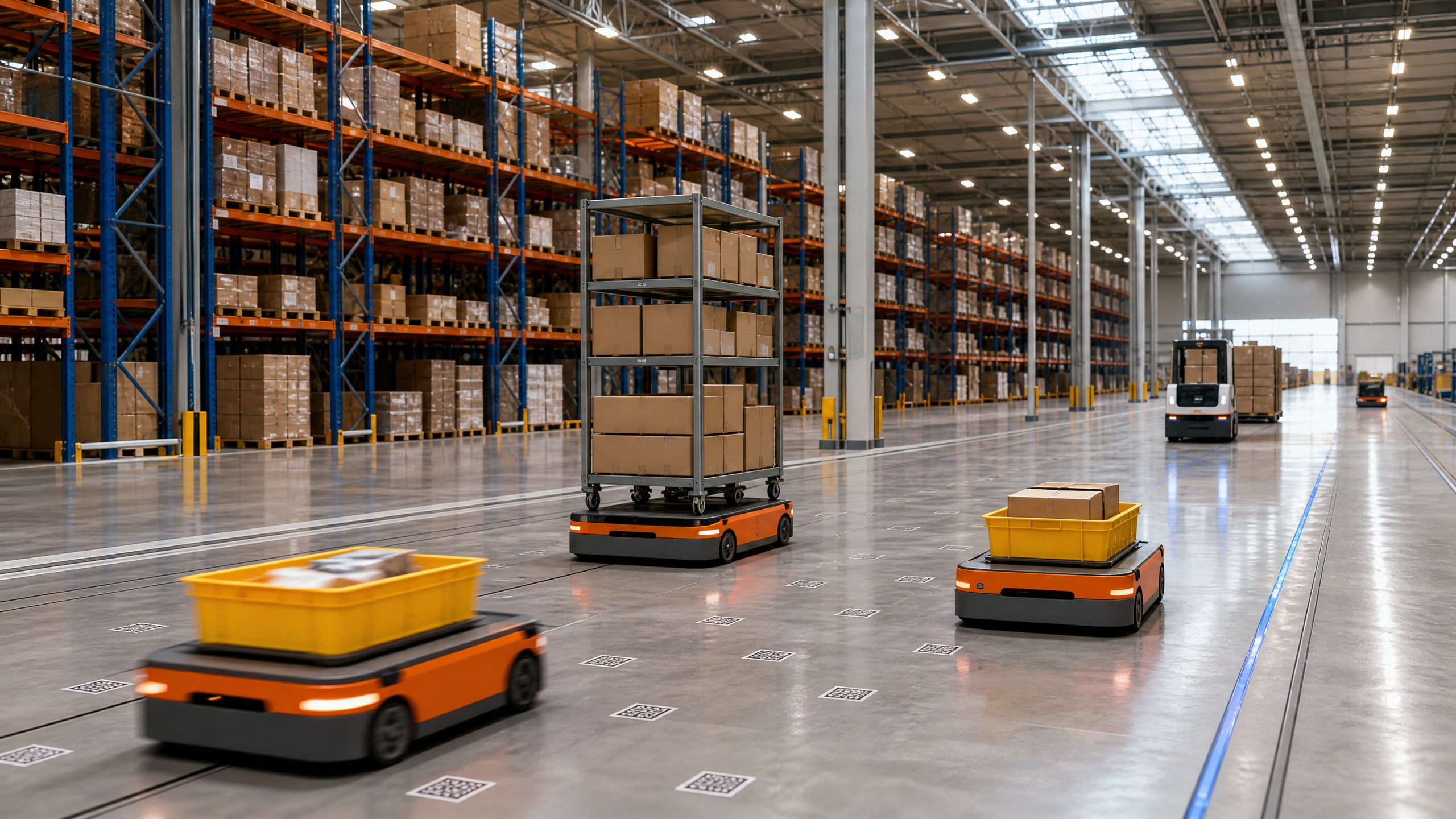
The most numerous professional service robot sold on Earth today is not a humanoid, a surgical system, or a delivery drone. It is a wheeled machine that moves boxes. According to the International Federation of Robotics, transportation and logistics robots reached 102,900 units sold in 2024, growing 14 percent year on year and outselling every other class of professional service robot. Almost all of them are one of two things: an automated guided vehicle, known as an AGV, or an autonomous mobile robot, known as an AMR. The commercial stakes behind that jargon are real. The world's largest warehouse fulfilment robot maker, Beijing-based Geek+, grew revenue 31.6 percent to RMB 3,171 million (approximately USD 443 million) in 2025 and recorded its first adjusted profit, according to its annual results filed with the Hong Kong Stock Exchange in April 2026. This article, the first in our ten-part series on the asset class, establishes the fundamentals a buyer or engineer needs before comparing variants, prices, or vendors.
Definition
An automated guided vehicle is a driverless wheeled vehicle that transports materials along predefined routes. It follows fixed guidance infrastructure, historically buried wires, magnetic tape, or floor markers, and more recently reflectors or QR-code grids, and it stops when something blocks its path. An autonomous mobile robot performs the same core job, moving goods from one point to another, but navigates by perceiving its environment directly. Using onboard sensors and a stored map, an AMR computes its own route, replans around obstacles, and can be redeployed to a new workflow largely through software rather than through changes to the building.
Both machines answer the same commercial problem: the movement of materials inside factories, warehouses, and increasingly hospitals and airports is repetitive, injury-prone, and hard to staff. The International Federation of Robotics identifies staff shortages as a key driver of professional service robot adoption, and indoor transport away from public traffic as the most important application within the logistics segment. In plain terms, an AGV is a follower of fixed paths, an AMR is a self-navigating vehicle, and both exist to take the walking, lifting, and towing out of human jobs that are increasingly difficult to fill.
How It Works
The operating chain of any mobile robot runs through four repeated steps: localise, plan, move, and verify. Where AGVs and AMRs differ is in how each step is executed. A classic AGV localises against physical infrastructure. It senses a magnetic tape line, a wire in the floor, or laser reflectors mounted on columns, and its controller holds the vehicle on the prescribed route. Deviation is not permitted by design, which makes behaviour highly predictable and certification straightforward, but any route change means physically altering the guidance layer, and an obstruction typically halts the vehicle until the path clears.
An AMR localises statistically. During commissioning it builds a digital map of the facility, most commonly through simultaneous localisation and mapping, the technique known as SLAM, which fuses laser scanner returns and camera views with wheel odometry to estimate the robot's position on the map many times per second. Path planning then happens onboard: the robot computes a route to its goal, watches for people, forklifts, and dropped pallets, and either steers around them or negotiates a new route. Fleet software above the individual robots assigns jobs, balances traffic at intersections, and sequences charging. The practical scale of this orchestration layer is significant: Geek+ states that its Hyper+ platform can schedule fleets of more than 5,000 robots in a single deployment.
The boundary between the two categories is blurring at the hardware level. At the LogiMAT intralogistics fair in Stuttgart in March 2026, the organiser's own review of the exhibition noted AGV forklifts equipped with AI-assisted obstacle classification and movement prediction, which is AMR-style perception grafted onto a traditionally infrastructure-guided vehicle class. Buyers should therefore treat the AGV and AMR labels as descriptions of a navigation philosophy rather than fixed product boxes.
Key Components
Every AGV or AMR is assembled from the same six subsystems, and understanding them explains most of the price and performance differences buyers will encounter later in this series. The chassis and drive unit carry the load and determine payload class, which spans from compact tote-carrying platforms to heavy tuggers; among machines shown at LogiMAT 2026, SEW-Eurodrive presented an omnidirectional platform rated for payloads up to 1,600 kilograms at speeds up to 1.6 metres per second, while the compact Igus ReBeLMove Pro lifts 250 kilograms and tows up to 900 kilograms. The sensing package is the robot's eyes: safety-rated laser scanners, 2D or 3D cameras, ultrasonic sensors, and bumpers. The compute and control layer runs localisation, path planning, and safety logic. The battery and charging system, today typically lithium-based with automated opportunity charging and in some designs contactless charging, sets the duty cycle. The load-handling attachment, whether a lift deck, roller conveyor, shelf, or fork, adapts the vehicle to the goods. Finally, fleet management software connects the vehicles to the warehouse management system and turns individual robots into a coordinated system.
Two safety standards frame how these components must behave. ISO 3691-4 specifies safety requirements for driverless industrial trucks, the standards home of the classic AGV, while ANSI/RIA R15.08 addresses industrial mobile robots that plan their own paths. A buyer does not need to read either document to make a sound purchase, but should expect vendors to state clearly which standard their machine is designed and validated against.
Where It Sits in the Robotics Ecosystem
Mobile robots occupy the transport layer of the automation stack. Robot arms, including the collaborative robots covered in our previous series, manipulate goods at fixed stations; conveyors and sorters move goods along fixed lines; AGVs and AMRs move goods flexibly between stations. The three are complements more often than competitors, and the market is increasingly delivered as integrated systems in which a mobile robot brings a shelf or tote to a picking station where a human or an arm completes the task.
The ecosystem position is also shifting upward in intelligence. The LogiMAT 2026 exhibition featured a production use case in which a humanoid robot worked side by side with an AMR, and Geek+ launched an embodied-intelligence subsidiary in 2025 to add general-purpose robotic arm picking to its mobile fleets. The direction of travel is clear: mobile bases are becoming the carriers onto which higher-value manipulation and AI capabilities are mounted. For a buyer, this means an AMR fleet purchased today is best understood as a platform investment, with software and attachments defining much of its future value.
Why It Matters Now
Three forces make 2026 a consequential year to understand this asset class. The first is demonstrated scale. This is no longer an experimental category: the unit leadership documented by the International Federation of Robotics, and Geek+'s delivery of more than 66,000 robots to over 40 countries as of mid-2025, show a technology in industrial mass deployment. The second is a maturing business model. Robot-as-a-service arrangements in the transport and logistics segment grew 42 percent in 2024 according to the same IFR report, which lowers the entry barrier for mid-sized operations that cannot justify a capital purchase. The third is competitive intensity. The research firm Interact Analysis forecasts the mobile robot market to grow at roughly 19 percent annually to 2030, and CIC Consulting, cited in Geek+'s results announcement, projects the global AMR solution market to reach RMB 162.1 billion (approximately USD 22.7 billion) by 2029. Growth of that pace attracts entrants, and crowded supplier markets historically favour buyers on price and terms.
The Bottom Line
To give first-time readers a practical anchor, we close with an original decision framework comparing the three ways to move goods indoors. The table below scores AGVs, AMRs, and fixed conveyors across the five dimensions that most often decide real projects: infrastructure change, route flexibility, throughput predictability, redeployment cost, and typical best fit. The framework simplifies deliberately, and it does not weight industry-specific factors such as cold-chain environments or cleanroom rules, so treat it as a starting map rather than a substitute for a site survey.
Table 1: ARPI Indoor Goods Movement Decision Framework
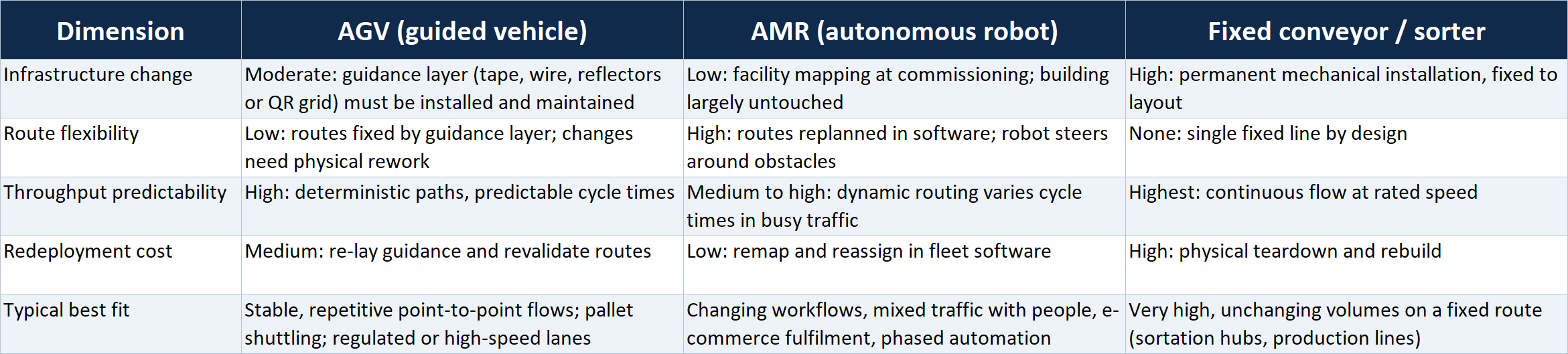
Scores summarise typical characteristics of each technology class; individual products vary and hybrid AGV/AMR designs increasingly blur the boundary. Not a substitute for a site survey. Safety reference: AGVs are covered by ISO 3691-4; path-planning industrial mobile robots by ANSI/RIA R15.08.
Table 2: AGV vs AMR at a Glance
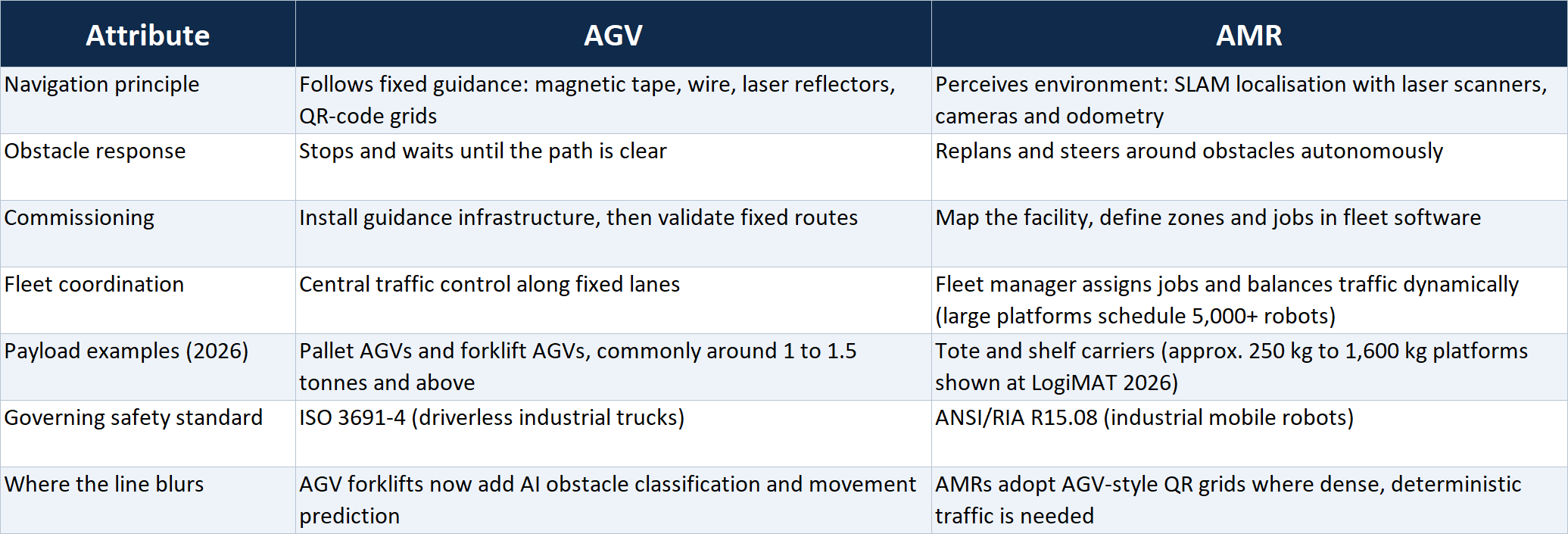
Compiled from the LogiMAT 2026 organiser exhibition review (product specifications as stated by vendors), Geek+ company disclosures, and the ISO 3691-4 and ANSI/RIA R15.08 standard scopes. Vendor specifications support technical characteristics only.
The fundamentals reduce to a single sentence: AGVs trade flexibility for predictability, AMRs trade simplicity for adaptability, and the right answer depends on how often your material flows change. In the next article in this series we break the category into its subcategories and variants, from goods-to-person shuttles to autonomous forklifts, and explain which type fits which operation.
This article is part of the ARPI AMR/AGV Foundations series. Information cut-off: 26 July 2026. Figures are drawn from company filings, official industry statistics, and organiser publications; currencies are stated in their original denomination with approximate US dollar equivalents at indicative exchange rates (RMB 7.15 per USD). This content is for general information and does not constitute procurement, investment, or legal advice.