The Death of the Loading Spinner
On-device AI is reshaping how we interact with technology by bringing intelligence directly onto our devices. Driven by advances in model optimization and dedicated hardware, this shift reduces latency, enhances privacy, and minimizes reliance on the cloud. However, the future isn’t purely local—it’s hybrid, combining the strengths of both on-device and cloud AI to deliver scalable, secure, and efficient solutions.
The Quiet AI Revolution Happening Inside Your Device
It starts with something small.
You click a button…
…and nothing happens.
No spinner.
No “thinking…” animation.
No awkward pause.
Just—instant intelligence.
At first, it feels like magic.
Then you realize something deeper:
The AI didn’t go to the cloud.
It never left your device.
We Built the Cloud… Then Outgrew It
For years, we accepted a simple contract:
“Send your data to us, and we’ll send intelligence back.”
That’s how the AI boom scaled.
Massive data centers. Infinite compute. Global APIs.
And it worked.
But every time you waited for a response—
every slight delay, every failed request, every “reconnecting…”—
you were feeling the friction of a system not built for immediacy.
In a world where decisions happen in milliseconds,
even a 2-second delay is a liability.
The Moment Everything Changed
Somewhere between 2024 and 2026, a quiet shift happened.
Not a headline.
Not a viral launch.
Just… devices getting smarter.
Laptops started shipping with dedicated AI chips
Phones began running local language models
Applications stopped asking permission to “connect to server”
And slowly, almost invisibly—
the cloud stopped being the default brain.
This Isn’t About Speed. It’s About Control.
Speed is the obvious win.
No round trips. No latency. No broken flow.
But the real story?
Control.
Because every time your data leaves your device, you lose something:
Visibility
Ownership
Trust
Now imagine the opposite:
Your financial data.
Your source code.
Your internal strategy docs.
All processed locally.
Never transmitted.
Never exposed.
This is why enterprises are paying attention.
Not because it’s faster—
but because it’s safer by design.
The Rise of “Personal AI Infrastructure”
We’re entering a new era:
Every device is becoming its own AI data center.
Not massive.
Not global.
But personal, sovereign, and always-on.
Instead of one giant model in the cloud, we now have:
Small, specialized AI agents
Running on optimized models
Powered by NPUs capable of trillions of operations per second
They don’t try to do everything.
They just do your tasks—extremely well.
Write. Analyze. Code. Decide.
Instantly.
The Trade-Off No One Talks About
Let’s be clear—this isn’t a perfect world.
Run a heavy model too long, and your laptop heats up.
Push too far, and your battery reminds you who’s boss.
And while local AI is brilliant for individual productivity,
it struggles with:
Massive datasets
Real-time global collaboration
Deep, multi-modal reasoning at scale
So no—the cloud isn’t dead.
But it’s no longer in charge.
The Real Future: Sovereign Hybrid AI
The winners won’t choose between local and cloud.
They’ll orchestrate both.
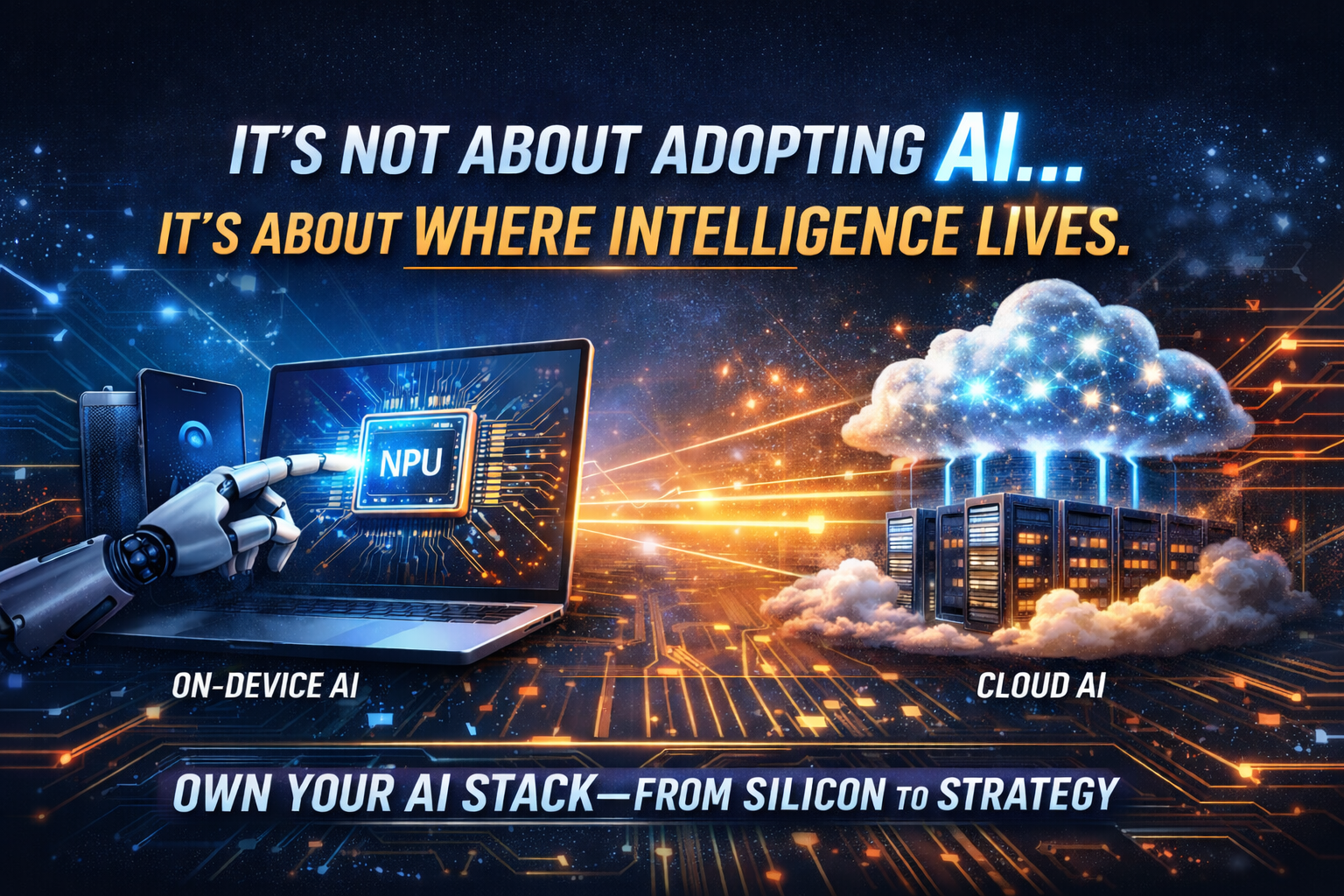
Local AI for speed, privacy, and personalization
Cloud AI for scale, collaboration, and heavy lifting
Think of it like this:
Your device becomes your first brain.
The cloud becomes your extended brain.
And you decide when to use each.
Why This Matters More Than You Think
This isn’t just a technical upgrade.
It’s a power shift.
From centralized intelligence → to distributed intelligence
From platform control → to user control
From “requesting AI” → to owning AI
The disappearance of the loading spinner?
That’s just the visible symptom.
The real transformation is this:
AI is no longer a place you go.
It’s something you carry.
Final Thought: The New Default
In a few years, we’ll look back and laugh at the idea that:
AI required internet
Sensitive data had to be uploaded
Intelligence came with a delay
Because the new expectation is already forming:
If it’s not instant, private, and local—
it feels broken.
And just like that…
The loading spinner becomes a relic
of a slower, more dependent era of AI.