The Buyer's Guide to Sourcing a Collaborative Robot
A practical procurement playbook for collaborative robots covering the specifications that separate suppliers, a seven-question due-diligence checklist, lead time and supply chain exposure, the 2025 rewrite of ISO 10218 and R15.06, a total cost of ownership preview, and an original five-dimension sourcing readiness matrix.

Sourcing a collaborative robot in 2026 is less a product selection problem than an evidence collection problem. The market offers hundreds of arms that look interchangeable on a datasheet, yet the disclosed economics behind them differ sharply. One listed Chinese manufacturer reported a six axis cobot factory average selling price of RMB47,100 in the first half of 2024, while a March 2026 United Kingdom public contract for a single arm and software package was signed at £47,386 excluding value added tax. 1 2 Those two verified numbers describe different purchase scopes, and the distance between them is where most sourcing mistakes happen. This guide sets out the specifications, questions, supply chain checks, and compliance evidence that turn a cobot shortlist into a defensible sourcing decision, building on the pricing benchmark, manufacturer ranking, and technology roadmap published earlier in this series.
Key Specifications to Evaluate
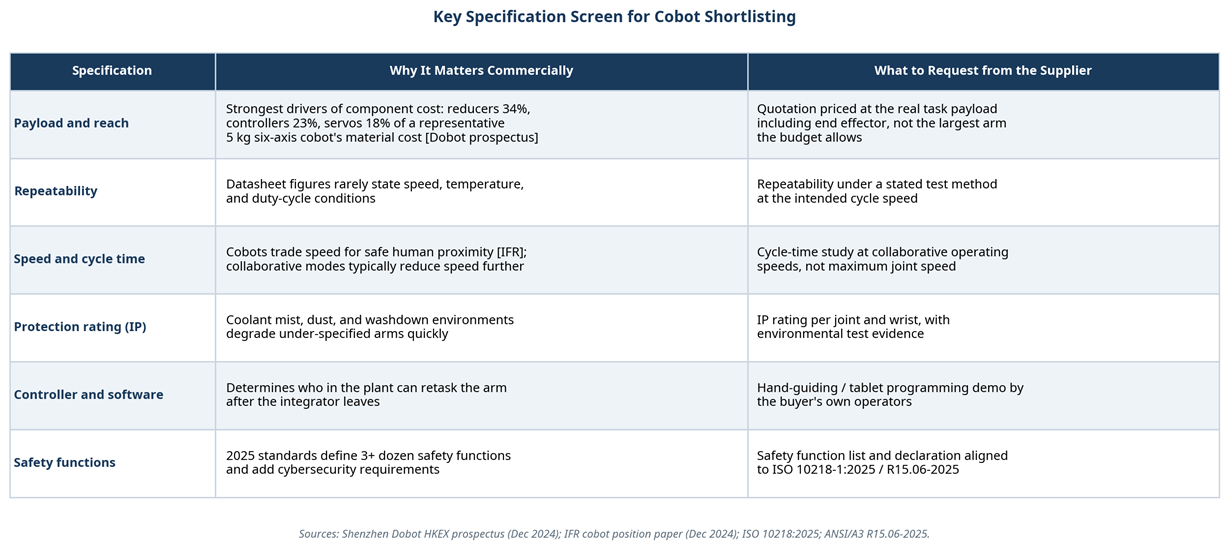
The specification sheet is the first filter, but it must be read as a set of trade-offs rather than a scoreboard. Payload and reach define the physical envelope of the task, and they are the two parameters that most strongly drive component cost. The disclosed cost structure of a representative five kilogram six axis cobot allocates 34 percent of material cost to gear reducers, 23 percent to motion controllers, 18 percent to servo systems, and 10 percent to sensors. 1 A step up in payload or reach raises the specification of several of those component groups at once, which is why a 16 kilogram arm is not priced as a linear extension of a 5 kilogram arm. Buyers should specify the real task payload including the end effector and the heaviest workpiece, then add a modest margin.
Repeatability deserves more scrutiny than it usually receives. A figure of plus or minus 0.02 millimetres is common in marketing material, but the buyer's question is whether that repeatability holds at the intended speed, temperature range, and duty cycle, and under what documented test method. The same discipline applies to speed. The International Federation of Robotics notes that cobots carry inherent speed and payload trade-offs relative to conventional industrial robots, because their design purpose is safe operation alongside people. 3 If a cycle time calculation only closes at maximum joint speed, the application probably sits on the wrong side of the cobot boundary.
Protection rating, mounting orientation, and environmental tolerance complete the technical screen. An IP54 arm that performs well in a demonstration may fail quickly in a machining cell with coolant mist, where IP66 or IP67 wrist protection matters. Finally, evaluate the controller and software ecosystem as a specification in its own right. Hand guiding, tablet based programming, and plug and play peripherals made cobots accessible to factories without robotics engineers, and they determine who in the plant can retask the arm after the integrator leaves. 3
Questions to Ask Suppliers
The following checklist consolidates the due-diligence questions that separate a demonstration-grade vendor from a production-grade partner. Require documentary answers rather than verbal assurance.
1. Which edition of the safety standards does your documentation reference, and can you provide the declaration of incorporation and safety function list aligned to ISO 10218-1:2025?
2. What exactly is included in the quoted price: arm, controller, software licences, end effector, accessories, training, warranty terms, and freight?
3. What is the current factory lead time for this model, and what were your actual delivery times on comparable orders in the last two quarters?
4. Where are your gear reducers, servo motors, and controllers sourced, and what is your exposure to rare earth magnet supply and any single-country component dependency?
5. What is your installed base and service coverage in my region, including guaranteed response time, spare parts stocking location, and mean repair turnaround?
6. Can you provide two reference customers running a comparable application in production for more than one year?
7. If the quotation includes AI-enabled features, what is the approved operating envelope, the validation evidence, and the recovery procedure when the feature fails?
The financial stability of the supplier belongs on the same list. Cobot suppliers span loss-making startups, mid-cap listed manufacturers, and divisions of large industrial groups. Teradyne, the owner of the largest Western cobot brand, reported robotics segment revenue of 91 million US dollars in the first quarter of 2026 after a 2025 in which segment revenue declined 15.5 percent and two restructuring rounds affected roughly 350 robotics employees. 4 5 None of that makes the products weaker, but it shows why a buyer should read the most recent segment disclosure of any listed supplier, and demand audited financials or parent guarantees from private ones, before committing a production line to a five year support relationship.
Lead Times and Supply Chain Considerations
Published, verifiable lead time statistics for cobots do not exist as a public dataset, so buyers should treat delivery windows as a contractual matter rather than an industry constant. The planning horizon is set by the slowest element of the cell, which is rarely the arm itself. Standard arms from high-volume manufacturers are often available within weeks, while the end effector, vision system, safety validation, and integration engineering typically govern the calendar. A realistic procurement plan works backwards from production start through commissioning, integration, delivery, and order placement, and it assigns explicit dates to safety validation because that step cannot be compressed by paying more.
Two structural exposures deserve written answers during sourcing. The first is component concentration. Cobot joints depend on precision gear reducers and servo motors built around rare earth permanent magnets, and China's export controls on rare earths and magnet products, tightened through late 2025, have made magnet-dependent supply chains a live procurement risk rather than a theoretical one. 6 A supplier that can document dual sourcing or buffer inventory for magnets and reducers is structurally more reliable than one that cannot. The second exposure is trade policy. The United States opened a Section 232 national security investigation into imports of robotics and industrial machinery on 2 September 2025, and the outcome remains pending as of this article's information cut-off on 21 July 2026. 7 A buyer importing into the United States should model a tariff scenario in the landed cost and negotiate quotation validity periods and price adjustment clauses that state who absorbs a new duty. Buyers elsewhere should note the demand-side effect, since trade measures in the largest Western market can redirect supplier attention and reshape regional pricing.
Demand growth compounds these considerations. The IFR recorded 542,000 industrial robot installations in 2024, forecast 575,000 for 2025, and expects the market to exceed 700,000 annual units by 2028, with cobots having reached 10.5 percent of global installations in 2023. 3 8 A structurally growing market gives suppliers little reason to hold capacity idle, which strengthens the case for early ordering and contractual delivery commitments.
Certification and Compliance Standards
The compliance baseline changed materially in 2025, and many buyers have not yet caught up. ISO published the third edition of ISO 10218-1 and the second edition of ISO 10218-2 in February 2025, the first major revision of the governing industrial robot safety standards since 2011. 9 10 Part 1 covers the robot itself as partly completed machinery, while Part 2 covers the integrated application and cell. The revision folds the collaborative content of the former ISO/TS 15066 into the standard proper, expands the catalogue of defined safety functions to more than three dozen, and introduces cybersecurity requirements. 11
The United States adopted the revision as ANSI/A3 R15.06-2025, and the same body published a third part covering user responsibilities for robot cells. 11 The terminology shift carries a practical sourcing lesson: the new standard avoids the phrase collaborative robot in favour of collaborative application, because safety is a property of the whole application, comprising the arm, end effector, workpiece, and layout, not of the arm alone. The three recognised collaborative technologies are hand guiding, speed and separation monitoring, and power and force limiting. 11 A vendor claim that an arm is certified safe is therefore incomplete by definition. The buyer should verify which edition the supplier's documentation references, obtain the declaration of incorporation for the arm, and budget for a cell-level risk assessment and validation under ISO 10218-2:2025 in every deployment. European buyers should additionally confirm CE marking, and North American buyers should check applicable UL or CSA listings alongside R15.06-2025 alignment.
Total Cost of Ownership Preview
The invoice is the most visible number in the sourcing process and one of the least decisive. The verified pricing evidence in this series already shows why: a factory average selling price, an arm and software package, and a commissioned cell are three different financial objects, and the distance between them is filled with integration engineering, end effectors, safety validation, training, spare parts, and downtime risk. A low arm price can still produce an expensive cell. The next article in this series builds the full five year total cost of ownership model, including installation, training, maintenance, downtime, and end of life value. For sourcing purposes, the immediate rule is simpler: never sign a purchase order until the quotation is decomposed into layers and the total deployed cost of the first cell has been estimated alongside the arm price.
The Sourcing Readiness Matrix
The matrix below is an original synthesis of the evidence reviewed for this series rather than a reproduction of any single source. It scores a supplier engagement across five dimensions, with 5 indicating documented evidence held by the buyer, 3 indicating partial or verbal evidence, and 1 indicating no evidence. Its limitation is that evidence availability varies systematically by supplier type: listed manufacturers disclose segment financials that private startups do not, so a low score can reflect opacity rather than weakness. The matrix guides due diligence and does not replace an application-specific risk assessment.
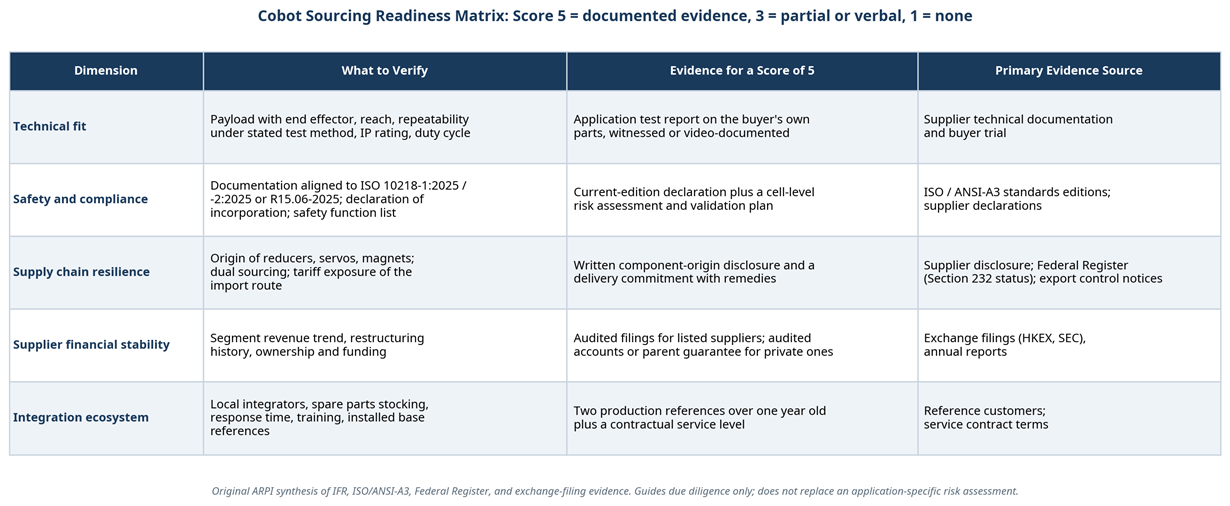
A shortlist candidate scoring below 3 on safety documentation or supply chain resilience should not proceed to commercial negotiation regardless of price, because those two dimensions carry the cost of failure into production. Price advantages are recoverable in negotiation; missing safety evidence and fragile component supply are not.
The procurement conclusion of this series is consistent. Cobot hardware is becoming cheaper and more standardised at the arm level, while durable value and durable risk concentrate in evidence: verified pricing scope, verified safety documentation to the 2025 standards, verified component supply, and verified supplier stability. Buyers who assemble that evidence before signing will source arms on terms the market cannot easily take back, and they will be positioned to redeploy capital confidently as the asset class compounds toward the 700,000 unit annual installation market the industry now projects. 8
References
1. Shenzhen Dobot Corp Ltd, Global Offering Prospectus, 13 December 2024.
2. UK Contracts Finder, Universal Robot Arm and Software contract award, March 2026.
4. Teradyne Inc, Teradyne Reports First Quarter 2026 Results, 28 April 2026.
5. Teradyne Inc, Form 10-K for the Year Ended 31 December 2025.
8. International Federation of Robotics, World Robotics 2025 Press Release, 25 September 2025.
9. International Organization for Standardization, ISO 10218-1:2025.
10. International Organization for Standardization, ISO 10218-2:2025.
Disclaimer
The information provided in this article is for informational purposes only and should not be construed as financial, investment, or strategic advice. Figures are drawn from the primary sources cited above and reflect the disclosure scopes and reporting periods stated in those sources.