How Robots Learn to Move, and Why Action Tokenization Is the Quiet Bottleneck in Physical Intelligence
Vision Language Action models can read a scene and follow an instruction, but they still have to turn that understanding into smooth, continuous motion. The method that bridges language and motor control is called action tokenization, and it has quietly become one of the most consequential design choices in robot learning.
The problem hiding inside every smart robot
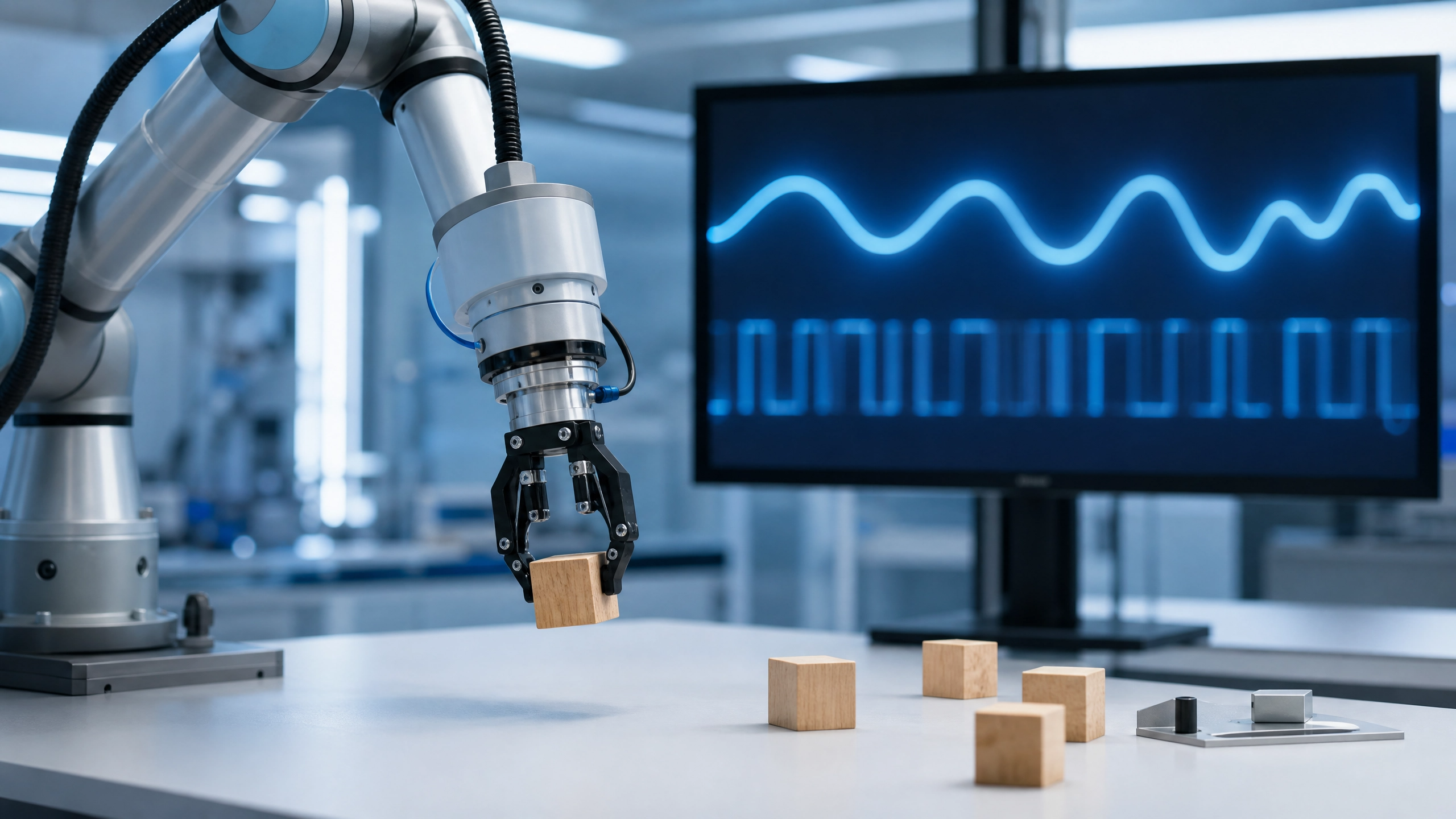
A modern robot that can be told, in plain language, to fold a shirt or sort parts on a bench is running on a class of model known as a Vision Language Action (VLA) model. The name describes the job. The model takes in vision, meaning camera images of the scene. It takes in language, meaning the instruction and any context. Then it has to produce action, meaning the actual stream of motor commands that drive the joints and the gripper.
The first two parts of that pipeline borrow heavily from the artificial intelligence that already works. A VLA model reuses a vision language backbone, the same family of model that powers image understanding and chat, and those backbones are trained on enormous amounts of internet text and images. The third part is where robotics becomes genuinely hard. Language is naturally discrete, built from a finite vocabulary of word pieces called tokens, and a transformer predicts the next token from the ones before it. Robot motion is not like that. It is continuous, high frequency, and physical. Joint angles, end effector positions, and gripper commands flow as smooth real valued signals, often dozens of times per second.
So a question sits underneath every capable robot, and most people outside the research community never hear it asked. How do you take continuous motion and turn it into something a token predicting model can learn and generate. The answer is a step called action tokenization, and the way a team answers it shapes how fast the robot trains, how dexterous it can become, and how well a single model transfers across different machines.
What action tokenization actually does
Tokenization is the act of converting a continuous action chunk, a short window of future motion, into a sequence of discrete symbols that the model can predict one after another. After the model predicts those symbols, a decoder converts them back into continuous commands that the robot can execute. If you have heard how language models break text into subword tokens, this is the motor control equivalent, and the comparison is not loose. The leading robotics researchers borrow directly from the compression ideas that made text and image tokenizers work.
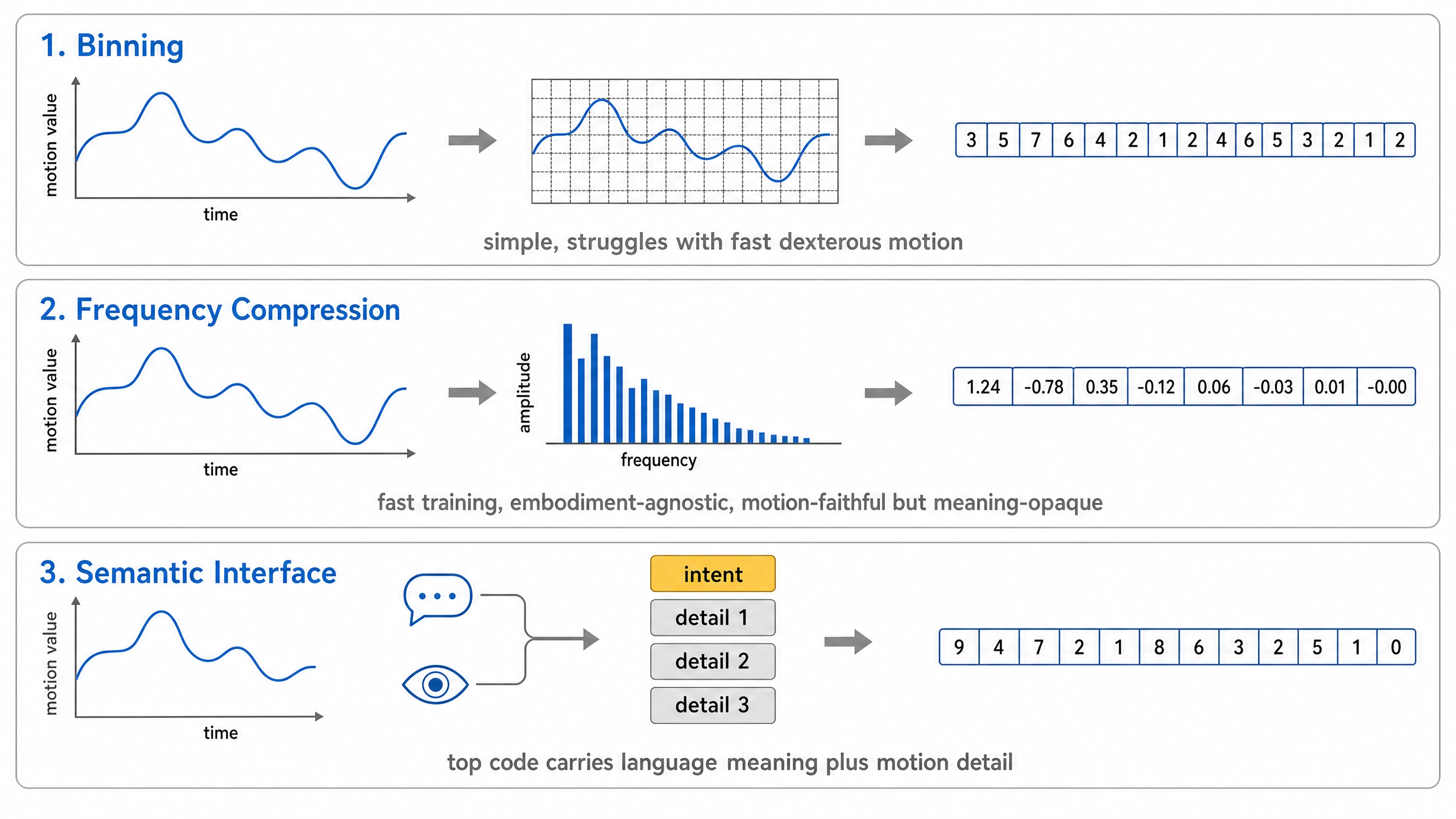
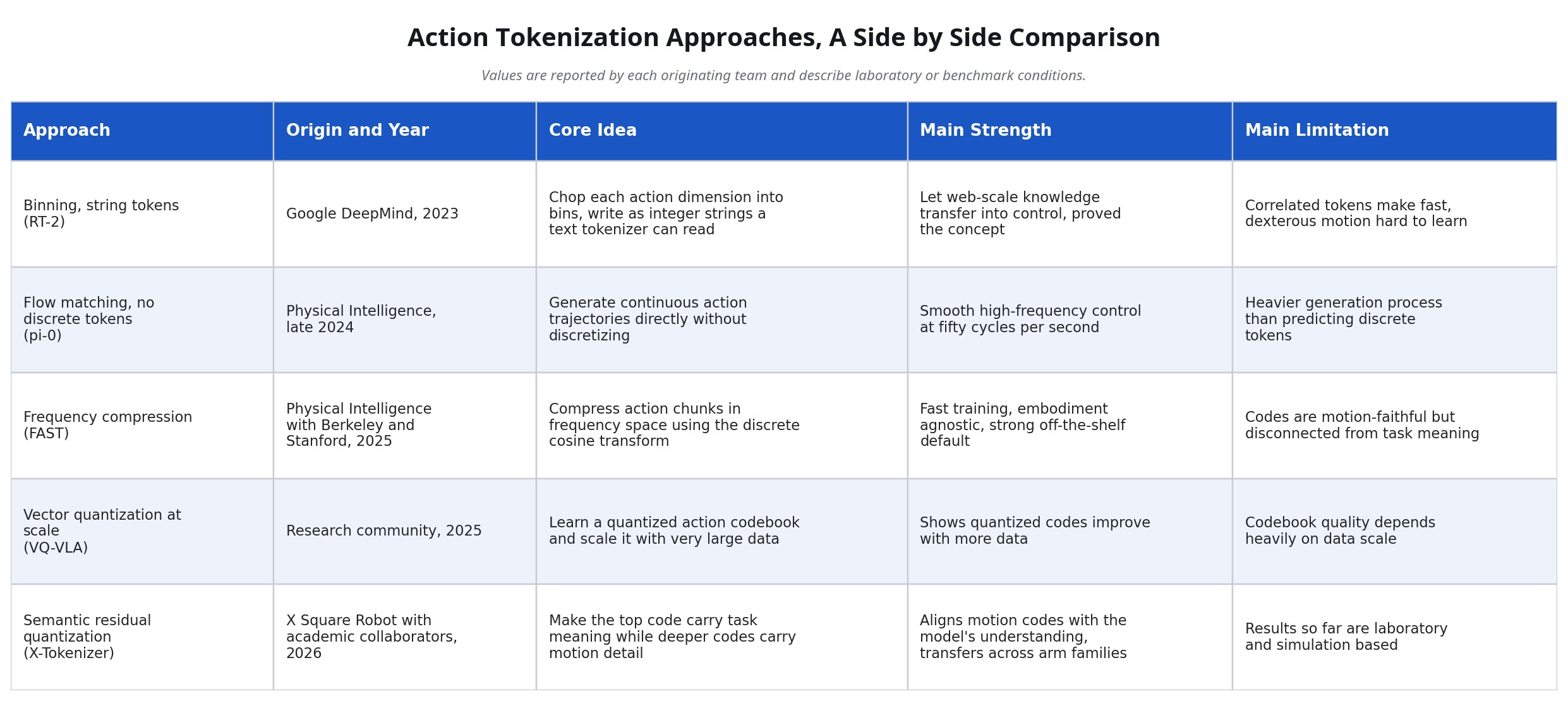
The reason the choice matters is that a tokenizer is not a neutral pipe. It decides what information survives and what gets thrown away. A tokenizer that captures motion faithfully but scrambles the relationship between consecutive moments can make training slow or unstable. A tokenizer that compresses too aggressively can blur the fine control needed for dexterous tasks. And a tokenizer that is easy for the model to predict but disconnected from the meaning of the task can leave the robot fluent in motion yet poor at following intent. The figure below shows the three broad philosophies that have emerged, which the rest of this article unpacks in order.
Approach one, binning, the method that proved it was possible
The first widely known demonstration that a single model could read the web and control a robot came from Google DeepMind in 2023 with a model called Robotic Transformer 2 (RT-2). Its method for handling actions was direct. It took the robot action, the change in end effector position and rotation plus the gripper command, and chopped each dimension into discrete bins, then wrote those bins out as a string of integers that looked like ordinary text, for example a sequence such as 1 128 91 241 5 101 127 217. A standard text tokenizer then processed that string, which meant the robot actions and the web data could flow through the same model without redesigning it.
This was a real breakthrough in capability. RT-2 improved performance on previously unseen scenarios from the 32 percent of its predecessor to 62 percent, and it showed more than a threefold jump in generalization on emergent skills compared to earlier baselines. It proved that web scale knowledge could transfer into physical control. What it also revealed, with hindsight, was the weakness of simple binning. When motion is fast and dexterous, consecutive action tokens become highly correlated, and a next token predictor can score well by doing something trivial like copying the previous token. That traps the model in a poor solution and explains why naive binning tends to stay confined to slower, simpler control.
Approach two, frequency compression, the method that made it fast
The team at Physical Intelligence, working with collaborators at the University of California, Berkeley, and Stanford University, attacked the correlation problem at its root in early 2025 with a method called Frequency-space Action Sequence Tokenization (FAST). Their insight was that action signals should be compressed before training, so that the tokens carry independent information rather than repeating each other. The technique they reached for is the discrete cosine transform, the same family of compression used in JPEG image files, which represents a smooth signal as a small set of frequency components.
The practical payoff was significant. The team released a universal tokenizer trained on one million real robot action trajectories spanning single arm, dual arm, and mobile robots, and showed it could be used as an off the shelf, embodiment agnostic component. When paired with their flagship policy, the frequency tokenized autoregressive model scaled to ten thousand hours of robot data and matched the performance of a heavier diffusion based approach while training up to five times faster. Frequency compression became something close to a default for teams that want autoregressive training without the instability of binning.
There is a subtle limitation, and it sets up the next idea. Frequency tokens are faithful to the motion, but they are semantically opaque. The codes describe how the arm moves, not what the movement means in relation to the instruction the model was given. The vision language backbone reasons in a space of meaning, while the action codes live in a space of signal compression, and nothing forces the two to line up.
Approach three, the semantic interface, the method that tries to close the gap
This is where the newest entry, and the reason for this explainer, comes in. A team associated with the Chinese robotics company X Square Robot, working with academic collaborators, published a tokenizer called X-Tokenizer in mid 2026. Its argument is a shift in framing. Instead of treating tokenization as pure compression, it treats the tokenizer as a semantic interface, a shared layer where motion codes are deliberately aligned with the meaning the vision language model already understands.
The mechanism is a four level residual quantizer with an asymmetric job. The top level code is trained so that it forms a coarse, discrete action vocabulary that lines up with the model's understanding of the scene and the instruction, while the deeper levels stay focused on reconstructing fine motion detail. In effect, the first symbol is taught to mean something, such as the broad intent of a motion, and the later symbols fill in the precise execution. The encoder is pushed to match each action chunk to the backbone's view of the same moment, drawn from multiple camera angles and the task language, so the action codes and the perception features speak a common language.
The reported results are measured against the frequency compression baseline rather than against binning, which is the right comparison for a 2026 method. Trained across 2.4 million trajectories and 17 families of robot arm, with the tokenizer then frozen and reused with no per task tuning, the approach reports a 13.5 percent improvement in multimodal grounding and an 8.25 point gain in long horizon execution over the frequency baseline. On a hard dual arm benchmark its performance degraded less than a leading comparison policy when difficulty rose, and training one model jointly across different robot bodies lifted the hardest scores rather than diluting them. These remain simulation and tabletop laboratory results, so they point to a promising direction rather than a settled production advantage, a distinction worth keeping in mind.
A side by side comparison
The table below summarizes the leading approaches and the design tradeoff each one represents. The values describe the method as reported by its originating team.
The frontier debate in one sentence
Strip away the engineering detail and the field is arguing about a single question. Should the action tokenizer be a neutral compressor that stays simple, fast, and indifferent to meaning, which is the frequency compression view, or should it be an active participant that binds motion to language so the robot's understanding and its movement share one vocabulary, which is the semantic interface view. A third camp sidesteps the question entirely by generating continuous motion directly with flow matching and using no discrete tokens at all. There is no settled winner, and the most likely outcome is that different deployment needs will favor different answers.
The automation, robotics, and physical intelligence read for buyers
For an operator or a procurement team, this looks like an academic argument until you connect it to cost and risk, and the connection is real. The expensive parts of deploying a robot are rarely the arm itself. They are the data collection, the per task tuning, and the integration effort when a site runs more than one kind of machine. Action tokenization sits exactly on top of those cost centers, because it governs how easily one trained policy moves from a benchmark to a bench, and from one robot body to another.
A buyer should take three practical points from this. First, the tokenizer is a transfer lever. A tokenizer that is embodiment agnostic, or one that transfers across many arm families without retraining, directly lowers the integration cost of a mixed fleet, because the team does not have to rebuild the motion layer for every machine. Second, training speed is a budget line. The frequency compression result that cut training time several fold is not a trivia point, it is the difference between iterating on a deployment in days versus weeks. Third, and most important, claimed laboratory gains are not the same as floor performance. Every approach discussed here reports its best numbers on benchmarks and tabletop tasks, so the right posture for a buyer evaluating a vendor is to ask for results on tasks that resemble the intended job, on the specific robot intended for purchase, under realistic disturbance and cycle time, rather than accepting a headline benchmark figure.
The deeper signal for the next two years is that the action layer, not just the size of the language model behind it, is becoming a competitive battleground in physical intelligence. The teams that make motion and meaning share one vocabulary, and that make a single trained policy port cleanly across different machines, will hold a real advantage in deployment economics. That is the metric procurement teams should track, because it is the one that turns a laboratory result into a line on an operating budget.
Source Evidence Note
Primary and authoritative sources consulted for this explainer:
• Google DeepMind, RT-2 announcement and method description, July 28, 2023, and the corresponding paper RT-2, Vision Language Action Models Transfer Web Knowledge to Robotic Control, arXiv 2307.15818.
• Pertsch and colleagues, FAST, Efficient Action Tokenization for Vision Language Action Models, Physical Intelligence with the University of California, Berkeley, and Stanford University, arXiv 2501.09747, January 2025.
• Physical Intelligence pi-0 and pi-0-FAST technical description, including flow matching action generation, as documented in the Hugging Face LeRobot model release, February 2025.
• VQ-VLA, Improving Vision Language Action Models via Scaling Vector Quantized Action Tokenizers, arXiv 2507.01016, 2025.
• X-Tokenizer, cross modal embodied action tokenizer from X Square Robot with academic collaborators, arXiv 2606.14752, submitted June 2026, with the associated project page, code repository, and model card. Technical claims, including the reported 13.5 percent multimodal grounding gain and 8.25 point long horizon gain over the frequency compression baseline, were verified against the primary artifacts.
All comparative figures in this article are reported as published by the originating teams and describe laboratory or benchmark conditions unless otherwise stated.