Leading the Pack: The Top 5 Humanoid Robot Brands Worldwide
A buyer-focused competitive map of five evidence-qualified humanoid brands, using official customer, exchange, procurement, and regulatory records rather than unsupported market-share claims.
A procurement team does not need another unqualified “top five” list. It needs to know which humanoid brands have left a public evidentiary trail that survives supplier demonstrations, customer headlines, and price claims. The official record is still too thin to support a global ranking by revenue, shipments, market share, or installed base. It does support a more useful map: five brands with named humanoid products and a qualifying record of customer testing, industrial task definition, listed-company disclosure, or public procurement.
That distinction changes the buying decision. A customer-side production record says more about a bounded workflow than a product launch. A listed company’s roadmap describes its intended path, not independently verified scale. A public procurement award proves that a named configuration was acquired for a specific institutional use, not that it is ready for a factory. Buyers should therefore select a brand against the proof needed for their own pilot, rather than treating brand visibility as a substitute for evidence.
Selection Criteria
The five brands in this guide are selected for the strength and clarity of their public track record, not arranged in a numerical global ranking. Each has a named humanoid product linked to a documented customer activity, industrial task, company filing, or institutional purchase. The sector does not yet offer a consistent public dataset that compares revenue, shipments, installed base, or market share across manufacturers. The comparison therefore focuses on what buyers can assess today: task relevance, deployment stage, and the questions still requiring validation.
The practical test has three parts. First, is the product named and linked to a defined task or institutional context? Second, does the available information distinguish a demonstration, a test, a planned rollout, or documented production work? Third, can a buyer see what the record does not yet show? This creates an evidence ladder. A customer-side operational record is most useful for a bounded task. A company report can clarify a product and a roadmap but cannot validate the wider market. A public procurement record anchors a configuration and buyer context but cannot establish industrial readiness.
A fourth screen now matters for a global comparison. The Federal Communications Commission states that new foreign-produced advanced robotic devices covered by its July 2026 update are generally unable to receive equipment authorization for import, marketing, or sale in the United States unless the applicable approval path is met. The definition can include qualifying humanoid robots. That rule is not a judgement on product quality, but it means a procurement map must include market access and sourcing evidence alongside capability claims.
Player Profiles (x5)
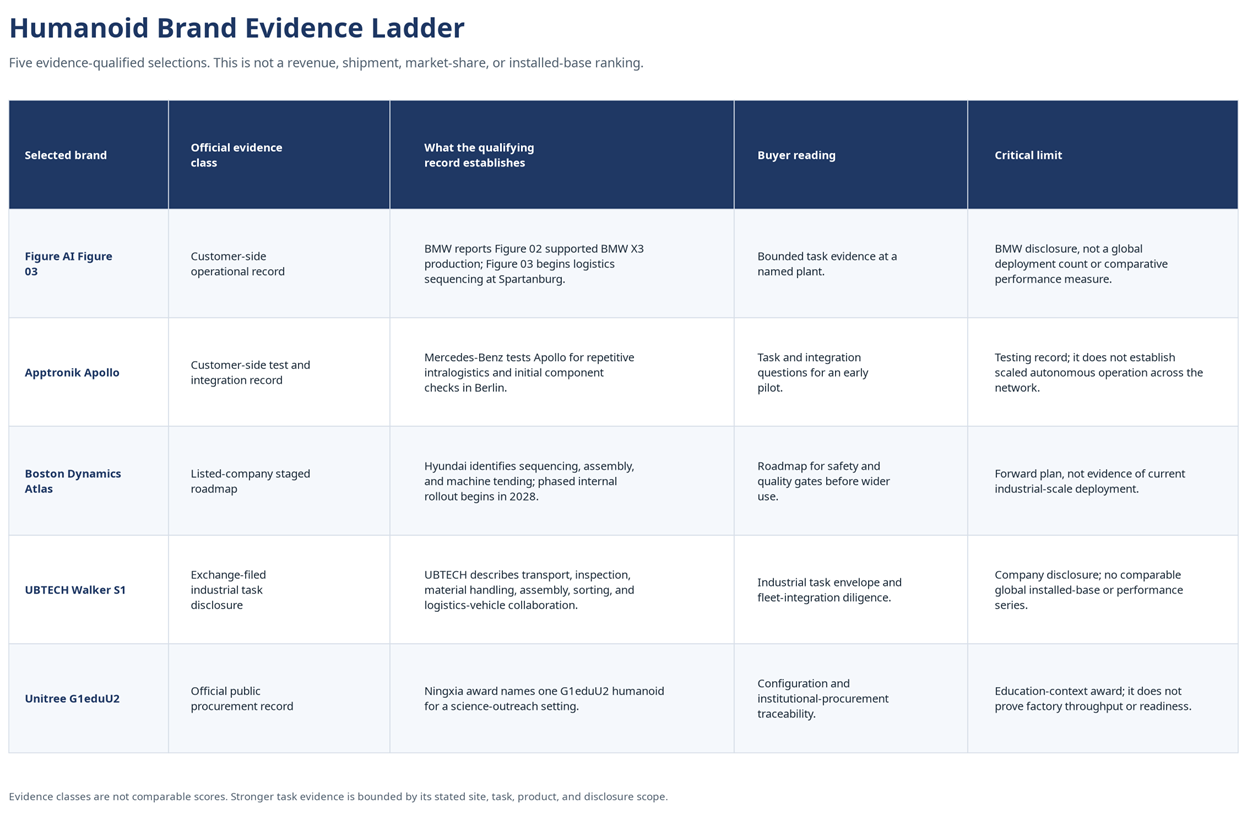
Figure AI, Figure 03. BMW Group provides the clearest customer-side operational record in this set. In its June 2026 disclosure, BMW says that Figure 02 supported production of more than 30,000 BMW X3 vehicles over ten months at Spartanburg, where it inserted sheet-metal parts for welding. BMW also describes the next Figure 03 use case as logistics sequencing: components arrive unsorted, are placed into a sequencing trolley, and then move onward to the assembly process. For a buyer, the distinguishing fact is not a general claim of autonomy. It is the progression from a defined body-shop task to a specific logistics workflow at a named plant. The limitation is equally important: the disclosure is BMW’s account of its own collaboration, not a global Figure deployment count or a comparative measure of supplier reliability.
Apptronik, Apollo. Mercedes-Benz describes Apollo as a humanoid robot from the United States-based company Apptronik and says it is testing the robot in its Berlin-Marienfelde production environment. The initial focus is repetitive intralogistics. Mercedes-Benz identifies two intended task categories: moving components or modules to the production line and conducting initial component quality checks. It also states that production employees have transferred task knowledge through teleoperation and augmented-reality processes as Apollo is trained for specific uses. This makes Apollo relevant to a buyer whose first question is whether a human-form platform can fit a material-flow problem. The evidence remains a test and integration record. It should not be read as proof of scaled autonomous operation across the Mercedes-Benz network.
Boston Dynamics, Atlas. Hyundai Motor Group’s January 2026 strategy disclosure presents Atlas as an industrial humanoid product within a broader manufacturing and robot-development network. The Group identifies intended applications including material sequencing, assembly, and machine tending, and it states a phased internal plan to introduce Atlas into selected sequencing processes in 2028 before expanding to component assembly in 2030. The distinguishing fact is the explicitly staged path: safety and quality validation come before broader deployment. This is valuable for a buyer that needs a roadmap for building an internal learning environment, but it is a forward plan, not evidence that the product is already operating at industrial scale. Hyundai’s stated product features and production objectives should likewise be read as the Group’s own roadmap, not as an independent benchmark against other humanoids.
UBTECH, Walker S1. UBTECH Robotics’ exchange-filed 2024 annual report positions the Walker series around industrial applications. The company describes cargo transport, quality inspection, process material handling, parts assembly, and sorting as tasks performed or targeted in its industrial humanoid work. It also identifies Walker S1 as an industrial product and describes its use alongside automated logistics vehicles. The differentiator for a buyer is the explicitly industrial task envelope and the availability of a public listed-company record rather than only a launch presentation. Yet the disclosure does not provide a comparable global installed base, revenue category for industrial humanoids alone, or audited cross-supplier performance data. It should be used to define diligence questions about task repeatability, fleet coordination, support, and customer acceptance criteria.
Unitree, G1eduU2. The National Public Resources Trading Platform in China recorded a March 2026 award for one Unitree G1eduU2 humanoid robot in a Ningxia science-outreach procurement. The public notice names the model, quantity, and institutional setting. This offers a different signal from the customer-side automotive records. Its value lies in configuration traceability and a published institutional procurement context. Its limitation is decisive: an educational science-outreach award cannot demonstrate industrial throughput, production reliability, or global commercial leadership. For a buyer considering Unitree, the next diligence step is to obtain evidence specific to the proposed model, task, site conditions, support arrangement, and market-access pathway.
The Chinese Contender
The selected map includes two Chinese brands, UBTECH and Unitree, but the available public disclosures point to different conclusions for each. UBTECH’s Hong Kong exchange filing provides a company-side industrial task narrative for Walker S1. Unitree’s public record in this article is a named, one-unit science-outreach acquisition. Neither record supports a claim that one brand is globally dominant, cheaper, or more production-ready than the other.
A procurement manager should resist converting national origin into a proxy for capability or regulatory eligibility. The United States Federal Communications Commission update is country-neutral in its stated treatment of qualifying foreign-produced devices, and its effect depends on the model, production status, authorization position, and approval path. The useful China-versus-global comparison is therefore operational: can the supplier document the exact product configuration, the target task, the support model, the data and connectivity architecture, the import or certification route, and the acceptance test? That common due-diligence frame is more defensible than a country scorecard built from incompatible disclosures.
Ones to Watch
AgiBot is the clearest outside challenger in the public record considered here. A Shanghai Pudong New Area Government report dated April 2026 says AgiBot humanoids completed an eight-hour continuous shift on an electronics production line, performing pick-and-place operations and defect identification while connected to the factory system. The report gives the reader a task-specific deployment signal that differs from a product roadmap or procurement award.
The appropriate buyer interpretation remains narrow. This is one government-reported case, not a verified global shipment figure, margin measure, or evidence that every installation will reproduce the result. A buyer should ask for the production line’s interface assumptions, the intervention and recovery procedure, the data-governance arrangement, the acceptance metric, and the service responsibility before treating the case as transferable.
The forward-looking procurement position is direct. The brands that matter most will not be the ones with the loudest general-purpose claim. They will be the ones that help a buyer turn a named robot, a bounded task, a compliant market route, and a measurable acceptance test into a repeatable operating system. Until comparable market data exists, an evidence ladder is a stronger competitive map than a headline ranking.
This analysis synthesizes company statements, exchange filings, and public market activity; figures reflect disclosures available as of the information cut-off of August 14, 2026.
Disclaimer: This article is for general information purposes only and does not constitute investment, legal, or procurement advice. Readers should verify details with primary sources before making business decisions.