WAIC 2026: The Robot Stack Is the Product
WAIC 2026 revealed a robotics market whose most important product is no longer a single machine. The conference brought together task specific robot bodies, dexterous manipulation, sensing, batteries, control hardware, and embodied AI software as interdependent parts of a deployable stack. The industry is beginning to standardize the building blocks that can turn advanced robotics from bespoke engineering programs into repeatable industrial products.
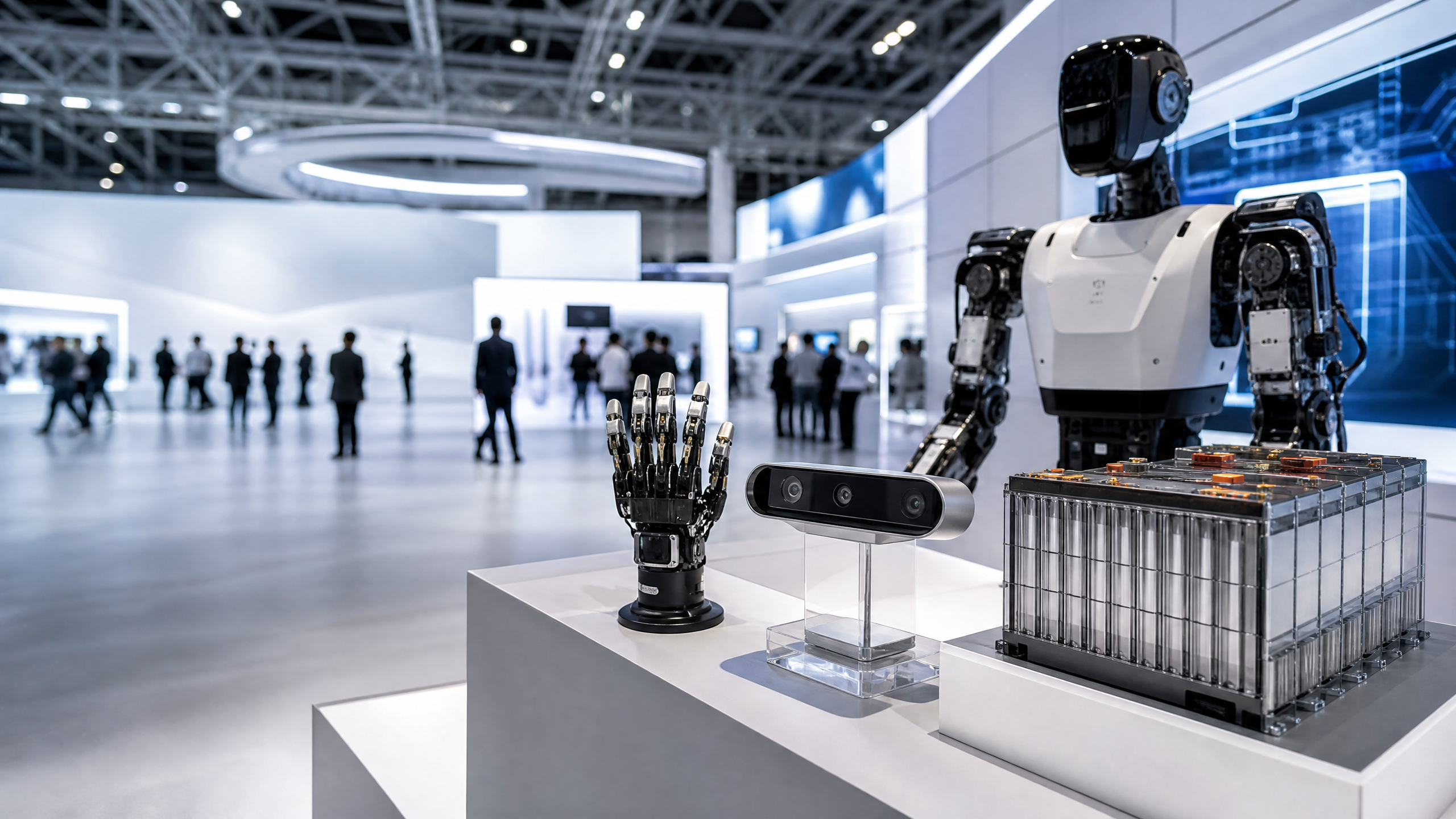
When the World Artificial Intelligence Conference opened across three Shanghai venues on July 17, 2026, the central question was no longer which robot could draw the largest crowd. Joyson Electronics, headquartered in Ningbo, China, showed the component stack for embodied AI, while Pudu Robotics, headquartered in Shenzhen, China, showed a semi humanoid platform for commercial service and industrial manipulation. The market reality was a growing demand for working systems rather than isolated demonstrations. The structural shift was visible in the component tables, software layers, and task specific forms surrounding the headline machines. The implication was direct: the next generation of robotics competition will be won through integration across a supplier ecosystem, not by a single company presenting a complete robot in isolation.
Shanghai Became a Bill of Materials Conversation
Exhibitions are often measured by visitors, launches, or the visual impact of a robot walking through a crowd. That lens misses what matters in a maturing technology market. The important signal at Shanghai was that the invisible parts of a robotics system were becoming visible products. A dexterous hand was not simply a demo accessory. It was a component category. A battery was not a technical footnote. It was a performance and safety system. An AI head, an electronic skin, and a controller were not proprietary mysteries. They were increasingly separate layers in a commercial supply chain.
The conference’s academic program was distributed across the Expo Exhibition Hall, Expo Center, and Xuhui West Bund International Convention and Exhibition Center. The multi venue structure reflected the breadth of the field, but the deeper point was industrial. Physical AI is becoming too complex for one company to own every element from raw sensor to customer deployment. The show floor presented a market gradually accepting that constraint and turning it into a division of labor.
For buyers, that change can reduce dependence on a single robot maker. For hardware companies, it can reduce development time and capital intensity. For suppliers, it creates the opportunity to sell an essential layer into multiple robot platforms. The result is a more familiar industrial structure: a system integrator at the top, specialist suppliers beneath it, and an operating software layer that determines how the parts work together.
Joyson Brings Automotive Discipline to the Stack
Joyson Electronics, a Ningbo, China headquartered technology supplier with deep automotive manufacturing experience, brought that supplier logic directly into robotics. Its WAIC portfolio included a dexterous robotic hand, a solid liquid hybrid battery, a third generation AI head assembly, electronic skin, an embodied AI brain, and robot controller products. The breadth matters more than any single specification because it maps the core interfaces a robot company must solve before it can scale.
The TeleHand Professional Edition illustrates the point. The hand combines direct drive, tendon driven, and linkage actuation across 20 degrees of freedom. A hand at this level is not merely a mechanical part. It is a system that must combine actuation, tactile sensing, force control, compact packaging, reliability, and software compatibility. When that system is offered by a dedicated supplier, a robot maker can spend more of its engineering budget on the task and less on reconstructing a component category from scratch.
Joyson also described its robot controllers as being in volume production and delivered to leading robotics firms. That statement is meaningful because controller volume matters to the economics of the entire stack. In the laboratory, a controller can be adapted to a particular robot and revised frequently. In production, it needs stable supply, thermal performance, safety protection, diagnostics, and a path for servicing thousands of units. An automotive supplier entering that layer brings experience with validation cycles, traceability, and supplier management that young robotics companies may struggle to build independently.
The same logic applies to batteries. A mobile robot needs energy density, safe operation, charging behavior, temperature tolerance, and predictable degradation. A battery is part of robot uptime. A component supplier that can integrate the battery management system with the controller, power electronics, and mechanical package may create more deployment value than a new robot body design. The market is beginning to recognize that reliability will emerge from the relationship among components, not from a single headline specification.
PUDU D7 Tests a Different Geometry
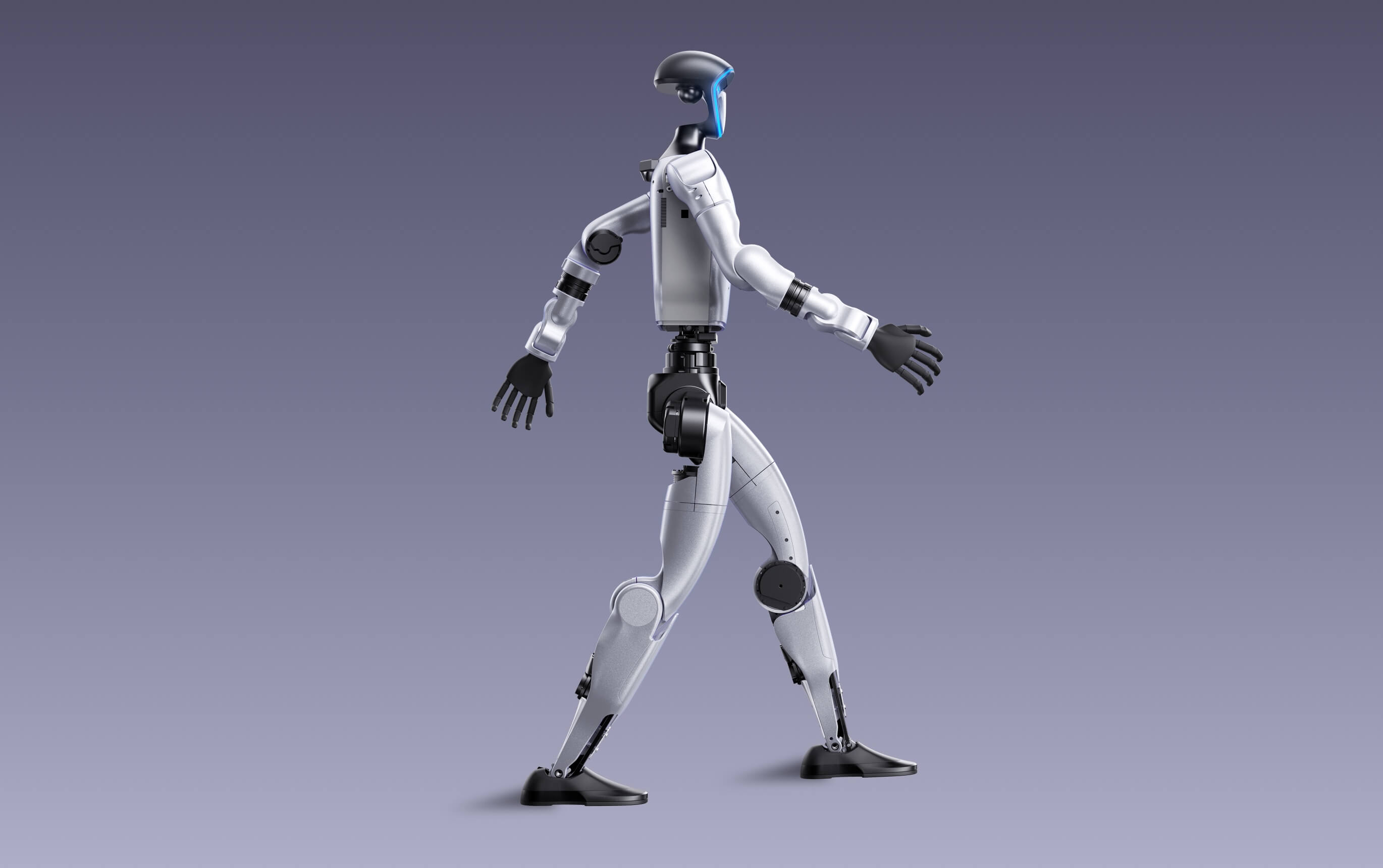
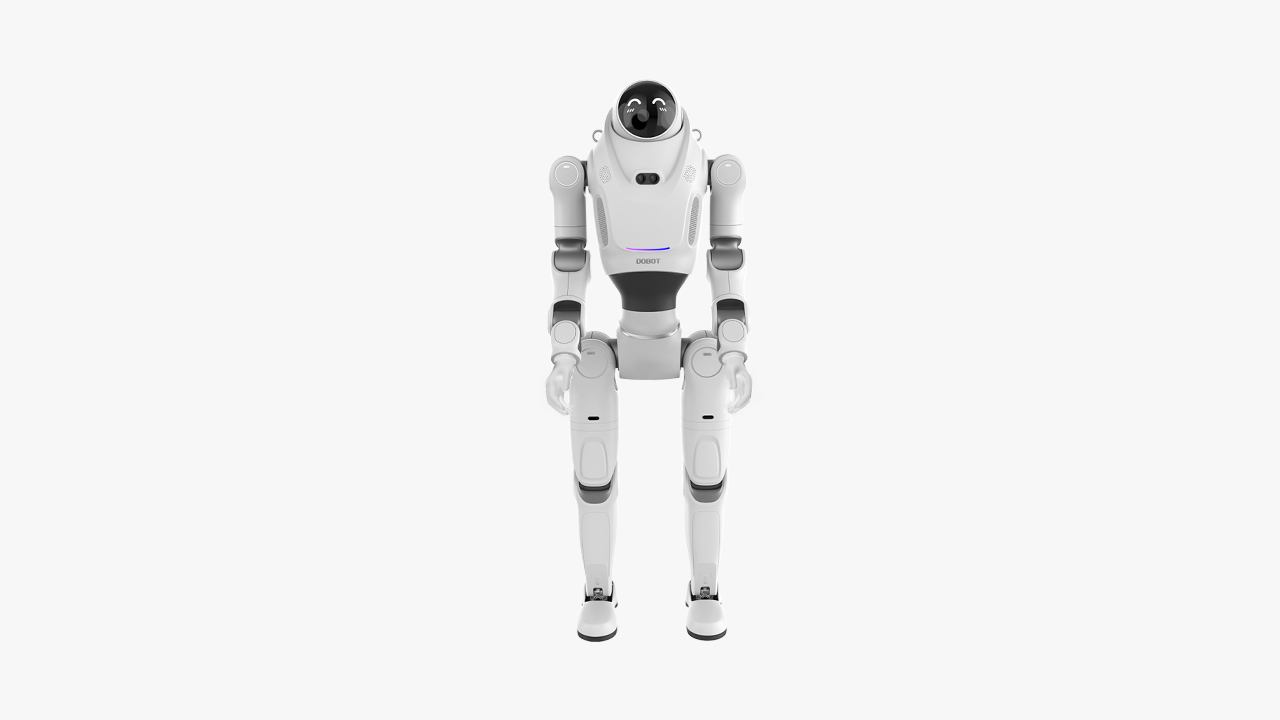
The show also challenged the assumption that the commercial future belongs exclusively to a general purpose bipedal humanoid. Pudu Robotics, a Shenzhen, China based commercial service robot developer with experience in delivery and cleaning systems, staged the first offline public showing of its PUDU D7. The machine was presented as an industrial grade semi humanoid designed for manipulation and operational reach rather than a universal imitation of a human body.
The D7 supports payloads up to 14 kilograms and operates at a height of two metres. Those details point to a design choice. In a warehouse, factory, or other structured environment, a robot may not need to run, climb stairs, or match human leg geometry to create value. It may need to reach a shelf, carry a component, interact with an existing workstation, and operate for long enough to justify the service model. A semi humanoid form can pursue those requirements with less mechanical complexity than a full bipedal machine.
Pudu described its Physical Agent architecture as a three layer arrangement: the robot body, a PuduAgent OS system layer, and a PuduFM skill layer. The architecture is a useful shorthand for the direction of the ecosystem. The body gives the machine reach and movement. The operating system manages sensing, action, and state. The skill layer turns the platform into a task specific asset. Separating the layers makes it easier to use a shared intelligence system across multiple forms rather than designing each robot as a closed world.
The company has reported more than 130,000 units shipped across more than 85 countries and regions. That is a company reported scale figure, but it adds context to the strategic transition. A vendor with an installed base of commercial robots has operational data, service networks, and customer relationships that can help it introduce more complex manipulation systems. The advantage is not only a new machine. It is the ability to carry forward a service operation that already understands deployment friction.
The Integration Test Replaces the Demo Test
A mature exhibition market creates a more demanding test for participants. The question is no longer whether a hand can grasp an object at a booth. It is whether the hand can be sourced at volume, paired with a compatible controller, supplied with reliable power, connected to an operating system, and maintained by a field team. The ecosystem shown in Shanghai makes that test easier to define and harder to evade.
There are risks in this emerging structure. Standard components can create dependence on a handful of suppliers. A robot maker that uses a common controller or sensor may struggle to claim unique technical advantage. Integration failures can also move from a single company’s laboratory into the handoff between suppliers. Yet these risks are a sign of industrial maturity. They are the same problems encountered in automotive, aerospace, and consumer electronics when a technology becomes a supply chain rather than a research project.
For customers, the operational issue is simple. They need an answer to who fixes a problem, who supplies a replacement, who updates the software, and who is responsible for performance when a component and a robot come from different companies. The best exhibitors will not only show a machine. They will show the contract, service pathway, and partner network that supports it.
The Next Signal Is Outside the Exhibition Hall
The next evidence to watch will not be another product reveal. It will be the first customer deployments that show whether component providers and robot makers can integrate their offerings into a repeatable operating system. The most valuable announcements will identify task boundaries, service responsibility, maintenance outcomes, and the route from display unit to volume delivery.
Shanghai has made the central competitive question clear. The company that assembles the most impressive robot will not necessarily lead the next cycle. The company that combines compatible components, reliable software, appropriate task geometry, and a credible service model will set the commercial standard.
This analysis synthesizes company statements and public market activity.