Robotics Events Become the New Test Infrastructure
The most consequential exhibition signal this week was not another product launch. It was the expansion of Beijing’s World Humanoid Robot Games into a large, multi-event test environment with 666 teams, 2,056 robots, and 1,301 competition sessions across 51 events. The event points to a new role for exhibitions: they are becoming places where suppliers, researchers, policymakers, and buyers can observe repeatable performance, not only watch demonstrations.
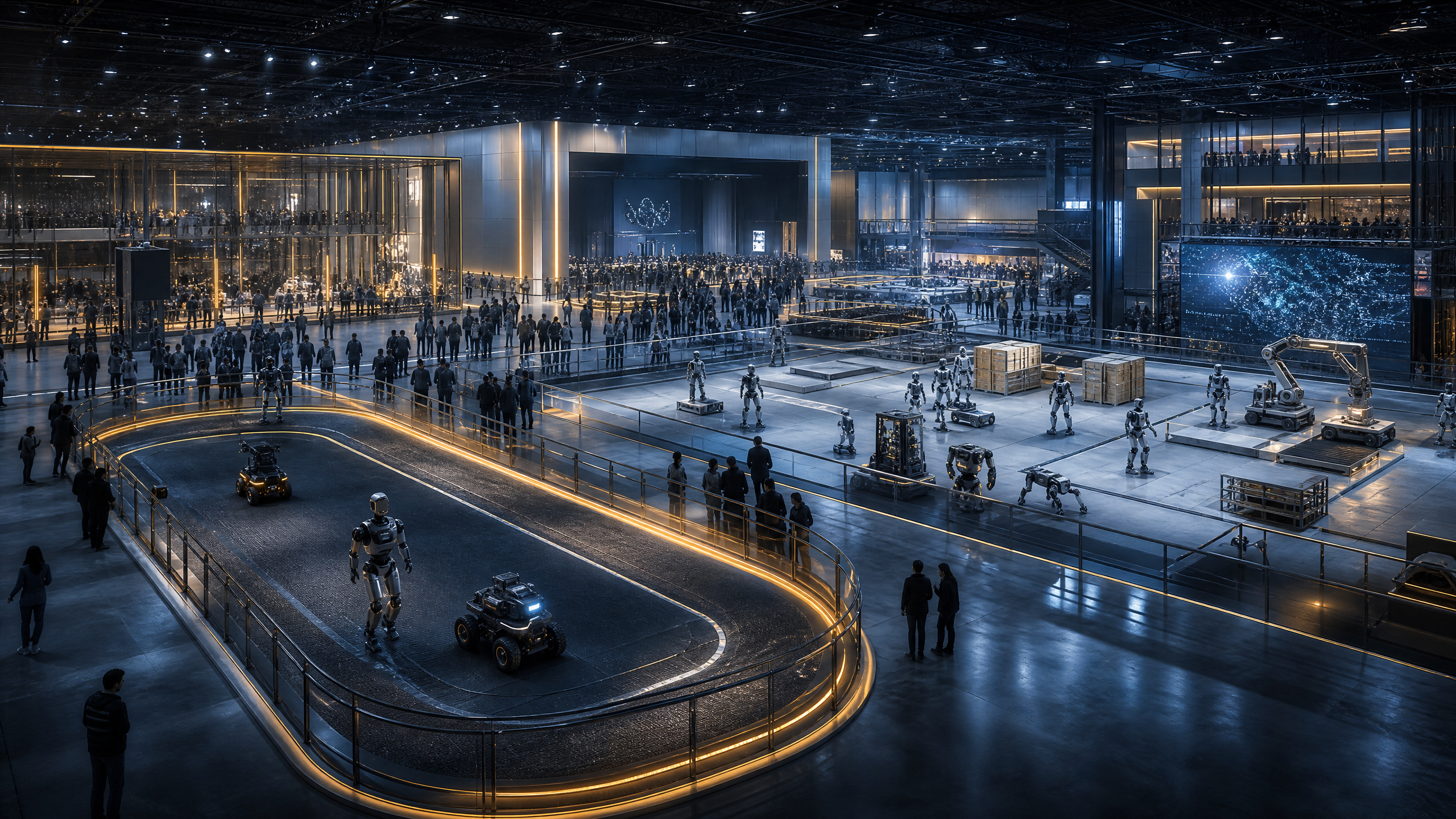
A robotics exhibition used to reward the most polished demo. The next generation of events will reward the robot that can complete a task repeatedly, recover from failure, work within a defined interface, and produce evidence that an outside team can inspect. That change is visible in Beijing’s plan for the second World Humanoid Robot Games, scheduled for August 22 through 26 at the National Speed Skating Oval. The official Beijing government event page says the program will include 1,301 competition sessions across 51 events, with 30 competitive events and 21 scenario-based events. It also reports 666 registered teams and 2,056 robots.
Those numbers are not a proxy for commercial deployment. They describe an event. Their significance is that the event is being designed as a large test surface for an industry that still lacks common ways to compare robots outside controlled demonstrations. A robot that wins a sprint is not automatically ready for logistics. A robot that completes a household task in a staged video is not automatically safe in a factory. But a program that separates competitive tasks from scenario-based tasks can start to expose the difference between spectacle and operational capability.
A venue becomes a measurement system
The increase from 26 events in the inaugural games to 51 in the second edition is important because it broadens what counts as evidence. The official description includes both competitive and scenario-based events. That division creates room for different types of evaluation. Competitive events can test speed, balance, coordination, and repeatability under visible rules. Scenario-based events can test whether a robot can work through a task sequence with changing conditions, constrained spaces, objects, and handoffs.
The distinction matters to buyers. A warehouse operator does not purchase a robot because it has the fastest gait. A manufacturer does not purchase a humanoid because it can perform a dramatic kick. The buyer wants to know whether the machine can interpret a task, maintain safe behavior near people, recover from an interruption, and deliver a measurable result at an acceptable cost. Scenario-based events can make those requirements visible to people who are not building the robot.
They also create a shared language for the supply chain. Robot makers need sensors, actuators, batteries, compute, grippers, software, and test equipment. A common event can reveal which components survive repeated use and which systems require a high level of human intervention. It gives component suppliers a place to observe failure modes, while giving integrators a chance to see whether different machines fit the same operational logic.
The ecosystem is moving from booths to protocols
The event’s scale suggests that the exhibition ecosystem is also becoming a coordination layer. Six hundred and sixty-six teams cannot be evaluated by a single informal demo. The organizers need registration rules, venue logistics, technical inspection, event scheduling, safety procedures, and a way to make results legible to spectators. Each layer is part of the emerging robotics stack.
That stack extends beyond the robots themselves. Competitors need training environments, simulation tools, data pipelines, repair support, battery management, and transport. They need ways to reset a machine after a fall, diagnose a perception failure, and distinguish a model limitation from a hardware problem. As event complexity grows, the organizations that provide these services become more important to the ecosystem. A robot competition can therefore function as a stress test for the infrastructure around the robot.
This is the point at which exhibitions begin to resemble industrial test sites. The difference is that the public can see the work. A private factory validation program may generate stronger commercial evidence, but it is not accessible to competitors, researchers, or buyers. An open event can expose design choices and operational trade-offs to a wider audience. It can also accelerate imitation, which means the advantage shifts toward the quality of the data and the speed of learning after the event.
From public performance to private deployment
The path from an event result to a customer contract is not automatic. Organizers, manufacturers, and buyers must agree on what can be transferred. A good benchmark should identify the task, the environment, the permitted level of human assistance, the number of trials, the failure definition, and the reset procedure. Without that information, a result may be visually impressive but commercially ambiguous.
This is especially important for humanoid systems because their form factor creates several separate technical problems. Balance and locomotion are visible, but perception, manipulation, energy consumption, thermal management, and safety behavior can determine the economics. A competition may isolate one capability for fairness. A production site must combine them. The ecosystem’s challenge is to keep the event legible without allowing the metric to become the product.
The World Humanoid Robot Games are therefore best understood as a bridge. They can help developers discover which tasks are difficult, help researchers compare approaches, and help the public understand the technology. They can also give policymakers a way to observe the industry without relying only on vendor claims. But their lasting value will depend on whether results are translated into repeatable evaluation protocols that customers can use after the lights are turned off.
The event calendar is becoming a deployment calendar
The timing of the Beijing games is also revealing. The event follows a week in which the current news record documented large production claims, a planned central-enterprise robotics consortium, a humanoid training school, and multiple local programs. Those stories show an ecosystem building production and support capacity. The games add a public layer where the capabilities of that capacity can be compared.
A similar shift is visible in the way companies describe their own demonstrations. LG and NVIDIA’s August 13 announcement connected a future humanoid to real-world validation of a wheel-based robot on a washing-machine line, along with a physical AI data platform for collection, synthetic data, training, and verification. The statement is not an exhibition announcement, but it reflects the same logic. The robot is no longer presented as a finished object. It is presented as part of a loop that must be measured and improved in a real environment.
This loop creates new roles for events. A venue can host the first public test. A factory can host the second. A buyer’s site provides the final test. Suppliers and investors will increasingly ask whether the results are comparable across all three. That is why the strongest events will connect competition, data, standards, and deployment rather than treating them as separate programs.
What buyers should watch in the results
The next useful question is not which team wins most medals. It is whether the event produces evidence that survives translation into industrial diligence. Buyers should watch for task completion rates, intervention frequency, recovery behavior, battery endurance, maintenance needs, and performance under changes in lighting, objects, and layout. They should ask whether the result came from a single optimized machine or a repeatable production configuration.
They should also watch the event’s treatment of human assistance. Teleoperation can be a valuable part of a learning system, especially when it creates data for later improvement. It should not be confused with autonomy. A benchmark becomes more useful when it discloses how much remote control, physical guidance, task scripting, and environment preparation were required.
The supply chain will be visible in the failures. A robot may stumble because of a model, a sensor, an actuator, a battery, a network, or a poorly defined task. An exhibition that captures those distinctions creates value for the whole industry. An exhibition that hides them creates another layer of marketing.
The leading ecosystem signal this week was the expansion of robotics events into structured evaluation environments. Beijing’s games will not prove that humanoids are commercially ready, but they may show how the industry intends to make readiness observable. The next generation of buyers will not ask only where the robot was displayed. They will ask what the robot had to repeat, what it was allowed to do, and what happened when the demonstration stopped going to plan.