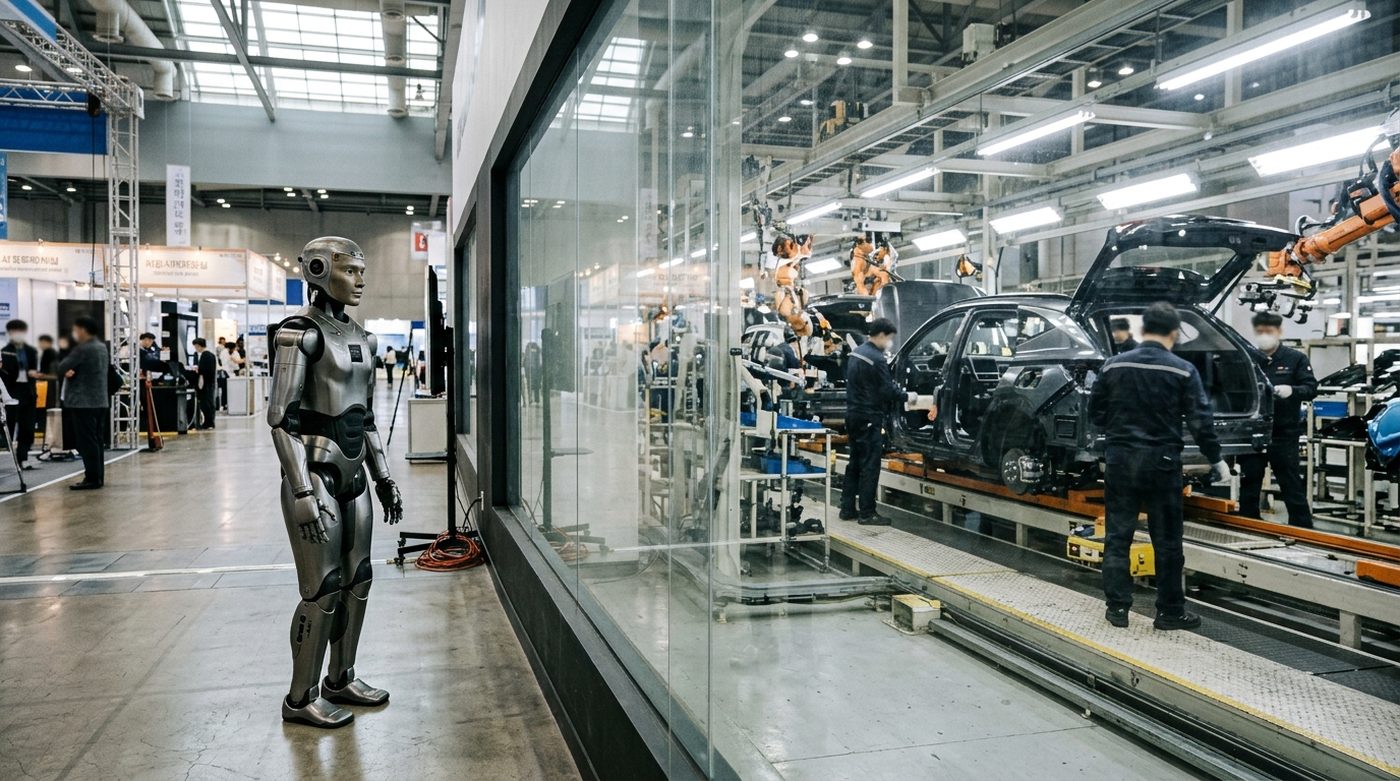
XPeng Starts Building Its Humanoid the Way It Builds Cars, and the Countdown to Mass Production Is On
XPeng's humanoid robot IRON has formally entered small-batch trial production at the company's Guangzhou factory, People's Daily Online and Sina Tech reported on July 24, with the dedicated mass production line now in final systems integration. An internal mobilization meeting fixed the timeline: mass production in 2026, then deployment across XPeng's global stores from 2027 as sales guides and product explainers, with a stated ambition to lift monthly capacity beyond 1,000 units. The EV maker is systematically reusing its automotive supply chain, AI stack, and manufacturing muscle for robots, making IRON the clearest test yet of whether carmakers are the natural winners of the humanoid production race.
The most consequential robot factory news in China this week did not come from a robotics company. It came from a carmaker. XPeng has formally begun small-batch trial production of its IRON humanoid robot at its Guangzhou factory, People's Daily Online reported on July 24, while the dedicated mass production line alongside it enters final systems integration. In the company's own framing, the sprint to volume manufacturing has officially entered its countdown.
The disclosure, first reported as a Sina Tech exclusive and carried the same afternoon by the Communist Party's flagship online outlet, is the strongest production signal yet from a program that has spent 2026 accumulating them. According to the reports, an internal mass production mobilization meeting fixed XPeng's key milestones: humanoid mass production achieved within 2026, followed from 2027 by phased deployment into XPeng's stores and commercial venues worldwide, where the robots will work as sales guides and product explainers. Guandian reported the ambition beyond that: pushing IRON's monthly production capacity above 1,000 units, with mass production defined explicitly as large-scale output sold to ordinary consumers, not just enterprise pilots.
From Catwalk Stunt to Production SOP
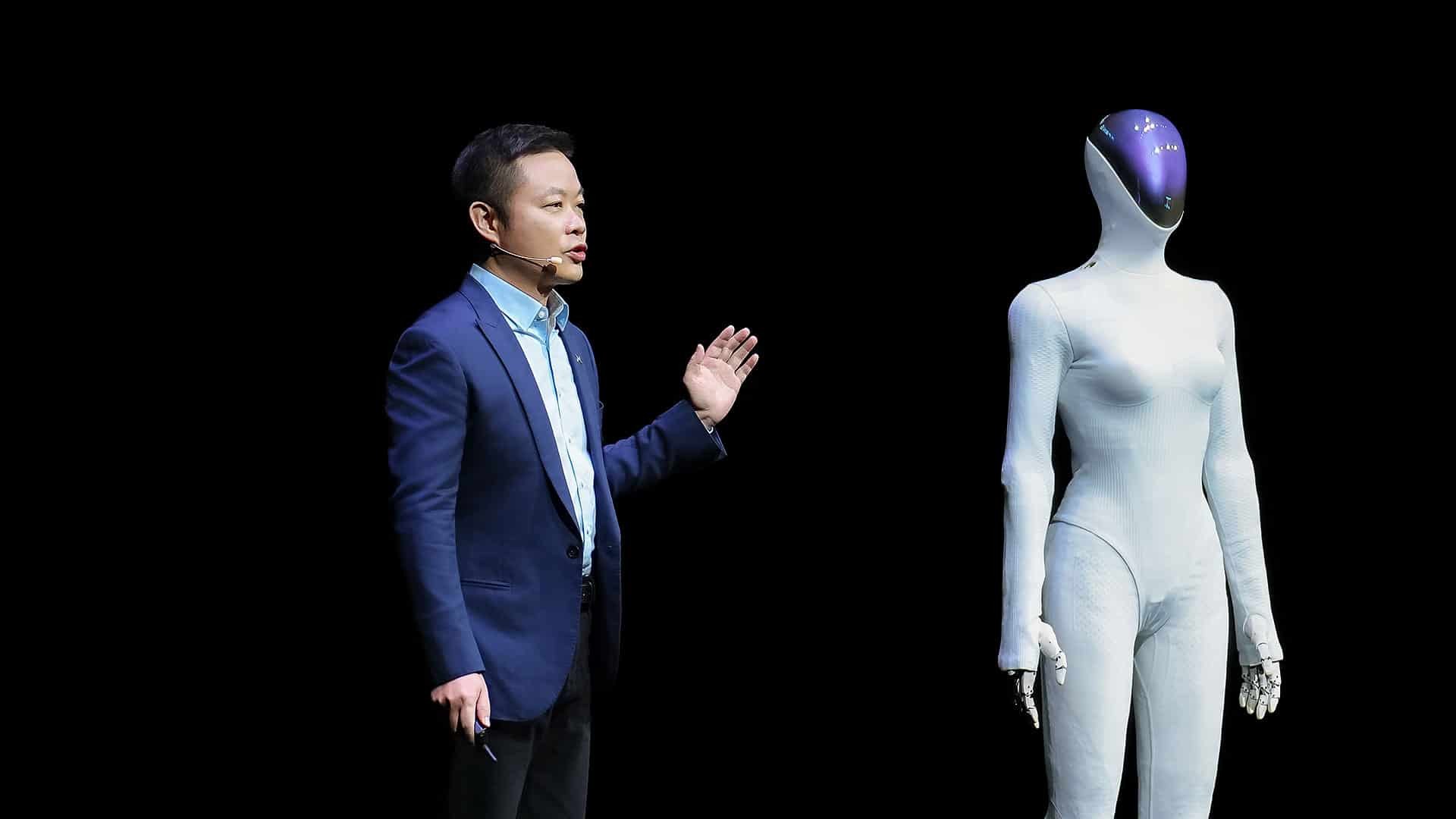
IRON earned its public reputation the theatrical way. The 178-centimeter humanoid's catwalk demonstration at XPeng's AI Day last November went viral enough that chief executive He Xiaopeng cut one unit open on stage to prove there was no human inside. The machine carries three of XPeng's in-house Turing AI chips and a solid-state battery, and it was pitched from the start not as a research platform but as a product with a manufacturing plan attached.
The company has been assembling that plan in public all year. In February, XPeng said it had built the industry's first full-chain humanoid manufacturing layout, spanning every stage from small-batch trial to scaled production. In June, He Xiaopeng personally took over the robotics unit, a signal Chinese corporate watchers read correctly as the program moving from experiment to deliverable, and set the sequence now being executed: mass production in the fourth quarter, robots working as in-store guides in the first quarter of 2027, broader customer deployment the quarter after. July 24's news converts that roadmap from stated intent into machines physically moving down a line.
What makes the XPeng program distinct is not the robot. It is the reuse. According to the People's Daily report, the robotics business consolidates the group's existing capabilities in hardware, large AI models, supply chain, and marketing, and systematically transplants the software-hardware co-development, intelligent manufacturing, and global channel experience accumulated in the car business into robots. Think of it like a restaurant group opening a second cuisine in the same kitchen: the recipes are new, but the suppliers, the equipment, the quality systems, and the delivery network are already paid for.
The Carmaker Thesis Gets Its Chinese Test
A humanoid robot is, in manufacturing terms, uncomfortably close to a car: motors, reduction gears, battery packs, sensors, wiring harnesses, cast structural parts, and software that has to control all of it in real time under safety constraints. That is why the boldest humanoid production claims worldwide come from vehicle makers. Tesla is preparing Optimus lines in Fremont with a stated million-unit ambition. Hyundai owns Boston Dynamics and is building robot capacity in Georgia. And in China, XPeng's IRON now moves first among the EV natives, with an actual trial line running.
The advantages are real and mostly boring, which is why they matter. Automotive-grade supply chains already deliver components at tolerances and volumes robotics startups spend years negotiating toward. Car factories already run the quality regimes, takt-time discipline, and worker training systems that turn prototypes into repeatable products. And a global retail network solves the humanoid industry's least glamorous problem, distribution, before it arises: XPeng's first robot customers are, in effect, its own showrooms, a captive deployment environment where every failure mode happens in front of staff who can log it rather than customers who can be harmed by it.
The in-store guide mission deserves more respect than it usually gets. A common misconception is that a robot greeting shoppers is a toy application beneath a machine of IRON's sophistication. It is closer to the opposite: retail floors are semi-controlled environments with real humans, real acoustics, real liability, and real brand consequences, and they generate exactly the interaction data a general-purpose humanoid needs next. It is the same logic by which XPeng's cars gathered driving data from ordinary commutes rather than test tracks.
The Scoreboard Among the Car-Robot Contenders
Placing XPeng's announcement on the global grid clarifies what was actually claimed. Tesla remains the reference point, but its Optimus program spent this week reaffirming rather than accelerating: production at Fremont beginning late this year, a new Optimus Academy training humans to train robots, and Elon Musk's own caution that the production curve will be anything but smooth. Hyundai's Atlas is the technical marvel of the field, yet its deployment plan runs through the group's own factories rather than a consumer launch, and this week's news from Seoul was about keeping humanoids out of union negotiations, not putting them into stores. Xiaomi, the other Chinese EV crossover with humanoid ambitions, has kept CyberOne largely in the laboratory while its car business absorbs the company's manufacturing attention.
Against that field, XPeng's position is distinctive on two axes. It is the only contender that has named consumer retail, its own showrooms, as the first deployment environment, and it is the only one publicly committing to sell humanoids to ordinary consumers as the definition of mass production. Both choices are aggressive, and both are coherent with what XPeng actually is: a company whose survival skill has always been shipping ambitious technology to consumers faster than its size should permit, from urban driver assistance to flying-car prototypes under its AeroHT affiliate.
Three Chips and a Solid-State Battery
The vertical integration inside IRON deserves its own ledger entry, because it is where XPeng's car business does the most invisible work. The robot runs on three of XPeng's self-developed Turing AI chips, silicon originally designed for the company's vehicles and now amortized across a second product line, delivering claimed on-board compute in the thousands of TOPS. The solid-state battery in IRON's torso is the kind of component choice only a company with automotive battery procurement leverage makes casually. Every yuan of that shared engineering pushes IRON's bill of materials down the same curve that made Chinese EVs globally price-competitive, and it is the quiet answer to how a robot for ordinary consumers could ever be priced for them.
He Xiaopeng has put a horizon on the ambition that most rivals avoid saying aloud: he has spoken of robots eventually becoming a business as large as, or larger than, XPeng's car business itself, with investment measured in the tens of billions of renminbi. Whether investors should discount that as founder theater or price it as guidance is precisely the question the Guangzhou trial line has now made urgent.
What the Countdown Does Not Tell Us
The skeptical checklist remains long, and worth stating plainly. Small-batch trial production is the stage where optimistic timelines go to be audited: yield rates, component consistency, and cost curves will decide whether the 2026 mass production milestone means thousands of sellable robots or a ceremonial batch that technically clears the bar. The program lost its robotics product head in June, mid-sprint, and XPeng has not disclosed IRON's pricing, its bill-of-materials trajectory, or what a robot that guides shoppers must cost to justify itself against a human doing the same job. Nor has it said how many units the trial batch actually contains, a number that separates a production line from a photo set. The claim that mass production means selling to ordinary consumers is the most aggressive definition any humanoid maker has put on record, and nothing published so far explains what a household IRON would actually do.
There is also the matter of the neighbourhood. XPeng's countdown lands in the same week the first Henan-built humanoids shipped from EngineAI's two-month-old factory, AgiBot confirmed its Hong Kong listing plans with its first revenue disclosure, and the industry ministry's projection of more than 100,000 Chinese humanoids produced in 2026 kept looking conservative. Trial production is a milestone precisely because the Chinese market has made it table stakes; the differentiating milestones now sit downstream, at yield, cost with paying customers.
Still, the direction is unambiguous. A year ago, IRON was a stage demonstration impressive enough to require dissection to be believed. Today it is a production article on a trial line inside one of China's most capable manufacturers, with a dated plan to stand in stores on three continents. For the global field, the reference clock has moved too: the question Tesla, Figure, and Hyundai now get asked in every boardroom is no longer whether a carmaker can mass-produce a humanoid, but whether they can do it before Guangzhou does. The humanoid race's next phase belongs to whoever can manufacture credibly, and XPeng just moved its claim from the keynote to the factory floor.
Disclaimer: This article is for general information purposes only and does not constitute investment, legal, or procurement advice. Readers should verify details with primary sources before making business decisions.