The GD01 Is Not What China Is Saying It Is — Which Is Exactly Why It Matters
Unitree (宇树) just launched a rideable mecha. The spectacle is deliberate. The signal is underneath it.

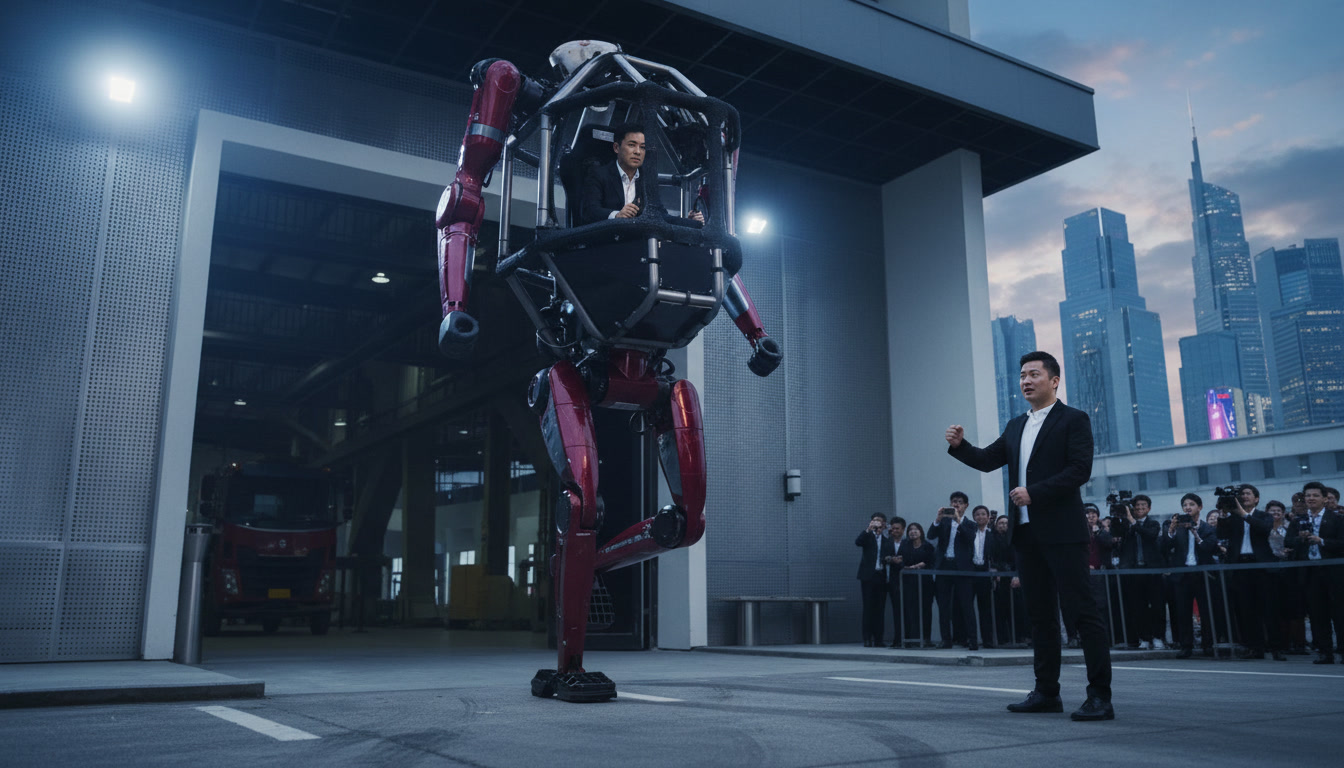
Unitree (宇树) CEO Wang Xingxing climbed into a 500 kg metal frame on 12 May 2026, buckled himself into an open cockpit, and walked the machine through a workshop wall. The GD01 — priced at 3.9 million yuan, approximately USD $574,000, and marketed as the world's first mass-produced manned mecha — looks like something that escaped from a Gundam script. It looks like a Warhammer Power Armour prototype built over a long weekend. It looks, depending on your reference points, like the most ridiculous thing a serious robotics company has ever put into production.
That reading is wrong, and the companies watching this as entertainment are making a costly analytical mistake. In May 2026, Unitree (宇树) did not just release the world's first mass-produced manned mecha — it demonstrated, in one product launch, what three years of humanoid robot production at scale actually builds toward. The GD01 is not proof that China has big robotic ambitions. It is proof that China's physical AI manufacturing infrastructure has matured to the point where scaling form factor is an engineering exercise, not a research programme.
Executive Summary
What actually changed is the demonstration — and the timing of what surrounds it. Unitree (宇树) launched the GD01 simultaneously with a filing for a 4.2 billion yuan IPO on Shanghai's STAR Market, and one week after opening UniStore, the world's first humanoid robot app store. The company that shipped more than 5,500 humanoid robots in 2025 — while every major US competitor shipped approximately 150 — is not launching a mecha suit to impress Gundam fans. The headline framing misses the real signal because it treats the product as the story, when the product is the evidence and the manufacturing stack is the story. If Unitree's physical AI infrastructure can produce a 500 kg manned platform as a product line extension, the downstream question is not "who will buy a rideable mecha?" — it is "what else does this stack produce, and how fast?"
Why You Should Read This
- Chinese companies held approximately 90% of global humanoid robot sales in 2025, according to Omdia research — and Unitree (宇树) is now demonstrating what sits at the top of the product range that infrastructure supports
- The GD01's specification gaps (battery life, top speed, operational duration — all undisclosed) are more revealing than its capabilities
- The concurrent IPO filing signals Unitree's own assessment of where this is in the maturation curve
- The defence applications are obvious, the commercial readiness is not, and most coverage is confusing the two
- The Gundam and Power Armour references in coverage are accurate and analytically useless at the same time
Core Claim
The GD01 is the product-line ceiling of a physical AI manufacturing stack that Unitree (宇树) built from the ground up — and its existence means the question facing every robotics competitor is no longer "can China build humanoid robots?" but "what does a country do when the company that builds humanoid robots can also, incidentally, build this?" The production stack transfers upward. That is all.
Two questions surface immediately.
Q: What is the Unitree GD01 robot? A: The Unitree GD01 is the world's first mass-produced manned mecha robot, unveiled by Chinese robotics company Unitree (宇树) on 12 May 2026. It weighs approximately 500 kg with a pilot aboard, switches between bipedal and quadrupedal movement, and is priced at 3.9 million yuan (approximately USD $574,000), according to Unitree's official announcement. The GD01 is marketed as a civilian vehicle targeting industrial operations, emergency rescue, and cultural tourism.
Q: How does the Unitree GD01 compare to other humanoid robots? A: The GD01 is not a humanoid robot in the conventional sense — it is a manned vehicle that uses bipedal and quadrupedal locomotion systems. Unitree (宇树) shipped more than 5,500 conventional humanoid robots in 2025, according to the South China Morning Post, making it the world's largest humanoid robot producer by volume, while US competitors including Tesla, Figure AI, and Agility Robotics each shipped approximately 150 units. The GD01 sits at the opposite price extreme from Unitree's entry-level R1 humanoid, which starts at approximately USD $5,566, demonstrating the company's deliberate multi-tier product architecture.
Manufacturing Stack Reaches Critical Mass
The GD01 looks like Gundam. It is actually the exhaust from an engine Unitree (宇树) has been building since 2021. The actuator systems, bipedal control architecture, structural materials engineering, and production line logic that produce a 25 kg G1 humanoid robot are not fundamentally different from those required to produce a 500 kg manned platform — they are scaled, reinforced, and recombined. That is what a mature physical AI manufacturing stack does. This is the same dynamic that produced successive generations of increasingly capable Unitree products at dramatically falling prices: the R1 humanoid launched in 2025 at USD $5,566, against the G1's 2024 price of approximately USD $13,800, against the H1's earlier price of approximately USD $90,000 — a price compression curve driven by accumulated production knowledge, not by research breakthroughs. The GD01 is going in the opposite price direction not because it is harder to build, but because it is earlier in its production volume curve and because a manned platform carries liability requirements that a small robot does not.
The concurrent IPO filing — 4.2 billion yuan on Shanghai's STAR Market, confirmed by CnEVPost — is the detail most coverage buried. A company filing for a major IPO the same week it launches its most spectacular product is signalling confidence in its institutional narrative, not just its technology. The IPO positions Unitree (宇树) as a multi-tier physical AI platform company, not a humanoid robot specialist. The GD01 is the demonstration that earns that framing.
The Specification Gaps Are the Story
Unitree (宇树) disclosed the GD01's price, weight, and transformation capability. It did not disclose battery life, top speed, payload capacity, or operational duration. That omission is not accidental. Every performance-critical specification — the ones that determine whether this is a viable operational platform or an elaborate proof-of-concept — is absent. The demo video shows bipedal walking at moderate pace, quadrupedal transition, and wall-smashing. It does not show sustained operation, terrain adaptation beyond an indoor workshop floor, or anything that approximates the industrial and rescue environments the company claims as target markets. This is not unusual for a first-generation product in a new category. It is, however, a meaningful distance from operational readiness. The Global Times quoted veteran analyst Ma Jihua saying the GD01 "reflects China's growing ability to turn bold imagination into real-world products." With respect, this frames it backwards — the GD01 is not the output of bold imagination. It is the output of a disciplined manufacturing infrastructure that was always going to reach this form factor once the component layer matured. The imagination is interesting. The engineering lineage is what makes it significant.
What most coverage misses is the product range signal rather than the product signal. The most consequential sentence in the GD01 launch is not "it can smash through walls" — it is "Unitree is filing for a 4.2 billion yuan IPO on the Shanghai STAR Market," which tells you exactly what the company thinks the GD01 is for. The GD01 is the anchor of a product narrative that runs from a USD $5,566 research humanoid through a USD $574,000 manned platform — a range that tells capital markets Unitree (宇树) is not a single-product robotics company but a physical AI manufacturer with deliberate multi-tier architecture. The wall-smashing is the press release. The IPO is the actual communication.
RobotAIGeek's Read
The defence applications are obvious enough that every serious analyst is already running them. A 500 kg manned bipedal platform with high-strength alloy construction, terrain-adaptive locomotion, and a Chinese manufacturer's supply chain access is not a stretch toward military relevance. Unitree (宇树) calling it a "civilian vehicle" and asking users to operate it "in a friendly and safe manner" is the kind of disclaimer that belongs in the same category as DJI's "for recreational use only." That said, the current platform is nowhere near combat or serious operational utility — the undisclosed battery life alone is a gating constraint that would make the GD01 less useful than a tracked vehicle in any real-world demanding scenario. What the GD01 actually demonstrates is not military capability. It is manufacturing credibility. And that — not the demo, not the Gundam aesthetic — is what the companies in other countries with humanoid robot aspirations should be reading.
Chinese companies held approximately 90% of global humanoid robot sales in 2025, according to Omdia. Unitree (宇树) alone shipped more than 5,500 units while Western competitors shipped approximately 150 each. The embodiment gap — the distance between what AI can compute and what a robot can reliably execute in the physical world — remains real and constraining for the GD01. But the production capability gap between China and everywhere else is compounding faster than the technical capability gap is closing. The GD01 is evidence of the production story. Covering it primarily as a technical story is how you miss what matters.
Central Tension
Unitree's (宇树's) GD01 demonstrates that China's physical AI manufacturing stack can produce platforms at scales and form factors previously confined to concept renders — but the absence of operational specifications confirms that the distance between "can produce it" and "can deploy it effectively" remains the defining gap in the manned robotics category, and how fast that gap closes depends less on engineering ambition than on whether real operational environments can generate the data that makes the next generation reliably capable.
If the GD01's production volume scales as Unitree's (宇树's) previous humanoid models did — price falling, specification improving, capability extending into genuine operational environments — what changes first: the civilian transport applications the company markets, the defence procurement conversations nobody is officially having, or the competitive recalculation by Western robotics companies who watched this launch as entertainment? The answer depends on how quickly Unitree discloses the battery life.
1. What is the Unitree GD01? The Unitree GD01 is the world's first mass-produced manned transformable mecha robot, unveiled by Hangzhou-based Unitree Robotics (宇树) on 12 May 2026. It weighs approximately 500 kg with a pilot aboard, transitions between bipedal and quadrupedal movement, and starts at 3.9 million yuan (approximately USD $574,000), according to Unitree's official announcement. It is explicitly marketed as a civilian vehicle for industrial operations, emergency rescue, and cultural tourism.
2. How much does the Unitree GD01 cost? The Unitree GD01 starts at 3.9 million yuan, approximately USD $574,000, for the base model according to Unitree's May 2026 announcement. This places it at the opposite extreme of Unitree's product range from the R1 humanoid robot, which launched in 2025 at approximately USD $5,566 — demonstrating the company's deliberate multi-tier physical AI product architecture rather than a single-price-point strategy.
3. Can you ride inside the Unitree GD01? Yes — the GD01 is specifically designed to carry a human pilot inside an open cockpit within the robot's torso frame. CEO Wang Xingxing piloted the machine himself during the May 12 demonstration, walking the robot forward and switching between upright bipedal and quadrupedal crawl mode. Total weight including pilot is approximately 500 kg, according to Unitree's official specifications.
4. Is the Unitree GD01 ready for commercial use? The GD01 is in mass production according to Unitree (宇树), but critical operational specifications — battery life, top speed, payload capacity, and operational duration — were not disclosed at launch. The demo footage shows indoor walking at moderate pace and a controlled wall-smashing exercise, not sustained operation in the industrial or rescue environments the company targets. Most analysts treat the current platform as a first-generation proof-of-concept in a genuinely new category, with operational readiness for demanding real-world environments requiring further development.
5. What does the Unitree GD01 mean for the robotics industry? The GD01's significance is less about what it can do today and more about what it demonstrates the Unitree (宇树) manufacturing stack can produce. Chinese companies accounted for approximately 90% of global humanoid robot sales in 2025, according to Omdia, with Unitree shipping more than 5,500 units while major US competitors shipped approximately 150 each. The GD01 shows that the actuator systems, bipedal control architecture, and production infrastructure developed for small humanoid robots can scale upward in form factor — a manufacturing capability signal that changes competitive calculations regardless of the current platform's operational limitations.
6. Does the Unitree GD01 have military applications? Unitree (宇树) explicitly markets the GD01 as a civilian platform and has not announced military use cases. The potential military applications — terrain-adaptive heavy bipedal platforms for logistics, rescue in contested environments, or direct combat roles — are structurally apparent and widely discussed in defence analysis. However, the platform's undisclosed battery life and demonstrated speed limitations place it well below the operational requirements of serious military deployment in demanding scenarios. The more immediate military-relevant implication is the manufacturing capability it demonstrates, not the GD01 platform itself.