Tesollo Nears 1,000 Robotic Hand Sales, Preps Korean IPO
South Korea's Tesollo expects cumulative sales of its DG-series articulated robotic hands and multi-finger grippers to surpass 1,000 units by the end of 2026, backed by Samsung Venture Investment, POSCO Technology Investment, HL Mando and Daesung Hi-Tech, while it prepares a technology-track IPO with KB Securities as lead underwriter.

Tesollo, a South Korean maker of articulated robotic hands and multi-finger grippers, said on October 14, 2026 that cumulative sales of its hand and gripper products are on track to surpass 1,000 units by the end of this year, and confirmed it is preparing a technology-focused listing on a South Korean stock exchange.
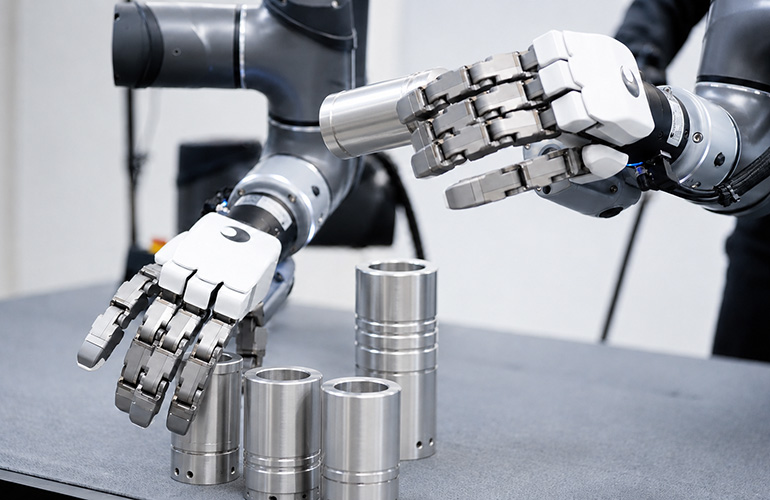
The announcement doubles as an introduction for a company most buyers outside Korea's robotics supply chain would not recognize by name. Tesollo, headquartered in South Korea, designs and manufactures an articulated end-effector lineup, the DG series, spanning from the single-finger DG-1F through the five-finger dexterous DG-5F hand, aimed at industrial automation, robotics research, AI learning, humanoid robotics and the broader Physical AI push toward machines that manipulate objects rather than simply move through space. For a supplier at that stage, crossing four digits in cumulative unit sales is the kind of data point that reframes a lab-stage vendor as a production-stage one.
A Component Category Finally Leaving the Demo Bench
Dexterous end-effectors have spent most of the past decade as a showcase part: the hand that grips an egg without crushing it, the five-finger rig that stacks blocks at a trade show, the manipulator bolted to a humanoid for a thirty-second video clip. Few of those builds were ever ordered in triple digits, let alone four. Tesollo's own framing of its milestone leans on exactly that gap. The company describes approaching 1,000 cumulative units, for products it calls technically demanding and still early in their transition to mass commercialization, as evidence of something beyond a sales count: repeatable manufacturing, consistent product quality and sustained market demand across multiple customer segments rather than a single flagship order.
Put in plainer terms, a robotic hand is not one part but dozens of small, precisely toleranced mechanisms working in concert, tendons, actuators and sensors packed into a housing roughly the size of a human hand. Getting one of those to perform reliably on a lab bench is a solvable engineering problem. Getting the five-hundredth and the thousandth copies to hit the same grip force, the same failure rate and the same tolerance stack, assembled, inspected and shipped on a schedule a customer can plan a production line around, is a manufacturing problem, and manufacturing problems are what actually separate suppliers from science projects. Tesollo says it expanded its production facilities during 2026 and upgraded its manufacturing infrastructure to cover assembly, inspection, quality control and shipment, in response to demand from customers in Korea and overseas spanning industrial automation, robotics research, AI learning, humanoid robotics and Physical AI applications.
That breadth of customer segment matters as much as the unit count. A supplier selling 1,000 units to one humanoid program carries concentration risk that a supplier selling 1,000 units across five application categories does not. Tesollo has not disclosed a customer-by-segment breakdown, so the claim of diversified demand remains a company assertion rather than an audited figure, but the direction, from research and proof-of-concept work toward recurring industrial orders, matches the broader trajectory the humanoid and manipulation sector is trying to make: moving past the gap between demo performance and deployment reality toward hardware that a procurement department can actually specify.
An Investor Roster That Reads Like a Korean Industrial Supply Chain Map
Tesollo's shareholder list is where the component-supplier narrative gets more interesting than the unit count alone. Samsung Venture Investment and POSCO Technology Investment backed the company during its earlier growth stages, giving it institutional credibility while it was still proving the technology. More recently, HL Mando, an automotive parts and systems maker, and Daesung Hi-Tech have invested directly in Tesollo's common equity, a step up from passive financial backing toward what the company describes as collaborative relationships tied to each investor's own industrial capabilities. Platinum Technology Investment is also a shareholder, and its largest shareholder, Jahwa Electronics, a Korean maker of electronic and precision components, is now in discussions with Tesollo about manufacturing cooperation.
None of those names are robotics specialists. That is precisely the point. A component supplier whose capital table includes an auto-parts manufacturer and a precision-electronics maker, both companies with decades of experience hitting automotive-grade tolerances at automotive-grade volumes, has a different kind of backing than one funded purely by robotics-focused venture capital. It suggests a company trying to borrow manufacturing discipline from adjacent industries that already know how to build a mechanical assembly a million times without a defect, rather than one trying to reinvent that discipline from a research lab. A robotic hand that can only be built once is a prototype; a hand that can be built a thousand times to spec is a supply chain, and Tesollo's investor roster is a bet on which of those two things it is becoming.
A Listing Track Built for Companies That Are Not Yet Profitable
Tesollo has appointed KB Securities as lead underwriter and is proceeding with preparations for what the company calls a technology-based initial public offering (IPO), using South Korea's technology special listing track, a public-market route designed for pre-profit technology companies that can demonstrate technical and commercial promise without yet showing conventional earnings. No offering size, share count, valuation or revenue figure has been disclosed, and buyers should not read the listing preparation itself as proof of financial scale. That is the honest limit of what Tesollo has said publicly: a sales trajectory it expects to clear 1,000 cumulative units, an expanded production base, a shareholder group with industrial ties, and an underwriter engaged for a listing process that has not yet priced or completed.
Chief Executive Officer Youngjin Kim framed the moment less as a financial milestone and more as a manufacturing one. "Robotic hands must move beyond technical demonstrations and become products that can be manufactured repeatedly," Kim said, adding that "Tesollo is evolving into a robotics manufacturer that supplies robotic hands and grippers to real customers." That framing is consistent with where the company is actually verifiable: production capability and customer breadth, not disclosed financials. A technology listing track exists specifically because a company has not yet generated the profit a standard listing would require, and treating IPO preparation as validated commercial success, rather than as a milestone still subject to pricing, demand and regulatory review, is the most common misreading of this kind of announcement.
What a Buyer Should Still Verify Before Specifying a Tesollo Hand
For a procurement team evaluating dexterous end-effectors for a humanoid or industrial manipulation program, Tesollo's milestone is a useful signal, not a substitute for due diligence. Three questions stand out. First, lead time and capacity: an expanded Korean production line covering assembly, inspection, quality control and shipment is a meaningful claim, but Tesollo has not disclosed current monthly capacity, backlog or how quickly it can scale beyond today's output to meet a large program's order size, which is the lead time question that separates a pilot order from a production contract. Second, unit economics at volume: crossing 1,000 cumulative units says nothing about margin, and a supplier moving from proof-of-concept orders to recurring industrial contracts typically discovers that research-grade pricing does not survive contact with industrial-scale purchasing, so a buyer should expect, and negotiate for, a different cost structure at higher volumes rather than assuming today's unit price holds. Third, after-sales support and spare-parts logistics: a five-finger dexterous hand with tendons, actuators and sensors is a serviceable mechanical assembly, not a disposable part, and a buyer specifying it into a production line needs a clear answer on repair turnaround, spare-parts availability and warranty terms in both Korea and whatever market the buyer operates in, none of which this announcement addresses.
The investor relationships with HL Mando and Jahwa Electronics are worth watching for a different reason: if those manufacturing-cooperation discussions mature into actual shared production capacity or component sourcing, Tesollo's effective manufacturing base could expand well beyond what its own facilities support today, which would be a more durable supply-chain signal than the unit count by itself. Until that cooperation produces disclosed, concrete terms, it remains a relationship to monitor rather than a capacity figure to plan around.
The Verdict for Procurement Teams
Crossing 1,000 cumulative units does not make Tesollo a proven, high-volume industrial supplier on the scale of an established automation component maker, and it does not make the company profitable. What it does establish, on the evidence Tesollo has disclosed, is that a dexterous robotic hand and gripper maker has moved past the single-digit and double-digit order volumes that define most of this category, built a production process with assembly, inspection, quality control and shipment stages, attracted direct equity investment from established Korean industrial manufacturers rather than robotics-only capital, and engaged a lead underwriter for a public listing track reserved for pre-profit technology companies. That combination, unit volume, industrial investor backing and a formal listing process, is a more concrete maturity signal than a demo video or a funding round announcement alone, and it is the clearest evidence yet that dexterous manipulation hardware is starting to behave like a manufacturable component category rather than a permanent research exhibit.
This analysis draws on Tesollo's own public statements, including its October 14, 2026 announcement and executive remarks, regarding its sales trajectory, production capacity, shareholder base and listing preparations, as of the stated publication date.
This article is provided for general information purposes only and does not constitute investment, procurement, legal, or engineering advice. Figures reflect the sources listed above as of the stated information cut-off and may change without notice.