Rhoda AI Blocks Its Robot's Cameras to Prove Touch Alone Works
Palo Alto startup Rhoda AI demonstrated a robot finding and retrieving textured balls with its cameras blocked, using a new tactile sensor and an extended Direct Video-Action model to search by touch alone.


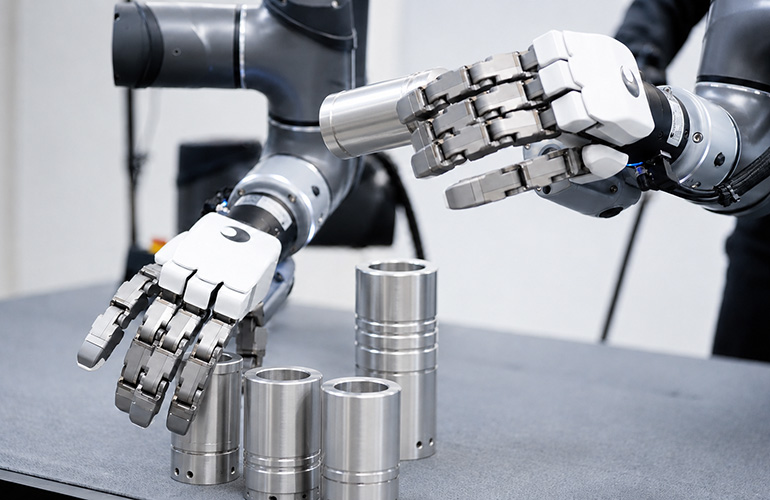
A sensor that can register forces as small as a few millinewtons and as large as more than 40 newtons on the same fingertip is the reason Rhoda AI could run its latest demonstration with the robot's cameras deliberately switched off. Rhoda AI, a Palo Alto, California-based robotics startup building tactile sensing and manipulation models, published a technical report on October 13, 2026 showing a robot finding, identifying and retrieving textured balls from a bin using touch alone, with its head and wrist cameras blocked throughout the task.
Rhoda's core technology is a new tactile sensor paired with an extension of the company's Direct Video-Action model, a system originally built to map visual input directly to robot actions, now adapted to predict future tactile signals instead of future images. An inverse dynamics model converts those tactile predictions into actual robot movements, and fresh sensor readings continuously update the predictions that guide the next move, creating a closed loop where touch, not vision, drives the search.
What "Blindfolded" Actually Proves
The blindfold framing is not a gimmick; it is a deliberate ablation designed to isolate what the tactile system can do on its own, without vision quietly compensating for any gaps in the touch model. Most robot manipulation systems today lean heavily on vision for object localization and only use touch as a secondary signal, fine-tuning a grip after the camera has already identified roughly where an object is. Rhoda's demo removes vision from the loop entirely for the search-and-retrieval phase, forcing the tactile model to do work that camera-based systems normally handle, locating an object by feel inside a bin, classifying which object it has found by texture alone, and deciding whether to retrieve it or keep searching.
That is a meaningfully harder problem than touch-assisted grasping. A camera-equipped robot searching a bin can see the whole workspace at once; a blindfolded robot relying on touch has to build an understanding of what is in the bin through sequential contact, one probe at a time, with no persistent global view to fall back on. Rhoda's sensor range, from a few millinewtons, fine enough to register the texture of a surface without disturbing it, up to more than 40 newtons, enough to register a firm grasp or a dumbbell-scale load, is the hardware precondition for that kind of fine-grained, contact-driven search to work at all.
The Honest Parts of the Demo
Rhoda did not publish a polished, error-free highlight reel, and that choice is itself informative for buyers evaluating tactile-sensing claims across the industry. The published video includes the robot occasionally selecting the wrong ball and having to re-scan before correcting itself, rather than cutting those moments out. Procurement teams evaluating emerging manipulation technology should treat that kind of disclosed failure mode as a more useful signal than a flawless demo reel, because it shows the system's actual error-recovery behavior rather than a cherry-picked successful run. The video is also partly sped up, by 6x and 12x in places, which buyers should read as a presentation choice for watchability rather than a claim about real-time task speed; Rhoda did not publish an underlying real-time completion figure.
The quantitative results Rhoda did disclose are narrow but specific. The model was trained on just two balls, one smooth and one textured, and tested on seven total, including two textured balls the model had never encountered during training. The company reports the robot successfully retrieved all three textured balls in testing, the trained one plus the two novel ones, though Rhoda did not publish an overall success rate across all seven test balls or disclose how many trials each test involved. That is a meaningful limitation: a small, specific result (three for three on textured balls) demonstrates the concept works in a narrow case, but it does not yet establish a statistically reliable success rate across a broader range of object shapes, materials or bin configurations that a real warehouse or assembly application would require.
Why Tactile Sensing Is the Harder Half of Robot Manipulation
Vision-based robot perception has advanced quickly over the past several years, largely because cameras are cheap, well-understood, and benefit from the same deep-learning techniques that transformed image recognition more broadly. Tactile sensing has lagged for more mundane engineering reasons: durable, high-resolution force sensors are harder to manufacture at low cost, the signal itself is noisier and more local than a camera's wide field of view, and there has historically been less standardized training data for touch compared with the vast image datasets available for vision models. Rhoda's bet is that closing that gap matters disproportionately for tasks where vision alone cannot reliably succeed, handling occluded objects inside a container, working in low-light or dust-obscured environments, or manipulating materials, like fabric or loose cable, where visual appearance does not reliably predict how the material will behave under contact.
For buyers evaluating robotics vendors on manipulation capability, tactile sensing claims have historically been among the hardest to verify independently, since most companies demonstrate touch as a secondary assist layered on top of vision rather than as a standalone capability. Rhoda's decision to strip vision out entirely for this demonstration gives procurement teams a cleaner, if narrower, data point to evaluate: whether the tactile model alone, without any visual crutch, can perform a basic search-and-retrieve task. The answer, on the limited evidence published so far, is a qualified yes for simple rigid, textured objects in a controlled bin, with the larger question of whether that generalizes to messier real-world manipulation tasks still open.
Where Rhoda's Approach Sits Among Tactile-Sensing Rivals
Rhoda is not alone in chasing better robot touch. Several humanoid and manipulation-focused robotics companies have published their own tactile sensor work over the past year, typically framing touch as a complement that sharpens an existing vision-based grasp rather than as a standalone perception channel. What sets Rhoda's demonstration apart is the explicit, deliberate removal of vision from the loop for the entire search task, not just the final grasp. That is a more aggressive claim than most competing tactile-sensor announcements have made, and it is also a claim that is easier for outside observers to verify, precisely because the camera feed being blocked is visible and unambiguous in the published video, unlike a touch-assist layer buried inside a broader vision-driven pipeline where it is hard to tell how much work touch is actually doing.
That verifiability cuts in Rhoda's favor reputationally, but it also raises the bar the company has set for itself. Having shown that a camera-free, touch-only system can search a bin and identify three for three textured balls in a controlled setting, Rhoda will now be expected to show the same approach working across messier conditions: more object types, harder textures to distinguish, cluttered bins with multiple overlapping items, and a disclosed success rate across a large enough sample size to be statistically meaningful rather than illustrative. Competitors in the tactile-sensing space, and buyers comparing vendors, will reasonably ask for that next round of evidence before treating touch-only manipulation as commercially ready.
The Commercial Case for Touch Without Vision
The practical value of a camera-independent tactile system is clearest in environments where vision already struggles for reasons that have nothing to do with the robot's intelligence: a warehouse bin stacked three items deep where a top-down camera cannot see what is underneath, a dusty or steam-filled industrial environment where lenses fog or film over, or a dark enclosed space like the inside of a machine housing during a maintenance task. In each of those cases, a robot that can rely on touch alone to locate, identify and retrieve an object has an operational advantage that a purely vision-based system cannot match, because the physical environment itself is denying vision the information it needs regardless of camera quality.
For procurement teams evaluating emerging manipulation vendors against those specific failure modes, Rhoda's demonstration is a useful early signal that camera-independent operation is mechanically possible with current tactile hardware, not yet proof that any vendor, Rhoda included, has a deployable product for those harder environments. The gap between a bin of textured balls in a lab and a genuinely occluded, cluttered industrial bin is large, and closing it will require the kind of larger-scale, statistically robust testing that Rhoda has not yet published.
What Would Change the Verdict
The sensor's measurement range, from a few millinewtons to more than 40 newtons, sampling vibration at roughly 500 Hz, is the number worth remembering from this announcement, because it is the concrete hardware spec that makes the blindfolded search possible at all, and it is also the figure competitors building rival tactile sensors will be measured against. Until Rhoda publishes a larger-scale success rate across a more diverse object set, buyers should treat this demonstration as a credible proof of concept for touch-only object search and identification, not as evidence that tactile sensing alone is ready to replace vision in a commercial manipulation deployment.
This account synthesizes Rhoda AI's October 13, 2026 technical research post and Humanoids Daily's October 15, 2026 reporting on the blindfolded-robot demonstration, as of the stated publication dates.
This article is provided for general information purposes only and does not constitute investment, procurement, legal, or engineering advice. Figures reflect the sources listed above as of the stated information cut-off and may change without notice.