Volvo and NVIDIA Expand Automated-Driving Safety Partnership
Volvo Cars and NVIDIA are expanding their decade-long partnership to combine Volvo's own vehicle safety systems with NVIDIA's Hyperion, Halos and Alpamayo Stack technologies, targeting door-to-door automated driving in a next-generation Volvo model.

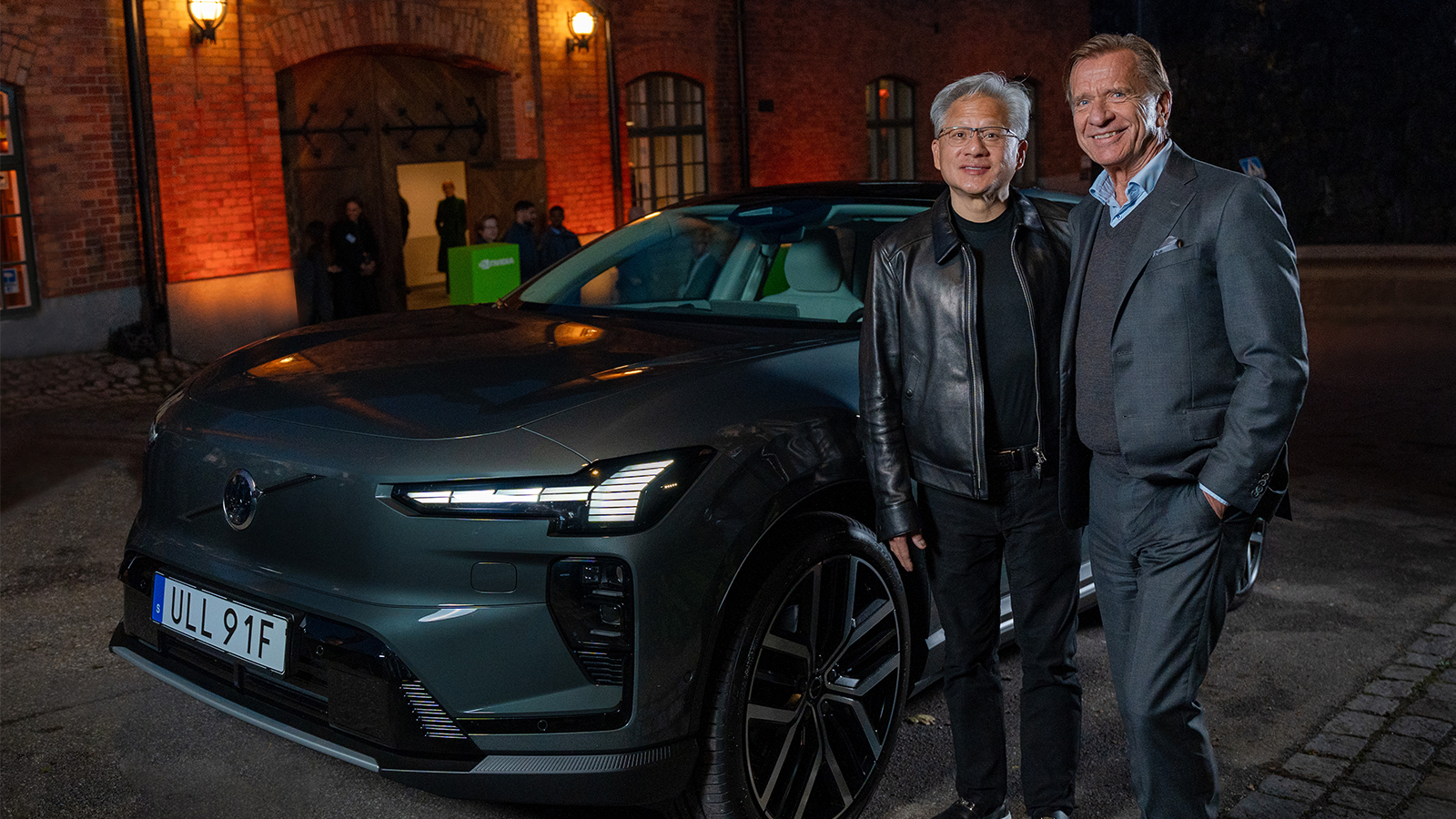
Volvo Cars and NVIDIA announced on October 15, 2026, an expanded decade-long partnership that will bring door-to-door automated driving, covering highways, city streets and parking, to a next-generation Volvo vehicle. The expansion combines Volvo's own vehicle safety systems with three NVIDIA technologies: the Hyperion sensor and compute architecture, the Halos safety operating system, and the Alpamayo Stack driving software, with the companies describing a gradual rollout toward eyes-off and mind-off driving rather than a single feature launch.
Volvo and NVIDIA have worked together since 2017, but this agreement moves the relationship from supplying compute hardware to co-engineering the full safety case for automated driving, a distinction that matters more to regulators and fleet buyers than to anyone reading a press release. The new platform will appear in a next-generation Volvo model as part of what the automaker has called its largest-ever product push, though neither company disclosed a launch date, a specific vehicle platform, or which markets would see the capability first.
Moving From Hardware Supplier to Safety Co-Engineer
The mechanics of the deal separate cleanly into three layers. Hyperion is NVIDIA's reference sensor and compute architecture, the physical stack of cameras, radar, lidar and processors that gives the car its view of the world and the horsepower to interpret it in real time. Halos is NVIDIA's safety operating system, the software layer responsible for monitoring the automated-driving stack itself and intervening when something in the sensor data, the compute pipeline or the vehicle's behavior falls outside safe bounds. Alpamayo Stack is the driving software that actually plans and executes maneuvers, from highway lane-keeping to the far harder problem of reading an unmarked urban intersection.
Buyers evaluating automated-driving suppliers should note what Volvo chose to keep in-house: its own vehicle safety systems and nearly a century of crash-safety engineering. Volvo is not outsourcing the definition of what counts as safe; it is pairing its own safety requirements with NVIDIA's compute and software so the combined system has to satisfy both the automaker's internal standards and NVIDIA's own safety architecture. That dual-accountability structure is the part of the announcement most likely to matter when regulators in Europe and the United States evaluate the resulting vehicle, since a single-vendor safety case is an easier target for scrutiny than one built on two independently audited layers.
Why "Door to Door" Is a Bigger Claim Than It Sounds
Most automated-driving systems on the market today are strong in one domain, highway cruising, for instance, and weak or entirely absent in others, such as dense urban streets or tight parking maneuvers. Volvo and NVIDIA are explicitly targeting all three in a single system: highways, busy urban streets and parking. That scope is the harder engineering problem, because the sensor coverage, compute budget and decision logic that work well on a highway at 110 kilometers per hour do not transfer cleanly to a pedestrian-dense city block or a tight multi-level parking structure. A system that genuinely handles all three without separate, bolted-on subsystems for each domain would be a meaningful technical step beyond most current advanced driver-assistance offerings, assuming the finished product matches the ambition stated in the announcement.
Hakan Samuelsson, Volvo Cars' president and chief executive, framed the collaboration as a pairing of two kinds of expertise: "Volvo has been synonymous with car safety for almost 100 years," combining what he described as industry-leading safety knowledge with world-class artificial intelligence technology. Jensen Huang, NVIDIA's founder and chief executive, put the underlying shift in computing terms: "Accelerated computing has transformed the car into an intelligent machine that can understand the world around it," pointing to the combination of Volvo's safety systems with NVIDIA Hyperion and Halos as the mechanism behind that transformation.
The Gradual Path to Eyes-Off Driving
The companies were explicit that the rollout will be gradual, introducing eyes-off and mind-off capability in stages rather than shipping full autonomy on day one. That sequencing is itself a signal worth reading: Volvo and NVIDIA are building toward a system where the driver can first look away from the road in defined conditions, and only later stop actively monitoring the drive at all, which is the difference between SAE Level 2-plus assistance and true Level 3 or Level 4 automation in regulatory terms. Automakers that have tried to skip straight to broad hands-off, eyes-off claims, rather than staging the rollout by domain and operating condition, have generally run into regulatory pushback or real-world incidents that forced a retreat. Volvo's public commitment to a staged approach suggests the company is positioning for regulatory approval as a first-order constraint, not an afterthought.
For fleet and procurement buyers, the practical question is timing, and the announcement deliberately leaves that open. No launch date, no named vehicle platform and no specific market sequencing were disclosed, which means this is a roadmap commitment rather than a product that can be ordered or budgeted for today. Buyers tracking automated-driving capability as a purchasing criterion should treat this as evidence of direction from two credible suppliers rather than as a near-term deliverable.
Volvo's Scale Gives the Partnership Commercial Weight
The announcement lands against a company backdrop that explains why NVIDIA is willing to co-engineer rather than simply sell compute. Volvo sold more than 710,000 cars in 2025, with 46% of that volume electrified, across more than 100 countries, and the automaker employed an average of 42,600 full-time staff. That is a large enough installed base and sales channel that a successful automated-driving rollout would meaningfully expand NVIDIA's footprint in consumer automotive compute, not just in a halo model but across a mainstream production run. Volvo's own stated target of net-zero greenhouse gas emissions by 2040 also puts the automated-driving push inside a broader electrification and software strategy, where the car increasingly competes on software capability rather than purely on mechanical engineering.
That scale cuts both ways. A safety failure in a system deployed across hundreds of thousands of production vehicles carries far more regulatory and reputational weight than the same failure in a low-volume pilot fleet, which is precisely why the dual-layer safety architecture, Volvo's own systems paired with NVIDIA Halos, matters as much as the headline automation claim. Competing automakers racing toward similar door-to-door automated-driving claims will be measured against Volvo's safety-first framing whether they intended to invite that comparison or not.
How the Deal Compares With Rival Automaker-Chipmaker Pairings
Volvo is not the first automaker to lean on NVIDIA for automated-driving compute. Mercedes-Benz, Jaguar Land Rover and several Chinese automakers have already adopted variants of the Hyperion architecture, and NVIDIA has spent several years positioning itself as the default compute and software supplier for automakers that do not want to build a full self-driving stack from scratch the way Tesla or Waymo have. What differentiates the Volvo agreement is the explicit inclusion of Halos as a dedicated safety operating system layered on top of the compute hardware, rather than treating safety validation as a separate function handled entirely by the automaker's internal engineering teams. Other NVIDIA automotive partners have generally licensed Hyperion for perception and compute while keeping their own in-house safety validation processes; Volvo's arrangement folds NVIDIA more deeply into that validation chain itself.
That distinction matters commercially because it changes where liability and engineering responsibility sit if something goes wrong. An automaker that buys compute hardware and writes its own safety case retains full control over, and full exposure for, the safety argument it presents to regulators. An automaker that co-engineers the safety operating system with its chip supplier is making a bet that NVIDIA's accumulated safety engineering across multiple automotive partners produces a more defensible system than what Volvo could build entirely alone, in exchange for a tighter coupling between the two companies' roadmaps and release cycles. For competing automakers, the practical takeaway is that the bar for what counts as a credible automated-driving safety case is moving toward this kind of jointly validated architecture, and suppliers who cannot point to an equivalent dedicated safety layer may find it harder to clear the same regulatory bar Volvo and NVIDIA are now aiming for.
What a Mainstream Automaker Brings That Robotaxi Operators Do Not
Much of the public conversation about automated driving over the past two years has centered on dedicated robotaxi operators, companies that design, own and operate a bounded fleet in a handful of cities under direct operational control. Volvo's approach is structurally different: a consumer-owned vehicle, sold through a traditional dealer network, driven by an owner who sets the destination and the route, operating across whatever mix of highways, cities and parking structures that owner happens to encounter. That is a substantially harder deployment pattern to validate than a robotaxi's pre-mapped operating area, because the vehicle has to perform safely in geographies and traffic conditions the manufacturer never specifically tested for.
Buyers and fleet operators tracking automated driving as a purchasing criterion should treat consumer-owned, geography-unbounded automation and operator-controlled robotaxi fleets as two different product categories that happen to share underlying compute suppliers. A system that eventually clears the bar for the Volvo-NVIDIA partnership would represent a broader and commercially larger validation of automated driving than any single-city robotaxi deployment, precisely because it has to work everywhere the owner decides to drive, not just where the operator chose to deploy it.
What to Watch Next
The next concrete marker will be Volvo naming the specific vehicle platform and market where the Hyperion-Halos-Alpamayo combination first ships, since that disclosure will convert a roadmap commitment into a dated product plan that regulators, competitors and buyers can actually evaluate. A second marker worth tracking is whether Volvo or NVIDIA publishes the safety validation data behind the "eyes-off" and "mind-off" claims before launch, since regulators in the European Union and the United States have increasingly demanded disclosed test data rather than marketing assurances before approving higher levels of automation. Until either marker appears, this announcement should be read as a credible expansion of a proven decade-long partnership, not as confirmation that door-to-door automated driving is imminent in showrooms.
This account synthesizes NVIDIA's October 15, 2026 press release announcing the expanded Volvo Cars partnership, including statements attributed to Hakan Samuelsson and Jensen Huang, as of the stated publication date.
This article is provided for general information purposes only and does not constitute investment, procurement, legal, or engineering advice. Figures reflect the sources listed above as of the stated information cut-off and may change without notice.