120ft Puts Humanoid Robots in Shipping Containers, Sells by the Part
Swedish startup 120ft raised EUR576,000 to build shared microfactories, three shipping containers staffed by humanoid robots, that charge brands per finished part rather than per robot or facility.


Most manufacturers who want humanoid robots on a production line face the same arithmetic problem: a single unit costs tens of thousands of dollars, needs integration work before it is useful, and sits idle whenever order volume dips below whatever throughput justified buying it. 120ft, a Stockholm, Sweden-based startup, is betting that the fix is to make sure its customers never own a robot at all. The company has raised EUR576,000, approximately US$625,000, from 22 angel investors to build shared microfactories, manufacturing cells built from three standard 40-foot shipping containers and staffed entirely by humanoid robots, that brands rent by the finished part rather than by the machine.
120ft's pitch is a manufacturing-as-a-service model rather than a robotics-hardware sale: the company intends to own and operate the microfactories itself, and charge customers per completed product rather than for access to the robots or the floor space. Founder and chief executive Martin Willers previously co-founded the speaker company Transparent and the design studio People People, which gives 120ft a founding team with product and industrial-design experience rather than a robotics research background, a detail worth noting for buyers assessing whether the company understands manufacturing operations or is approaching the problem purely as a robotics showcase.
Three Containers, Three Jobs
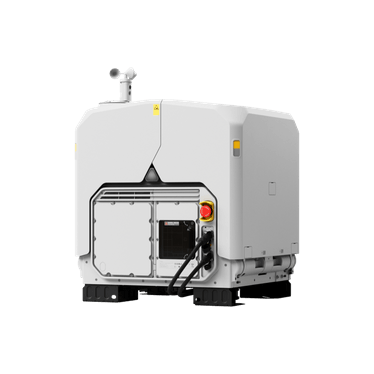
The physical design is deliberately modular and portable. One 40-foot container handles incoming components, receiving and staging the parts that will go into a finished product. A second container is dedicated to assembly, where the humanoid robots perform the actual joining work. A third handles inspection and packing, the quality-control and shipping-preparation step before a finished product leaves the facility. Because the entire unit is built from standard shipping containers, 120ft can in principle relocate or replicate a microfactory wherever demand justifies it, without the multi-year lead time and capital commitment of building or leasing a purpose-built factory floor.
That modularity is the company's answer to one of the hardest problems in small-batch contract manufacturing: matching fixed production capacity to variable, often seasonal or trend-driven demand. A conventional factory represents a large sunk cost that has to run near capacity to make financial sense, which pushes manufacturers toward either overbuilding capacity they will not always use or underinvesting and turning away orders during demand spikes. A container-based, humanoid-operated cell that can be added, relocated or idled without the same capital stranding risk changes that calculation, at least in theory, for brands whose production needs do not justify committing to a dedicated factory.
Starting Narrow on Purpose
120ft is not promising to make anything yet. Its initial pilots are scoped narrowly to rigid parts weighing under 5 kilograms that can be joined with screws or press-fit connections, excluding cables, flexible materials and gluing from the first phase of deployment. That scoping choice is the detail procurement teams should pay closest attention to, more than the funding figure or the container concept itself. Humanoid robots remain genuinely difficult to trust with flexible materials, cable routing and adhesive work, tasks that require fine tactile feedback and compliant motion that rigid-part assembly does not demand to the same degree. By restricting its pilots to the easier end of that difficulty spectrum, 120ft is choosing a path that plays to the current state of humanoid manipulation technology rather than overselling what a robot can reliably do today.
Based on imagery the company has published, the humanoid units running 120ft's pilot containers appear to be Unitree G1 robots, a widely available commercial humanoid platform, though this is an inference from the images rather than a specification the company has formally disclosed. If accurate, it means 120ft's core technical contribution is not building a proprietary humanoid, but integrating an off-the-shelf robot into a repeatable, container-based manufacturing cell and a pay-per-part commercial model, a lower-risk and faster path to a working pilot than developing both the hardware and the service from scratch.
Why Rent-the-Output Beats Rent-the-Robot
The commercial structure is the part of 120ft's pitch most likely to interest procurement and operations leaders who have already looked at humanoid robots and concluded the economics do not work for their volume. A robotics-as-a-service lease, where a customer pays a monthly fee for access to a robot, still leaves the customer responsible for integration, line balancing, and the risk that the robot sits idle during slow periods while the lease payment continues regardless. 120ft's pay-per-finished-product model shifts that utilization risk onto 120ft itself: if a customer's order volume drops, so does what they pay, because the fee is tied to output rather than to machine time. That is a meaningfully different risk allocation than most humanoid-robot commercialization approaches have offered so far, most of which still price around the robot rather than around the finished good.
For 120ft, that model only works financially if the company can keep its microfactories running close to capacity across multiple customers sharing the same physical cells, which is the actual bet behind the shared-microfactory language in its own pitch: aggregating demand from several brands into one facility to keep utilization high enough that per-part pricing remains profitable even after accounting for the capital cost of the containers and robots. Whether that aggregation works depends on 120ft finding enough customers with compatible, rigid, screw-or-press-fit parts to fill a shared facility's capacity, a sales and operations challenge that is arguably harder than the robotics integration work itself.
How 120ft's Bet Differs From Other Humanoid Manufacturing Plays
120ft's container model sits apart from two more common approaches to humanoid robots in manufacturing. The first is the large industrial automaker or contract manufacturer buying humanoids to staff its own existing factory floor, the approach companies like 1X Technologies and Agility Robotics have pursued with warehouse and logistics customers, where the robot is deployed inside a facility the customer already owns and operates. The second is the humanoid maker selling or leasing the robot itself as a standalone product, leaving integration, line design and utilization risk with the buyer. 120ft is proposing a third structure: it owns and operates the entire production cell, container, robots and process included, and sells only the finished output, which means a customer never has to evaluate humanoid robotics as a capital purchase or a facilities question at all.
That structure trades scale for simplicity. A large manufacturer with predictable, high-volume demand for a single part is usually better served building or buying dedicated automation sized to that exact volume, where per-unit costs fall as volume rises. 120ft's model is built for the opposite case: brands with variable, uncertain or seasonal demand for relatively simple rigid parts, who would otherwise either overpay a traditional contract manufacturer for small production runs or underuse a dedicated automation investment of their own. European contract manufacturing, long criticized by domestic brands for high per-unit costs on small runs compared with manufacturing in Asia, is the market most directly exposed to a credible lower-cost, flexible-capacity alternative, if 120ft can actually deliver on quality and lead time once real customer orders start flowing through a container rather than a demonstration.
A Small Round for an Unproven Model
EUR576,000 (approximately US$625,000) from 22 angels is a pre-seed-sized round, not the kind of capital that funds building and operating multiple physical microfactories at scale. It is enough to build and demonstrate a working pilot cell, which appears to be exactly what 120ft intends to do before raising a larger round on the strength of real production data rather than a concept pitch. Buyers and competitors should read this funding announcement as evidence that 120ft has cleared the first credibility bar with angel investors, not as confirmation that the shared-microfactory model works at commercial scale; that proof will come, if it comes, from the pilot's actual throughput, defect rates and customer retention once containers are running real production orders rather than demonstrations.
Picture the end state 120ft is selling: a brand that needs a few thousand units of a small plastic or metal part, with no factory of its own, no robots to buy or maintain, and no idle capacity to carry between orders, simply places an order and a shipping container somewhere does the rest. Whether that container ever fills with real, paying production runs, rather than remaining a single demonstration cell in a Stockholm industrial park, is the only test that will actually answer whether 120ft's shared-microfactory model works at the scale its pitch requires.
This account synthesizes Humanoids Daily's October 15, 2026 reporting on 120ft's funding announcement, cross-referenced against SiliconANGLE's coverage of the same raise and 120ft's own public website, as of the stated publication date.
This article is provided for general information purposes only and does not constitute investment, procurement, legal, or engineering advice. Figures reflect the sources listed above as of the stated information cut-off and may change without notice.