Two Hackers Raised US$71 Million to Put 100 Robots on the Internet and Let Strangers Drive Them
Unit 8200 alumni Jonathan Jacobi and Gal Niv emerged from stealth with Index Ventures and Ribbit Capital leading, plus angels from OpenAI, Anthropic, xAI, Thinking Machines, and Cognition. Over 100 in-house robots are publicly drivable online, doubling as an interaction-data flywheel. Thesis: the human-robot interface layer is the industry’s missing GUI moment. Skeptical frame preserved: no disclosed business model.

The largest robotics seed round of the summer did not go to a humanoid maker. It went to a one-year-old research lab that thinks the industry has the problem backwards. Enigma, founded by Israeli cybersecurity prodigies Jonathan Jacobi and Gal Niv, emerged from stealth on July 27 with a US$71 million seed round led by Index Ventures and Ribbit Capital, with participation from Sarah Guo's Conviction Partners and executives and researchers from OpenAI, Anthropic, Thinking Machines, xAI, and Cognition.
The company's opening move is as unusual as its cap table: it has put more than 100 proprietary AI robots, housed in hangars in Israel and California, onto a public online platform where anyone can interact with them in real time. Visitors can watch and direct robotic arms painting with brushes, sword-fighting each other, and running simple chemistry experiments with flasks. Enigma says both the robotic arms and the AI models behind them were developed in-house from the ground up, and that the platform doubles as a large-scale experiment in how ordinary people actually engage with machines.
That experiment is the company's core bet. "No matter how good robots get, if they aren't intuitive enough, not enough people will use them," Jacobi told reporters at launch. His analogy of choice is the car volume knob: nobody reads a manual to turn up the radio, and nobody should need an engineering degree to redirect a robot. In Enigma's telling, the binding constraint on the robot economy is no longer actuation or even intelligence, but the interface layer, the missing equivalent of the graphical user interface that turned computers from institutional equipment into personal tools.
Outsiders by Design
Neither founder is a roboticist, and their lead investor considers that the point. "They're outsiders — they're not roboticists. It affords them more room for originality," Index Ventures partner Shardul Shah said of the pair. Jacobi became Microsoft's youngest-ever employee after being recruited by Wiz founder Assaf Rappaport, later worked at Check Point, and first met Niv as a rival in teenage hacking competitions before the two served together in Unit 8200, Israel's elite cyber-intelligence unit, where Niv became one of its youngest cyber operations managers. The wider team draws on alumni of top AI labs, mathematics Olympiad winners, and PhD dropouts.
The founding story has a domestic origin. Jacobi describes watching a robot take fifteen minutes to load dishes and concluding, "Forget it, I'll just do it myself." That impatience, common to anyone who has watched a teleoperated humanoid fold a towel at one-quarter human speed, is the emotional core of the pitch: robots will not cross into everyday life on capability alone. They must be effortless to command, and today they are not.
Technically, Enigma claims progress on two fronts that matter to anyone tracking embodied AI economics. First, it says its training approaches reduce the need for manually collected physical demonstration data, the expensive human-teleoperation feedstock that companies from Scale AI's robotics arm to China's data-collection factories currently sell by the hour. Second, it is building what it describes as an AI layer that can power different types of robots across environments and tasks, cutting the custom engineering that today makes every deployment a bespoke project. The US$71 million will fund larger AI research and engineering teams, GPU compute, and the robotics software platform itself.
The Interface Thesis Meets the Data Thesis
Enigma's public robot platform is best understood as both marketing and instrumentation. Every stranger who logs on to fence with a robot arm or botch a chemistry pour is generating exactly the interaction data the company says the field lacks: how untrained humans phrase commands, where they get frustrated, what feedback loops keep them engaged. It is the same flywheel logic that made consumer chatbots the world's largest human-preference data collectors, transplanted to physical machines. "We're going to learn a lot about what is the right way to interact with robots," Jacobi said.
A fair-minded skeptic will note what Enigma has not disclosed: a business model. The company names healthcare, logistics, entertainment, and retail as sectors where it is already partnering, but it has not said what it sells, to whom, or at what price, and a US$71 million seed for a pre-product research lab is precisely the kind of cheque that ages badly if the interface thesis turns out to be a feature rather than a company. The counterargument is the composition of the round itself. Ribbit Capital, a fintech specialist, and Conviction, an AI-native fund, do not underwrite robot hardware margins; they underwrite software layers that aggregate demand. The presence of angels from five frontier AI labs suggests the people building foundation models see the human-robot interface as an open problem worth owning, not a solved one.
History offers the founders a favourable precedent, if they can live up to it. Every prior computing platform reached mass adoption only after an interface breakthrough that looked trivial next to the underlying engineering: the mouse and windowed desktop for the PC, the touchscreen for the phone, the chat box for large language models. In each case the enabling hardware existed years before the interface unlocked demand, and in each case the company that owned the interface captured a disproportionate share of the platform's economics. Robotics in 2026 sits in the pre-interface phase of that cycle. Machines can walk, grasp, and increasingly reason, yet commanding them still requires engineers, teach pendants, or teleoperation rigs. Enigma is explicitly positioning to be the interface event for physical machines, and its investors are pricing it accordingly.
The round also stands out for its sheer position on the seed distribution.
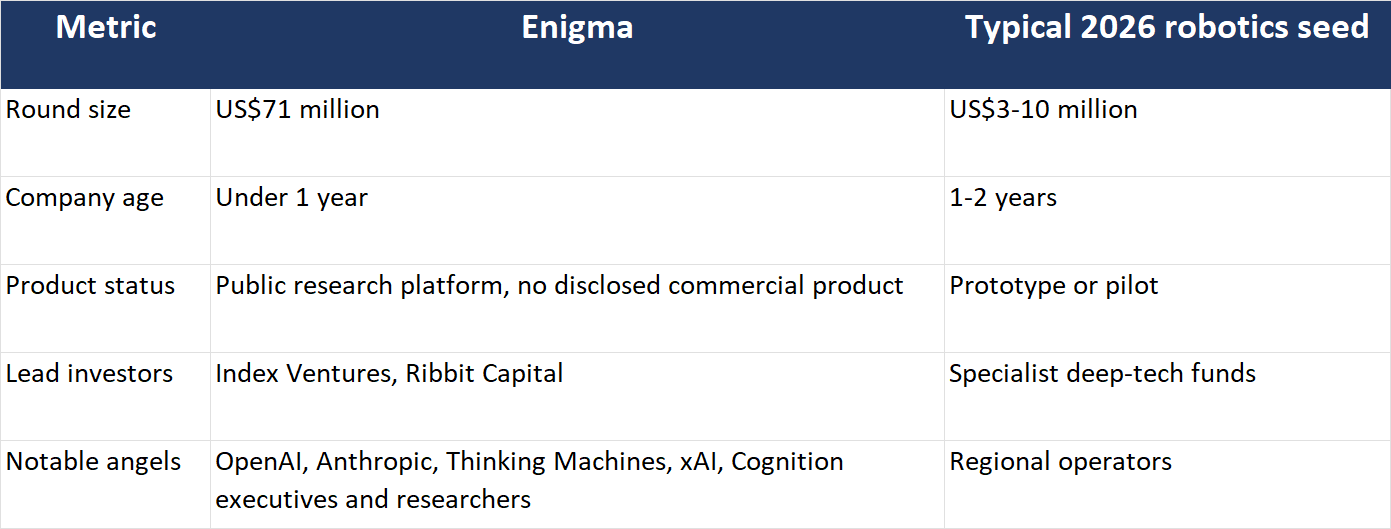
There is a market-structure reading too. The seed lands in a month when capital has been flowing to every layer of the embodied AI stack except this one: China's dexterous-hand and actuator startups repriced the component layer, listed platforms like Horizon Robotics raised at near-zero cost, and infrastructure players attracted billions for AI factories. Almost nobody has raised at scale for the layer where a warehouse supervisor, a nurse, or a hotel manager actually tells a robot what to do. If robots are to be operated by the people who already work in those buildings rather than by fleets of remote teleoperators, someone has to build that layer, and Enigma has just been funded like the category leader before the category exists.
The comparison that will define its next eighteen months is unforgiving. Physical Intelligence raised at a US$5.6 billion valuation on the strength of its π-series foundation models; Skild AI commands billions for a general robot brain; and in Shanghai this same week, a state-backed institute open-sourced a long-horizon vision-language-action model for free. If capable robot brains become abundant and cheap, the scarce asset shifts to whoever owns the relationship between humans and machines, which is Enigma's wager exactly. If instead the model layer captures everything, an interface company becomes a feature of someone else's stack.
What to Watch
Three markers will show whether the wager is paying off. The first is traffic and retention on the public platform: an interface experiment is only as good as the number and diversity of humans it observes, and Enigma has chosen a metric that outsiders can partially verify just by logging on. The second is whether the promised cross-robot AI layer ships on third-party hardware, not just Enigma's own arms; the claim of reduced dependence on manually collected physical data is testable the moment another manufacturer's robot runs Enigma software in a customer site. The third is the first disclosed commercial contract in one of the four named sectors, which will reveal whether the business is data, software licensing, or operations.
For the robotics industry at large, the round extends a pattern this publication has tracked all month: the money is migrating from the robot body to everything around it, data, compute, simulation, and now the human-facing control layer. Two hackers who never built a robot before last year just raised more in a seed round than most humanoid startups raised in their Series A, on the argument that the hardest part of the robot revolution is not making machines move, but making people want to use them. The industry will find out soon whether that is profound or merely fundable. For now, the most telling fact is the simplest one: on the day Enigma came out of stealth, the fastest way to understand what it does was not to read the press release but to open a browser tab and pick up a virtual sword, which is, of course, exactly the point the founders are trying to make about how robots should be experienced.
This article is for informational purposes only and does not constitute investment advice. Readers should conduct their own research before making investment decisions.