The World's Biggest Robot Vacuum Maker Just Gave Away Its Home Robot, and Its Reasons Are a Manifesto
Ecovacs, the Suzhou company that leads the world in robot vacuums, has fully open-sourced its Bajie embodied robot, from hardware design to the underlying system, and opened a physical Bajie Open-Source Innovation Space in Suzhou, with the announcement covered by QbitAI from the July 25 event. The wheeled, one-armed home robot runs a 7-billion-parameter model locally on dual RK3588 chips, and chairman Qian Dongqi paired the giveaway with a contrarian argument: household robots do not need to be humanoid, end-to-end VLA models are overrated for homes, and embodied AI's ChatGPT moment has not arrived.
While China's humanoid startups spent the weekend teasing silhouettes and filing for IPOs, the company that actually put more robots into homes than anyone else on earth did something stranger: it gave its newest robot away. Ecovacs, the Suzhou-based maker whose vacuums clean floors in tens of millions of households, announced that it has fully open-sourced Bajie, the embodied home robot it launched earlier this year, from hardware design down to the low-level system code, and opened a physical Bajie Open-Source Innovation Space in its home city where developers, students, and companies can use the platform free of charge.
The announcement, made at a Suzhou event covered by Chinese tech outlet QbitAI on July 25, comes wrapped in an argument that cuts against nearly every orthodoxy of the current embodied AI boom. Ecovacs founder and chairman Qian Dongqi used the occasion to say aloud what many deployment engineers mutter privately: home robots do not need to look human, end-to-end vision-language-action models are not ready for the messy specificity of real households, and the industry's ChatGPT moment has not arrived. From a company with fourteen years of home robot deployments, tens of millions of machines in the field, and a Shanghai-listed balance sheet behind the giveaway, the manifesto carries considerably more weight than a startup's pitch deck, because Ecovacs is the rare speaker whose opinions about home robots have been audited by actual households at scale.
What Ecovacs actually opened
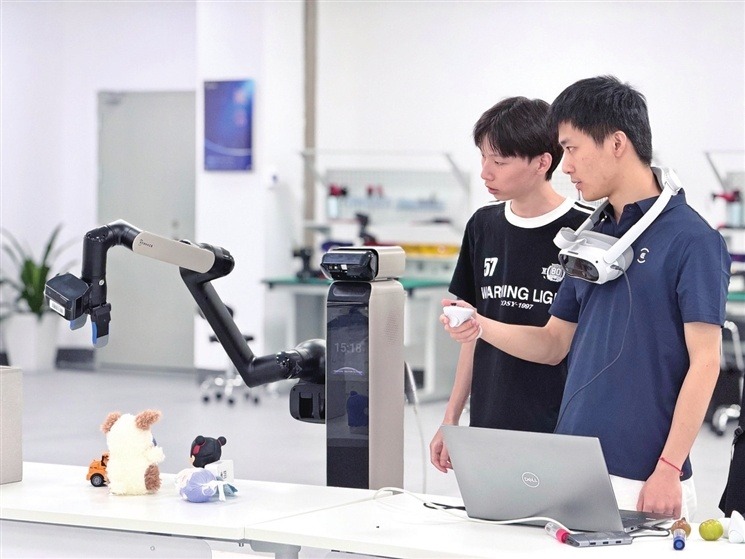
The Bajie platform itself is a study in pragmatism. Instead of legs, it rides a silent wheeled chassis, which Qian notes is quieter and dramatically more power-efficient than bipedal walking, no small matter for a machine meant to live in an apartment. Instead of two five-fingered hands, it carries a single six-degree-of-freedom arm with an 800-millimeter reach, a two-finger gripper with integrated ultraviolet self-cleaning, a 44-centimeter body lift, and a cargo tray. Force sensing runs through arm and gripper, and a power-loss soft-descent strategy keeps a falling arm from damaging whatever, or whomever, is below it. Compute is dual Rockchip RK3588 systems-on-chip, fused and PCI-E expandable, running a 7-billion-parameter model entirely locally, with no cloud round-trip for core functions, a privacy and latency posture that most humanoid vendors have not matched. Every one of those choices trades spectacle for deployability, which is to say every one of them is the choice a company makes when it expects to be judged by returns departments rather than conference audiences.
The open-sourcing is unusually complete by the standards of corporate robotics. Ecovacs is releasing the full low-level system source code and its on-body AI agents, OpenClaw and Hermes, with four access tracks graded by user sophistication: natural-language command for ordinary users, a C++ and Python SDK of atomic skills for developers, SSH and serial access with custom ROS2 node support for researchers, and secondary development channels for enterprises. Source code sits on AtomGit and GitHub, with an online community, visual control platform, skill marketplace, and documentation open to any developer without application or review. The first target tasks, drawn from user research, are almost defiantly domestic: tidying toys, organizing shoes, collaborative laundry handling, fetch-and-carry, and desktop cleanup.
For a plain-language analogy, Ecovacs is attempting for home robots what Google did for smartphones with Android: give away the operating layer to everyone, so the ecosystem's applications get built on your platform, and monetize the hardware and services that ride on top. The company that already owns the home's floors is bidding to own the home's robot developer community too.
The company making the bet
For readers who know Ecovacs only as a logo on a vacuum, the company's standing is worth stating. Founded in Suzhou in 1998 as a vacuum-cleaner contract manufacturer, it built the Deebot line into the world's best-selling robot vacuum family, listed on the Shanghai Stock Exchange in 2018, and now sells across more than 100 markets alongside its Tineco floor-care brand. Its core technology is exactly the layer home embodied AI needs most: simultaneous localization and mapping in cluttered apartments, obstacle recognition trained on the world's largest corpus of real household imagery, and the manufacturing discipline to build sensor-dense machines at consumer prices. Its market niche has always been the unglamorous one, machines that work every day in real homes, which is the niche the humanoid industry has yet to enter.
The timing of the giveaway also tracks the category's economics. Robot vacuums have become a saturated, price-warred market in which Ecovacs, Roborock, and Dreame all need a second act, and all three have chosen embodied AI as that act, with Dreame famously spinning up humanoid and even flying-car programs. Ecovacs choosing openness over spectacle is a differentiated answer to the same shareholder question: what comes after the vacuum?
The contrarian argument underneath
Qian's reasoning deserves attention because it comes from deployed experience rather than theory. Robots, he argues, were originally conceived for hard labor, and nothing about a household task requires the laborer to be human-shaped; the humanoid form is a solution in search of a justification in domestic settings. On the fashionable end-to-end VLA architectures, where a single model maps camera pixels to motor commands, he is openly skeptical for the home, preferring what he calls a thousand faces for a thousand homes: per-household tuning, because no two apartments, families, or clutter patterns are alike. And he proposes two tests any embodied product must pass before declaring victory, technological readiness and a closed loop of consumer willingness to pay, tests he says the industry has not yet met, which is why, in his phrase, embodied AI's ChatGPT moment has not arrived.
The company's history explains the confidence. Ecovacs shipped its Qinbao home service robot in 2012, years before the current boom, deployed its Wangbao public-service robots into banks and government halls, and has iterated home robotics through fourteen years of actual consumer returns, warranty claims, and app reviews. At AWE this year, Bajie was the industry's first embodied robot shipping with the OpenClaw agent. When a company with that deployment record says one firm alone cannot complete the environmental-cognition puzzle, and backs the claim by giving away its platform, it is describing a lesson paid for in recalls and one-star reviews.
The skeptical reading writes itself, and it should be aired. Open-sourcing is also what companies do when a product needs an ecosystem it cannot build alone, and Bajie's commercial traction since launch has not been disclosed. Ecovacs faces brutal competition in its core vacuum market from Roborock and Dreame, both of which are also pushing into arms and embodied features, and handing developers a free platform is a cost-efficient way to outsource the search for the home robot's killer application. The four access tracks and the physical Suzhou space are ecosystem infrastructure, but they are also a admission that Ecovacs does not yet know which household tasks will make this category indispensable, so it is paying the developer community, in hardware access rather than cash, to find out.
There is also a genuine strategic tension between openness and control. Android succeeded because Google controlled the services layer even as it opened the OS. What Ecovacs controls is manufacturing scale and channel distribution, real advantages, but ones that matter only if the Bajie form factor wins. If the home robot market ultimately tips toward humanoids, as Unitree, BYD, and this year's capital flows are betting, an open-source wheeled platform becomes a well-documented dead end.
The non-humanoid counterweight
That is precisely why this release matters to readers beyond the smart-home aisle. This weekend alone, this publication is reporting a BYD humanoid teaser, a Japanese teardown conceding China's humanoid hardware lead, and a tactile dataset aimed at humanoid-grade dexterity. Ecovacs supplies the counterweight: the largest installed base in home robotics is placing a public, fully financed bet that the winning domestic robot is wheeled, one-armed, locally intelligent, and cheap to run, and that the path to the robot butler goes through tool, then butler, then companion, in that order, a roadmap Qian states explicitly. The quotable version: the company that already won the home's floors just declared the humanoid race optional, and open-sourced its alternative to prove it.
For developers and product strategists, the practical takeaway is that a free, fully documented, force-sensing home manipulation platform with a skill marketplace now exists, with no application gate, from a manufacturer that can produce at consumer-electronics volume. The evaluation checklist over the coming quarters is concrete: whether the GitHub and AtomGit repositories stay current or drift behind internal builds, the fate of the first hundred community skills in the marketplace, whether any Western university adopts Bajie as a teaching platform the way labs adopted TurtleBot a decade ago, and whether Roborock or Dreame feel compelled to answer with openness of their own. An open platform is a promise renewed with every commit, and the repository history will tell the truth about Ecovacs's commitment long before any press release does. Whether Bajie becomes home robotics' Android or its Symbian will be decided by what the community builds on it in the next four quarters. Either way, the era in which embodied AI platforms compete by giving themselves away has now reached the home, and it started in Suzhou, not Silicon Valley.
Disclaimer: This article is for general information purposes only and does not constitute investment, legal, or procurement advice. Readers should verify details with primary sources before making business decisions.