Seoul Flies Its Entire AI Supply Chain to San Francisco for a Week of Deal-Signing
South Korean President Lee Jae Myung landed in San Francisco on July 24 to open an eleven-day tour with the most concentrated schedule of AI diplomacy any head of state has attempted: back-to-back one-on-ones with the chief executives of Anthropic, OpenAI, Nvidia, and Broadcom, followed by a 150-person AI summit where Samsung's Lee Jae-yong, SK's Chey Tae-won, and Hyundai's Chung Eui-sun will sign memoranda with American big tech. Lee will unveil a San Francisco AI Declaration extending his government's three AI mega projects, a program in which physical AI and robotics carry much of the industrial weight. Korea is placing a state-orchestrated bet that its chaebol hardware base plus American compute equals a seat among the AI superpowers.
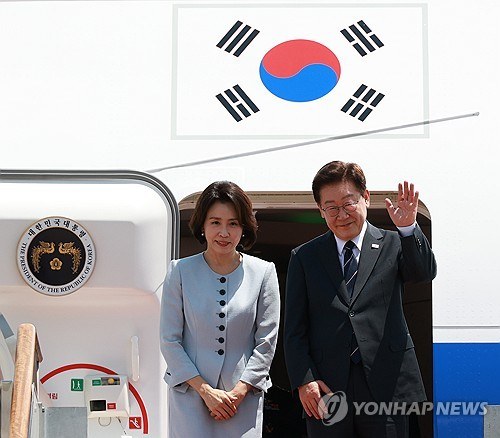
When South Korea decided to escalate its artificial intelligence ambitions, it did not send a delegation. It sent the president, the first lady, and the chairmen of Samsung, SK, and Hyundai, all converging on San Francisco in the same week.
President Lee Jae Myung's aircraft touched down at San Francisco International Airport at 8:23 in the morning local time on July 24, opening a seven-night, eleven-day tour of the United States and South America whose first and most consequential stop is a burst of AI diplomacy in the Bay Area. San Francisco Mayor Daniel Lurie, Korean Ambassador to the United States Kang Kyung-wha, and Consul General Lim Jung-taek met him on the tarmac, according to Dong-A Ilbo.
The schedule that follows is remarkable in its concentration. Lee's first official engagements are sequential one-on-one meetings with four executives who together control the commanding heights of the AI supply chain: Anthropic chief executive Dario Amodei, OpenAI chief executive Sam Altman, Nvidia chief executive Jensen Huang, and Broadcom president and chief executive Hock Tan. No previous Korean president has stacked meetings with foundation-model labs and chip suppliers in this way, and few heads of state anywhere have.
A Summit Built to Produce Signatures
The centerpiece is an AI summit gathering roughly 150 participants: global big tech chief executives, AI companies, researchers, startups, and investors, alongside the heaviest names in Korean industry. Samsung Electronics chairman Lee Jae-yong, SK chairman Chey Tae-won, Hyundai Motor Group chairman Chung Eui-sun, and Naver founder Lee Hae-jin are all attending, and memoranda of understanding between Korean companies and American big tech firms are scheduled to be signed at the event itself. The president will cap the gathering by announcing what his office calls the San Francisco AI Declaration, a statement of intent for what it describes as a leap in the global AI ecosystem, before hosting a dinner for Korean corporate leaders and their American counterparts.
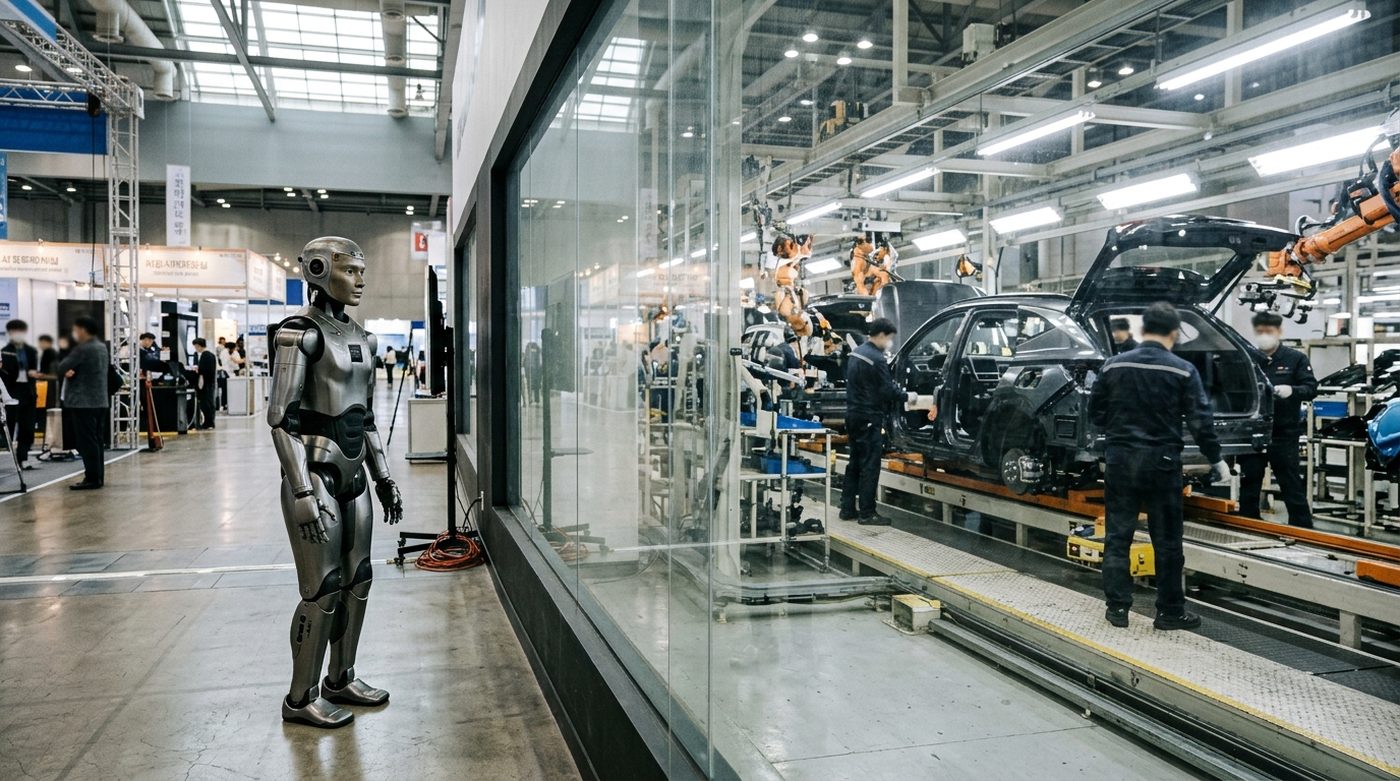
The summit is explicitly framed as the international extension of the three AI mega projects Lee's government announced earlier this month, a program of large-scale state investment intended to vault Korea into the top tier of AI nations. The mega projects link government capital to sovereign compute infrastructure, industrial AI transformation, and, critically for this audience, physical AI: the application of foundation models to robots, factories, and machines, the domain where Korea believes its industrial DNA gives it an edge no amount of American software can replicate.
The Robotics Subtext Is the Text
Read the guest list through a robotics lens and the trip's real architecture becomes visible. Chung Eui-sun chairs the group that owns Boston Dynamics, is building a robot-ready manufacturing base in the American South, and this week publicly separated its humanoid deployment plans from wage negotiations with its Korean union. Lee Jae-yong's Samsung has spent the year converting Rainbow Robotics into a consolidated subsidiary and standing up an RX robotics division. Jensen Huang has spent two years evangelizing physical AI as the next platform, and Nvidia's chips sit inside most of the world's robot development programs. Even Broadcom's Tan matters here: custom AI accelerators are becoming the cost lever for anyone running large fleets of embodied machines.
Think of the trip as Korea shopping for the one component it cannot build at home. Korea's national kit already contains world-class robot hardware, actuators, batteries, displays, memory, shipbuilding, and automotive manufacturing at scale. What it lacks is frontier model capability and preferential access to the compute that trains it. The San Francisco itinerary, model labs first, chip suppliers second, chaebol signing ceremonies third, is a supply chain being assembled in public, with the state as the general contractor.
The timing on the American side is equally deliberate. Seoul is negotiating its industrial relationship with Washington in a season when the House has just passed a defense bill barring Pentagon procurement of Chinese humanoid robots and when American policy is actively sorting allies into trusted and untrusted technology tiers. Every memorandum signed in San Francisco doubles as a flag planted on the trusted side of that line, and Korean robotics companies, from Hyundai's Atlas program to Samsung-backed Rainbow, stand to inherit demand that Chinese suppliers are being legislated out of.
What Each Chaebol Actually Needs From the Table
The corporate delegations are not traveling for the group photograph, and their individual shopping lists explain the summit's architecture better than the official program does. Samsung arrives as both supplier and customer: its memory and foundry businesses want deeper design wins inside American AI accelerators, while its device and robotics units, from the Ballie home robot to the RX division's industrial ambitions, need frontier models to animate the hardware. SK's stake is the most direct commercial dependency in the room, since SK Hynix's high-bandwidth memory is already the binding physical constraint on Nvidia's accelerator shipments, and every incremental GPU commitment Huang makes anywhere in the world flows back through SK's fabs as demand.
Hyundai's calculus is the most robotics-specific. The group has committed billions to American manufacturing capacity and owns the most famous legged-robot maker on earth, but Boston Dynamics' Atlas still needs what Korea cannot yet supply: a foundation model stack that converts world-class hardware into general-purpose usefulness. A co-development channel with an American lab, formalized under state auspices, would be the missing layer of that stack arriving on politically stamped paper. Naver, the least known name abroad, rounds out the strategy; it is one of the few companies outside the United States and China operating its own hyperscale AI infrastructure, and it anchors the sovereign-compute leg of the mega projects.
The sovereign compute arithmetic deserves a number. Korea's government has spoken of securing hundreds of thousands of GPUs this decade for national AI infrastructure, an ambition that at current accelerator prices implies tens of trillions of won in capital deployment, before a single model is trained. Nothing at that scale can be purchased on the open market in useful timeframes; it must be negotiated, which is precisely why the president's itinerary runs through Huang and Tan rather than a procurement portal. Allocation, in the AI economy of 2026, is a diplomatic outcome.
What Could Make the Declaration More Than Paper
A common misconception about presidential technology summits is that the communiqué is the deliverable. It rarely is. The San Francisco AI Declaration will be judged not by its language but by what the accompanying memoranda actually commit: reserved GPU capacity for Korean sovereign compute, joint research centers with the model labs, co-development agreements that put Korean robots on American factory floors, or procurement channels for Korean physical AI in the United States market. Those details, not the declaration, will determine whether this week registers as a turning point or a photo opportunity.
The skeptical case writes itself. Korea's government has announced ambitious technology moonshots before, and the gap between mega project announcements and appropriated, deployed capital can swallow years. The chaebol chairmen signing memoranda this week face their own constraints, from semiconductor cycle pressures to labor disputes at home, and American AI labs sign cooperation documents with many governments while reserving their frontier capabilities for themselves. Sovereignty through partnership is a delicate construction: the harder Korea leans on American models and chips, the more its AI stack depends on decisions made in Washington and San Francisco rather than Seoul. The memoranda signed this week will need line items in next year's budget, and export-control weather in Washington can reprice any of them overnight.
But the counterargument is the trip itself. Lee has chosen to spend the opening week of a major diplomatic tour, and his personal political capital, on placing Korea inside the AI supply chain at the highest possible level. For the robotics industry specifically, a state that treats physical AI as a pillar of national strategy, backs it with mega-project capital, and brokers its companies into partnership with the American compute complex is building exactly the kind of demand floor that China constructed for its own robot makers through provincial investment funds.
For robotics investors and operators outside Korea, the practical takeaway is about demand geography. If even a fraction of the summit's memoranda convert into funded programs, Korea becomes one of the few places on earth where humanoid and industrial robot deployment is simultaneously pushed by state capital, pulled by conglomerate manufacturing need, and lubricated by preferential access to American models and compute. That combination is precisely what turned Chinese provinces into the world's fastest robot adoption zones, and Korea is assembling its own version with fewer robots but better silicon. Suppliers of actuators, sensors, and integration services should read the San Francisco guest list as a map of next year's procurement budgets.
Two of the world's three great robotics powers now run national strategies with the head of government personally closing deals. The third, the United States, still lets its market do the closing. San Francisco this week is where the second model comes to visit the third, and the robots will be watching what gets signed.
Disclaimer: This article is for general information purposes only and does not constitute investment, legal, or procurement advice. Readers should verify details with primary sources before making business decisions.