SAIC, CATL, and BYD Money Just Backed a Huawei Veteran's Bet That Robots Should Carry People First
Physical AI company founded by Huawei/Baidu-Apollo veteran Wu Shulin closed several hundred million yuan across angel rounds from CDH VGC, Linear Capital, and SAIC-, CATL-, and BYD-affiliated funds plus Chow Tai Fook. Product: Quorra X5 personal mobility vehicle with autonomous following. Thesis: the autonomous-driving diaspora and auto capital claiming personal mobility as physical AI’s near-term wedge.
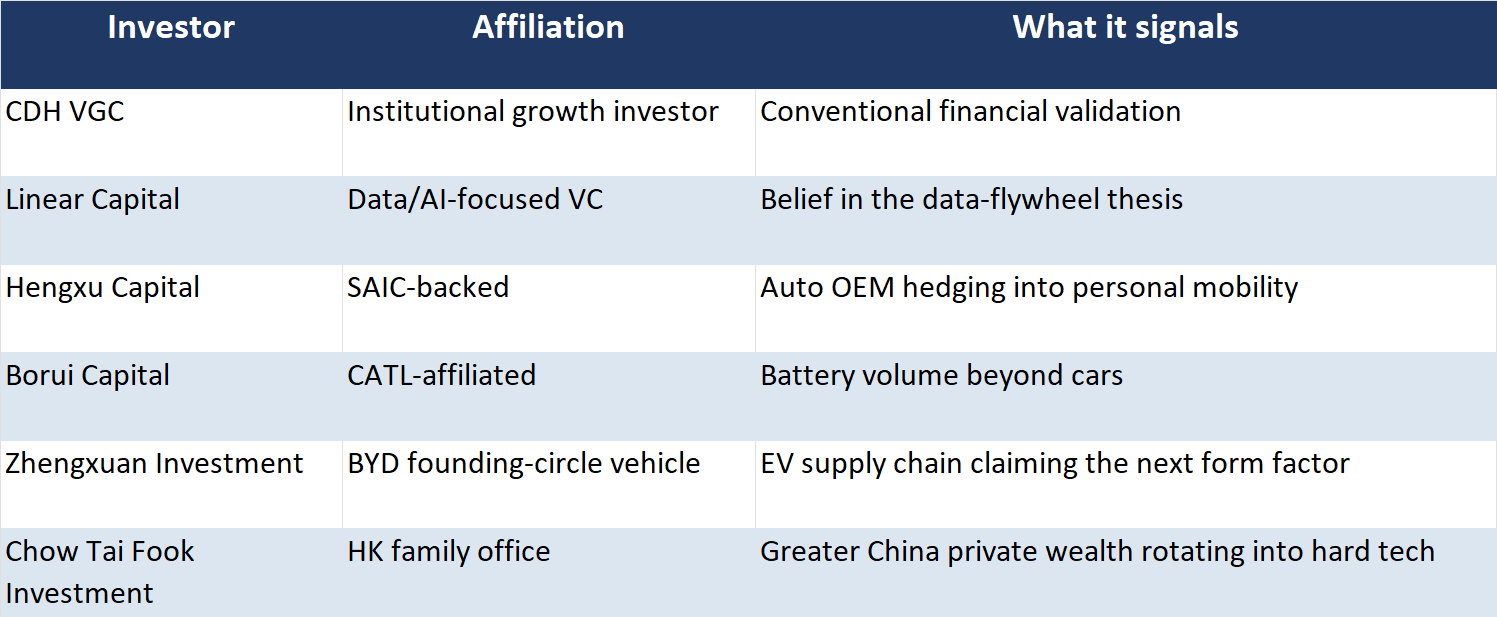
The investor list tells the story before the product does. Zhengqi Future, a physical AI company founded in 2023 by a fifteen-year Huawei veteran who later ran product as a vice president in Baidu's Intelligent Driving Group, announced on July 27 that it has completed several hundred million yuan (roughly US$30 million to US$70 million) in angel-series funding accumulated across eight months and multiple rounds. Alongside financial investors CDH VGC and Linear Capital sit three names that amount to a statement: Hengxu Capital, backed by SAIC; Borui Capital, affiliated with battery giant CATL; and Zhengxuan Investment, the vehicle associated with BYD's founding circle, joined most recently by Hong Kong's Chow Tai Fook Investment, which corporate registries show came aboard as a strategic investor on July 15.
China's automotive supply chain, in other words, has collectively decided that this particular robotics startup is worth owning early. The company's founder, Wu Shulin, spent fifteen years at Huawei building product lines from zero to more than RMB 10 billion (US$1.4 billion) in scale before joining Baidu in 2020 as a vice president in its Intelligent Driving Group, the unit behind the Apollo autonomous-driving platform. His startup's thesis is what he calls Door-to-Door mobility: rather than beginning with a humanoid that must master everything, begin with a machine that masters one universally valued task, moving a person from where they are to where they need to be and let a data flywheel spin from a product people must use daily.
Corporate records show the syndicate assembled patiently rather than in one oversubscribed frenzy: three angel tranches preceded the Chow Tai Fook strategic entry disclosed on July 15, with the full picture only announced to media on July 27, a cadence that suggests deliberate cap-table construction rather than momentum fundraising.
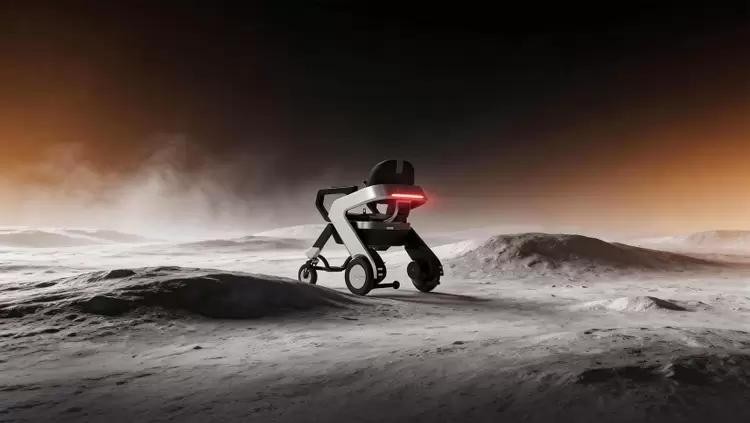
The first embodiment of that thesis is the Quorra X5, a smart personal mobility vehicle styled like a piece of exoskeleton armour with diamond-cut lines, closer in spirit to a robotic steed than to a medical scooter. It operates in three modes, remote control, smart cruise, autonomous following, and carries a sensor suite more commonly found on autonomous cars: a lidar matrix and multi-camera vision, millisecond-class response and active braking, orchestrated by what the company calls its DDAS end-to-end intelligent driving system and an AEIS self-evolving interaction system updated over the air. Commercial orders have arrived from more than ten countries and regions, the company says, with an overseas direct-to-consumer push planned alongside Tmall and JD flagship stores and offline retail networks in China within the year.
The Autonomous-Driving Diaspora Finds Its Wedge
Zhengqi Future is best understood as part of a migration this publication has been tracking all year: the flow of autonomous-driving talent and capital into embodied AI. The self-driving industry spent a decade and tens of billions of dollars building exactly the technologies embodied AI now needs, end-to-end driving models, sensor fusion, safety-rated control loops and its veterans have concluded that the fastest route to deployed physical AI may not be the robotaxi's five-year regulatory gauntlet or the humanoid's unsolved dexterity problem, but smaller machines that drive themselves in spaces where no driving licence is required.
The diaspora is broad enough to be a category now. Across China, founding teams out of Huawei's car unit, Baidu Apollo, XPeng's autonomy group and DJI's engineering ranks have launched embodied AI companies in the past eighteen months, carrying with them the hard-won institutional knowledge of shipping safety-critical autonomy at consumer price points. Investors have learned to price the pedigree: a founder who has taken a sensor-heavy product through automotive-grade validation cycles is a different risk class from a robotics PhD with an impressive video reel.
A personal mobility vehicle is a shrewd wedge for that playbook. It operates at low speeds on campuses, in parks, airports, and residential compounds, environments regulated far more lightly than public roads. It addresses a market with genuine demographic tailwind: China will have more than 400 million citizens over sixty within a decade and mobility is among the first capacities aging bodies surrender. And unlike a humanoid demo, a mobility vehicle generates revenue per unit today while accumulating exactly the real-world navigation data, crowded sidewalks, unpredictable pedestrians, curb cuts that any future ambulatory robot will need. The analogy is Tesla's original ladder: sell the Roadster to fund the Model 3. Wu is selling a robotic steed to fund and train, whatever comes next.
The auto-capital participation makes strategic sense from the other direction too. SAIC, CATL, and BYD's affiliated funds have watched their own industry's electric-vehicle margins compress under brutal price wars and all three groups are hunting for the next volume application of their core competencies, batteries, motors, drive-by-wire chassis and manufacturing scale. A personal mobility vehicle is, component-wise, a very small EV. If the category scales, the supply chain that dominates electric cars inherits it by default and early equity positions ensure the winners are family.
The syndicate's composition rewards a closer look because each participant maps to a strategic slice of the thesis.
The Skeptic's Ledger
The case against enthusiasm is worth stating plainly. The personal mobility category is littered with beautiful machines that died in the gap between technology demo and durable demand; Segway itself, the category's cautionary founding myth, sold a fraction of its projections before finding modest niches and it is not obvious that lidar-equipped autonomous following transforms the underlying economics of a product whose addressable buyers may simply want a cheaper, dumber scooter. "Several hundred million yuan" across four announced rounds and eight months is meaningful seed capital but a fraction of what hardware-plus-autonomy burn rates typically demand; the company will be raising again within the year. Order counts from "10+ countries and regions" are disclosed without volumes and self-reported traction in pre-launch hardware companies deserves the standard discount. Finally, the D2D framing invites a question the announcement does not answer: whether the data collected by a human-carrying vehicle at walking speeds actually transfers to the more general physical AI ambitions the company's name and positioning imply, or whether Zhengqi ends up a well-funded scooter company with unusually good sensors.
What tilts the ledger back is the specific composition of the syndicate. CDH VGC and Linear Capital are disciplined institutional investors, not momentum tourists; Linear in particular built its reputation on data-infrastructure and AI bets made early. The three auto-affiliated funds bring not just money but the component pricing, manufacturing capacity and channel relationships that determine whether small EVs can be built at consumer price points. Chow Tai Fook's presence signals Hong Kong family-office money continuing its rotation into mainland hard tech, a thread that connects directly to the celebrity-and-conglomerate capital wave documented in this publication's recent coverage. Syndicates like this do not assemble around scooters. They assemble around platform bets.
What to Watch
Three tests will resolve which company Zhengqi Future actually is. The first is retail reality: when Tmall and JD flagships open within the year, pricing and delivery volumes will become public in China's most transparent e-commerce environment, including the gap between orders announced and units shipped will close one way or the other. The second is the data flywheel's first visible turn, whether the company publishes or productises anything, a navigation model, a safety benchmark, an OTA capability leap that demonstrably derives from fleet data rather than lab development. The third is the follow-on round: if the next raise brings a marquee lead at a step-up valuation, the auto-capital thesis will have been externally repriced; if the same insiders bridge, caution is warranted.
The wider signal stands regardless of the company's individual fate. In the same month that celebrity restaurateurs bought into AgiBot's ecosystem and Brookfield committed billions to Korean AI factories, the most sophisticated industrial capital in China's most competitive manufacturing sector chose to seed an autonomous-driving veteran's mobility robot. The smart money keeps arriving at the same conclusion from different directions: physical AI is leaving the laboratory and the vehicles it leaves in will be smaller, humbler and sooner than the humanoid posters suggest. Whether Zhengqi Future becomes the category's Tesla or its Segway, the syndicate behind it has already told us which future China's auto industry is hedging toward and it is one where the line between a vehicle and a robot stops existing.
This article is for informational purposes only and does not constitute investment advice. Readers should conduct their own research before making investment decisions.