Robots Can See. This Shanghai Lab Just Published 30,000 Hours of Teaching Them to Feel
Shanghai startup NeoteAI (Xinzhi Embodied Intelligence) and Fudan University's Institute of Trustworthy Embodied AI released three technical reports on July 26 built on what they describe as more than 30,000 hours of visual-tactile interaction data, around 1.4 million manipulation clips across 450 real long-horizon tasks. The stack spans a tactile dataset (NeoData), a unified tactile representation model (NeoForce), an anticipatory visuo-tactile-language-action model (VTLA) reporting 85 to 99 percent success on contact-rich tasks, and a tactile world model (TWAM), with data and models pledged as open source. It is the most aggressive public claim yet that touch, not vision, is the next scaling frontier in robot learning.
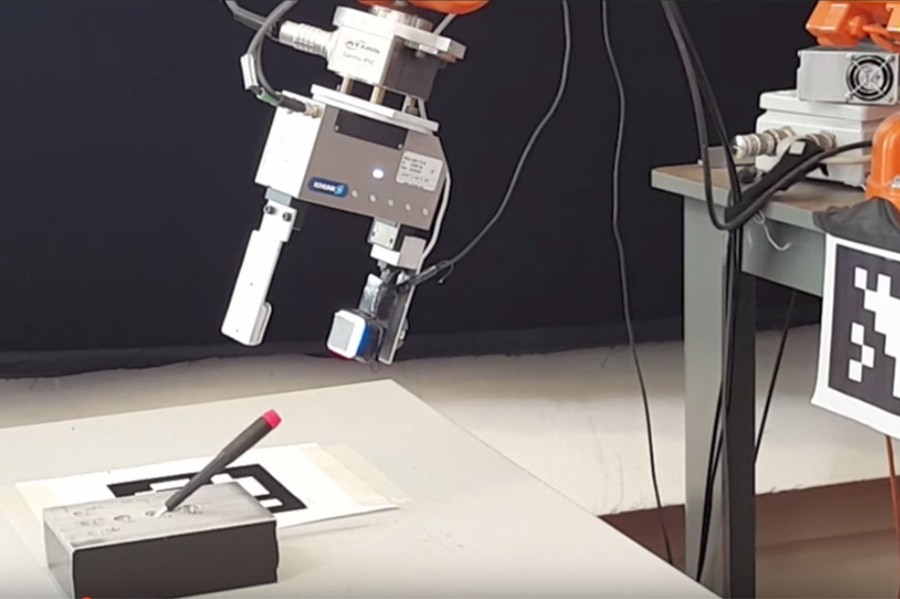
Ask a robot to fold a shirt or seat a connector in a socket and you discover what the last decade of computer vision never solved: the moment that matters happens where the camera cannot see, at the interface between finger and object, where success is a matter of force, slip, and texture. On July 26, a Shanghai startup and one of China's top universities published their answer to that blind spot, and its scale is the story.
Xinzhi Embodied Intelligence Technology, which operates in English as NeoteAI, released three technical reports jointly with Fudan University's Institute of Trustworthy Embodied AI, built on a corpus the partners call NeoData: more than 30,000 hours of synchronized visual-tactile interaction video, roughly 1.4 million operation clips, spanning 450 real-world long-horizon tasks from folding laundry to plugging and unplugging connectors. Coverage of the release cites billions of aligned RGB and tactile frames. The partners say both the data and the models trained on it will be open-sourced.
For calibration, the vision-language datasets that ignited the generative AI boom were assembled from an internet that already existed. Tactile data has no internet to scrape. Every hour must be produced by instrumented robots and handheld collection rigs physically touching objects, which is why most academic tactile datasets top out in the tens or hundreds of hours. If NeoData's scale withstands scrutiny, it would stand among the largest touch corpora ever assembled, and the fact that it comes from a year-old Chinese startup rather than a Silicon Valley lab is itself a data point in the embodied AI race.
Why touch defeated a decade of robot learning
A short detour explains why this corpus is worth arguing about. Modern robot policies are trained mostly on camera views and joint positions, which suffice for reaching and coarse pick-and-place. Contact-rich tasks break that recipe for three compounding reasons. First, occlusion: at the moment of contact, the robot's own fingers hide the interaction from every camera angle. Second, dynamics: forces change in milliseconds, faster than vision pipelines process frames, so by the time a camera sees an object slipping, the failure is seconds old in contact time. Third, invisibility: the properties that decide success, friction, compliance, tension in a cable, exist in no image at all. Human hands solve all three with roughly 17,000 mechanoreceptors and a spinal reflex loop that corrects grip force before the brain is even consulted. Robots have nothing comparable, and the datasets to learn it from have never existed at scale. That is the hole NeoData claims to fill.
Three models and one argument
The release bundles three technical routes that together form a single argument: touch should be treated as a first-class modality with its own scaling laws, not a garnish on vision.
NeoForce, the first report, tackles the problem that has fragmented tactile research for years: every sensor speaks a different language. Readings from different tactile hardware do not transfer, so datasets cannot be pooled. NeoForce proposes a unified tactile representation with temporal structure and cross-device transfer, effectively a common embedding into which different sensors' signals can be projected. If it works as described, it addresses the field's data-fusion bottleneck the way shared tokenizers enabled pooled text corpora.
VTLA, the second report, adds anticipation. Conventional approaches consume the current tactile reading, which lags the physics: by the time slip is sensed, the object is already moving. The VTLA model predicts how touch will evolve up to 50 steps ahead and conditions actions on that forecast. The reported results on two contact-rich benchmarks, 85 percent success on plug insertion and 99 percent on key extraction, are the kind of unglamorous, high-precision tasks where vision-only policies routinely fail, and they are the numbers rival labs will try to reproduce first.
TWAM, the third report, is a tactile world model, a system that rehearses an operation in imagination, rolling forward both visual and tactile consequences before the robot commits to a movement, reporting an average simulated success rate of 84.5 percent. World models are the current frontier across embodied AI, from Nvidia's Cosmos to Google DeepMind's Genie line, but nearly all of them predict pixels. A world model that also predicts touch is a genuinely uncommon artifact, and if its simulated rehearsals transfer to physical hardware at anything near the reported rate, it would shorten the most expensive part of robot training: failure on real objects, with real breakage, in real time.
The company behind the corpus
NeoteAI is young, small, and deliberately full-stack. Incubated out of Fudan's Institute of Trustworthy Embodied AI, the Shanghai company announced an angel round approaching RMB100 million, roughly US$14 million, in late May, and its strategy spans its own visuo-tactile sensors, developed from the work of Fudan researcher Chen Wenming's team, through data collection to tactile foundation models. Its collection pipeline runs on two tracks, real robots and handheld universal manipulation interface devices operated by humans, which is how a startup accumulates 30,000 hours without owning a warehouse of robot arms.
The full-stack posture matters strategically. In the American ecosystem, tactile sensing remains largely a component business, with companies selling sensors into other firms' robots. NeoteAI is betting that whoever owns the sensor, the data format, and the model together sets the standard for how machines feel, the position Nvidia occupies in simulation. The open-source pledge should be read through that lens: releasing data and models seeds the ecosystem with your formats and benchmarks, so that the field's tooling grows up around your hardware. It is the same playbook Unitree ran in low-cost hardware and Ecovacs is running this same weekend with its open-sourced home robot platform, covered separately today.
The Fudan connection also carries a signal about how China's embodied AI bench is deepening. The Institute of Trustworthy Embodied AI is one of a wave of university-affiliated institutes that Shanghai has stood up to convert academic robotics into companies, and NeoteAI's trajectory, from lab sensor to angel round to a headline dataset release inside fourteen months, is the template working as designed. The same weekend produced parallel evidence across the ecosystem: Ecovacs open-sourcing a home robot platform in Suzhou, and celebrity capital flowing into embodied AI ventures, both covered separately today. The density of independent actors making credible moves in a single weekend is itself the measure of how far China's embodied AI ecosystem has compounded.
The skeptical checklist is straightforward. The reports are self-published and not yet peer-reviewed, the headline success rates come from the authors' own task selections, and simulated success in a world model is not deployed success on a factory line. The exact composition of the 30,000 hours, how much is human handheld collection versus robot experience, and how much passes rigorous alignment quality checks, will determine whether the corpus is an oil field or a landfill. And open-source pledges from startups arrive on their schedule, not the community's; until the download links are live, the pledge is marketing. The precedent worth remembering is vision-language robotics itself, where dataset announcements have sometimes outrun usable releases by quarters.
Why touch is becoming the next data race
The context that elevates this beyond one startup's technical reports is a pattern this publication has tracked all month. The scarce resource in embodied AI is shifting from compute and capital to embodied data, the kind that cannot be scraped because it must be physically generated. KAIST and Nvidia announced a center on July 26 to build a foundation model from clinical-grade human motion data, reported separately today. China's national data bureau has been standing up embodied data infrastructure, and municipal training grounds from Beijing to Shenzhen exist precisely to manufacture robot experience at scale. Touch is the logical next front: it is the modality where human dexterity most exceeds robot capability, and the one with the least existing data anywhere in the world.
There is also a supply-chain implication worth flagging for hardware buyers. If tactile models mature on Chinese sensors and Chinese data formats, tactile sensing could follow the trajectory of robot joints, where Chinese four-in-one actuator modules became the de facto global reference. Sensor vendors and dexterous-hand makers in the West and Japan, a field that includes strong incumbents in force-torque sensing, should treat unified representations like NeoForce as a standards play, not just a paper.
For robotics teams evaluating whether to engage, the practical sequence is concrete. Watch for the promised repositories to go live on the usual hosts, and when they do, test NeoForce's transfer claim first, since a representation that genuinely bridges sensor types would immediately benefit any lab holding its own small tactile dataset. Benchmark VTLA's plug-insertion and key-extraction numbers on independent hardware before citing them. And treat NeoData's licensing terms as strategic information: whether commercial use is permitted, and under what attribution regime, will reveal whether NeoteAI is building a commons or a funnel to its sensors.
The quotable summary is this: robots learned to see from the internet, but there is no internet of touch, so someone has to build it hour by hour, and a Fudan-incubated startup just claimed the largest head start yet made public. Whether NeoData proves to be embodied AI's ImageNet moment or an overstated corpus will be settled by replication, not press coverage. Either way, the race to teach machines to feel now has a posted benchmark, and it is thirty thousand hours long.
Disclaimer: This article is for general information purposes only and does not constitute investment, legal, or procurement advice. Readers should verify details with primary sources before making business decisions.