Precision IO uses SRS to show how Epione and NeuWave could become one ablation platform
The group formed in February by combining Quantum Surgical and NeuWave will present Epione alongside an early remote-planning programme. The technology is clinically used, but the remote element is not yet commercial and US musculoskeletal applications remain investigational.
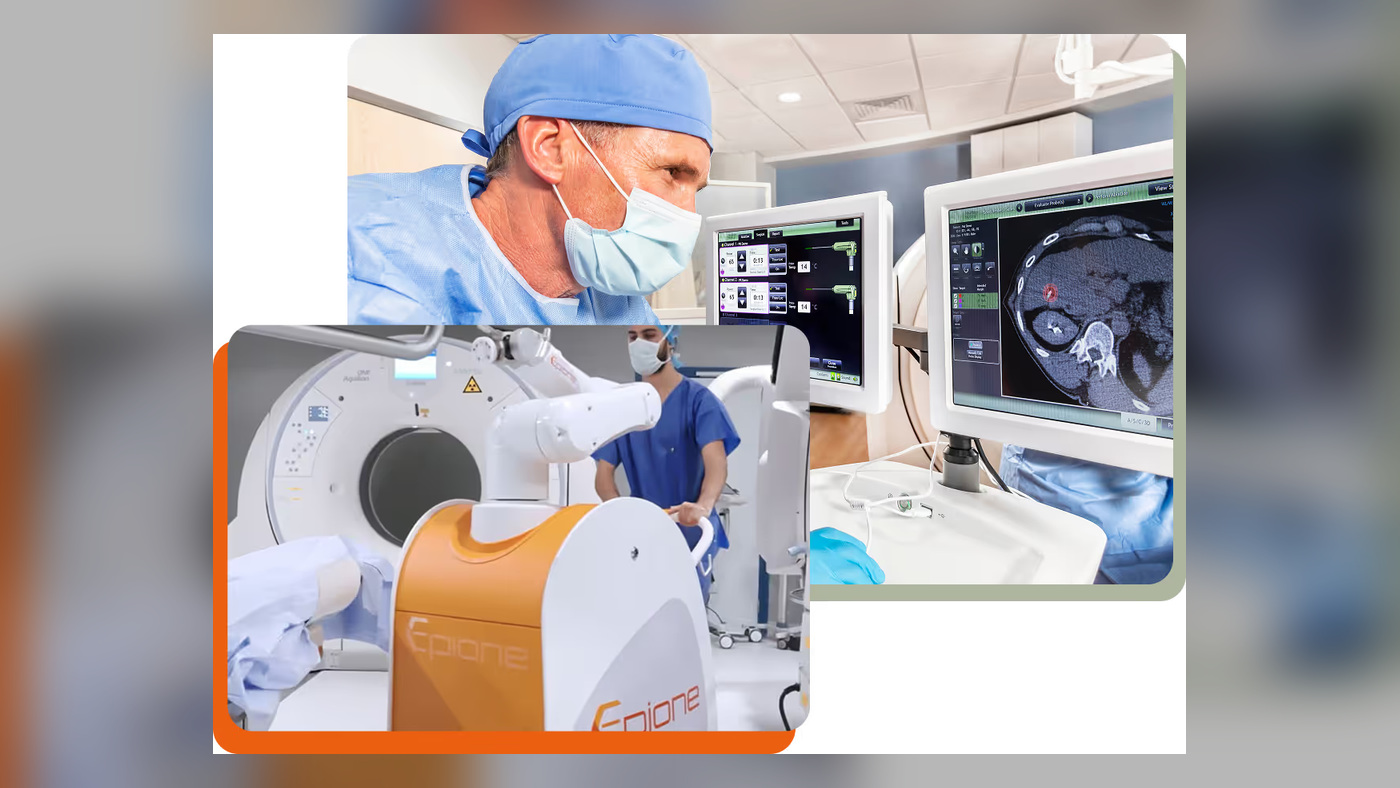
What will Precision IO present at SRS 2026?
Precision IO will present Quantum Surgical’s Epione image-guided robotic platform and an in-development remote-intervention programme at the Society of Robotic Surgery meeting in Hollywood, Florida, from July 22 to July 26. The disclosed remote scope covers trajectory planning and post-treatment assessment, not remote robotic treatment, and the programme is not commercially available [1].
Precision IO's formation and product portfolio
Precision IO Group’s July 20 announcement that it will present at the Society of Robotic Surgery (SRS) annual meeting is the first clear public demonstration of how the newly formed parent company intends to connect two previously separate businesses: Quantum Surgical’s Epione image-guided robotic platform and NeuWave Medical’s established microwave-ablation portfolio [1].
Precision IO Group Inc. is a US parent company led by CEO Kurt Azarbarzin [3]. It was formed when Quantum Surgical acquired NeuWave Medical from Johnson & Johnson MedTech on February 24, 2026 [3]. Quantum Surgical and NeuWave remain operating subsidiaries [3]. Ally Bridge Group is the group’s largest investor; neither the acquisition price nor a financing amount was disclosed [3]. The group’s stated headquarters address is in Miami, Florida, while Quantum Surgical retains its principal research, production, and company campus in Montpellier, France [3] [4].
Quantum Surgical was founded in 2017 by former Medtech colleagues Bertin Nahum, Fernand Badano, Lucien Blondel, and Sophie Roca [5]. Its official site reports 130 team members in Europe and the United States [5]. Precision IO’s July announcement reports more than 275 employees worldwide across the combined group [1].
The Epione robotic platform
Epione is a mobile, CT-suite platform for image-guided percutaneous interventions [6]. It includes a robot cart, a six-degree-of-freedom collaborative arm, a navigation camera, a patient reference, a universal needle guide, and planning, control, and confirmation software [6]. The arm positions the guide; the physician manually advances the needle or probe and retains tactile feedback [6]. The product can be used with several ablation modalities, including microwave, radiofrequency, cryoablation, and irreversible electroporation [6].
How Epione changes the procedure without replacing the physician
In plain language, Epione helps a clinician plan a path through the body and hold a guide at the selected angle. The physician still advances the needle or ablation probe manually [6] [9]. That distinction separates robotic positioning assistance from an autonomous treatment system. The robot can support repeatable geometry and confirmation inside a CT-guided workflow, but the cited FDA record assigns control and instrument advancement to the user [9].
A typical procurement case would therefore depend on workflow rather than the robot arm alone. The hospital must consider how the mobile platform enters an existing CT suite, how staff prepare and reference the patient, how planning and confirmation fit around imaging, and how the chosen ablation modality is supplied and supported [6]. Epione’s ability to work with microwave, radiofrequency, cryoablation, and irreversible electroporation broadens its technical compatibility, but the sources do not show that every modality, anatomy, or procedure has the same regulatory status in every market [6].
This is the human stake behind the technology: image-guided ablation requires a clinician to reach a target through a constrained pathway while avoiding surrounding anatomy. Epione is designed to assist with planning and guide positioning. It does not remove clinical judgement, manual instrument advancement, patient selection, or the need to manage complications.
Clinical scope and US regulatory status
The FDA’s original 510(k), K211645, describes Epione as a user-controlled stereotactic accessory for planning, manual instrument advancement, and position verification during CT-guided percutaneous liver ablation under general anaesthesia [8] [9]. The decision date was February 24, 2022 [8]. Quantum Surgical reports the first US Epione procedure occurred at Baptist Health South Florida in May 2023 [7]. The company reported more than 1,400 patients treated in Europe and the United States by February 2026 [3]. This is a company-reported cumulative patient-use figure, not a regulator-certified volume.
Quantum Surgical currently says Epione is FDA cleared for abdominal ablation and CE marked for abdominal, chest, and musculoskeletal uses [3]. In the United States, musculoskeletal uses are not FDA cleared. ClinicalTrials.gov NCT07325578 is a recruiting 60-patient IDE study of pelvic and spinal procedures at UC San Diego, Baptist Hospital of Miami, and Rush University Medical Center, with no results posted as of July 20, 2026 [10].
Remote intervention programme limits
Precision IO plans to present Epione and an in-development remote-intervention programme at the SRS meeting in Hollywood, Florida, July 22–26, 2026 [1]. The named clinicians are Sean Tutton and Govindarajan Narayanan [1].
The remote programme’s disclosed initial scope is remote trajectory planning and post-treatment results assessment [1]. Precision IO states it is not commercially available [1]. It is not a fully remote robotic treatment system, and the evidence does not establish latency, cybersecurity architecture, clinical equivalence, performance, launch timing, or regulatory status [1].
The most important correction to the event language is that “remote intervention” does not mean a distant physician will operate the robot and perform an ablation over a network. Based on the disclosed scope, a remote participant could contribute to planning a trajectory or reviewing post-treatment results [1]. The local clinical team, instrument advancement, imaging operation, patient monitoring, and ablation delivery are not described as remotely controlled. Any broader interpretation would run ahead of the evidence.
For hospitals, a future remote-planning service would also raise operational questions that the announcement does not answer. These include identity and access management, transfer and storage of medical images, latency, cybersecurity monitoring, audit trails, clinical responsibility, cross-jurisdiction licensing, and what happens if connectivity fails. These are evaluation questions, not disclosed system features. Until Precision IO publishes architecture, testing, regulatory pathway, and service terms, the programme should be treated as an early development signal.
The commercial logic is nonetheless visible: Precision IO can combine an installed microwave-ablation business and sales-support network with Quantum Surgical’s navigation and robotic-positioning platform [3]. Over time, that could create an integrated “plan, position, ablate, and confirm” offering. It remains a strategic direction rather than proof of an integrated commercial product.
Procurement model and buyer questions
Epione and NeuWave are hospital systems acquired through direct sales, distributors, or formal institutional procurement [6] [11]. Epione is designed as mobile equipment that can enter an existing CT suite [6]. NeuWave provides case support, technical service, and ordering support [11].
Neither company publishes public list prices, lease terms, service fees, maintenance charges, consumable economics, or reimbursement arrangements [6] [11]. The evidence supports describing the model as capital equipment plus clinical implementation, support, and device consumables, but does not support a price estimate.
A hospital business case would need to separate the capital platform from procedure-specific economics. Relevant questions include whether the hospital already performs enough eligible CT-guided ablations, which clinicians will use the system, what training and credentialing are required, how much CT-suite time changes, which probes and disposables are consumed, how service downtime is handled, and whether the platform expands treatable cases. None of those answers can be inferred from the company’s cumulative patient figures.
The reported 1,400-plus Epione patients and more than 100,000 NeuWave patients demonstrate company-reported clinical use, but they are not the same as installed-base, revenue, utilisation, or comparative-outcome data [3] [11]. Likewise, NeuWave’s claim that its system is used in 70% of leading US cancer centres cannot be converted into overall hospital market share because the denominator and institution list are not disclosed [3] [11]. Buyers should request local references, service performance, consumable pricing, workflow data, and regulatory documentation rather than treating headline patient counts as a complete commercial benchmark.
Market context and competitive position
NeuWave sells a microwave-ablation system, ABLATE-IQ planning and margin-confirmation software, multiple probe types, multi-probe synchrony, and Tissu-Loc probe-stabilisation technology [11]. NeuWave says its system has served more than 100,000 patients worldwide and is used in 70% of leading US cancer centres; both figures are company claims, and the cancer-centre denominator is not disclosed [3] [11].
The most defensible direct comparator for Epione is Perfint Healthcare’s MAXIO because the FDA named it as Epione’s predicate device [9]. CAScination’s CAS-One IR is an FDA-identified reference device and another close comparator in CT-guided intervention planning and navigation [9]. These products compete around image-guided needle placement, workflow integration, and procedure standardisation.
Remote vascular-intervention systems from Corindus, Robocath, and Stereotaxis are useful only as maturity benchmarks for teleoperation, not as direct percutaneous tumour-ablation competitors. Intuitive Surgical’s Ion is adjacent in robotic image-guided access but is designed for bronchoscopy and lung biopsy, not tumour ablation.
The FDA comparison offers the safest competitive boundary. MAXIO is the predicate used in Epione’s substantial-equivalence review, and CAS-One IR is a reference device [9]. That establishes regulatory relevance, not a current market ranking. The closed evidence does not provide comparable revenue, installed base, procedure volume, pricing, or outcomes for the three systems. Precision IO can therefore be described as entering a recognised image-guided intervention category, but not as the numerical leader.
Precision IO’s strategic difference is the ownership combination. Quantum Surgical contributes robotic planning and guide positioning, while NeuWave contributes a microwave-ablation portfolio, software, probes, support, and an established company-reported patient base [3] [6] [11]. The potential value is a more connected procedure pathway. The unresolved question is whether the group can turn that portfolio logic into validated integration, simpler procurement, reliable support, and measurable clinical or operational benefit.
What to watch next
The progress of the IDE study for musculoskeletal uses in the United States will be a key indicator of Epione's expanding clinical scope [10]. The development of the remote-intervention programme from its current planning and assessment focus towards broader capabilities will also be closely watched [1]. Ultimately, the market will look for evidence of how effectively Precision IO can integrate Quantum Surgical's robotic platform with NeuWave's established microwave-ablation business to create a unified commercial offering [3].
References
[1] Precision IO July 20, 2026 SRS announcement
[2] Precision IO official site
[3] Quantum Surgical acquisition announcement
[5] Quantum Surgical company history
[10] ClinicalTrials.gov NCT07325578
Disclaimer: The information provided in this article is for informational purposes only and should not be construed as financial, investment, or strategic advice. RobotAIGeek does not endorse any specific company or product mentioned.