Matrix launches MATRIX 3 as Chinese humanoid competition intensifies
Matrix Robotics used WAIC 2026 to introduce the MATRIX 3 biped, the WAVE foundation model, and a starting price of RMB 580,000. While the company reports roughly 1,000 orders and sets ambitious capacity targets, it must now convert that pipeline into verified deployments to match the scale evidence of its strongest peers.
What did Matrix Robotics launch at WAIC 2026?
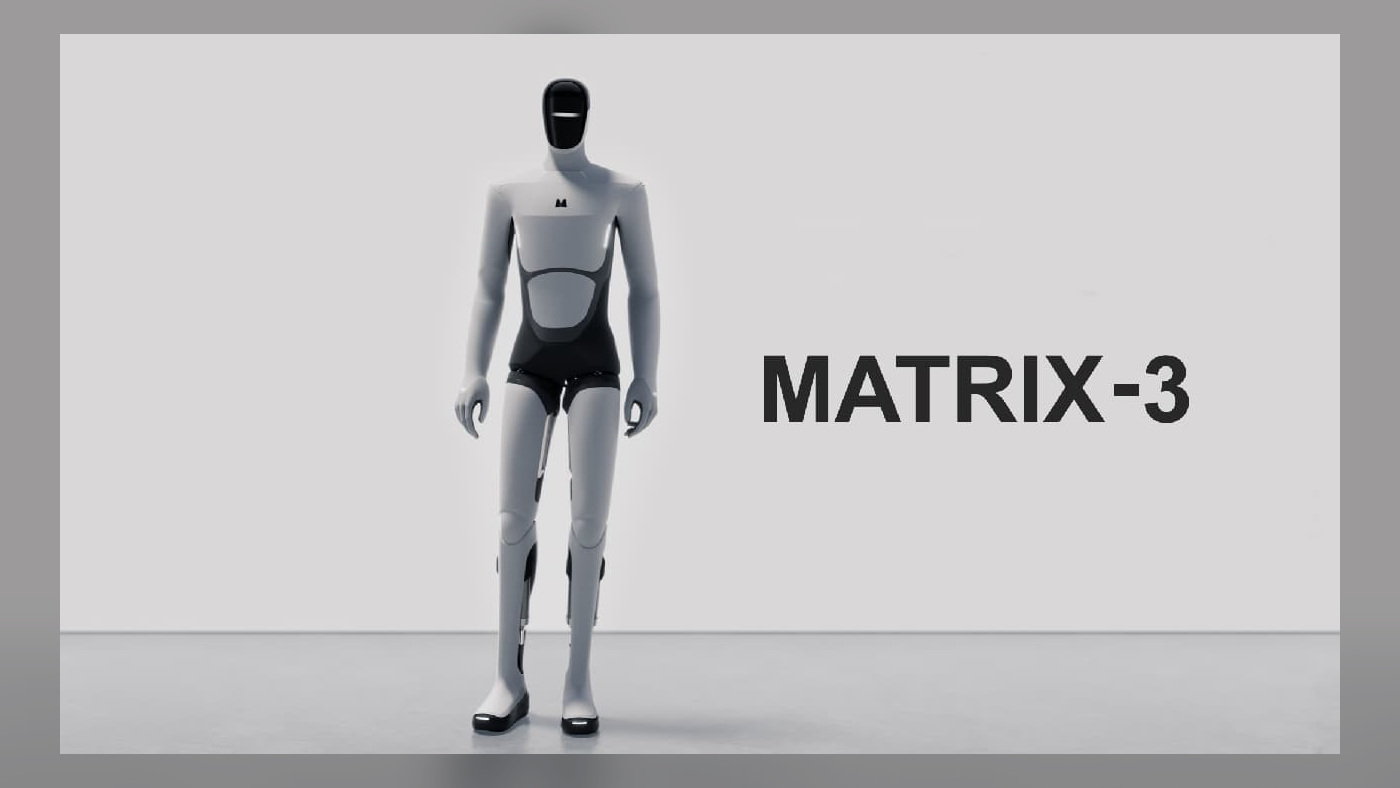
Matrix Robotics introduced the full-size MATRIX 3 biped and its WAVE Physical World Foundation Model at WAIC 2026 in Shanghai. The company set a starting price of RMB 580,000, reported roughly 1,000 orders, and announced annual-capacity targets of 5,000 units in 2026 and 10,000 in 2027 [1].
MATRIX 3 hardware and the WAVE foundation model
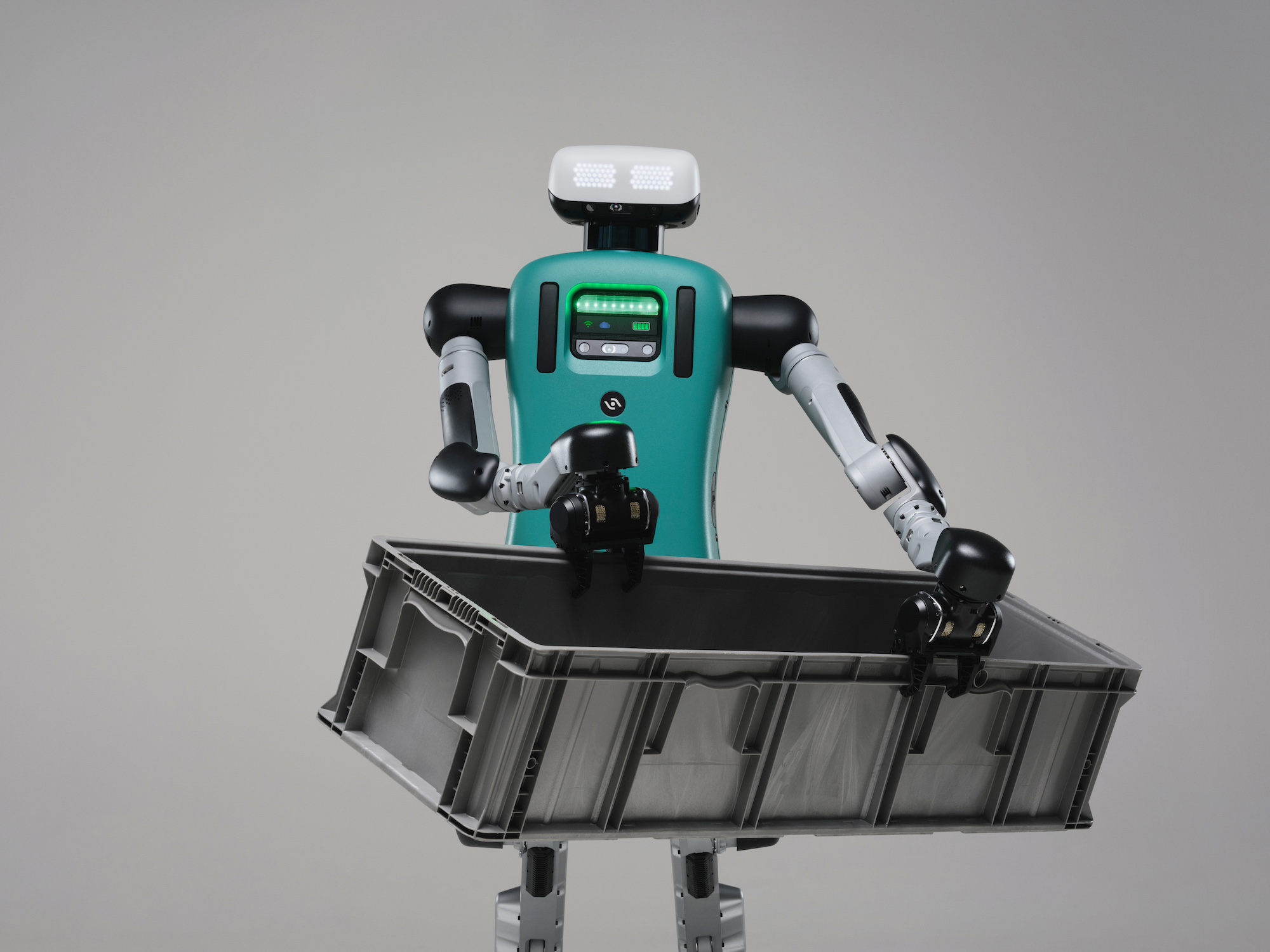
Matrix Robotics presented its MATRIX 3 humanoid robot and WAVE Physical World Foundation Model at the World Artificial Intelligence Conference (WAIC) 2026 in Shanghai [1]. The MATRIX 3 is a full-size biped standing 1.70 metres tall and weighing 65 kilograms. It features tendon-driven dexterous hands and a high-density tactile skin [1]. According to the company, these features are designed to handle complex physical tasks and provide nuanced sensory feedback [1].
Matrix introduced WAVE as a Physical World Foundation Model architecture for the MATRIX 3, according to the company [1]. The cited record does not provide an independently verified technical benchmark, training-data description, or real-world performance comparison for the model.
Orders, capacity, and stated markets
Matrix announced a starting price of RMB 580,000 for the MATRIX 3 and reported receiving approximately 1,000 orders [1]. The company has set an annual capacity target of 5,000 units for 2026 at its Zhangjiang facility, with plans to expand to 10,000 units in 2027 [1]. The target markets include hospitality, restaurant service, research, culture, and entertainment [1].
The company also introduced the MATRIX Global Partner Program and referenced a Robot as a Service, or RAAS, commercial approach [1]. The cited evidence does not disclose RAAS fees, participant obligations, service levels, or detailed commercial terms.
Chinese humanoid commercial benchmark
Matrix’s July 20 release is unusually specific for a young humanoid vendor, naming a starting price, reporting roughly 1,000 orders, and setting annual-capacity targets. However, the company does not disclose binding-order terms, customer names, order value, produced units, shipped units, current output, or independently verified deployments. A comparison with selected Chinese humanoid peers provides context for these claims. The table does not imply that every company listed was a confirmed WAIC 2026 exhibitor.
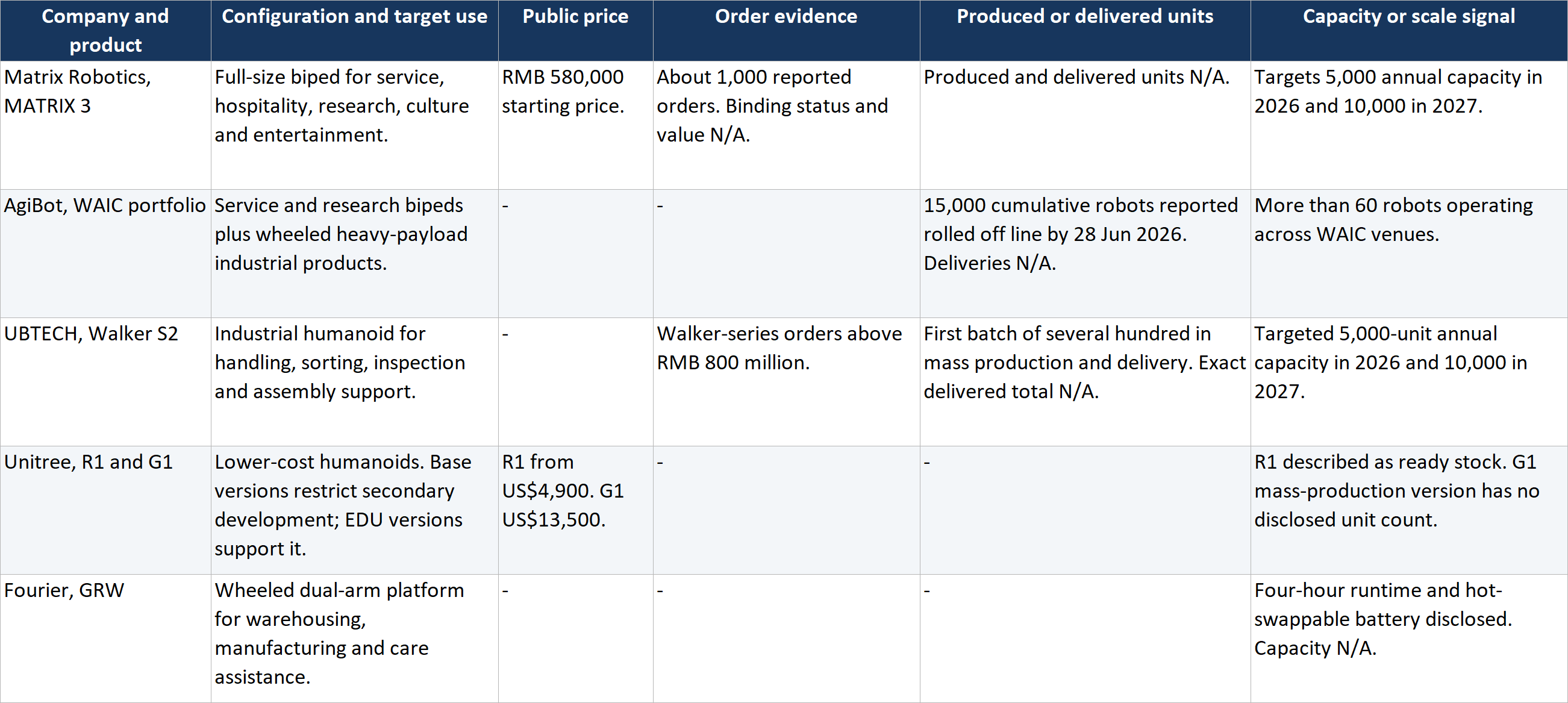
AgiBot provides the strongest public scale evidence in this peer set because it reports cumulative production milestones, reaching 15,000 units rolled off the line by June 28, 2026 [3] [4] [5]. Production is not the same as delivery, and the exact number of deployed robots is not disclosed. UBTECH provides the strongest order-value evidence, reporting more than RMB 800 million of Walker-series orders and the start of a first batch of several hundred Walker S2 deliveries in November 2025 [6]. It did not disclose an exact delivered total. Unitree provides the clearest public entry pricing and ready-stock signal, with an R1 starting at US$4,900 [10]; its base R1 and G1 products, however, restrict secondary development, and the company does not disclose order or shipment totals in the sources used here [9] [10] [11]. Fourier’s GRW is a wheeled dual-arm product for industrial and care-assistance work; its company-originated product disclosure gives specifications but no price, binding orders, deliveries, or capacity [12] [13].
Commercial posture and buyer visibility
Matrix appears to sit between two ends of the Chinese humanoid market. At one end, Unitree offers much lower public prices for relatively accessible humanoid platforms [10] [11]. At the other, AgiBot and UBTECH disclose stronger scale or contract signals for service and industrial deployment [3] [6]. Matrix’s own differentiators are its full-size biped design, tendon-driven hands, tactile-skin claims, WAVE model architecture, reported order pipeline, and partner-led deployment plan [1].
The starting price improves buyer visibility but does not establish the total installed cost because RAAS fees, integration, training, maintenance, spare parts, warranty, and support terms are not disclosed [1]. Matrix’s reported 1,000 orders are evidence of an announced pipeline, not proof of revenue, binding contracts, or deliveries [1]. Its 5,000-unit and 10,000-unit figures are capacity targets, not output forecasts that can be treated as achieved [1].
Why the starting price is not the procurement price
For a buyer, RMB 580,000 is an entry point rather than a complete business case [1]. A deployable service robot also requires a defined task, site preparation, workflow integration, operator training, safety review, maintenance, spare parts, software support, and clear responsibility when performance falls below expectations. Matrix’s announcement does not price those elements or explain whether any are included through its RAAS model [1]. It also does not disclose warranty duration, service-level commitments, upgrade terms, or the commercial treatment of partner-developed applications.
This is especially important because the target markets are diverse. A restaurant, research laboratory, cultural venue, and hotel do not share the same operating conditions, labour economics, risk tolerance, or integration needs. The same base robot may therefore produce very different total costs and payback periods. The public price is useful because many humanoid suppliers disclose no price at all, but it cannot be compared directly with Unitree’s lower-cost R1 or G1 without accounting for differences in size, capability, developer access, intended use, and service support [9] [10] [11].
How to read orders, production, and deployment evidence
Humanoid announcements often place orders, capacity, production, delivery, and deployment in the same paragraph even though they measure different stages. An order can be binding or non-binding. Capacity is what a factory is designed or planned to produce. Production records units leaving a line. Delivery records transfer to a customer. Deployment indicates operation in a real setting. Matrix publicly reports an order figure and future capacity targets, but not produced, delivered, or operational units [1].
That is why the peer comparison does not produce a simple league table. AgiBot’s 15,000-unit figure is a cumulative production milestone, not a delivery count [3]. UBTECH’s RMB 800 million is an order-value disclosure accompanied by a first delivery batch, but not exact delivered volume [6]. Unitree’s ready-stock language and visible prices show availability, not shipment scale [10] [11]. Matrix can strengthen its position by publishing customer identities where permitted, binding-order value, paid delivery numbers, uptime, task completion, and service performance. Until then, its commercial posture is ambitious and relatively transparent about forward goals, but not proven at the public scale evidenced by the strongest peers.
Humanoid scalability and deployment friction
The outstanding proof points for Matrix are the conversion of the stated order book into named, paid deployments; evidence that the Zhangjiang capacity plan is operating; and public shipment or service-performance data [1]. Matrix described four demonstrations using identical hardware at WAIC [1]. Demonstrations do not by themselves establish reliable performance across diverse, unstructured real-world settings.
What is not disclosed
The cited announcement does not provide several details crucial for evaluating commercial viability. It does not name the customers comprising the 1,000 reported orders or specify whether these are binding contracts or expressions of interest [1]. The financial value of the order book and the company's current revenue are not disclosed [1]. While a starting price is given, the total cost of ownership, including the RAAS subscription, maintenance, and integration costs, is absent [1]. Furthermore, the announcement does not offer independent verification of the WAVE model's performance metrics or the MATRIX 3's reliability in operational environments [1].
What to watch next
The key indicator of Matrix's progress will be the transition from capacity targets and order pipelines to verified deployments and shipments [1]. Monitoring the execution of the Zhangjiang facility's production ramp-up will be critical [1]. The success of the MATRIX Global Partner Program in establishing reference sites and demonstrating real-world utility in the targeted service and hospitality sectors will provide the necessary evidence to validate the company's commercial ambitions [1].
References:
[1] Matrix Robotics company release
[2] AgiBot official WAIC release
[3] AgiBot official 15,000th-unit release
[4] AgiBot official 10,000th-unit release
[5] AgiBot official 5,000-unit release
[6] UBTECH company-issued release
[7] UBTECH Walker S product page
[8] UBTECH industry-solutions page
[9] Unitree official humanoid store
[12] Fourier-originated GRW disclosure, traceable republisher
[13] Fourier original WeChat URL
Disclaimer: The information provided in this article is for informational purposes only and should not be construed as financial, investment, or strategic advice. RobotAIGeek does not endorse any specific company or product mentioned.