MagicLab's X1 and D1 Coordinate Tasks Live at IFA 2026
MagicLab showed its X1 humanoid and D1 wheeled robot sharing a single AI model to coordinate tasks at IFA 2026, but the company has not yet published EU certification for either platform.


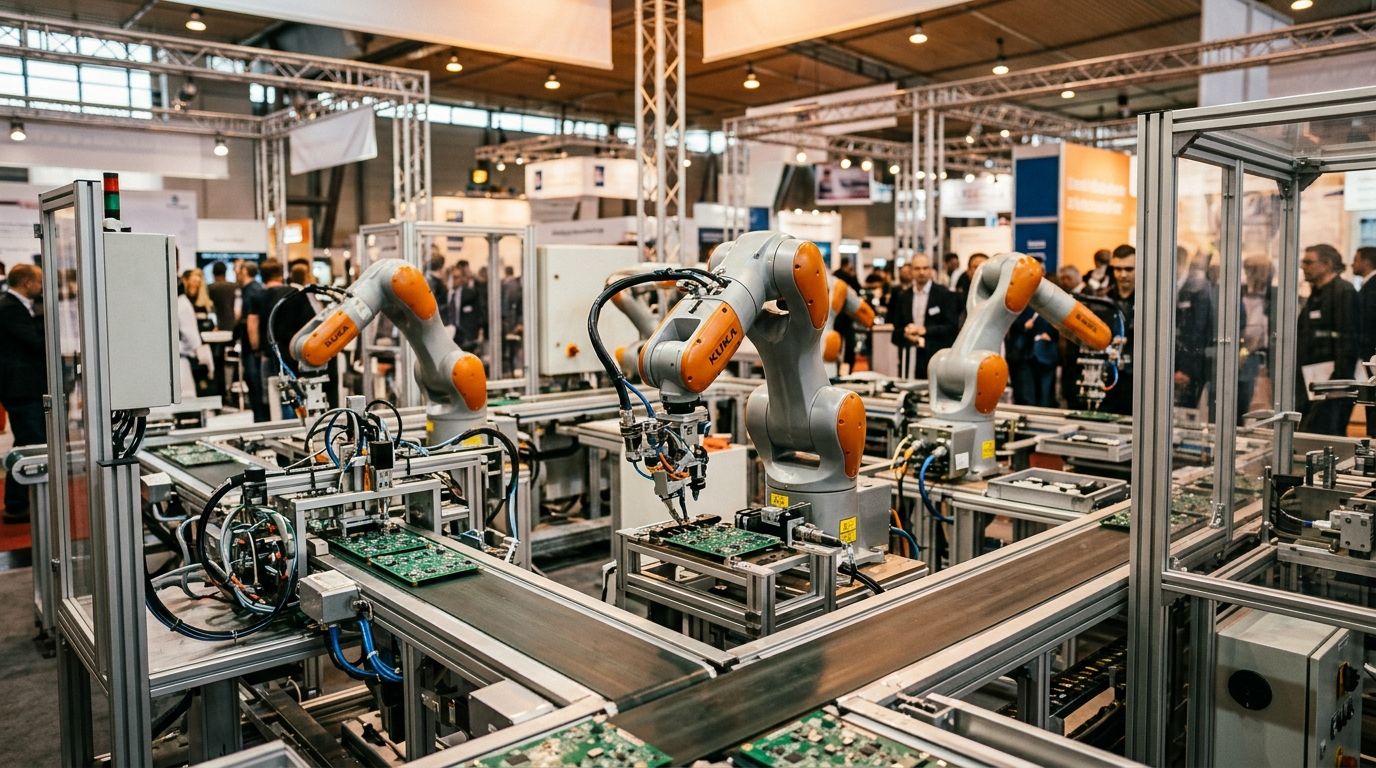
Two humanoid robots stood in a mocked-up production cell at Messe Berlin this week, passing components between a wheeled industrial unit and a bipedal one, coordinating without a human directing either machine. The demonstration, running through IFA 2026's September 4-8 run, belongs to MagicLab, the Beijing-based embodied-AI company showing its MagicBot X1 and MagicBot D1 platforms working a shared task rather than performing separately staged routines. For a buyer evaluating whether humanoid robots can actually operate as a coordinated fleet rather than a collection of standalone demos, that distinction is the whole story.
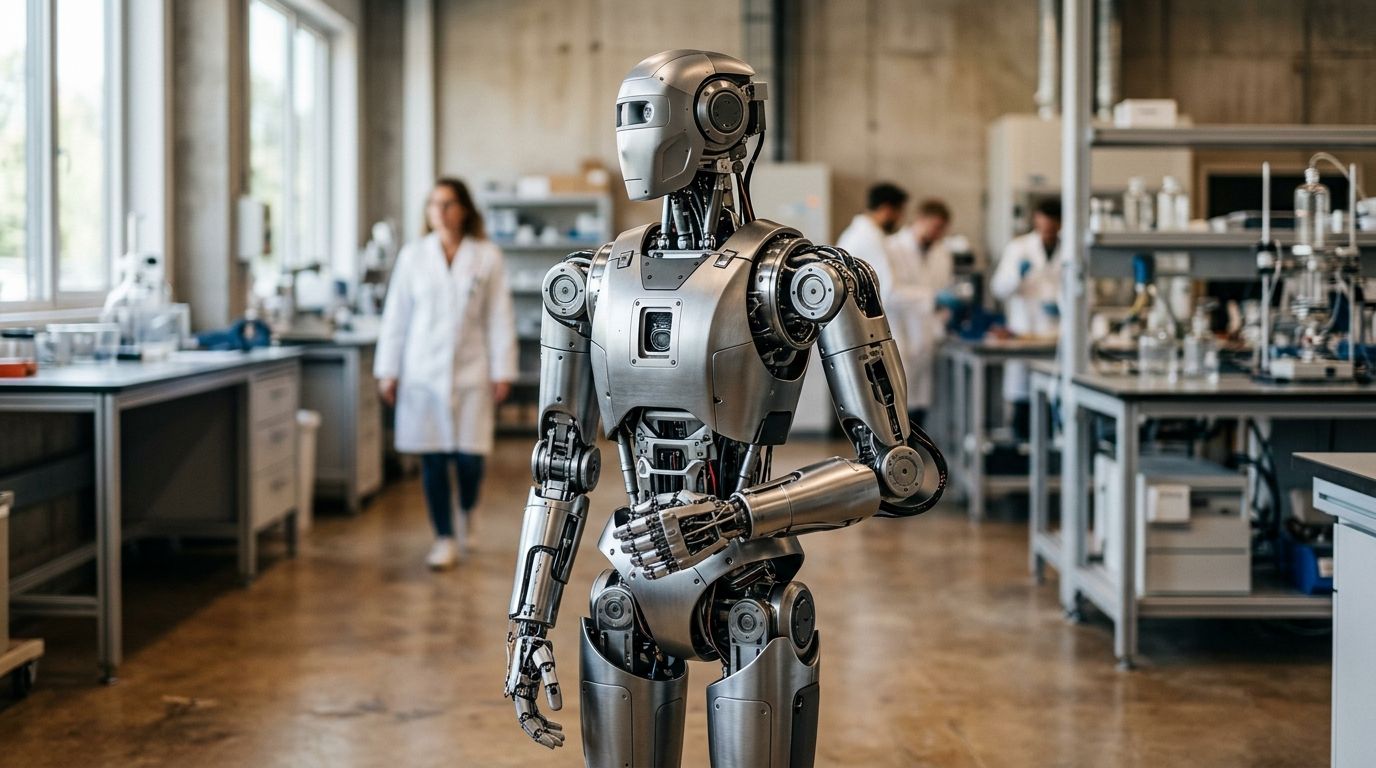
MagicLab is one of several Chinese robotics companies using IFA's expanded IFA Next zone, now roughly 300 exhibitors deep, to make the case that 2026 is the year humanoid hardware moves from stage tricks to shared work. The company's flagship, MagicBot X1, stands 180 centimeters tall, carries 31 active degrees of freedom, and generates a peak single-joint torque of 450 newton-meters, specifications MagicLab first disclosed at July's World Artificial Intelligence Conference in Shanghai alongside two companion products: MagicBot D1, a wheeled industrial humanoid built for factory material handling, and MagicDog T1, a lightweight quadruped intended for campus patrol and equipment monitoring.
Moving From a Single Star Robot to a Coordinated Line
What IFA is showing that WAIC did not is fleet behavior. Inside MagicLab's demonstration cell, the D1 unit uses visual recognition and force-controlled arms to grasp material and load it across zones, while the bipedal X1 handles tasks that benefit from human-scale reach and balance, an arrangement meant to mimic how a real production line would split labor between a fixed-station robot and a mobile one. MagicLab has already put a version of this arrangement to work outside a trade show: the company says a D1 unit has been operating inside a Dreame manufacturing facility, handling material grasping, cross-zone transport, and production-line loading duties.
The company's foundation model, Magic-VLA K02, is the software layer meant to make that coordination possible without task-specific programming for every station. In its WAIC demonstrations, Magic-VLA K02 handled long-horizon chores including box stacking and sealing, folding flexible clothing, and packing luggage, with the integrated box-stacking-and-sealing sequence clearing a success rate MagicLab put above 90 percent. That figure has not been replicated by an independent lab, and buyers should treat it the way they would treat any vendor-reported benchmark: a reasonable indicator of capability under the vendor's own test conditions, not a guarantee that a random warehouse floor will reproduce the same number.
Nine Deployments Is a Portfolio, Not a Product Line
MagicLab has been unusually willing to name where its robots are actually working. The company lists nine real-world scenarios spanning manufacturing floors, the Wuxi Marathon, China Central Television's Spring Festival Gala broadcast, and a Cannes Film Festival appearance, a portfolio that reads more like a demonstration circuit than a settled product line. That is a fair characterization, and MagicLab has not disputed it: the company frames the current phase explicitly as validating where embodied AI can generalize before committing to narrower, higher-volume manufacturing of any single configuration.
For a procurement team, that framing should change how the IFA demonstration gets weighed. A robot proven across nine disparate scenarios has shown breadth, which is genuinely useful evidence that the underlying perception and control stack is not narrowly overfit to one warehouse layout. It has not shown depth in any single vertical the way a narrower competitor focused exclusively on, say, automotive final assembly might have. Buyers shopping for a fleet to run one specific job, day after day, at fixed cycle times should ask MagicLab directly for uptime and error-rate data from the Dreame deployment specifically, rather than extrapolating from the marathon or film-festival appearances, which are built to showcase range rather than reliability.
The Regulatory Question MagicLab Has Not Yet Answered
IFA's own leadership has been blunt about what it wants this year's show to prove. Show management has said explicitly that 2026 is meant to mark a shift from cool demonstrations toward robots that actually work in commercial settings, a bar that at least one competitor on the same exhibition floor, AiMOGA's Chery-backed Mornine, has cleared through full European Union hardware-and-software certification verified by TÜV Rheinland. MagicLab has not announced equivalent EU certification for the X1 or D1 platforms, and its public materials do not currently list a specific compliance pathway for European deployment beyond exhibition participation.
That gap matters more for a European buyer than an American or Southeast Asian one, given the EU's increasingly specific cybersecurity and machinery-safety requirements for networked robots operating around the public. It does not mean MagicLab's hardware is unsafe or non-compliant; it means the company has not yet published the paperwork that would let a compliance officer sign off on a purchase order without a separate, vendor-specific review. A buyer seriously considering the X1 or D1 for a European facility should ask MagicLab directly where its certification process stands, rather than assuming a booth at IFA implies regulatory clearance for commercial use.
What the Coordination Demo Actually Proves
Strip away the show-floor staging and MagicLab's IFA appearance is making a specific, checkable claim: that a wheeled industrial humanoid and a bipedal one can share a single Magic-VLA K02 model and hand off physical tasks without a human coordinating the exchange. If that claim holds up under scrutiny beyond a controlled demonstration cell, it addresses one of the more persistent complaints from systems integrators evaluating humanoid fleets, that every additional robot on a floor multiplies integration cost because each unit needs its own task programming and its own supervisory logic. A shared model that lets heterogeneous hardware negotiate a handoff is a meaningfully different proposition than another single robot doing a single job well.
Whether MagicLab can turn that proof of concept into a certified, service-supported product is now a manufacturing and compliance question rather than a technical one. The company has the specifications, the foundation model, and a growing deployment list. It does not yet have the paperwork that would let a European operations team put an order in without an extended internal review, and until that changes, MagicLab's strongest evidence remains the deployment list itself, not the runway.
What Comes Next for a Fleet Still Proving Itself
The most useful thing MagicLab could publish in the next quarter is not another demonstration but a single case study with hard numbers: cycle time, error rate, and unplanned downtime from the Dreame deployment over a full production run, rather than a headline success-rate figure from a controlled showcase. Every serious systems integrator evaluating humanoid fleets eventually asks for exactly that data, and the vendors that can produce it quickly are the ones that convert trade-show interest into signed contracts. MagicLab's decision to name its actual customer, rather than hiding behind an anonymized "manufacturing partner" the way several competitors do, is itself a mildly encouraging signal, since it suggests the company expects the deployment to hold up to scrutiny.
The next twelve months will likely separate the humanoid vendors treating trade shows as the product from the ones treating trade shows as a recruiting tool for pilot customers. MagicLab's IFA appearance, taken together with its Dreame deployment and its WAIC specification disclosures, puts it closer to the second category than most of the runway's other entrants. Watch whether the company follows this demonstration with a named European pilot and a published compliance roadmap within the next two quarters; that sequence, more than any single benchmark number, will indicate whether the fleet-coordination story holds up outside a booth built specifically to show it off.
This analysis draws on MagicLab's public technical disclosures from WAIC 2026, IFA Berlin's official show materials, and independent trade reporting on the September 2026 exhibition. This article is for general information purposes only and does not constitute investment, financial, or legal advice.