Korea's Robotics Stocks Erupt as Army Robot Dog Deployment and Samsung's New Division Collide
South Korea's robotics shares staged a broad Wednesday surge, with T-Robotics hitting its daily limit and Rainbow Robotics gaining nearly 20 percent, as Samsung's new robotics division and the planned year-end deployment of up to 1,000 RB-01K military robot dogs with the Korean Army converged into a single physical AI narrative.
Korean robotics stocks surged broadly on July 22, 2026: T-Robotics rose 29.95 percent to its daily limit at KRW 12,540 (approximately US 9.10), actuator supplier SPG gained 23.33% and Rainbow Robotics advanced 19.81% to KRW 493,000 (approximately USD357). The triggers were Samsung's new robotics division and a planned year-end army deployment of up to 1,000 RB-01K military robot dogs.
South Korea's robotics sector delivered its most forceful market session of the year as investors repriced the country's entire physical artificial intelligence supply chain in a single morning. The KOSDAQ index rose 2.8 percent while gains cascaded through humanoid developers, actuator makers, and robot software firms alike: automation equipment maker Coses climbed 23.02 percent, motion-control specialist Samhyun rose 16.19 percent, industrial robot maker Robotstar gained 15.11 percent, actuator and platform developer Robotis added 14.72 percent, robot software firm Clobot climbed 13.98 percent, and home-service robot maker Everybot rose 11.42 percent.
The breadth is the analytically important part. This was not a single-stock story but a supply chain repricing: SPG surged because actuators, the motorized joints that let a quadruped bend, balance, and climb, are the highest-value components in a robot dog, and a 1,000-unit military order implies actuator demand in the tens of thousands of units. When a market bids up the component layer harder than the brand layer, it is pricing production volume, not press releases.
The RB-01K and Korea's First Robot Soldier Program at Scale
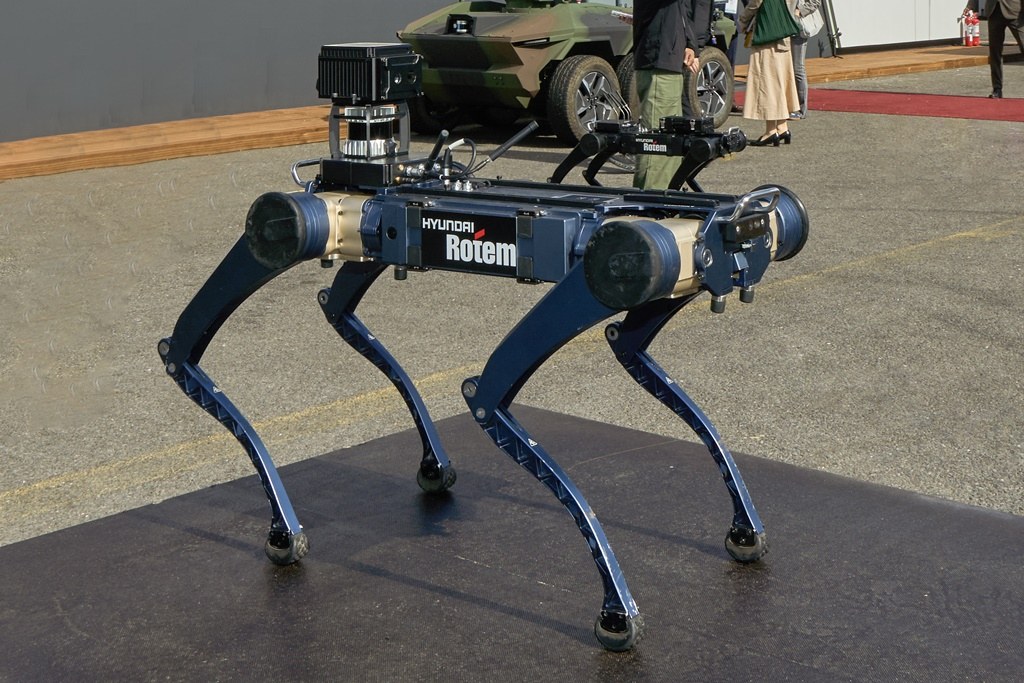
The deployment program at the center of the rally pairs two companies with complementary monopolies. Rainbow Robotics, the KAIST-descended humanoid pioneer in which Samsung Electronics holds a 35 percent stake, manufactures the RB-01K quadruped platform. Hyundai Rotem, the defense arm of Hyundai Motor Group best known for K2 tanks, integrates the military payload: hardened sensors, remote-control systems, and weapons-related technology for combat employment. The Korean Army is expected to begin fielding the machines later this year, with missions spanning base patrol, advance entry into hazardous areas ahead of soldiers, and counter-terrorist response. An eventual fleet of up to 1,000 units would constitute the largest disclosed military quadruped deployment by any army anywhere.
The strategic context makes the timing legible. Ukraine has normalized unmanned ground vehicles for resupply, casualty evacuation, and terrain inspection since 2022. The United States military has tested robot dogs for patrol, surveillance, and explosive detection, and China has demonstrated armed quadrupeds in exercises as part of its intelligentized-warfare modernization. Korea, facing a demographic collapse in available conscripts, has stronger structural incentives than any of them: the RB-01K program is explicitly framed around doing more missions with fewer personnel. The division of labor within the program also anticipates the governance questions that armed ground robots raise. By placing weapons-related integration entirely with Hyundai Rotem, an established defense contractor operating under military procurement law, the structure keeps the civilian robot maker's platform business separable from combat employment decisions, a boundary that will matter to Rainbow Robotics' commercial customers and international partners as scrutiny of armed robotics intensifies.
A military robot dog order might seem distant from a company that makes precision gears, but the connection is direct. Think of the robot as a body and the actuators as its muscles: every one of the four legs needs several, and each must survive mud, recoil, and cold that consumer robots never face. If the army buys 1,000 robot dogs, the muscle maker receives orders for tens of thousands of military-grade joints, plus spares, for years. Investors were not buying a story about robots on Wednesday; they were counting joints.
Samsung's Division and the Huang Effect
The rally's second engine was organizational rather than mechanical. Samsung Electronics said Tuesday it had established a robotics division, reported by Korean outlets as the Robotics eXperience unit, to consolidate robotics strategy, core technology development, and business execution, the company's most significant structural robotics commitment since it began building the business in 2021. Markets read the move as a signal that Korea's largest company intends to pull its vast supplier network into physical artificial intelligence, echoing comments Nvidia chief executive Jensen Huang made in Seoul last month, when he identified robotics as Korea's next major growth industry and argued the country's manufacturing depth positions it to build the sensors, actuators, and machine intelligence the field requires.
The Samsung connection runs deeper than sentiment because of the ownership lattice underneath it. Samsung's 35 percent stake in Rainbow Robotics means the conglomerate is simultaneously the strategic anchor of the company supplying the army's robot dogs and the operator of the electronics factories where humanoid pilots are expected first. When a single corporate group links national defense procurement, consumer electronics manufacturing, and a listed robot maker, every announcement in one arm reprices the others, which is exactly the amplification mechanism Wednesday's session displayed.
Demographics Meet Manufacturing Depth
Beneath the day's price action sits a structural argument that distinguishes Korea's robotics moment from a generic technology rally. The country combines the world's lowest fertility rate with one of its highest industrial robot densities, meaning both the labor shortage and the automation competence are already in place. Its manufacturing base spans precisely the component categories that quadrupeds and humanoids consume in volume: harmonic-style reducers and precision gears from firms like SPG, servo actuators from Robotis, motion controllers from Samhyun, and the battery and semiconductor supply chains of the conglomerates above them. This is why the rally's composition, component makers outrunning integrators, reads less like speculation and more like the market mapping a bill of materials onto listed companies. Korea's government has reinforced the thesis with its K-humanoid alliance and defense innovation programs, which channel procurement toward domestic platforms. The comparison investors are reaching for is the country's defense export boom: Korea turned K9 howitzers and K2 tanks into a global export franchise inside a decade, and the RB-01K program is the first test of whether robot platforms can follow the same playbook from domestic fielding to allied export markets.
The Volatility Behind the Euphoria
A common misconception after sessions like Wednesday's is that a broad surge marks the start of a new bull market. The arithmetic argues otherwise: according to IBK Investment and Securities, the combined market value of Korea's major robotics companies more than tripled from about KRW 16 trillion (approximately US11.6 billion in August 2025 to KRW49 trillion (approximately USD35.5 billion) in early June, then collapsed to KRW 23 trillion (approximately US$16.7 billion) by July 20. Wednesday's surge is a rebound inside a drawdown. The brokerage's own caution is the correct frame: the sector's next durable leg depends on commercial products, repeat orders, and tangible earnings, not organizational announcements. Military programs are also slower revenue than markets assume; defense acceptance testing, integration cycles, and budget appropriations routinely push deliveries to the right. Investors and industry watchers should treat the RB-01K timeline as a plan with political will behind it, and verify actual fielding against Army statements at year-end.
Implications of a Priced-In Military Quadruped Market
The robot dog has crossed from a research platform to a procurement category, and Korea just became the reference market for what a national quadruped program does to a robotics supply chain. For component makers globally, military quadruped demand is emerging as the first volume market for ruggedized actuators outside industrial automation, a pattern Chinese suppliers such as Unitree's ecosystem will watch closely since export controls fence them out of allied defense programs. For defense ministries, Korea's Army is about to generate the first large-scale operational dataset on quadruped reliability in service, data every NATO procurement office will want. And for the robotics industry broadly, the pairing of a civilian robot maker with a defense integrator, Rainbow Robotics supplying the body and Hyundai Rotem the mission systems, offers a template that keeps civilian firms one contractual step removed from weaponization while still capturing defense volume.
One connected thread deserves a closing note. The rally unfolded even as Hyundai Motor's union continued partial strikes at Ulsan, with the company stating on the same day that humanoid deployment is not part of those negotiations. Korea is thus running both halves of the physical artificial intelligence experiment simultaneously: its capital markets are pricing the robot supply chain's upside while its largest factory floor negotiates the social terms of the same machines' arrival. How those two conversations converge will shape the speed at which Korea's robot decade actually proceeds, and it makes the country the single most informative jurisdiction to watch in global robotics right now.
This development confirms that physical artificial intelligence in Korea now spans from Samsung's boardroom to the front line, and year-end delivery of the first RB-01K units will be the checkpoint that converts Wednesday's enthusiasm into evidence, or exposes it. Between now and then, the disclosures that matter are Army acceptance milestones, actuator order books at the component makers, and any first detail of the new Samsung division's product roadmap, each of which will either validate Wednesday's repricing or unwind it.
This analysis synthesizes company statements and public market activity. Market moves described occurred during the July 22 trading session in Seoul.
Disclaimer: This article is for informational purposes only and does not constitute investment, legal, safety, or procurement advice. Readers should independently verify specifications, certification scope, pricing, availability, regulatory obligations, and operational suitability with the relevant suppliers and authorities before making decisions.