Korea Signs Its AI Alliance in Ink: US$950 Billion in Deals and a Declaration in San Francisco
South Korea converted last week's San Francisco summit diplomacy into signed commitments. President Lee Jae Myung unveiled the San Francisco AI Declaration on July 24 US time, and the presidential office put the total planned cooperation at nearly US$950 billion spanning semiconductors, AI infrastructure, robotics, and autonomous driving. SK Group signed deals worth US$750 billion, anchored by an SK Hynix partnership with Nvidia valued above US$500 billion, while Samsung agreed to up to US$200 billion of cooperation with Broadcom through 2030. For robotics buyers, the deals lock Korean memory, compute, and physical AI capacity into the American stack for years.
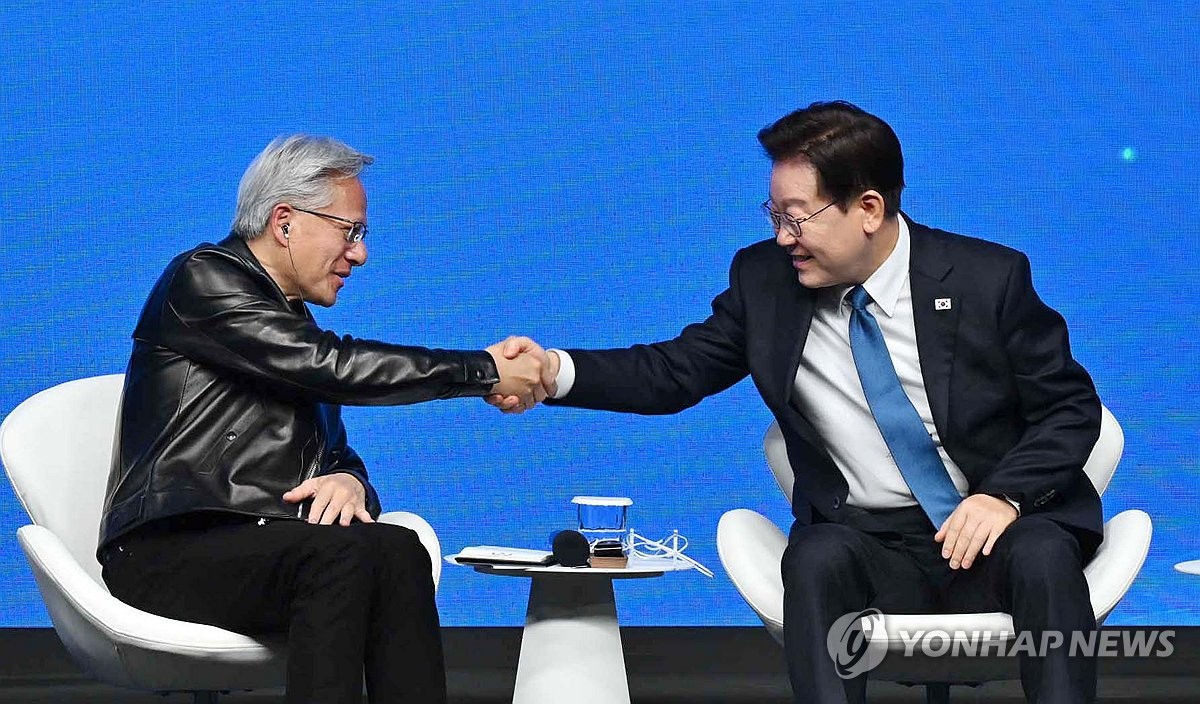
Three days ago, Seoul had flown its entire AI supply chain to San Francisco. The question then was what all those chairmen and chief executives would actually sign. The answer arrived over the weekend, and it is larger than most forecasts: nearly US$950 billion in planned cooperation, a formal declaration of Korea's role in the global artificial intelligence order, and a set of individual agreements that reach directly into robotics and physical AI.
The San Francisco AI Declaration, unveiled by President Lee Jae Myung at the summit on July 24 US time, commits South Korea to serve as a supply-chain hub for the AI economy in partnership with American technology companies. The presidential office said the accompanying agreements total nearly US$950 billion and span semiconductors, AI infrastructure, robotics, and autonomous driving. SK Group alone signed deals worth US$750 billion, anchored by an SK Hynix partnership with Nvidia valued at more than US$500 billion, while Samsung Electronics agreed to pursue up to US$200 billion in cooperation with Broadcom through 2030.
Numbers of this size deserve immediate skepticism and the fine print rewards it. These are framework agreements, memoranda of understanding, and long-term supply intentions rather than purchase orders. A commitment "valued at more than US$500 billion" describes the projected scale of memory supply, data center construction and joint development over many years, not cash changing hands this quarter. Anyone who lived through the last decade of announced-but-unbuilt semiconductor fabs knows the distance between a signing ceremony and a loading dock. What makes this round harder to dismiss is the demand pressure behind it. SK Chairman Chey Tae-won told the summit that every buyer he speaks to keeps raising its memory forecasts, and said of Nvidia's Jensen Huang that he would not be surprised if, at their next meeting, Huang tells him the current figures were too low and says he wants more.
What was actually signed
The individual agreements give the headline number its texture. SK Telecom plans to build up to 2 gigawatts of AI factories from 2027 using Nvidia's next-generation Vera Rubin platform and SK Hynix HBM4 high-bandwidth memory with the first data center due online in 2027. SK Hynix will jointly develop next-generation memory with Nvidia for AI training, AI agents and physical AI applications, an explicit acknowledgment that robotics workloads now shape memory roadmaps. SK Hynix separately agreed to long-term AI memory supply for Microsoft's future data centers, SK Telecom signed with Anthropic to cooperate on gigawatt-scale AI data centers in Korea, and the same company expanded its Amazon Web Services collaboration beyond their joint data center project in Ulsan.
Samsung's side of the ledger centers on Broadcom. The two companies will pair Broadcom's custom AI accelerator franchise with Samsung's memory, sub-2-nanometer foundry process, and advanced packaging, a combination Samsung describes as the industry's only integrated AI semiconductor manufacturing platform. Samsung will supply HBM4 and HBM4E memory for Broadcom's accelerators. Anthropic chief executive Dario Amodei confirmed at the summit that his company has signed supply arrangements with both Samsung and SK Hynix, extending relationships disclosed in May when Anthropic named both firms as critical memory partners at its US$965 billion valuation round.
Taken together, the projects described at the summit include AI data centers backed by roughly 5 gigawatts of power capacity and computing infrastructure equivalent to about 2 million graphics processing units. For scale, 5 gigawatts approaches the output of five large nuclear reactors dedicated to machine intelligence, and the 2 million GPU figure exceeds the estimated installed base of several individual hyperscalers today.
Robotics is written into the declaration, not bolted on
The significant phrase in the presidential office's framing is that the cooperation spans robotics and autonomous driving alongside chips and data centers. Physical AI is one of the three pillars with semiconductors and AI data centers that President Lee has identified as determining Korea's future. The declaration extends the three state-driven mega projects his government launched in June with more than US$576 billion in planned investment, one of which is a physical AI ecosystem anchored by the same chaebol groups that signed in San Francisco.
The robotics substance was delivered by Hyundai Motor Group Executive Chair Chung Euisun, who used the summit to outline the group's transformation into a physical AI company, including a plan for United States robot production capacity of 30,000 units a year by 2028. That announcement carries enough operational detail to warrant its own report, published separately today. The structural point for this story is that Korea has bound its robot ambitions to American compute and its memory dominance to American robot demand, in the same set of documents.
There is a plain-language way to hold all of this in one frame. Korea has effectively signed on as the foundry, warehouse, and power plant of the AI age, the way Rotterdam once positioned itself as Europe's port regardless of whose ships came in. The country is not betting on any single model, robot, or application winning. It is betting that whoever wins will need Korean memory, Korean packaging, and Korean-built physical AI capacity, and it has now put contractual scaffolding under that bet with nearly every American buyer that matters at once.
The summit gathered roughly 150 attendees at The Midway in San Francisco, including Samsung Electronics Executive Chairman Lee Jae-yong, SK's Chey, Hyundai's Chung, Naver founder Lee Hae-jin, Nvidia's Huang, Broadcom chief executive Hock Tan, OpenAI chief executive Sam Altman, and Anthropic's Amodei. President Lee held separate one-on-one meetings with Huang, Altman, Amodei, and Tan before the plenary. He also scheduled a Silicon Valley meeting between Korea's National Pension Service, the world's third-largest pension fund, and American venture capital firms to channel investment toward Korean startups, a reminder that the state is orchestrating capital at every layer of this play, from sovereign pension money down to startup rounds.
What Korea gets, and what it gives up
The declaration's four-pillar structure, as described by Korean officials, positions the country to expand from its memory stronghold into AI semiconductor production more broadly, sovereign AI infrastructure, physical AI industries, and talent pipelines. Each pillar has a domestic policy engine behind it. The June mega projects committed more than US$576 billion of state-coordinated investment across data centers, chips, and a physical AI ecosystem, and the San Francisco agreements now supply the foreign demand side for that capacity. Seoul is deliberately playing both roles at once, subsidizing supply at home while contracting demand abroad, which is the same industrial-policy pincer that built Korean shipbuilding and displays in earlier decades.
The cost of the strategy is dependency running in both directions. Korea's AI economy is now underwritten by the capital spending plans of perhaps six American companies, and any correction in hyperscaler budgets would land on Korean order books first. The declaration also arrives while Seoul and Washington continue to negotiate the fine print of a broader trade package covering Korean investment pledges in the United States, which means the commercial agreements sit inside a political frame that could shift with either country's election cycles. Korean officials appear to have judged that the risk of standing outside the American stack exceeds the risk of overexposure to it. Chinese state media reached the same conclusion from the opposite direction within a day, reading the declaration as another brick in a supply chain being organized around, and against, China's own embodied AI push.
The buyer's read: concentration, capacity, and a two-year clock
A procurement leader evaluating this news should separate three signals from the ceremony. The first is capacity direction. If even half of the announced data center and memory volume materializes, high-bandwidth memory and advanced packaging will remain the binding constraint on AI hardware into the late 2020s, and robotics programs that depend on onboard accelerators or cloud inference will be competing for the same silicon as hyperscalers. Budgeting for compute scarcity, rather than assuming the current shortage is cyclical, is the conservative position.
The second is concentration risk. The declaration deepens a structure in which two Korean memory makers, one American GPU vendor, and a handful of accelerator designers sit under every serious AI and robotics deployment on both sides of the Pacific. The efficiency gains are real, and so is the fragility: a single export-control decision, labor dispute, or fab incident in Korea now propagates to robot programs in Texas and Bavaria alike. Buyers with long-horizon automation roadmaps should be mapping their exposure to this stack the way they mapped Taiwan exposure three years ago.
The third is the two-year clock. The first SK Telecom AI factory is due in 2027, Hyundai's American robot capacity target lands in 2028, and the declaration's credibility will be tested by whether groundbreakings and tool move-ins happen on that schedule. Korea has chosen to compete not by building frontier models but by owning the physical substrate those models run on, and by extension the substrate that embodied AI runs on. That is a defensible position precisely because it is verifiable: either the gigawatts, the wafer starts, and the robot lines appear, or they do not. The signatures are now on paper. The next eighteen months of purchase orders will show whether the ink was the story or the start of one.
Disclaimer: This article is for general information purposes only and does not constitute investment, legal, or procurement advice. Readers should verify details with primary sources before making business decisions.