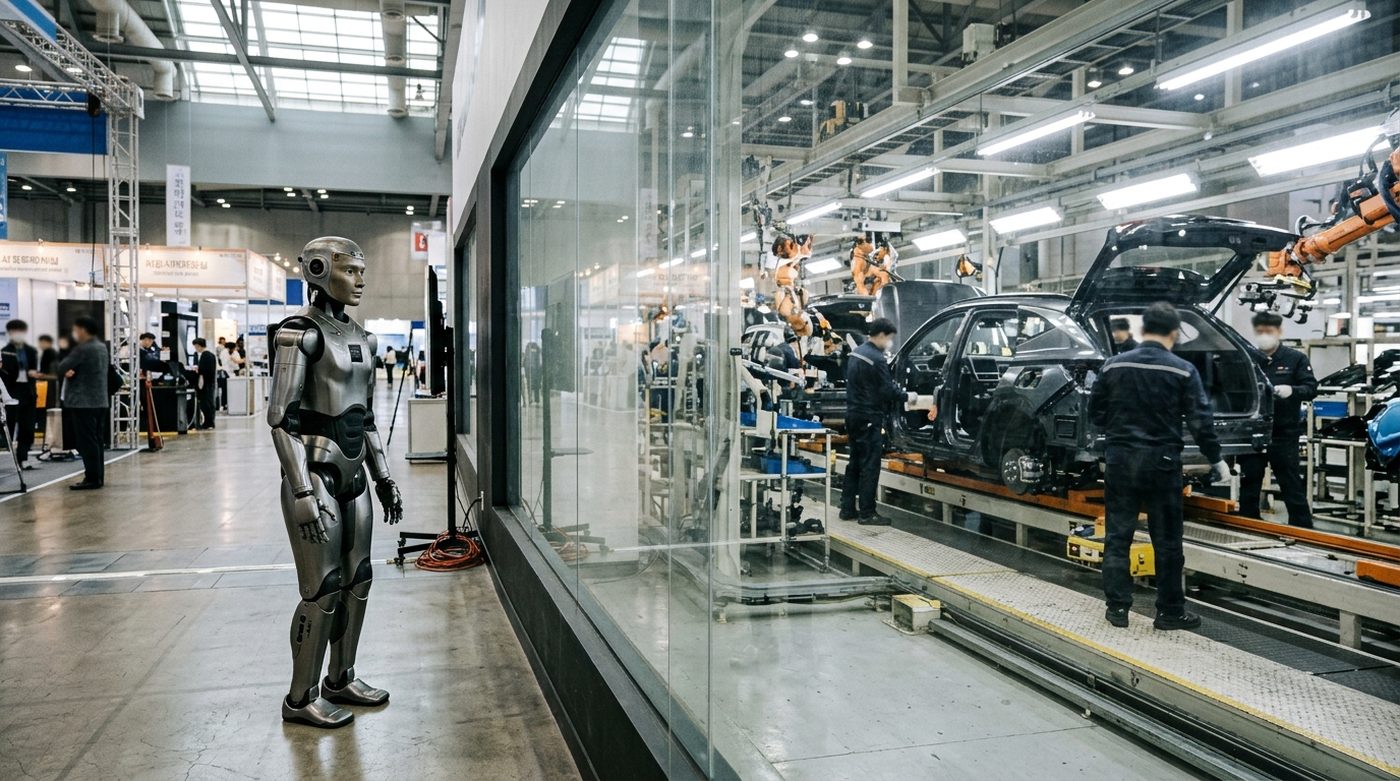
KAIST and Nvidia Bet That the Next Foundation Model Learns From Muscles, Not the Internet
KAIST announced on July 26 a joint center with Nvidia to develop physical AI that learns from real human motion data. The Human Physical Intelligence Technology Center, co-directed by wearable-robot expert Kong Kyoung-chul and bio-robot expert Kim Jung, will build a Human Motion Foundation Model that predicts and generates human movement, with applications spanning wearable robots, humanoids, rehabilitation, and digital healthcare. It is the second KAIST-Nvidia institution announced in three days, and its raw material is a data asset that internet-trained models cannot replicate.

The most valuable training data in robotics may not be on the internet at all. It lives in gait labs, rehabilitation clinics, and the log files of wearable robots that have spent a decade strapped to real human legs. That is the asset the Korea Advanced Institute of Science and Technology just brought to a new partnership with Nvidia, announced on July 26 and it explains why the chipmaker keeps deepening its Korean footprint days after the San Francisco AI Summit.
The new unit, called the Human Physical Intelligence Technology Center, pairs KAIST researchers with Nvidia on joint physical AI research. Its headline objective is a Human Motion Foundation Model, a general-purpose AI trained on large-scale measurements of how people walk, how joints articulate, how muscles produce force, and how bodies keep balance, built to understand, predict, and generate movement. The target applications run from humanoids and rehabilitation robots to digital healthcare, and the institute plans to expand into manufacturing, shipbuilding, steel, and logistics over time.
The announcement is easy to misfile as another university memorandum. The details argue otherwise. The center has named co-directors with commercial track records, a specific Nvidia technical lead, a defined model architecture goal, governance with six-month review cycles, and a data asset that took more than a decade to accumulate and cannot be scraped from the web.
Why motion data is the moat
KAIST, Korea's premier science and technology university in Daejeon, has spent years developing walking-assistance and rehabilitation exoskeletons and validating them on actual users, including through the international Cybathlon competitions its teams have won. The new center builds on the Human Physical Intelligence Research Center in KAIST's Department of Mechanical Engineering, with Professor Kong Kyoung-chul, a wearable-robot specialist who commercialized exoskeletons through his startup Angel Robotics, and Professor Kim Jung, a bio-robotics expert, serving as co-directors. Angel Robotics, a Seoul-based company listed on Korea's KOSDAQ market in 2024, sells walking-rehabilitation systems into hospitals, which means the lab's data pipeline runs through regulated clinical deployments rather than one-off experiments.
Korea's demographic arithmetic supplies the demand side of the equation. The country has the world's lowest fertility rate and one of its fastest-aging workforces, which makes rehabilitation robotics and physically assistive machines a domestic market before they are an export product. A motion model that can anticipate how an eighty-year-old moves differently from a factory worker in her thirties is not an academic refinement in Korea; it is the difference between a wearable robot that hospitals reimburse and one they return. The government's decision to name physical AI among its national pillars, and to fund it through the mega projects launched in June, gives the center a policy tailwind that most university labs never enjoy.
That pedigree matters because of a structural fact about physical AI that the generative AI boom has obscured. Language models could feast on decades of accumulated internet text. A model of human movement has no equivalent corpus. The data must be generated by instrumented people walking, lifting, stumbling, and recovering in real environments, with force and joint measurements attached, and by wearable robots recording how actual bodies respond to assistance. Whoever holds large, clean archives of that data holds something closer to oil reserves than to a dataset, and KAIST's archive is the explicit reason Nvidia is at the table.
The model the partners describe would invert how robots currently relate to people. Existing machines execute pre-programmed motions under situation-specific control code. A robot running a motion foundation model would read a person's posture and trajectory and predict the next action, letting a wearable robot inject force at the right joint at the exact moment a user takes a step, or letting a humanoid on a production line adjust its speed and path to the movements of the worker beside it. In plain terms, today's robots are like elevators that stop only at programmed floors; the goal here is a machine that watches you walk toward the doors and holds them open before you ask.
The second Korean deal in three days
From Nvidia's side, Charles Cheung, a senior manager at the Nvidia AI Technology Center, will provide technical advice and development support, and the center will run research and education programs on Omniverse, Nvidia's virtual-world simulation platform, and its digital twin tooling. The center will also review research goals every six months, hold an annual international symposium, and run a student ambassador program placing five to ten KAIST students into lectures, mentoring and joint projects with Nvidia experts.
The timing is not incidental. On July 24, KAIST and Nvidia announced a separate joint research institute focused on agentic AI for the Korean language and domestic industries. Two days later came this center, aimed squarely at the physical side. The pairing lands in the same week South Korea signed nearly US$950 billion in planned AI cooperation with American technology companies around the San Francisco AI Declaration, with physical AI named as one of the national pillars, and Hyundai committed to American robot production capacity of 30,000 units a year by 2028, both reported separately by this publication. Nvidia is methodically wiring itself into every layer of Korea's AI buildout, from SK Hynix memory contracts at the top to graduate students in Daejeon at the bottom.
The division of labor between the two July announcements is itself informative. The agentic institute handles the cognitive layer, language and reasoning tuned to Korean industry, while the new center handles the physical layer, movement and force. Together they mirror the architecture most robotics labs now converge on: a reasoning model that decides what to do, and a motion model that decides how a body should do it. Nvidia supplying simulation, compute, and advisory staff to both sides means the connective tissue between Korea's AI brain and its AI body will run on one vendor's platform, which is precisely the position Nvidia has spent two years engineering across every robotics ecosystem it touches.
The competitive context sharpens the picture. Google DeepMind is building robot foundation models with Boston Dynamics and its own Gemini Robotics line. Tesla trains Optimus on video and teleoperation data harvested at scale. Chinese groups, from Unitree to the Beijing humanoid robot innovation center, are racing to assemble motion datasets and a Chinese startup working with Fudan University released a large tactile dataset for robot touch this same weekend, also covered today. What distinguishes the KAIST approach is its clinical-grade human data: measurements of muscle force and balance from real patients and users, the kind of data that video scraping cannot produce and that matters most for machines that must physically cooperate with human bodies.
What buyers and builders should take from Daejeon
The wearable segment gives the center its clearest commercial runway. Exoskeleton adoption has been throttled for a decade by controllers that lag the wearer, forcing users to fight their own assistance device. A motion model that anticipates rather than reacts addresses the core usability complaint that has kept these systems in rehabilitation clinics and out of warehouses. If the center's model cuts that latency perceptibly, the buyers will not only be hospitals; they will be the logistics and construction firms that abandoned exoskeleton pilots in the early 2020s and would return for hardware that finally feels like help.
For technology evaluators, the near-term products of this center will not be robots but models and benchmarks, and the practical questions are about access. Universities, research institutes and startups should watch whether the Human Motion Foundation Model, or components of it, are released openly, licensed commercially, or kept within the Korean industrial ecosystem the government is assembling. The center's planned expansion into manufacturing, shipbuilding, steel, and logistics reads as a roadmap of Korean industries whose incumbents, from HD Hyundai's yards to POSCO's mills, will be the first institutional customers for motion-aware machines.
A skeptic should note what the announcement does not contain: no disclosed budget, no dataset size, no model timeline and no benchmark commitments. University-industry centers can absorb years of goodwill without shipping a model, and foundation models for motion face an unsolved scientific problem, since human movement varies across bodies, ages, and pathologies in ways that text does not. Six-month review cycles are a governance answer to that risk, not a technical one. The center's credibility will rest on whether it publishes reproducible results within its first review cycles.
There is also a quieter risk worth naming: data governance. Clinical motion data is health data, collected from patients under consent frameworks written before anyone imagined it training commercial humanoid controllers. How KAIST and Nvidia structure consent, anonymization, and cross-border data flows will set precedents for every hospital system and exoskeleton vendor that follows, and a single misstep could freeze the very archives that make the project valuable. The partners have said nothing publicly on this point yet, and evaluators should ask.
The strategic read is nonetheless clear, and it is quotable: in physical AI, the scarce resource is no longer compute or capital but verified human motion data, and the institutions that spent the last decade collecting it are suddenly the most interesting partners in robotics. Nvidia has now signed two Korean research alliances in three days to secure access to exactly that. Roboticists have argued for years that the field's bottleneck would shift from hardware to data. This center is what it looks like when the world's most valuable chipmaker agrees.
Disclaimer: This article is for general information purposes only and does not constitute investment, legal, or procurement advice. Readers should verify details with primary sources before making business decisions.