Japan's Biggest Landlord Is Building the Chip Lab for Robots, Next Door to TSMC
Mitsui Fudosan and Kumamoto Prefecture launched Japan’s first physical AI semiconductor centre (KSCM/PASTEC) adjacent to TSMC’s JASM fabs, with seven founding MOUs including Taiwan’s ITRI and Hsinchu Science Park, opening FY2027. Read as real-estate capital and regional government financing the robot economy’s chip-integration layer, and as a Japan-Taiwan industrial corridor milestone.
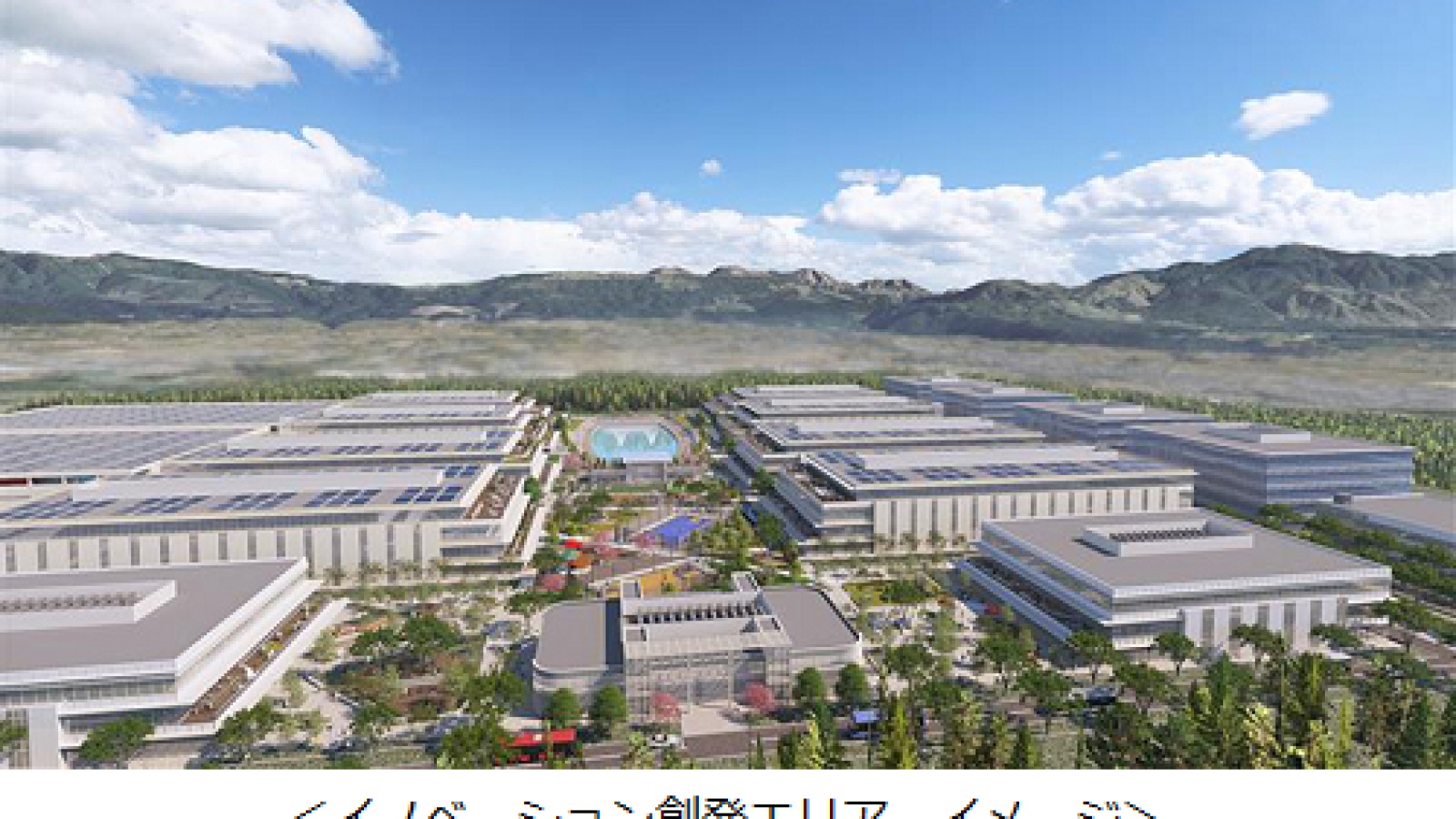
Japan has decided where the chips for its robots will be engineered, and it is a science park in Kyushu rather than a lab in Tokyo. Mitsui Fudosan, the country's largest real estate developer, and Kumamoto Prefecture announced on July 27 the establishment of Kumamoto Science Park Community & Management, a joint management body whose centrepiece is PASTEC, the Physical AI Semiconductor Technology Center, to be built in the Innovation Creation Area of the Kumamoto Science Park in Koshi City.
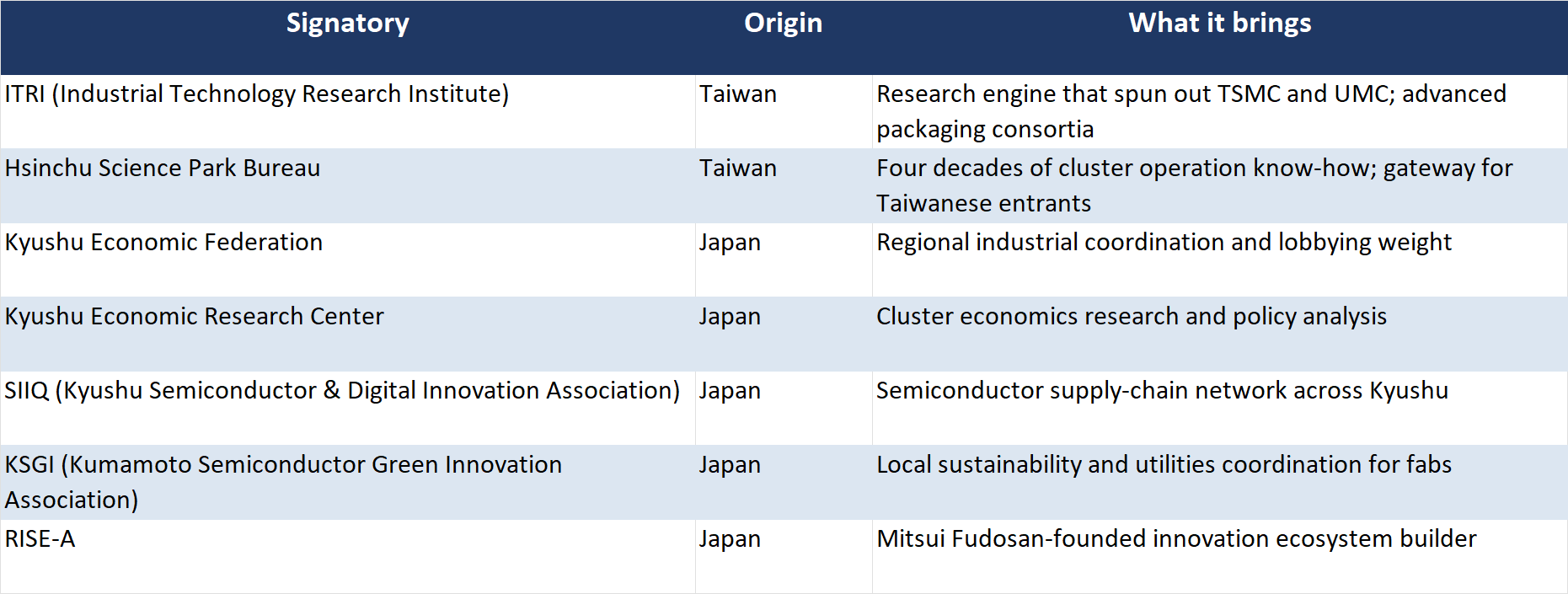
PASTEC's mandate is specific and, for the robotics industry, consequential: research and development of semiconductor technologies for physical AI, meaning the machines that operate in the physical world, from self-driving cars to industrial robots. Its technical focus is mounting and packaging, the art of combining cutting-edge and mature-node chips into finished products, and it will host joint research and demonstration projects across the manufacturing equipment, materials, and parts supply chain spanning Japan, Taiwan, and beyond. On launch day the new association signed memoranda of understanding with seven organisations, including two pillars of Taiwan's semiconductor establishment: ITRI, the research institute that spun out both TSMC and UMC, and the Hsinchu Science Park Bureau, administrator of the world's most famous chip cluster.
The location is the announcement's loudest statement. The Kumamoto Science Park sits a short drive from TSMC's JASM fabs in Kikuyo, the twin plants that have turned this agricultural prefecture into the anchor of Japan's semiconductor revival. Mitsui Fudosan and the prefecture signed their basic agreement with Koshi City in April; the park targets completion around 2030 as the hub of the Kyushu cluster. What was announced this week is the institutional machinery: a General Incorporated Association co-directed by Kumamoto Vice Governor Shingi Takeuchi and Mitsui Fudosan managing officer Kyosuke Hosoda, with membership applications opening in the fall of 2026 and a one-stop administrative service to help Taiwanese companies set up in Japan, complete with Japan-Taiwan business matchmaking.
Why Robots Need a Packaging Lab
The phrase physical AI is doing national-strategy work in Japan right now, and PASTEC shows what Tokyo means by it in practice. A humanoid robot or an autonomous tractor is not powered by a single frontier processor; it is a federation of chips, a cutting-edge AI accelerator for perception and planning surrounded by dozens of mature-node devices handling motor control, power management, sensor fusion, and safety interlocks. The engineering discipline that binds them, advanced packaging and heterogeneous integration, determines the machine's cost, power draw, and reliability far more than any single die does. It is also the layer where Japan retains genuine global strength through its materials and equipment champions, and where Taiwan's ecosystem excels at turning research into volume manufacturing.
Think of PASTEC as a test kitchen positioned between the flour mill and the restaurants. TSMC's fabs next door mill the silicon; Japan's robot and car makers cook the final dishes; the packaging centre in between works out the recipes that combine expensive frontier chips with cheap mature ones so the dish is affordable enough to serve at industrial scale. No robot company can justify that facility alone, which is why a prefecture and a property developer are building it as shared infrastructure.
The choice of Mitsui Fudosan as co-builder is less strange than it first appears, and it echoes a pattern this publication flagged in China earlier this month when JD's property arm bought robotics-industrial land in Shanghai's Zhangjiang district. Physical AI needs physical places: cleanrooms, demonstration floors, land near fabs, and housing for engineers. Developers monetise exactly that, and Mitsui Fudosan has already built an innovation-ecosystem practice through ventures like RISE-A, one of the seven MOU signatories. The other signatories map the coalition's breadth: the Kyushu Economic Federation, the Kyushu Economic Research Center, the SIIQ semiconductor and digital innovation association, and Kumamoto's own KSGI green-innovation body.
The Taiwan Connection Is the Strategy
The two Taiwanese MOUs deserve the most attention, because they formalise something that has been building since TSMC broke ground in Kikuyo: a Japan-Taiwan industrial corridor in physical AI hardware that deliberately parallels, and hedges against, both American software dominance and Chinese manufacturing scale. ITRI is not a symbolic partner; it is the institution that created Taiwan's foundry model and still runs its most advanced packaging research consortia. The Hsinchu Science Park Bureau brings four decades of know-how in operating the exact kind of research-to-production cluster Kumamoto wants to become by 2030.
For Taiwanese chip, materials, and equipment firms, the one-stop entry service lowers the friction of establishing Japanese operations at precisely the moment geopolitical concentration risk is pushing them to diversify beyond the island. For Japan, the corridor imports the world's best cluster-building playbook. And for the robotics industry globally, it means the semiconductor supply chain for embodied machines is being consciously organised in a democratic-bloc geography, one week after Washington's NDAA vote to bar Chinese humanoids from the Pentagon and days after Seoul signed its San Francisco Declaration. The map of who builds robot chips, like the map of who builds robots, is being drawn by flags as much as by engineers.
The seven launch-day MOUs sketch the coalition's architecture at a glance.
Kyushu's claim to the physical AI mantle is older than the current boom. The island produced roughly 40 percent of Japan's integrated circuits at the height of the first Silicon Island era in the 1980s before losing ground to Taiwan and Korea, and its comeback since TSMC's arrival has been the clearest industrial-policy success Japan has had in a generation. Sony's image sensors, Mitsubishi Electric's power semiconductors, and a dense web of materials suppliers already sit within a morning's drive of the new science park. What Kyushu never had was an institution dedicated to the system-level integration of those parts into intelligent machines. That is the gap PASTEC is chartered to fill, and it is why the centre's framing around robots and autonomous vehicles, rather than around chips in the abstract, matters.
A skeptic should still ask what, concretely, has been created. A management association, a named centre, and seven MOUs are institutional scaffolding, not a fab; memoranda of understanding are the industrial world's most breakable promises, and Japanese science parks have a mixed record of converting ribbon-cuttings into revenue. The park itself will not be complete until around 2030, an eternity in AI time, and PASTEC's budget and headcount were not disclosed. Those are fair cautions. The counterweight is that Kumamoto is the one place in Japan where the build-it-and-they-came argument has already been settled: TSMC's arrival pulled tens of billions of dollars of investment, suppliers, and wage growth into the prefecture in under five years, and the science park is an attempt to capture the next layer of that value, the application engineering, before it drifts to Tokyo or overseas.
The Robot Industry's Reading
Japanese robot makers have watched this year as attention concentrated on Chinese humanoids and American foundation models, and as a Nikkei teardown of Unitree's G1 concluded that Japan cannot quickly catch up in low-cost humanoid manufacturing. PASTEC is part of Tokyo's structural answer: rather than racing to assemble cheaper humanoids, Japan is investing where it retains leverage, the semiconductor packaging, materials, and precision components that every robot, whoever assembles it, must contain. FANUC, Yaskawa, Kawasaki, and the automotive giants all stand to draw on a domestic centre that de-risks the integration of AI accelerators into machines that must run for years on factory floors.
The practical milestones to track are three. First, whether PASTEC announces a physical facility timeline and anchor tenants when membership opens this fall; infrastructure declared is not infrastructure financed. Second, whether the first joint demonstration projects involve robot-relevant packaging, chiplet integration for motion controllers, in-sensor computing, power-efficient edge modules, rather than generic semiconductor research. Third, whether Taiwanese firms actually take up the entry service in numbers; a corridor is proven by traffic, not treaties.
The larger signal is unambiguous and matches the week's pattern from Seoul to Sejong: the physical AI race has entered its infrastructure phase, and the entities writing the cheques are increasingly states, prefectures, developers, and asset managers rather than venture funds. Japan's contribution to that phase is characteristically patient, a 2030-horizon science park betting that when the humanoid hype cycle settles, the money will be made by whoever owns the boring, essential layer where chips meet machines. It is a wager on compound interest rather than fireworks, which is to say it is a very Japanese wager, and it should not be underestimated for that.
This article is for informational purposes only and does not constitute investment advice. Readers should conduct their own research before making investment decisions.