Hyundai Puts a Number on Its Robot Future: 30,000 Units a Year in America by 2028
Hyundai Motor Group Executive Chair Chung Euisun used the San Francisco AI Summit to declare the group's evolution into a physical AI solutions company, backed by the most specific capacity commitment any automaker has made in humanoid robotics: a United States production system capable of building 30,000 robots a year by 2028. The plan centers on Boston Dynamics' electric Atlas humanoid, 50,000 Nvidia Blackwell GPUs, a Google DeepMind model partnership, and roughly US$5.97 billion for a Saemangeum AI Valley in Korea that includes contract robot manufacturing for smaller firms.
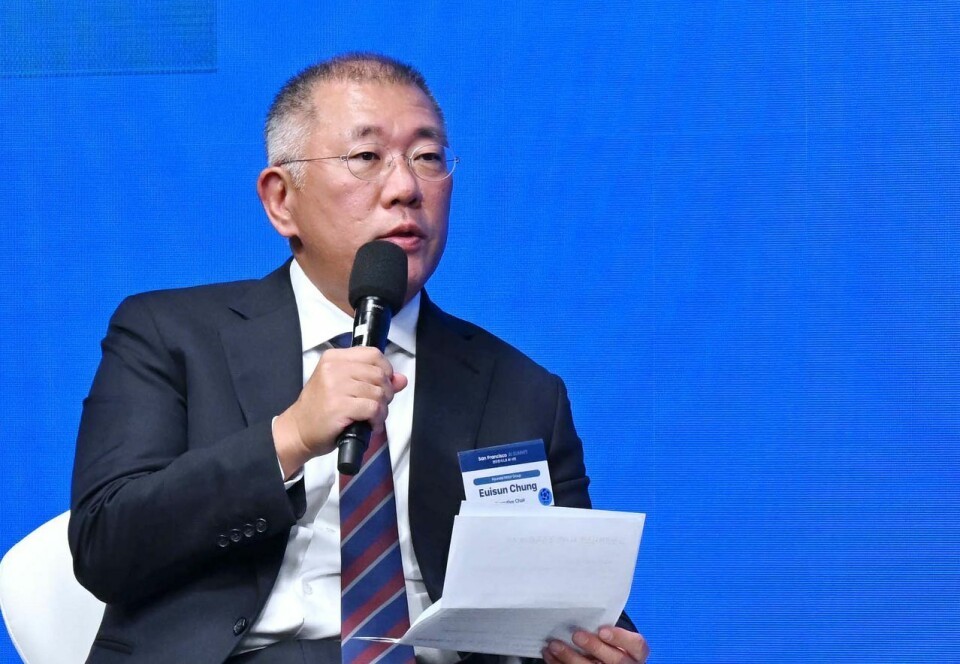
Every automaker now claims a robot strategy. Hyundai Motor Group just did something rarer: it named a number, a country, and a date. Speaking at the San Francisco AI Summit on July 24, Executive Chair Chung Euisun said the group is building a production system in the United States capable of manufacturing 30,000 robots a year by 2028, the most concrete humanoid capacity commitment yet made by any carmaker anywhere.
The announcement anchors Hyundai's declared transformation from an automotive manufacturer into what Chung called a physical AI solutions company. The plan combines Boston Dynamics' electric Atlas humanoid as its flagship product, a training pipeline built on 50,000 Nvidia Blackwell graphics processing units, artificial intelligence models co-developed with Google DeepMind, and roughly KRW9 trillion, about US$5.97 billion, for a new AI and robot manufacturing hub in Korea's Saemangeum region. Deliveries of Atlas development units will begin at Hyundai's own plants, including the Metaplant America facility in Georgia.
"Hyundai Motor Group is evolving beyond the traditional boundaries of automotive manufacturing to become a physical AI solution company," Chung told an audience of roughly 150 executives and officials gathered for the summit that also produced South Korea's San Francisco AI Declaration, reported separately today. The line would read as conference rhetoric if it were not attached to capital, capacity, and a supply chain that already exists.
From cars to robots along one assembly line
Chung described a three-stage strategy that moves from intelligent devices, meaning vehicles and robots, through intelligent spaces such as AI-run factories, to city-scale integrated intelligence. Binding the stages together is what the group calls a data flywheel: robots and vehicles operating in Hyundai facilities generate the real-world data that trains the next generation of models, which in turn make the machines more capable and generate richer data. It is the same self-reinforcing loop Tesla describes for its Optimus program, with one practical difference. Hyundai already owns a robotics company with a quarter century of locomotion research and an installed base of industrial robots working in commercial settings.
That company is Boston Dynamics, the Waltham, Massachusetts robotics developer founded in 1992 as a Massachusetts Institute of Technology spinoff, in which Hyundai acquired a controlling stake in 2021 at a valuation of US$1.1 billion. Its core technology is dynamic locomotion and whole-body control, the discipline of keeping a legged machine balanced while it works, and its market niche has evolved from research platforms into deployed industrial fleets, with more than 2,000 Spot quadrupeds working in inspection and public-safety roles worldwide. Boston Dynamics supplies the product portfolio: the Spot quadruped, the Stretch logistics robot, the MobED mobile platform, and now the all-electric Atlas humanoid as the centerpiece. Atlas development units will be deployed first across Hyundai manufacturing sites, with the Georgia Metaplant, the group's newest and most automated American factory, serving as a proving ground. That site is not an arbitrary choice. The US$7.6 billion electric-vehicle complex near Savannah opened in 2025 as Hyundai's showcase for software-defined manufacturing, already runs Spot units on inspection routes, and gives the group a robot deployment environment on American soil, inside the tariff wall, where every hour of Atlas operation generates training data the group owns outright. The sequencing mirrors the pattern this publication has tracked across the industry: prove the robot in your own plants, where you control the environment and absorb the failures, before selling it to customers who will not.
The 30,000-unit figure deserves careful reading. It describes production capacity, not confirmed orders, and Hyundai has not said what mix of Atlas humanoids, Spot units, and Stretch systems would fill those lines. For calibration, the entire global installed base of working humanoid robots today is measured in the low tens of thousands, and China's leading makers, Unitree and AgiBot, each shipped roughly 5,000 to 5,500 units in 2025. A single factory network able to produce 30,000 robots annually would, if utilized, roughly match the announced ambitions of Figure AI's BotQ facility and exceed anything currently operating outside China. Capacity announcements are cheap until steel is cut; this one at least comes from a company that builds two million vehicles a year and knows precisely what a 30,000-unit line costs.
The compute and brains are American, the factories are not
The Nvidia relationship supplies the training substrate. Hyundai confirmed it will deploy 50,000 Blackwell GPUs, a commitment first disclosed last year, across model training, validation, and deployment, alongside Nvidia digital twin tooling to simulate factories before machines are installed. The two companies also plan a joint robot reference platform that Korean universities, research institutes, and startups can build on, effectively making Hyundai's stack a national development platform rather than a proprietary island. Boston Dynamics' separate partnership with Google DeepMind covers the foundation models that give Atlas generalized manipulation and task understanding.
The Korean side of the ledger is just as specific. The Saemangeum AI Valley project, at roughly US$5.97 billion, packages AI data centers, a robot manufacturing cluster, water electrolysis for hydrogen, and an AI hydrogen city, with contract robot production capacity that smaller Korean firms can rent rather than build. Hyundai separately plans KRW42 trillion, about US$27.8 billion, of investment in Korea's Yeongnam region over the next decade. The architecture is unmistakable: American compute and American demand on one side, Korean manufacturing scale and state-coordinated infrastructure on the other, with Hyundai as the hinge. The group's Waymo relationship, under which IONIQ 5 vehicles built at the Georgia Metaplant supply the autonomous fleet, already demonstrates the template in vehicles.
For a plain-language frame, think of what Hyundai is attempting as the Foxconn move in reverse. Foxconn became indispensable by manufacturing other companies' intelligent devices at scale. Hyundai intends to design the intelligence, build the device, own the factories, and then rent spare capacity to everyone else, capturing every layer of margin that contract manufacturers normally leave on the table.
Where this leaves the competition
The competitive map now has three distinct Western automaker positions. Tesla is vertically integrated and secretive, promising Optimus volume from its own lines but publishing neither capacity figures nor external customer commitments. Mercedes-Benz and BMW are buyers, piloting Apptronik and Figure units respectively inside their plants while keeping robot manufacturing off their own books. Hyundai has chosen the third position: own the robot maker, own the factories, deploy internally first, and sell capacity outward. In China, the analogous play is fragmenting in the opposite direction, with XPeng building its IRON humanoid toward year-end mass production, Chery incubating the Aimoga consumer brand, and BYD teasing its first humanoid reveal for early August, a story this publication also covers today. The difference is that Hyundai is the only one of these automakers that already owns a robotics company with two decades of shipping products.
The adoption signals worth watching are therefore not press releases but procurement artifacts. Atlas development units appearing on Metaplant work orders, Boston Dynamics job postings for manufacturing engineers in Georgia or the American Southeast, tooling contracts for the Saemangeum cluster, and the first named external customer for electric Atlas would each confirm the plan is converting into hardware. Their absence by mid-2027 would say something equally clear.
The skeptic's ledger
The counterarguments are substantial. Hyundai's headline robotics numbers have grown quickly: the group announced in April 2025 that it would purchase tens of thousands of robots itself, and capacity plans have a way of expanding faster than deployed fleets. Boston Dynamics, for all its engineering pedigree, has never manufactured at automotive volume, and the gap between building hundreds of hand-finished Spots and running a 30,000-unit line is the gap that has humbled every robotics company that tried to cross it. The electric Atlas remains a development platform without a published price, cycle-time benchmark, or third-party customer commitment. And the whole plan assumes humanoid demand materializes on schedule, an assumption that labor economics supports in the long run but that no purchasing department has yet validated at five-digit volume.
There is also an industrial-relations shadow. As this publication reported on July 23, Hyundai's Korean union explicitly kept humanoid deployment out of this summer's wage negotiations, a truce rather than a settlement. Scaling robot production in Georgia while introducing robots into Korean plants will test that arrangement from both ends.
What separates Hyundai's announcement from the genre, though, is falsifiability. A production system in the United States capable of 30,000 robots a year by 2028 is a claim with a street address and a construction schedule. Either the tooling orders, hiring notices, and Atlas deployments at the Metaplant appear over the next 24 months, or they do not. Automation buyers should treat the announcement as a strong signal that a second credible Western supply source for industrial humanoids, alongside the Chinese cluster and ahead of most American startups, is being financed into existence by a company that already knows how to build machines by the million. The quotable version of this story is simple: humanoid robotics just acquired its first automaker-grade capacity commitment, and it is Korean-owned, American-built, and Nvidia-trained. The robot market Hyundai is betting on does not fully exist yet. The factory capacity to serve it, on this evidence, soon will and in this industry, as in cars a century ago, the companies that build the factories first tend to write the price list for everyone who arrives later.
Disclaimer: This article is for general information purposes only and does not constitute investment, legal, or procurement advice. Readers should verify details with primary sources before making business decisions.