Humanoid Secures US$152 Million Series A to Scale Wheeled Robot Manufacturing
UK-based robotics startup Humanoid has raised US$152 million in a Series A funding round, reaching a US$1.35 billion valuation. The capital will accelerate the mass manufacturing of its wheeled robots and the deployment of its KinetIQ AI stack, with beta deployments scheduled for the fourth quarter of 2026.
What is the Humanoid Series A Funding Event?
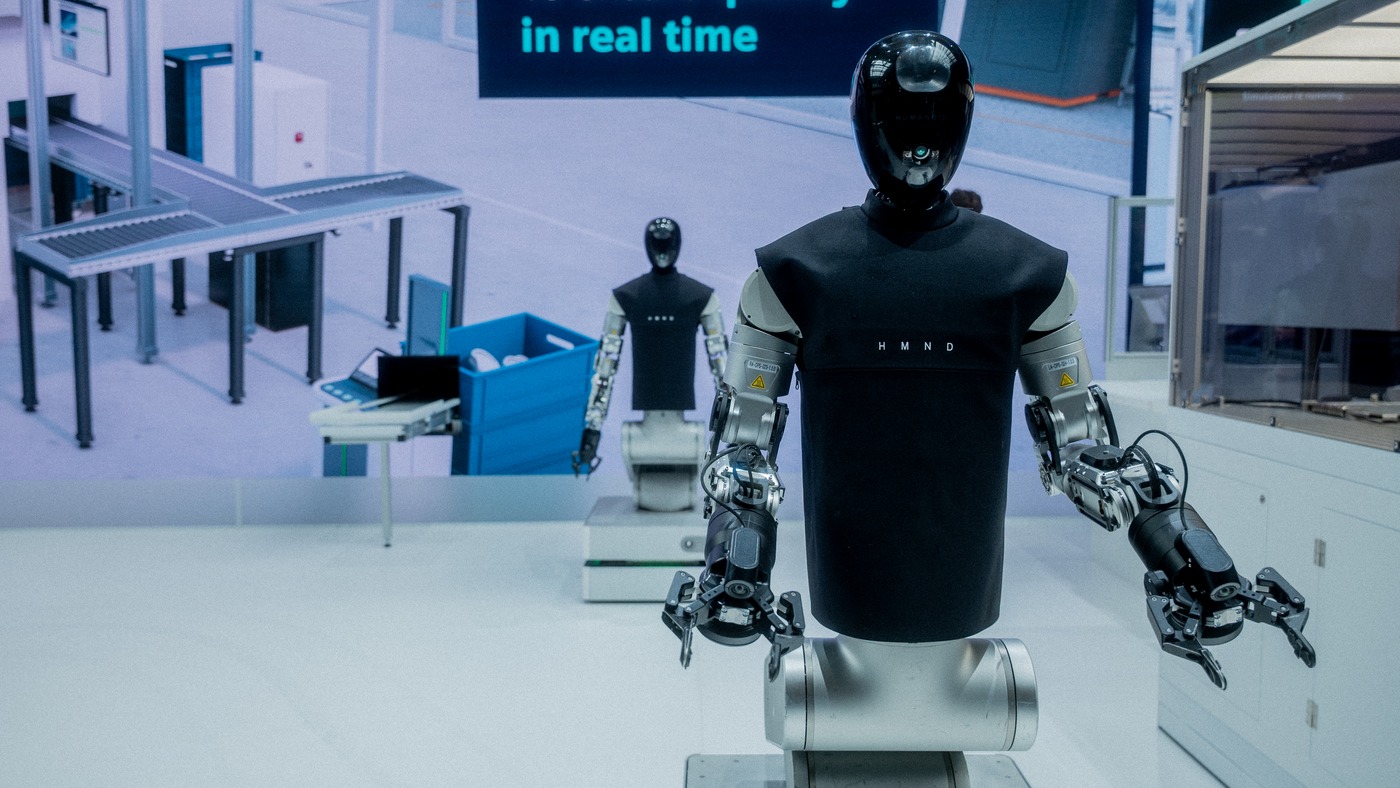
UK-based robotics startup Humanoid raised US$152 million in a Series A funding round on July 21, 2026, achieving a US$1.35 billion valuation. Led by Prime Movers Lab, the capital will fund the mass manufacturing of wheeled robots and the deployment of the KinetIQ AI stack by Q4 2026.
The robotics sector has recorded another significant capital event, with UK-based startup Humanoid securing US$152 million (EUR 133 million) in a Series A funding round. This transaction establishes a post-money valuation of US$1.35 billion (EUR 1.1 billion) for the company, bringing its total capital raised to US$270 million. Prime Movers Lab led the investment, with participation from industrial and financial entities including Schaeffler, Bosch, Fubon Financial Holding Venture Capital, and Aglaé Ventures. The capital injection is specifically allocated to support a next-generation hardware platform, the continued development of the KinetIQ artificial intelligence stack, and the mass manufacturing of wheeled robots. Beta deployments of these systems are scheduled to commence in the fourth quarter of 2026.
Humanoid, led by Chief Executive Officer Artem Sokolov, operates from the United Kingdom and focuses on the intersection of physical artificial intelligence and industrial automation. Unlike competitors pursuing general-purpose bipedal platforms, Humanoid has prioritized wheeled mobility for its initial commercial systems, targeting environments where flat surfaces allow for more efficient navigation and payload management. The company has established strategic partnerships with SAP, Nvidia, Bosch, and Siemens, positioning its technology within established industrial ecosystems. Notably, Bosch serves as the contract-manufacturing partner for the hardware, while Schaeffler is preparing for a large-scale deployment of the systems within its own operations.
The Economics of Production Discipline
The US$1.35 billion valuation reflects a market premium for companies that can demonstrate a clear path from prototype to production. The involvement of Bosch as a contract manufacturer is a critical operational signal. Many robotics startups struggle with the transition from building dozens of units in a laboratory to producing thousands of units on an assembly line. By outsourcing the manufacturing process to an established industrial supplier, Humanoid mitigates a significant execution risk. This arrangement allows the company to focus its internal resources on refining the KinetIQ artificial intelligence stack and managing customer integrations, rather than building factory infrastructure from scratch.
Think of it like designing a new smartphone: the software engineers write the operating system and design the interface, but they do not build the physical assembly lines to manufacture the glass and silicon. By partnering with Bosch, Humanoid is applying this proven consumer electronics manufacturing model to heavy industrial robotics, ensuring that when a customer orders a fleet of robots, the hardware arrives on time and functions reliably.
This approach contrasts with the vertical integration strategies seen elsewhere in the sector. While controlling the entire manufacturing process offers theoretical advantages in hardware iteration speed, it requires massive capital expenditure and introduces severe operational bottlenecks. The decision to utilize wheeled mobility rather than bipedal locomotion further simplifies the manufacturing requirements and reduces the unit cost, accelerating the timeline to commercial viability. For procurement teams evaluating automation vendors, a contract-manufacturing partnership with a tier-one supplier provides a tangible guarantee of production capacity and hardware reliability.
Integration Within Established Ecosystems
The strategic partnerships with SAP, Nvidia, and Siemens indicate a deliberate effort to embed the KinetIQ artificial intelligence stack into existing enterprise software and hardware environments. A robot that cannot communicate seamlessly with a warehouse management system or an enterprise resource planning platform is an isolated asset, limiting its operational value. By aligning with dominant enterprise software providers, Humanoid ensures that its systems can be deployed without requiring customers to overhaul their existing digital infrastructure.
The planned large-scale deployment with Schaeffler serves as a critical validation point for this integration strategy. Schaeffler, a major automotive and industrial supplier, operates technically demanding manufacturing and logistics facilities. The successful deployment of Humanoid systems within these environments will provide empirical data on the operational efficiency and return on investment of the KinetIQ platform. This deployment will likely serve as a reference case for other industrial buyers, demonstrating the system's capability to handle real-world variability and integrate with legacy equipment.
The Reality of Deployment Timelines
The commitment to beta deployments in the fourth quarter of 2026 establishes a firm timeline for evaluating the system's performance outside of controlled environments. The robotics industry frequently suffers from a disconnect between demonstration capabilities and deployment realities. A system that performs flawlessly in a carefully mapped laboratory often encounters severe difficulties when faced with the dynamic and unpredictable nature of an active factory floor. The true test of the KinetIQ artificial intelligence stack will be its ability to handle edge cases, recover from errors, and maintain continuous operation without human intervention.
A common misconception in the market is that bipedal locomotion is a prerequisite for advanced physical artificial intelligence. The reality is that the vast majority of industrial environments are already optimized for wheeled transport, making bipedalism an expensive and unnecessary complication for near-term commercial deployment. The focus on wheeled robots for these initial deployments is a pragmatic decision that acknowledges the current limitations of physical artificial intelligence. While bipedal robots offer greater versatility in environments designed for humans, they require significantly more demanding control systems and consume more power. Wheeled robots, operating on flat surfaces, can carry heavier payloads, move faster, and operate for longer durations between charges. This pragmatic approach prioritizes immediate commercial utility over long-term technological ambition, a strategy that aligns with the immediate needs of industrial buyers seeking reliable automation solutions.
Navigating the Transition from Prototype to Production
The transition from developing a functional prototype to manufacturing a reliable commercial product is the most perilous phase for any robotics startup. The US$1.35 billion valuation achieved by Humanoid reflects investor confidence in the company's ability to manage this transition successfully. The partnership with Bosch as a contract manufacturer is the cornerstone of this confidence. Bosch brings decades of experience in high-volume, high-quality manufacturing, providing Humanoid with immediate access to established supply chains, quality control processes, and production capacity.
This partnership mitigates the significant execution risks associated with scaling hardware production. Startups that attempt to build their own manufacturing infrastructure often face severe delays, cost overruns, and quality control issues. By leveraging Bosch's expertise, Humanoid can focus its internal resources on refining the KinetIQ artificial intelligence stack and developing the software infrastructure necessary to support large-scale deployments. This division of labor allows the company to iterate on its software capabilities rapidly while ensuring that the underlying hardware meets the rigorous reliability standards demanded by industrial customers.
Implications for the Broader Automation Ecosystem
The emergence of well-capitalized startups like Humanoid is reshaping the competitive dynamics of the industrial automation sector. Traditional automation providers, who have historically focused on rigid, single-purpose systems, are increasingly facing competition from agile companies offering flexible, AI-driven solutions. This shift is forcing established players to accelerate their own investments in physical artificial intelligence and explore new partnership models.
The true bottleneck in physical artificial intelligence is no longer algorithmic sophistication, but the ability to manufacture reliable hardware at scale and integrate it seamlessly into legacy industrial workflows. This highlights the critical importance of the Bosch and SAP partnerships.
For industrial buyers, this increased competition offers a wider range of automation options but also makes vendor selection more demanding. Evaluating the long-term viability of a startup, assessing the maturity of its software stack, and understanding its manufacturing capabilities are now critical components of the procurement process. The Humanoid Series A funding round, with its strong emphasis on production discipline and strategic partnerships, provides a compelling model for how robotics startups can build credibility and secure the trust of industrial customers. The success or failure of this model will have significant implications for the future trajectory of the physical artificial intelligence sector.
Market Positioning and Competitive Dynamics
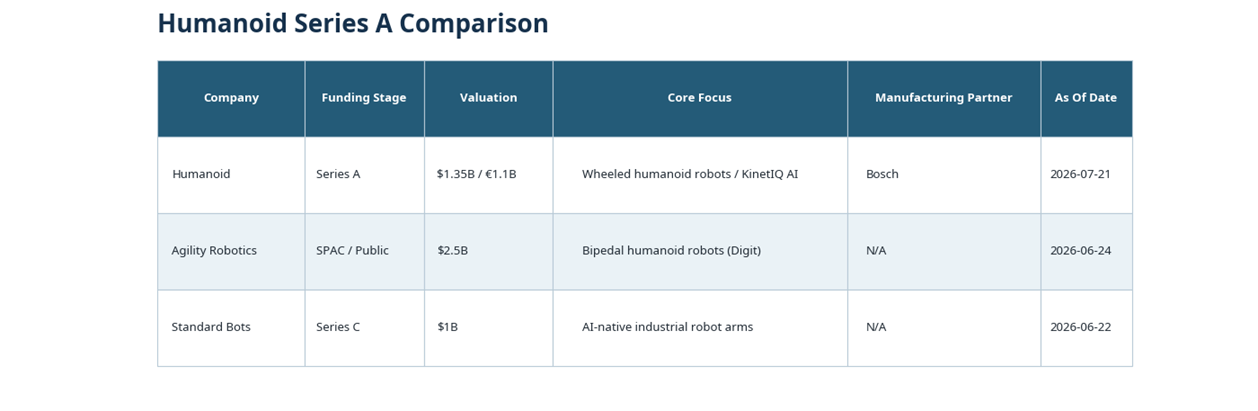
Comparison table. Source evidence and as-of dates are retained in the accompanying XLSX workbook.
The Series A funding round positions Humanoid as a well-capitalized competitor in the rapidly expanding market for physical artificial intelligence. However, the company faces significant competition from both established industrial automation providers and a growing cohort of well-funded startups. The success of Humanoid will depend not only on the technical capabilities of its hardware and software but also on its ability to execute its commercial strategy and deliver measurable value to its customers.
The comparison table illustrates the diverse strategies being pursued within the sector. While Agility Robotics has focused on bipedal locomotion and Standard Bots on industrial arms, Humanoid has carved out a niche with its wheeled platforms and strong industrial partnerships. The ultimate winner in this market will be the company that can most effectively bridge the gap between technological innovation and operational reliability.
The US$152 million Series A funding round provides Humanoid with the capital necessary to scale its operations and execute its commercial strategy. The involvement of tier-one industrial partners such as Bosch and Schaeffler provides significant validation for the company's approach. However, the true measure of success will be the performance of the systems during the beta deployments scheduled for the fourth quarter of 2026. For industrial buyers, the focus must remain on empirical evidence of operational efficiency and return on investment, rather than the scale of the capital raised.
This development confirms that the robotics sector is transitioning from a period of technological exploration to a phase of commercial execution, where production capacity and integration capabilities are as important as algorithmic sophistication.
This analysis synthesizes company statements and public market activity.
Disclaimer: This article is for informational purposes only and does not constitute investment, legal, safety, or procurement advice. Readers should independently verify specifications, certification scope, pricing, availability, regulatory obligations, and operational suitability with the relevant suppliers and authorities before making decisions.