DirectBooking and DeepYou Form AI Hospitality Joint Venture
DirectBooking Technology and DeepYou have announced a joint venture to build an AI-native travel platform. Despite ambitious targets for "robotic staff," the announcement lacks hardware details, capital commitments, or deployment evidence, raising questions about the gap between corporate strategy and physical robotics reality.

DirectBooking Technology and Beijing DeepYou Digital Technology have unveiled a joint venture framework for what they call China’s first natively Agent-to-Agent, fully integrated travel and stay artificial intelligence direct-booking platform. The announcement promises three to ten artificial intelligence “employees” at each of 30,000 to 50,000 hotels over three years while appointing former JD.com Senior Vice President Li Daxue as chairman. The gap between this scale and the disclosed commitments is material.
Beijing DeepYou Digital Technology, headquartered in Beijing, China, is the lesser known partner and the company to study first. DeepYou says it has signed cooperation agreements with more than 400 scenic attractions and serves hundreds of millions of visitors each year. Its core technology claim is a dedicated large model for cultural tourism, and its market niche centers on attraction partners that need digital visitor services and intelligent content. This domain knowledge could support a software booking platform, but it does not answer for physical robotics execution.
The Formal Framework and Its Commitments
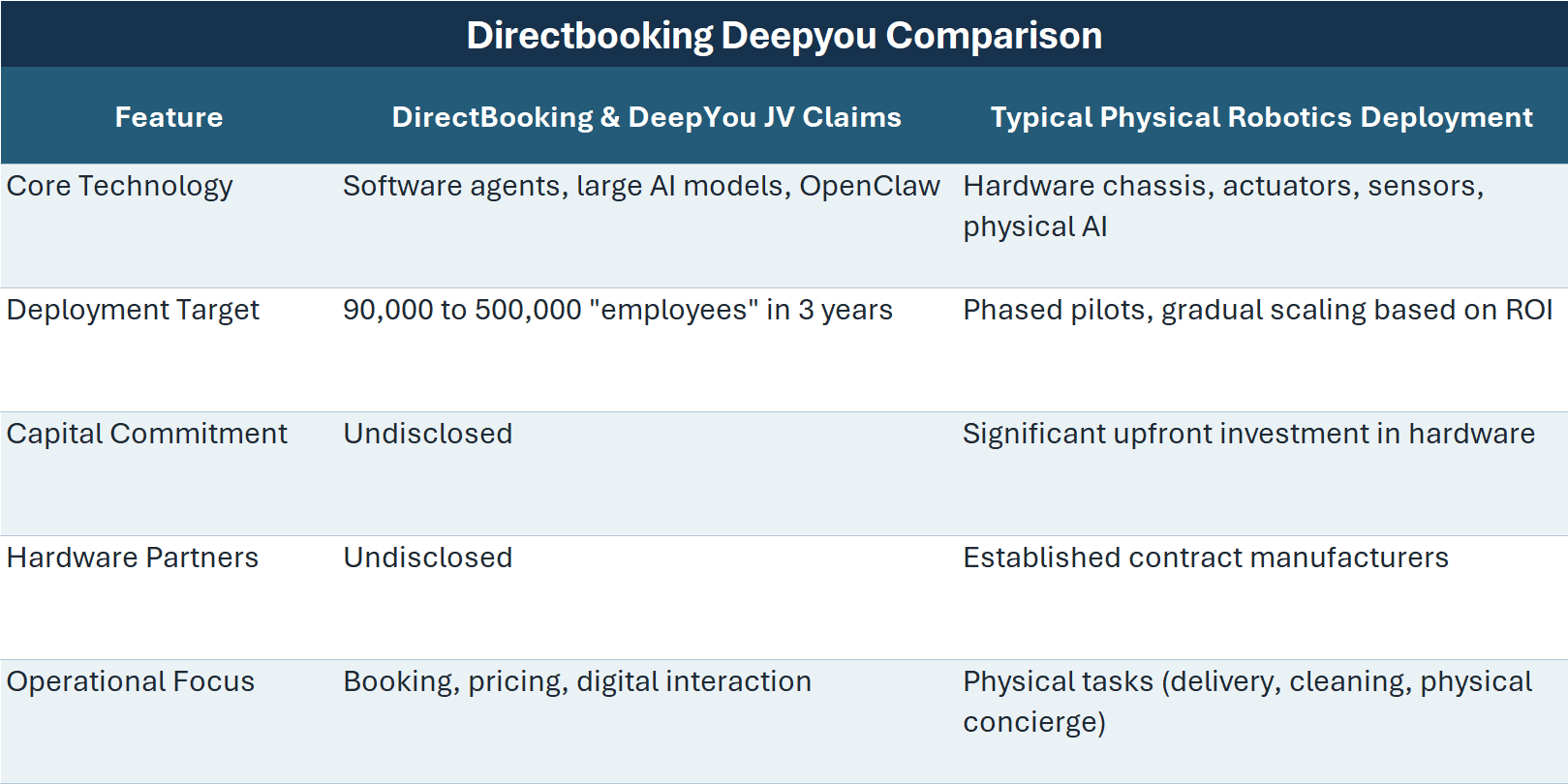
The joint venture framework states that DirectBooking will hold a 51 percent equity interest and DeepYou will hold 49 percent. The chair will be Li Daxue, formerly a senior leader at JD.com. The platform ambition is an Agent-to-Agent architecture that links hotels and travelers directly with artificial intelligence agents, which the companies say can reduce the 15 to 25 percent commissions charged by traditional online travel agency platforms. The target scope is large: three to ten artificial intelligence “employees” across 30,000 to 50,000 hotels over three years. The release only highlights software elements such as OpenClaw autonomous agent technology, real time location based service navigation, multilingual interaction, and dynamic pricing. It does not identify any hardware partners, contract manufacturers, or pilot sites. The total absence of physical robotics evidence signals a software heavy repositioning rather than an imminent hotel robot rollout.
What is the difference between an AI agent and a hotel robot?
An artificial intelligence agent is software that perceives context, plans, and acts in digital systems like booking or support. A hotel robot is a physical machine with motors, sensors, and safety systems that moves in real buildings and interacts with guests. Software scale is fast and cheap; hardware scale is slow, capital intensive, and verifiable on site.
Robotic Staffing Claims Meet Software-Only Evidence
The press claims “robotic staff solutions” and “robotic assistant services,” yet the only concrete technology described is software. OpenClaw agent orchestration, real time location based service navigation, multilingual interaction, and dynamic pricing point to a digital concierge or booking layer that lives in phones, kiosks, and call centers. Those are meaningful if built, but they are not mobile robots that deliver towels, shuttle luggage, or clean corridors. Conflating a software agent with a robot begs questions for buyers who assume a robotic assistant experience service.
Hotel Buildings Expose the Hardware Gap
On the other hand, hotels are variable spaces with elevators, narrow turns, housekeeping carts, room service trolleys, varying floor materials, and guests who stop, crowd, or change direction without warning. A real delivery robot must manage elevator calls, door thresholds, night mode operations, guest interaction etiquette, obstacle avoidance, battery endurance, spare batteries, charging docks, and service alerts that tie into maintenance workflows. Each of these requires engineering, pilots, and service processes that cannot be claimed into existence. Scaling to 90,000 to 500,000 physical units implied by the joint venture’s headcount language would demand large capital budgets, production slots at contract manufacturers, compliance testing, and field reliability data over multiple release cycles. None of those are present in the framework.
DirectBooking’s Existing Business Warrants Extra Diligence
A critical caveat is embedded in DirectBooking Technology’s own disclosures. The company is a holding entity incorporated in the Cayman Islands. Its operations are conducted through a Hong Kong operating subsidiary, Primega Construction Engineering Co. Limited. That subsidiary’s stated core business is transport of excavated materials, soil and rock transportation, and construction works such as excavation, lateral support works, and bored piling. These activities do not align with a claim of independently developed mature hotel property management system solutions and direct connect Software as a Service systems. That mismatch should trigger enhanced diligence from procurement teams because it creates a basic question: where do the hotel software products and customers come from, and where are they documented.
Procurement Checks Before Any Pilot
Before any shortlisting, buyers should anchor decisions to verifiable artifacts rather than vocabulary. Consider this checklist:
· Product definition and scope. Ask for a bill of materials if robots are claimed, or a system design document and architecture if software only. For robots, require safety certifications applicable in your region. For software agents, request security and privacy documentation, data flow diagrams, and multilingual model evaluation results.
· Real properties, not demo sites. Insist on live references in operating hotels with comparable size, elevator brand, service model, and occupancy pattern. Pilots in a lab or scenic attraction do not equal a mixed use hotel tower with conference traffic.
· Elevator and door integration. Confirm written approval from the elevator maintenance provider, including integration method and service procedures. If the plan depends on staff to escort robots between floors, budget the labor and verify any overtime implications.
· Service and uptime. Ask for on site or near site service coverage hours, spare unit availability, and mean time to repair. Attach service credits to service level agreement targets.
· Cost model. For software agents, request explicit per booking, per conversation, or per property pricing. For robots, compare lease or purchase cost with expected workload, battery replacement cost, and dock installation requirements. If no public price is available, record it as N/A until you receive a written quote.
· Data rights and channels. If the platform is “direct,” ensure your property keeps control of guest data, consent records, and communication channels. Spell out who can send marketing messages and how opt outs are honored.
· Exit plan. Require data export and decommissioning procedures that avoid service interruptions during transitions.
Incumbents Leave a Public Trail of Deployment Evidence
On the channel side, the joint venture positions itself against traditional online travel agency platforms that charge 15 to 25 percent commissions. A direct booking software agent that genuinely displaces those fees could improve property level margins, but the proof is conversion rates, fraud loss, customer support handoffs, and repeat booking behavior. Those data are not presented.
On the robotics side, established hotel deployments usually start with pilots at a handful of properties, months of refinement, and clear thresholds for expansion based on reliability and return on investment. Vendors that reach material scale tend to show a public trail of hotel brand references, documented integration guides for common elevator controllers, and field safety records. The joint venture provides none of these markers. That absence does not disqualify a software booking platform, yet it does undercut any claim of imminent robotic staff at scale.
Why Software Scale Differs from Robot Scale
Picture two kinds of helpers. One is a smart phone helper that reads messages, checks prices, and books a room for you. It lives in the cloud and talks through chat or voice. The other is a rolling cart with a brain that rides elevators, brings a toothbrush to room 1512, and waits while a guest takes it. The first helper is fast to copy, the second helper takes factories, spare parts, and careful training.
Robotics Branding Cannot Substitute for Hardware Evidence
The strongest part of this story is the software ambition to connect hotels and travelers without heavy commissions. The weakest part is the repeated use of the word robot without any hardware plan. A claim of hundreds of thousands of robotic staff is not a strategy. It is a stress test that the current disclosures do not pass.
A Software-First Pilot Has a Different Work Plan
If the near term product is an artificial intelligence booking and service agent, hotel teams should plan for data integration work rather than facility changes. Required steps would likely include:
· Connecting to the property management system, channel manager, and payment gateway through a secure application programming interface.
· Defining rate plans and promotions that the agent can quote and adjust under rules you approve.
· Training staff to triage conversations that the agent escalates and to verify identity for sensitive requests.
· Publishing agent access points inside owned channels such as the property website, app, and call center scripts.
· Updating privacy notices, consent flows, and opt out processes to reflect agent interactions.
By contrast, a robot deployment would also add building surveys, dock installation, elevator integration testing, and emergency procedures drills. None of those have reference evidence in the release.
Leadership Helps, but It Does Not Validate Robotics
Li Daxue’s background as a senior leader at JD.com is relevant to a high volume software platform. Experience with systems that handle large transaction volumes, rich catalogs, and multilingual customer support matters for an Agent-to-Agent model. That said, the track record does not substitute for hardware engineering capability, field service logistics, or safety case development. Buyers should treat leadership credibility as one input, not as validation of robotics readiness.
DirectBooking’s Disclosed Operations Need Reconciliation
The company states in its own filings that it is a Cayman Islands holding company that operates through a Hong Kong subsidiary focused on construction transport and works. That is a different domain from hospitality software or physical robotics. If the joint venture will rely on DeepYou for travel domain expertise, the partners should say so plainly and provide a roadmap that explains the software stack, the data sources, and the monetization model. Without that, procurement teams are left to infer a pivot that has not been evidenced.
A Vocabulary Test for Buyers
“Calling a software agent a robot does not put wheels under it. In hotels, elevators do not open for PowerPoint slides.”
Unit Economics Must Be Proven in a Controlled Pilot
The promise of direct booking is reduced take rates and more control of customer relationships. If a software agent can engage guests in Chinese, English, and other languages, provide location based recommendations, and close sales at lower cost, it warrants a pilot. Yet the math must include agent containment rate, human handoff costs, chargeback exposure, and net conversion after the novelty effect fades. On the robotics side, even a successful delivery robot program is judged by room delivery completion rate, guest satisfaction scores, overtime shifts avoided, and lifetime cost of ownership. Announcements do not provide those numbers. Running a controlled pilot with clear success metrics is the only path to a decision.
Evidence That Would Change the Risk Profile
This framework could become more tangible if the partners disclose the items that matter most to buyers. The most meaningful near term signals would be:
· A legal entity name for the joint venture, registration details, and board composition.
· A hotel pilot list with property names, elevator models, and scope of work.
· For software, live conversion and containment metrics from at least three hotels of different tiers.
· For robots, at least one physical model name, safety documentation, and a pilot service schedule that includes overnight operation.
· A priced commercial agreement template that covers data rights, service levels, and termination.
· A public integration index for property management systems and payment providers.
If those appear, the story moves from words to verifiable progress.
The Joint Venture Is a Software Bet Until Hardware Appears
The announcement can be read as a strategic repositioning by DirectBooking, given the mismatch between its declared construction transport activities and the hospitality technology claims. DeepYou brings cultural tourism ties and a declared large model. Together they frame a software centric path to margin improvement for hotels. That path does not require robots. It does require integration work, reference customers, and clear unit economics that stand on their own.
Contract Definitions Can Prevent Mismatched Scope
When a vendor uses the term robotic staff, ask them to define it in writing. If it means software agents, the scope should be service automation inside digital channels. If it means mobile robots, ask for model numbers, certifications, and a spare parts list. Clearing this term at the start will prevent mismatched expectations and disputes later.
A Credible Software Story Still Needs Production Proof
The joint venture between DirectBooking Technology and Beijing DeepYou Digital Technology announces an expansive vision yet withholds the fundamentals that operators and buyers need to see. There is a credible software story to test, centered on direct connections that may lower online travel agency commissions. There is no credible robotics story today, because there is no hardware plan, partner list, pilot evidence, or capital disclosure. Treat the platform as software first, request proof in production settings, and withhold any robotics judgment until a real machine rolls across a real lobby and into an elevator under its own power.
All claims summarized above were checked against the July 21, 2026 partner announcement and the company’s public filings.
Disclaimer: This article is for informational purposes only and does not constitute investment, legal, safety, or procurement advice. Readers should independently verify specifications, certification scope, pricing, availability, regulatory obligations, and operational suitability with the relevant suppliers and authorities before making decisions.