D-Link Forms Robotics Subsidiary and Targets Robot Dog Shipments by Year-End
Taiwanese networking equipment maker D-Link has established D-Link Robotics, pairing an ODM manufacturing deal with composites group Swancor to ship quadruped robots by the end of 2026, followed by a self-developed companion robot in the second quarter of 2027, all wrapped in a subscription software business model.
What is the D-Link Robotics Launch?
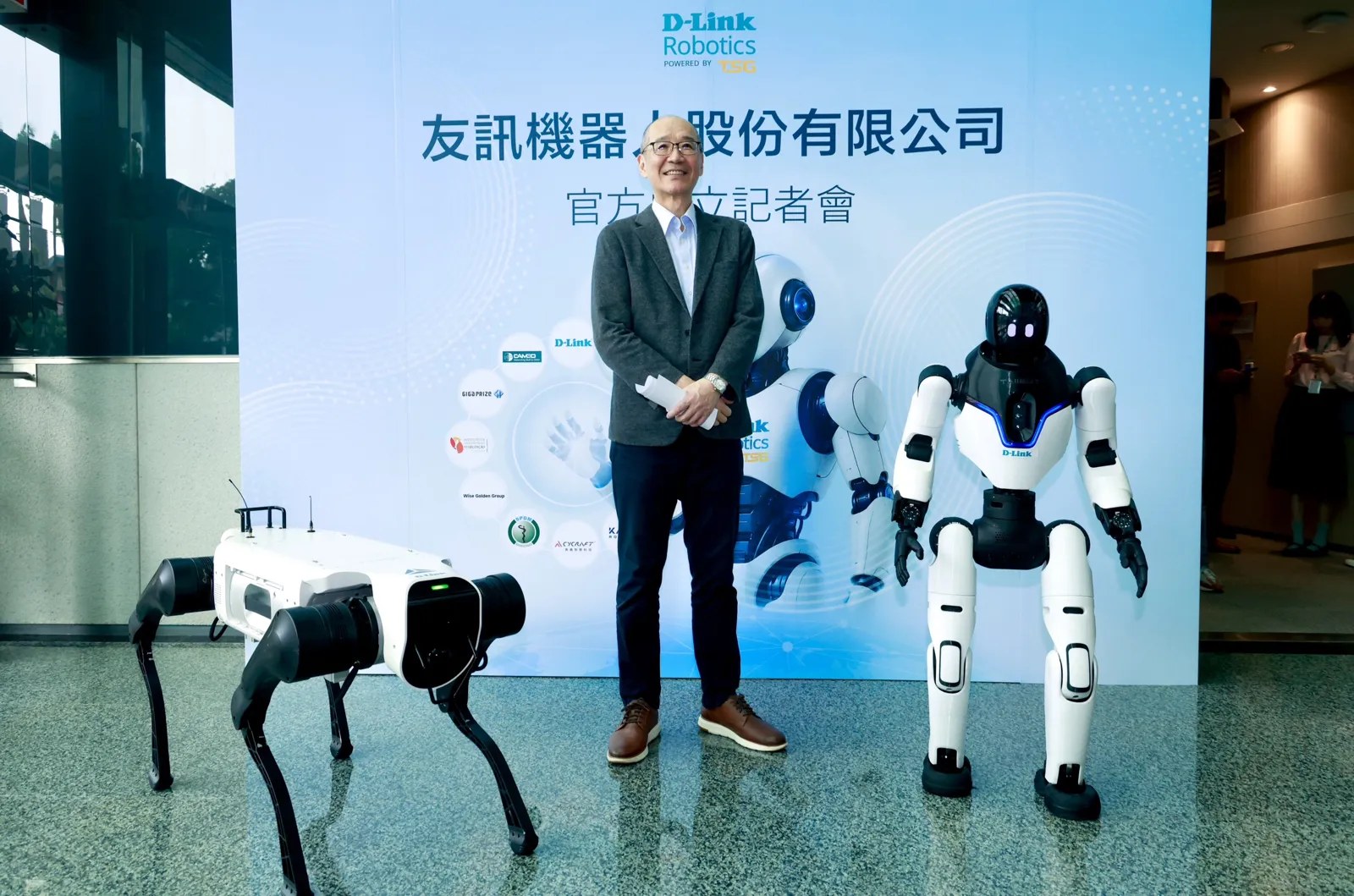
D-Link Corporation, the Taipei-based networking equipment maker, announced the formation of subsidiary D-Link Robotics on July 22, 2026. Working with composites group Swancor, it plans quadruped and inspection robots from the third quarter of 2026, robot dog shipments before year-end, a security care robot in early 2027, and a self-developed companion robot in the second quarter of 2027.
The move marks one of the clearest examples yet of a mature consumer electronics company converting its distribution and connectivity assets into a robotics business. The subsidiary launches with paid-in capital of approximately TWD 30 million (approximately US1 million), to be increased to TWD100 million (approximately US3.4 million) next year. D-Link chief executive Chang Chia-jui, who also chairs the new robotics company, framed the venture around two niche applications, intelligent companionship and safety-focused care, and an asset-light operating model. Manufacturing runs through the group's existing A-Link plant in Tainan on an original design manufacturer basis, while D-Link Robotics concentrates on software-as-a-service subscriptions, a cloud management platform, and an artificial intelligence application ecosystem. The company also signed a global strategic cooperation agreement with Taiwanese cybersecurity firm CyCraft on the same day, combining networking hardware with artificial intelligence security governance for robots, drones, and smart vehicles. Investors registered the announcement immediately: D-Link shares closed at TWD 23.9 (approximately US$0.81), up roughly 7 percent on the day.
The Non-Red Supply Chain Position
One phrase in the announcement will resonate far beyond Taiwan: D-Link emphasized that its Tainan manufacturing line offers a non-red supply chain advantage, industry shorthand for production untouched by Chinese components or assembly. As United States and allied procurement rules tighten around Chinese-made robotics, especially for anything with cameras, microphones, and network connectivity operating inside homes, offices, and critical facilities, a Taiwanese-manufactured quadruped with a Taiwanese security stack addresses a demand segment that Chinese market leaders cannot serve regardless of price. Unitree and Deep Robotics dominate global quadruped volume and undercut Western rivals dramatically on cost, but they are increasingly excluded from government, defense-adjacent, and sensitive-enterprise tenders in the United States and parts of Europe. D-Link is aiming its machines directly at that exclusion zone.
The CyCraft security partnership sharpens the same point. Robot procurement officers increasingly ask not what a robot can do but what its data does: where video streams terminate, who can push firmware, and how fleets are governed. A networking company with three decades of enterprise security experience answering those questions is a differentiated seller, even if its robots are mechanically unremarkable. The timing is also favorable to the pitch. Regulatory scrutiny of connected Chinese hardware has expanded steadily from telecommunications equipment to cameras, drones, and now ground robots, and several allied governments are drafting procurement guidance that treats robot fleets as network infrastructure subject to the same origin rules. Every tightening of that guidance enlarges the addressable market for a Taiwanese quadruped with an auditable security stack, without D-Link improving its robots at all. Geopolitics, in effect, is doing part of the product development, and D-Link's announcement reads as a company positioning itself to harvest a regulatory tailwind it can neither create nor control but can certainly ride.
A Companion Strategy With Unusual Demographic Precision
The self-developed companion robot, planned for the second quarter of 2027, comes with a market ambition of at least 100,000 units and a two-generation demographic strategy notable for its specificity. The first generation targets single adults around age thirty; the second generation shifts to elderly users with stronger privacy protections and fall detection. Chang said the company wants its companion robot to enter thousands of households, leveraging D-Link's consumer channel experience.
That sequencing inverts the industry's usual playbook, which attacks elder care first because the social need is obvious. D-Link's bet is that young, digitally fluent single adults will tolerate the imperfections of a first-generation product, generating the usage data and revenue needed to harden a second-generation machine for the far less forgiving elder care environment, where a missed fall detection is not an inconvenience but a liability. Taiwan's own demographic profile, among the fastest-aging societies in the world, gives the company a domestic proving ground for the second generation before it attempts export markets, and the staged privacy commitments suggest the roadmap was written with elder care regulation in mind from the start. The International Federation of Robotics counted nearly 200,000 professional service robots sold globally in 2024, with care and medical robots among the fastest growing categories, and the World Health Organization projects roughly 2.1 billion people aged over sixty by 2050. The demand backdrop is not in question; the product reliability bar is.
The Subscription Model as the Real Product Decision
The business model choice will determine whether D-Link Robotics is a hardware reseller or a durable business. Applied to quadrupeds and care robots, the software-as-a-service strategy means the machine is the entry ticket and the recurring revenue comes from monitoring services, security updates, fleet dashboards, and care-alert integrations. Industry evidence for this model is genuinely encouraging: Boston Dynamics sells Spot with software subscriptions attached, and the most resilient consumer robotics businesses, from robot vacuum leaders to security camera platforms, all migrated from one-time hardware margins to service attach rates. For a care robot watching an elderly parent, a monthly service tier with fall alerts routed to family phones is not an upsell; it is the entire value proposition, and a networking company with existing cloud operations and channel relationships is structurally equipped to deliver it.
Think of it like the router business with legs: a robot in the home is, functionally, an elaborate networked camera and speaker that walks, and every capability that matters commercially, streaming video securely, receiving updates, being managed remotely, billing a monthly subscription, is a networking and cloud problem before it is a robotics problem. D-Link has sold networked boxes into millions of homes and businesses for thirty years; it is now putting legs on the box and charging monthly for the service around it. The open question is whether it can achieve the reliability floor that recurring-revenue services demand, because subscribers cancel the first month the robot fails to notice what it was paid to notice.
The Gap Between Capitalization and Roadmap
A common misconception around corporate robotics launches is that a published roadmap implies funded execution. TWD 30 million (approximately US$1.0 million) in initial capital is a rounding error against the plan D-Link sketched, which spans quadrupeds, small quadrupeds, robot dogs, humanoids, inspection robots, care robots, and companion robots inside twelve months. Companies with a hundred times the robotics budget have failed to ship reliable companion robots; the category's graveyard includes Jibo, Anki, and Pepper. The asset-light model shifts hardware risk to Swancor and A-Link, but it also means D-Link Robotics owns little proprietary robotics technology at launch. The realistic near-term read is that the quadrupeds are rebadged partner platforms wrapped in D-Link connectivity and security software, and the 100,000-unit companion ambition is a marketing target rather than a forecast. Buyers should evaluate the year-end robot dog on service terms and security architecture, and treat the 2027 companion robot as unproven until units ship.
Competitive Position Against the Incumbents
The field D-Link enters is layered. In quadrupeds, Unitree's consumer-priced machines and Deep Robotics' industrial inspection units define the volume and performance benchmarks, with Boston Dynamics' Spot holding the premium industrial tier. In companionship, China's Futuring Robot, which disclosed nearly RMB 1 billion (approximately US140 million) incumulative funding this week, sells home service humanoids from RMB36,000 (approximately US5,000), while Japanese offerings like Lovot occupy the emotional-companionship premium niche. D-Link will not out-spec any of these on robotics fundamentals. Its wager is that distribution, connectivity, security, and a recurring-revenue software model matter more than mechanical superiority in the household and small-facility segments, the same logic by which networking brands beat more sophisticated rivals in the router wars two decades ago.
Implications for the Robotics Second Wave
The robotics industry's second wave will be led not by robot companies but by connectivity, security, and channel companies attaching robotics to assets they already own. D-Link's entry signals that the barrier to launching a robotics business has fallen low enough for mid-cap electronics firms to cross it through partnerships, a pattern already visible in Taiwan where Foxconn, Compal, and Wistron have all announced robotics initiatives this year. For incumbent quadruped makers, distribution-rich entrants compress margins in exactly the segments where hardware was becoming commoditized anyway. For enterprise and government buyers seeking supply chains outside China, credible Taiwanese options are multiplying, and that competition will discipline pricing in the non-Chinese tier that has until now carried a scarcity premium.
The robot dog shipping before year-end will be the first checkable milestone, and its service terms will reveal more about D-Link's intentions than any roadmap slide. This development confirms that in 2026 any company with a factory, a channel, and a cloud can decide to become a robotics company by Christmas, and the durable winners will be those that treat the robot as a service endpoint rather than a product.
This analysis synthesizes company statements and public market activity.
Disclaimer: This article is for informational purposes only and does not constitute investment, legal, safety, or procurement advice. Readers should independently verify specifications, certification scope, pricing, availability, regulatory obligations, and operational suitability with the relevant suppliers and authorities before making decisions.