China's Hospitals Are Becoming Robot Training Grounds, Starting With the Pharmacy Shelf
Shenzhen’s Chaowei Dynamics and PKU Healthcare announced cooperation on embodied AI for hospitals: a medical digital asset library reproducing pharmacy sorting and grasping in simulation, enabling consumables-free training. State-media placement (S&T Daily) read as policy signal. The 日前 dating caveat is disclosed in the body.
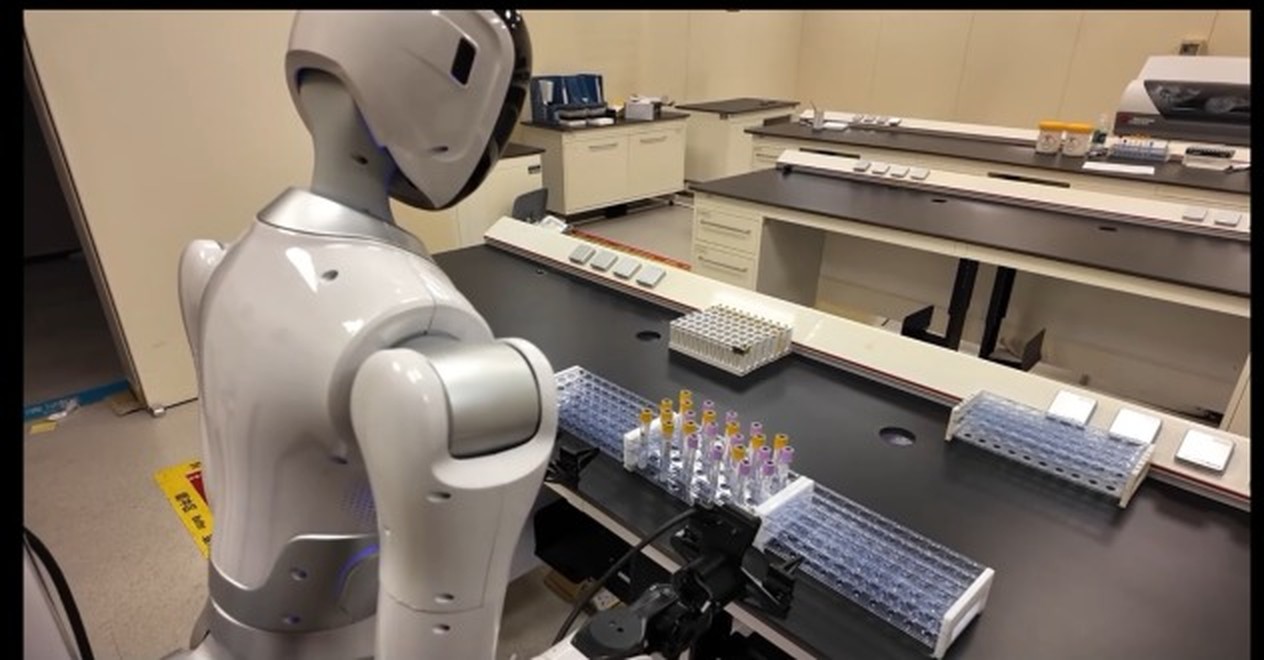
The next great data factory for embodied AI may not be a warehouse or a teleoperation floor. It may be a hospital pharmacy. Shenzhen-based Chaowei Dynamics and PKU Healthcare, the healthcare management group affiliated with Peking University, announced a deep cooperation on July 27 to build a practical path for embodied intelligence in medical settings, centred on data collection, world models, and simulation training, with state-run Science and Technology Daily carrying the news the same day.
The partnership's first concrete artifact is an interactive medical digital asset library: a simulated world constructed from images and videos of real drugs, instruments, and storage equipment, faithful enough to reproduce complete pharmacy workflows of sorting and grasping. Robots train inside this virtual dispensary before they ever touch a physical shelf, and because the rehearsals are digital, the partners say testing can be repeated endlessly at low cost without consuming physical supplies. PKU Healthcare contributes what no robotics startup can manufacture: real hospital scenarios, real workflows, and the institutional authority to deploy what emerges.
For a robotics industry that has spent the year arguing about data, the announcement marks a quiet expansion of the map. The embodied AI data conversation has been dominated by generic manipulation, folding towels, stacking cups, sorting packages, collected in purpose-built facilities. Medical environments have stayed largely off-limits, for good reasons: they are regulated, safety-critical, privacy-sensitive, and expensive to disrupt. The Chaowei-PKU approach threads that needle by digitising the environment rather than experimenting in it, an approach the industry calls world-model training and a hospital administrator would call not practising on the patients.
The Pharmacy Is a Shrewd First Target
Of all the places a robot could work in a hospital, the pharmacy is the most robot-shaped problem. Dispensing is high-volume, repetitive, error-intolerant, and conducted in a structured environment of shelves, bins, and barcodes; it is closer to warehouse picking than to surgery, yet every error carries clinical consequences, which is why human pharmacists spend hours daily on mechanical counting and sorting that adds nothing to their clinical judgment. China's hospital system, which handles outpatient volumes that dwarf Western systems, feels this arithmetic acutely: the largest facilities fill tens of thousands of prescriptions a day.
The analogy for the general reader is the flight simulator. Airlines do not train pilots by handing them a loaded passenger jet; they build a replica cockpit where every storm and system failure can be rehearsed a thousand times at negligible marginal cost. The medical digital asset library is a flight simulator for the dispensary: every vial, blister pack, and refrigerated cabinet is replicated so a robot can fail ten thousand times in silicon, where failure costs nothing, before it is allowed to fail zero times in the ward. The consumables point is less trivial than it sounds; training a physical robot to handle real pharmaceuticals means destroying stock, and drugs, unlike towels, cannot be re-folded.
There is also a data-moat logic that echoes the strongest theme in this month's Chinese robotics news. Generic manipulation data is becoming a commodity, with open datasets and 40,000-hour corpora circulating freely. Domain-specific data, the precise geometry of Chinese drug packaging, the workflow sequence of a tertiary hospital's dispensary, the exception cases where a label is torn or a box is dented, is scarce, proprietary, and impossible to scrape. A partnership that locks in a university-affiliated hospital group as the data source is claiming exactly the kind of vertical corpus that generalist robot-brain companies will eventually need to license.
The division of labour in the partnership maps cleanly onto what each institution uniquely holds.
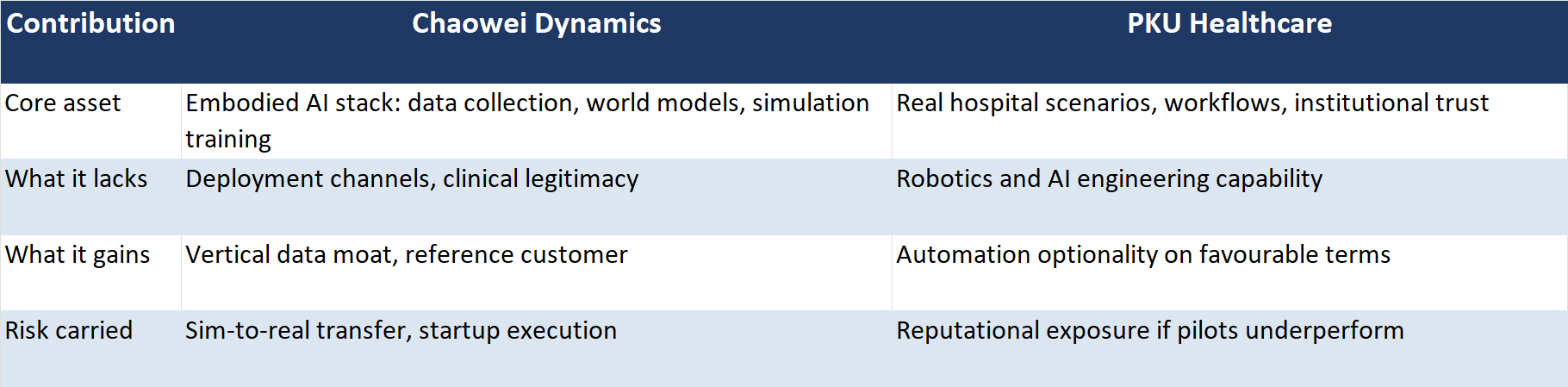
The market they are aiming at is not hypothetical. China's hospital logistics and pharmacy automation segment already supports listed suppliers of dispensing machines and transport robots and the National Health Commission's smart-hospital grading system explicitly rewards automation adoption in its evaluation tiers. What has been missing is the flexible middle ground between fixed dispensing cabinets, which handle only standardised boxes, and human hands, which handle everything else. An embodied system trained in a faithful world model is a play for precisely that middle: the torn label, the odd-shaped ampoule, the refrigerated biologic that current machines refuse.
What Each Side Is Really Buying
Chaowei Dynamics gets the critical asset in medical robotics: legitimate access. Hospital procurement in China runs on institutional trust, and PKU Healthcare's network, anchored by Peking University's medical ecosystem, offers both the training scenarios and the eventual deployment channel. PKU Healthcare, for its part, is buying optionality on labour economics. Chinese hospitals face the same demographic squeeze as the rest of the economy with nursing and pharmacy staff shortages projected to widen as the population ages, and a healthcare group that co-develops the automation stack will own it on better terms than one that procures it later at market prices.
The skeptical reading deserves equal time. Announced cooperations between startups and state-adjacent institutions are the most abundant renewable resource in Chinese technology media, and the release is conspicuously silent on the metrics that would make this measurable: no disclosed investment amount, no robot count, no deployment timeline, no named hospital sites. The word used in the Chinese coverage, 日前, "recently", suggests the agreement itself predates the coordinated July 27 media push by some days, which is standard practice but worth noting. Simulation training also has a known failure mode, the sim-to-real gap: a robot that performs flawlessly in a rendered dispensary can still fumble a real glass ampoule whose weight distribution and surface friction the world model approximated. Nothing in the announcement addresses contact physics, force feedback, or tactile sensing, the dimensions where digital replicas remain weakest, and where, as it happens, other Chinese teams like the NeoteAI-Fudan tactile group are attacking from the opposite direction.
Those caveats frame rather than deflate the story because the state-media placement is itself information. Science and Technology Daily does not carry startup partnership announcements at random; embodied AI in healthcare aligns with at least three standing policy priorities, elderly care automation, hospital efficiency and the commercialisation of the humanoid supply chain. In China's innovation system, that endorsement often precedes the pilot funding, the demonstration zones and the procurement catalogues turn from press releases into purchase orders.
The Vertical Data Race Has Begun
Step back and a pattern emerges across this week's Chinese announcements. τ0-VLA demonstrated that generic robot brains are becoming open and free; the competitive frontier is shifting to vertical data, the proprietary corpora that adapt those brains to environments where mistakes are expensive. Medicine is the extreme case, the vertical where data is hardest to get and worth most once gotten. Whoever builds the reference corpus for hospital manipulation, drug geometry, instrument handling, sterile-field protocol, will hold a position resembling what Epic holds in American health records: not the most glamorous layer of the stack, but the one everything else must integrate with.
The milestones show this partnership is real rather than performative are checkable. First, a named pilot site: a specific PKU-affiliated hospital running a robot in a live dispensary, even behind glass. Second, published error-rate data comparing simulated-trained robots against human dispensing baselines, the number a hospital regulator will eventually demand. Third, expansion of the digital asset library beyond pharmacy into logistics, specimen handling, or disinfection, which would confirm the world-model approach generalises across hospital workflows. None require billion-dollar capex, which is precisely why the medical vertical may produce deployed, revenue-generating embodied AI before the humanoid factories do.
While American medical robotics remains anchored to the surgical suite, an example being Intuitive Surgical's US$100 billion franchise was built, China is focusing on the hospital's back office, the unglamorous logistics of drugs and supplies where regulatory barriers are lower and volumes are higher. Different doors into the same building. The partners who chose the pharmacy door on Monday may have chosen the one that opens first because it is a key task that is repetitive to automate, simulate (with structure) and consequential enough that hospitals will pay for a machine that never miscounts. In embodied AI's long search for its first boring, profitable, defensible job, counting pills in a simulated pharmacy at midnight is a better candidate than most of what has been demonstrated on stage this year and the state media placement suggests Beijing's industrial planners have reached the same conclusion.
This article is for informational purposes only and does not constitute investment advice. Readers should conduct their own research before making investment decisions.