China Wants Humanoid Robots to Leave the Demo Stage. Its New Test-Bed Plan Shows How.
China’s Ministry of Industry and Information Technology and the State-owned Assets Supervision and Administration Commission of the State Council have launched a 2026 field-training drive that asks selected provinces and central state-owned enterprises to open real workplaces for humanoid and embodied-AI robots, with targets for normal deployment, more than 100 high-value scenarios, and ten-thousand-unit scale landing capability by year-end.
China’s humanoid-robot policy moved from broad ambition to a much more operational test this week: getting machines into real workplaces, measuring whether they can perform useful tasks, and deciding which deployments can scale beyond demonstrations.
The Ministry of Industry and Information Technology and the State-owned Assets Supervision and Administration Commission have jointly launched a 2026 special action for humanoid robots and embodied AI in real-scenario training. The notice calls for selected provinces and central state-owned enterprises to build training and validation spaces in industrial, service and special-purpose environments, then use those sites to improve models, robot bodies, components and deployment methods.
The practical target is explicit. By the end of 2026, the notice says key humanoid and embodied-AI products should complete application validation and normal deployment in a batch of representative scenarios, enter what it calls an operational “work mode,” form more than 100 high-value application scenarios, and help create ten-thousand-unit scale landing capability.
That matters because China’s humanoid-robot sector has been rich in public demos but still short of evidence that robots can work reliably, safely and economically in ordinary production and service settings. The new action attempts to close that gap by turning real factories, warehouses, care facilities, retail spaces and emergency-response sites into structured proving grounds.
The plan names Beijing, Tianjin, Shanghai, Jiangsu, Zhejiang, Shandong, Hubei, Hunan, Guangdong and Sichuan, as well as relevant central state-owned enterprises. Each participating provincial-level region is asked to select no fewer than 20 key scenario units covering at least two of the industrial, service and special fields. Each central enterprise is asked to select no fewer than 10 key scenarios tied to its own industry.
The notice also points to a more coordinated deployment model. For each scenario, it encourages an innovation application consortium built around the user organisation and the robot maker or application service provider, with model-algorithm companies, component suppliers and research institutes joining where needed. The user opens the site and defines the job requirements; the robot company works on task planning, manipulation, collaboration, reliability and adaptation; suppliers and research institutes help upgrade core components and common technologies.
The most important part of the programme may be the data loop. The notice says real-scenario training should accumulate high-quality real-machine data, including whole-body motion trajectories, force-control curves, manipulation sequences, timing logic, spatial semantics, object attributes and abnormal-condition handling. In other words, the state is trying to turn deployment sites into data engines for embodied-AI improvement, not just showcases for local industry policy.
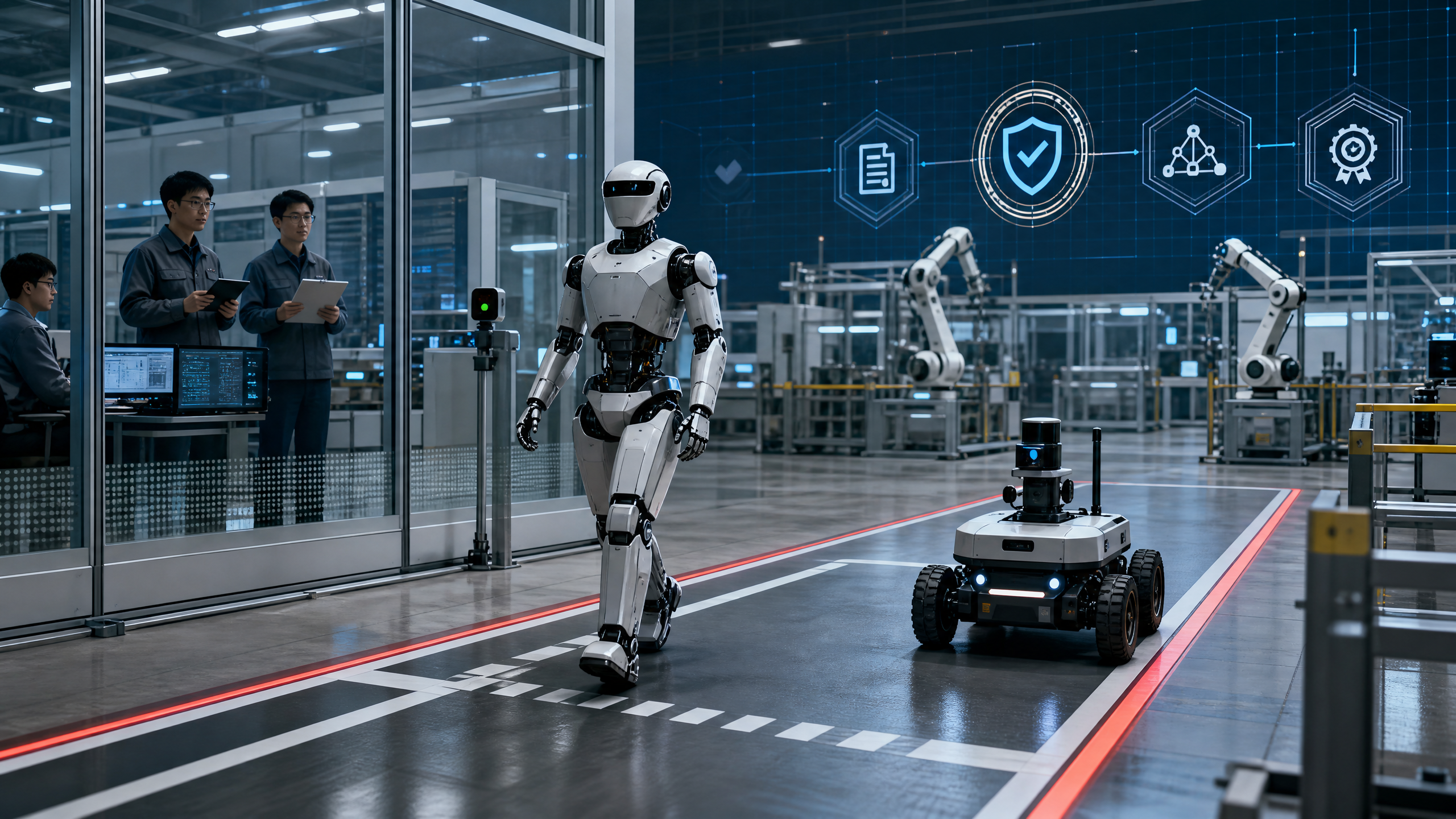
The notice is also unusually specific about operational risk. It calls for validation procedures, pass conditions, safety and reliability assessment, emergency braking, collision detection, force-control limits, black-box recording, privacy and commercial-secret protections, and risk-warning mechanisms for large-scale deployment. It also encourages robot-as-a-service models, leasing and payment-by-utility arrangements to reduce adoption barriers for users.
For manufacturers, the signal is clear: the next competitive phase is less about one-off stage performance and more about repeatable task success in documented environments. For buyers, the plan may create clearer benchmarks for whether a humanoid, quadruped or other embodied-AI product can justify deployment. For local governments, it turns robot adoption into a measurable industrial-policy programme with scenario counts, validation reports and year-end reporting deadlines.
The first near-term deadline is 30 June 2026, when participating provincial industry departments and central enterprises are asked to submit work plans. A second reporting deadline falls on 30 November 2026, when implementation outcomes and scenario-performance metrics are due. The results of those submissions should reveal which Chinese regions and state-owned enterprise groups are prepared to move humanoid robots from exhibition floors into daily operations.