China ties factory AI to global standards and industrial competition
MIIT’s July 20 directive places manufacturing at the centre of China’s AI programme as Beijing promotes open-source cooperation and international standards. The same scale that could lower technology costs abroad may also intensify pressure on overseas producers.
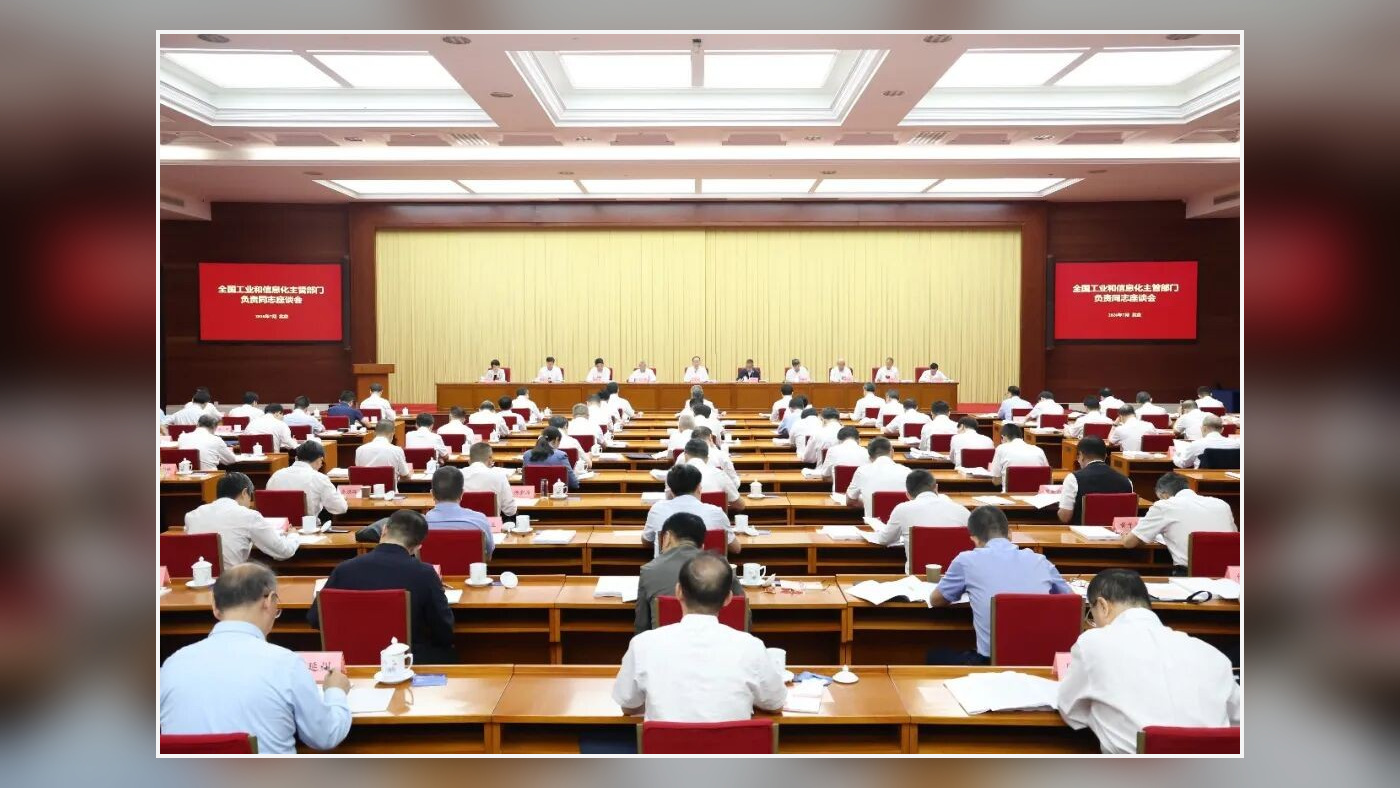
At its national midyear meeting in Beijing on July 20, China’s Ministry of Industry and Information Technology made manufacturing the principal arena for AI deployment. It linked that objective to application-service providers, lightweight and lower-cost industrial solutions for small and medium-sized manufacturers, computing, models, data, open source, standards, security safeguards, intelligent equipment, humanoid robots, and brain-computer interfaces [1].
China links Factory AI to an International Industrial Agenda
The midyear execution signal arrived the same week the World Artificial Intelligence Conference (WAIC), which ran from July 17 to July 20, featured an official keynote offering open-source cooperation and international standards alignment [6]. Together with the launch of the Fifteenth Five-Year Plan, the timing creates a coordinated policy window: China intends to use its manufacturing base as the principal proving ground for AI while shaping the global rules and networks that govern its adoption.
The international consequence is mixed rather than uniformly positive or negative. Diffusing AI through a manufacturing base that produces about 30% of global output could lower costs and speed product cycles for buyers worldwide [10]. It could also increase competitive pressure, compress margins, displace production in exposed sectors, and intensify trade-defence or localisation responses [8] [9]. The effect will vary by industry because policy ambition does not erase specialised intellectual property, capital intensity, integration complexity, or incumbent advantages [11].
Timing of the Policy Window
The July 20 timing is defensible on three layers. First, the July meeting was MIIT’s national midyear gathering, explicitly linking second-half work to full-year targets and the launch of the Fifteenth Five-Year Plan period [1]. Second, the January eight-department implementation opinion gathering had already turned "AI plus manufacturing" into a formal programme with 2027 targets [2]. The July readout was therefore an execution signal, not a new policy invented during WAIC. Third, WAIC ran from July 17 to July 20, supplying an outward-facing narrative about open source, international cooperation, global governance and standards [6] [7].
The Fifteenth Five-Year Plan provides the broader rationale. It describes an environment of sharper geopolitical competition, protectionism and pressure on the international economic order, while also identifying weak domestic demand and a strong-supply, weak-demand imbalance [3]. It calls for preserving a substantial manufacturing base, strengthening advanced industry, making supply chains more self-controlled and secure, upgrading value chains and treating AI as an economy-wide capability [3]. That context explains why MIIT combined growth, self-reliance, industrial deployment and internationalisation in the same policy window.
The Domestic Execution Model
MIIT’s July readout identifies an adoption architecture rather than a single technology. It calls for AI application-service providers, coordination of models and data, lightweight and low-cost solutions for smaller manufacturers, stronger supplies of computing, models, and data, intelligent equipment, next-generation manufacturing, smart devices, humanoid robots, brain-computer interfaces, a national open-source community, standards, safeguards, and legislative research [1].
The January opinion supplies measurable 2027 ambitions. These include the deep application of three to five general-purpose large models in manufacturing, 1,000 industrial agents, 100 high-quality industrial datasets, 500 typical application scenarios, 1,000 benchmark enterprises, two to three globally influential ecosystem leaders, and a globally leading open-source ecosystem [2]. These are targets, not achieved outcomes.
Official first-half data show the scale at which AI diffusion would operate. GDP reached RMB 69.57 trillion and grew 4.7% year on year [4]. Large industrial value added grew 5.4%, manufacturing 5.6%, equipment manufacturing 9.3%, and high-tech manufacturing 13.3% [4]. Output of 3D-printing equipment, lithium-ion batteries, and industrial robots rose 48.5%, 39.3%, and 28.0% [4]. Goods exports reached RMB 14.73 trillion, up 13.4%, while mechanical and electrical exports rose 20.1% and represented 63.5% of total exports [4].
The same data show the domestic tension behind the programme. Fixed-asset investment fell 5.7%, manufacturing investment fell 1.2%, private investment fell 8.5%, and retail sales grew 1.3% [4]. The National Bureau of Statistics described a strong-supply, weak-demand contradiction [5]. AI plus manufacturing can therefore be read as an attempt to raise productivity, stimulate investment, and create new applications at home, while a large export base makes the external spillover unavoidable if deployment succeeds.
What China is Offering beyond its Borders
The external message has four verifiable components. China presented AI as a global growth engine moving from digital systems into the physical economy [6]. It advocated open source, cross-border cooperation and scenario-based industrial application [6]. It argued for United Nations-centred alignment of governance rules and technical standards [6]. It also offered concrete institutional channels, including the World Artificial Intelligence Cooperation Organization in Shanghai, 5,000 training and seminar places for developing countries over five years, application cooperation centres with multiple regional organisations, and deployment of its MAZU meteorological-warning system in 30 countries [6] [7].
The January implementation opinion supports the commercial and industrial side of this message. It calls for country-specific AI products and industrial solutions, technical validation and compliance certification abroad, overseas promotion of Chinese benchmark cases, and participation in BRICS, ASEAN, the G20, APEC, and other forums [2]. China wants to shape both production systems and the institutional environment through which AI is adopted, though the evidence does not suggest cooperation recipients are required to purchase Chinese hardware or software.
Geopolitical Message
The documents support a conclusion about strategic direction, but not a claim that the July 20 meeting was staged as a direct response to one foreign government or trade measure. The Five-Year Plan openly describes sharper geopolitical competition, protectionism and pressure on the international economic order [3]. The WAIC keynote promotes international cooperation, governance alignment, training, application centres, and technical standards [6] [7]. MIIT’s meeting concentrates on domestic execution [1]. Read together, they show a coordinated domestic and external policy posture. They do not disclose a private decision-making record or identify a single overseas trigger.
That distinction matters because geopolitical analysis can otherwise turn timing into motive. The timing is significant: the midyear execution meeting, WAIC, and the opening phase of the new Five-Year Plan all converged in one week [1] [3] [6]. The defensible interpretation is that Beijing paired an industrial deployment programme with an international cooperation and standards message. The evidence does not justify stating that the directive was secretly aimed at a named country, company, or sanction.
What Overseas Industrial Buyers should Separate
For procurement teams, the policy signal is not a product certification or a guarantee that Chinese AI systems will be cheaper, safer, or easier to integrate. It is a sign that vendors may receive stronger ecosystem support through industrial datasets, application scenarios, service providers, open-source tools, and benchmark projects if the 2027 programme is implemented [2]. Buyers should therefore separate four questions: whether a solution is technically capable, whether it meets local security and compliance requirements, whether the supplier can support deployment abroad, and whether the quoted price captures integration, maintenance, data governance, and switching costs.
The same separation applies to competitors. Faster Chinese product cycles do not automatically remove advantages based on specialised intellectual property, qualification history, trusted service networks, or demanding safety standards [11]. However, foreign firms cannot assume those barriers will remain sufficient if China’s scale converts more prototypes into affordable, production-ready systems. The policy’s external importance lies in that possibility, not in a proven outcome today.
How Cheaper Production can Benefit Overseas Buyers
Larger-scale AI adoption can reduce costs for imported equipment, components and manufactured goods. New Zealand’s Ministry of Foreign Affairs and Trade (MFAT) credits China's scale, vertical integration, and rapid production translation with lowering costs and accelerating adoption in electric vehicles, batteries, solar, rail, and factory automation [10]. Faster translation of research into production can expand technology availability and accelerate adoption. Buyers may gain access to more affordable electric, automated, and intelligent products. Affordable equipment and robots can help users raise productivity [10]. Shared tools, training, and open-source systems may also lower adoption barriers [6].
Where Margin Pressure and Displacement could Emerge
Lower prices can compress margins for producers that cannot match scale or productivity [10]. Overseas firms may face shorter development cycles and greater capital demands. Export surges can shift production patterns and prompt trade or localisation responses [8]. Domestic producers in importing countries may lose share, particularly in commoditising segments [10]. Standards leadership can create dependence on a particular technical ecosystem or governance model [6]. Exposed sectors may seek anti-dumping, subsidy, investment-screening, or localisation measures [8] [9].
Federal Reserve staff authors estimate China’s 2025 trade surplus at US$1.2 trillion and report its global goods-export share rising from 13.1% in 2018 to 16.3% in 2024 [8]. They argue that the current export surge starts from a larger position than the early-2000s China shock and overlaps more with capital- and technology-intensive industries [8]. A European Parliament commissioned study identifies overcapacity indicators across many Chinese industries and expects continued pressure on European companies [9].
Why the Result will differ by Industry
The European Parliament study stresses that exposure is sector-specific and may be moderated by value-chain structures and technological leadership [9]. The US-China Economic and Security Review Commission concludes that China met or exceeded many market-share and localisation goals under Made in China 2025 while still lagging in areas protected by specialised intellectual property, capital barriers, and entrenched incumbents [11].
The July meeting does not create a new AI law, subsidy, budget, or binding procurement mandate. It does not predict automatic Chinese dominance in robotics, semiconductors, or other technically difficult sectors. The outcome will depend on how effectively Chinese manufacturers integrate AI into complex physical processes and how overseas competitors and policymakers respond.
What to Watch Next
The focus shifts to how the 2027 targets in the January implementation opinion translate into physical deployment. Watch for the emergence of the 1,000 industrial agents and 500 typical application scenarios, as well as the deep application of general-purpose large models in manufacturing [2]. The promotion of Chinese benchmark cases overseas and the establishment of international training and application centres will signal the progress of the external strategy [2] [6]. The response of importing nations, particularly regarding trade defence and localisation policies in high-tech manufacturing, will define the international environment for China's external AI-industrial strategy [8] [9].
References:
[1] MIIT national midyear meeting, July 20, 2026
[2] National Data Administration, AI plus manufacturing implementation opinion
[3] National Development and Reform Commission, Fifteenth Five-Year Plan outline
[4] National Bureau of Statistics, first-half 2026 economic release
[5] National Bureau of Statistics, first-half 2026 Q&A
[6] Ministry of Foreign Affairs, WAIC keynote
[7] State Council Information Office, official English WAIC keynote
[8] Federal Reserve staff note, China Shock 2.0
[9] European Parliament commissioned study on industrial overcapacities
[10] New Zealand MFAT, Made in China 2025 assessment
[11] US-China Economic and Security Review Commission, Made in China 2025 assessment
Disclaimer: The information provided in this article is for informational purposes only and should not be construed as financial, investment, or strategic advice. RobotAIGeek does not endorse any specific company or product mentioned.