China Just Gave Robots a Slow-Thinking Brain, and Then Gave It Away for Free
Shanghai Innovation Institute with AgiBot released τ0-VLA, a long-horizon vision-language-action model claiming state-of-the-art results above Google and Physical Intelligence baselines, trained on a claimed 40,115-hour real-robot corpus, released with weights and training recipe. Positioned as embodied AI’s potential DeepSeek moment; adoption metrics (forks, downloads) named as the verification to watch.
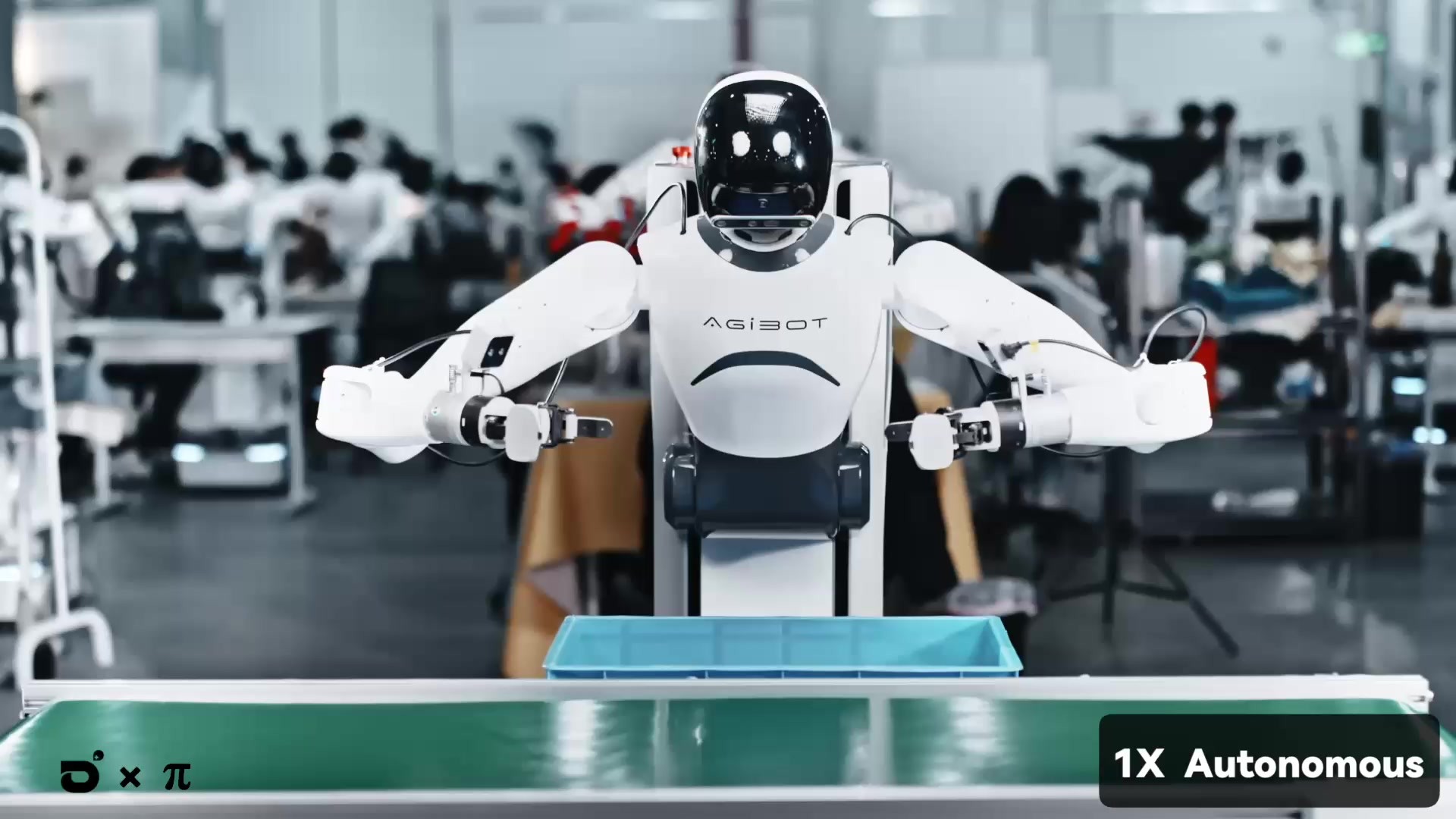
The reasoning revolution that transformed chatbots has arrived in robot bodies, and China is distributing it free of charge. The Shanghai Innovation Institute and AgiBot's Embodied Research Center released τ0-VLA on July 27, a robot foundation model that pauses to deliberate at the hard moments of a task, and published the paper, code, and weights as open source on GitHub and Hugging Face.
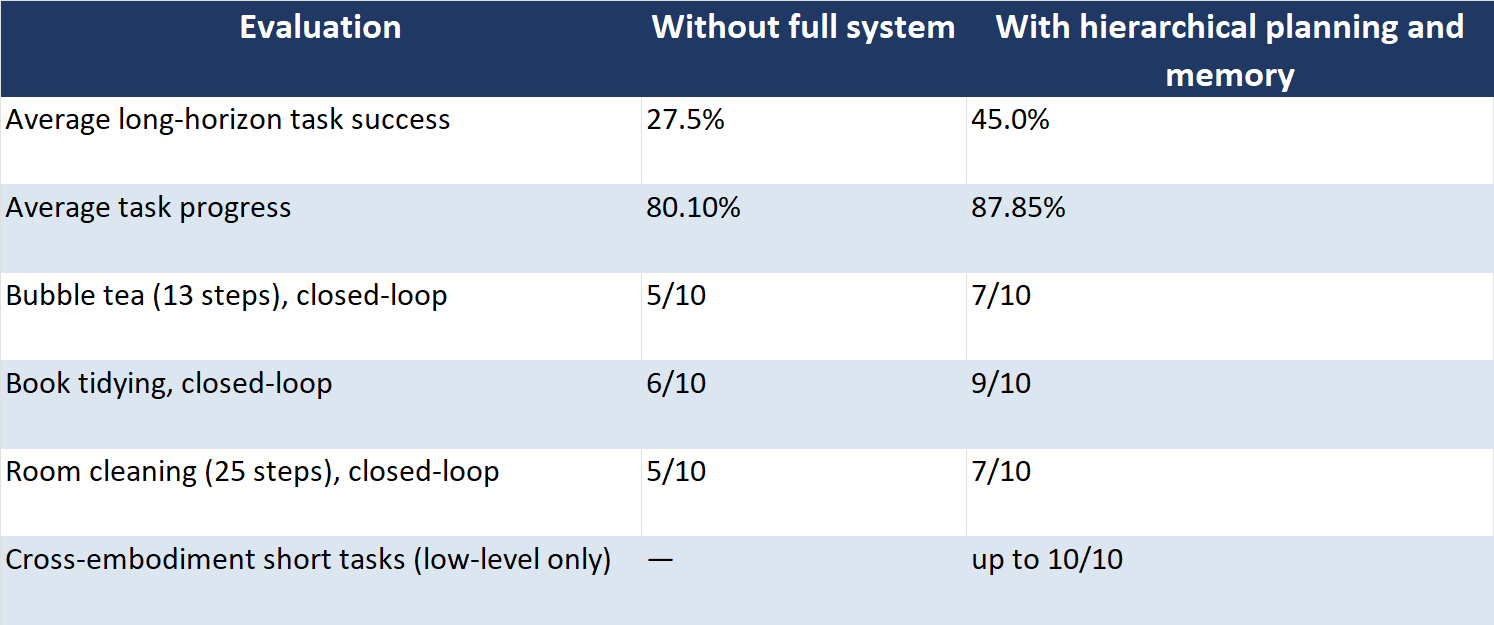
The release makes two claims that will reverberate through embodied AI labs. First, τ0-VLA is, by its developers' account, the first vision-language-action system to explicitly scale test-time compute at the level of subtask decisions, importing the slow-thinking paradigm of reasoning models like OpenAI's o1 and DeepSeek's R1 into physical manipulation. Second, it was pretrained on 40,115 hours of heterogeneous real-world robot data, including more than 20,000 hours of real-robot interaction data, which the team describes as the largest real-robot pretraining corpus assembled to date. In head-to-head long-horizon evaluations, the full system lifted average task success from 27.5 percent to 45.0 percent and beat Nvidia's GR00T N1.7, LingBot-VLA, and Physical Intelligence's π0.5 in the team's test setup.
The architecture is a two-speed brain. A low-level policy system, built on a vision-language backbone with a Mixture-of-Transformers action expert and conditional flow matching, executes continuous action chunks fast and reflexively. Above it sits a high-level decision system that activates at subtask boundaries: a Propose Model generates candidate next steps, a World Model predicts the visual end-state of each candidate, a Value Model scores them, and a Reflective Model synthesises the final choice through beam search. The robot, in effect, imagines several futures, grades them, and only then commits its motors.
Thinking Longer When It Matters
The analogy for the general reader is a chess player at the board. Most moves come from pattern and habit, played in seconds; the pivotal middlegame decision earns ten minutes of concentrated calculation. τ0-VLA budgets its computation the same way. The team found diminishing returns from lavishing deliberation on every step, so a dynamic routing mechanism invokes deep thinking only at difficult nodes, keeping the robot responsive while reserving its heaviest reasoning for the moments that decide success.
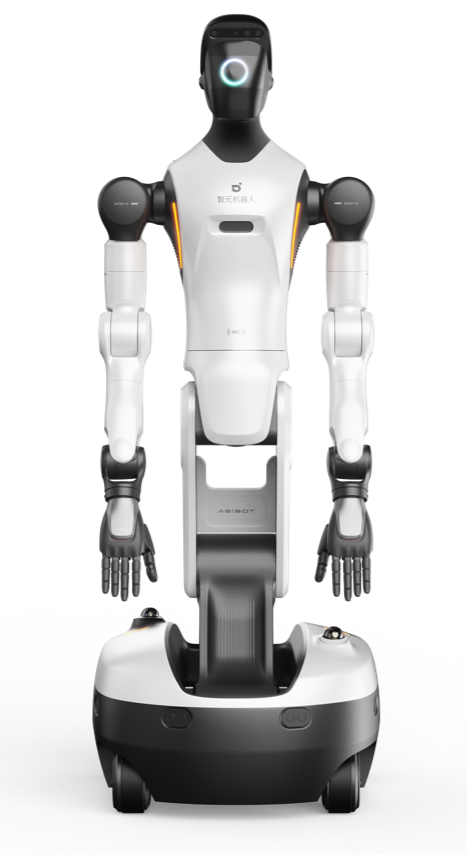
The numbers attached to that design are unusually concrete for a field addicted to cherry-picked demo reels. On next-subtask prediction, the system scored 87.3 percent on a 13-step bubble tea preparation, 88.0 percent on in-distribution book tidying, 74.0 percent on out-of-distribution variants, and 87.0 percent on a 25-step room clean. Closed-loop success on real robots rose from 5 of 10 to 7 of 10 trials on bubble tea, 6 of 10 to 9 of 10 on book tidying, and 5 of 10 to 7 of 10 on room cleaning once test-time reasoning was switched on. The evaluation suite itself signals ambition: 25-step room cleaning, 14-step food preparation, a 22-step tomato-and-egg stir-fry, tasks running three to twelve minutes, ten trials each, on AGIBOT G1, ARX AC One, and dual-arm Franka Research 3 platforms. A unified 40-dimensional state and action space, covering end-effector pose, joints, gripper, waist, and mobile base with masking for unused dimensions, lets one model drive different robot bodies; on short cross-embodiment tasks the low-level system alone posted near-perfect scores, including 10 of 10 on clothing collection.
The headline results compress into a scoreboard that is unusually checkable, since the artifacts behind it are public.
The data corpus behind those numbers deserves as much attention as the architecture. Forty thousand hours of real-robot experience is not scraped from the internet; it is manufactured, hour by hour, in staffed facilities where human operators teleoperate robots through household and industrial routines, supplemented by handheld UMI grippers and public datasets. AgiBot has been building exactly this kind of data factory since 2024, and the release effectively publishes the dividend of that industrial investment while keeping the factory itself proprietary. It is the embodied AI equivalent of a refinery giving away gasoline samples to prove the quality of a crude supply nobody else has.
There is a third component that practitioners will study closely: a correctable execution memory that records completed stages, constraints, and local failures as the robot works. The team trained it with deliberately corrupted samples, memory that lags, leads, or omits failures, so the deployed system learns to distrust and repair its own record without additional manual annotation. Anyone who has watched a robot repeat a failed grasp indefinitely will recognise what problem that addresses: long tasks fail not at step one but at step eleven, when the machine loses track of what it has and has not done.
The Strategy Behind the Generosity
Why give this away? The release fits a lineage and a flywheel. The Luo Jianlan team at the Shanghai Innovation Institute previously published τ0-WM, a world model, in June, alongside LWD, a real-world reinforcement-learning post-training system; τ0-VLA completes a pipeline of large-scale pretraining plus a post-training data flywheel. For AgiBot, which hired three banks for a Hong Kong IPO earlier this month, open-sourcing frontier research is the same play Alibaba ran with Qwen: commoditise the model layer, monetise the hardware, data services, and deployment stack above it, and let a thousand external teams validate your architecture while your listing narrative absorbs the citations. The 40,000-hour corpus is the moat the giveaway advertises, because weights can be copied but a data engine of teleoperation rigs, UMI devices, and staffed collection facilities cannot.
The skeptical reading deserves its paragraph. A 45 percent average success rate on long-horizon tasks is a research milestone, not a deployable product; no hotel will accept a robot that ruins half its stir-fries. The benchmark victories over GR00T, LingBot-VLA, and π0.5 come from the team's own evaluation design, a caveat that applies to every self-reported comparison in this field, and Physical Intelligence's newer π0.7 attacks the same long-horizon problem from the training-data side rather than the inference side, a rivalry of paradigms that one lab's benchmark cannot settle. Test-time deliberation also costs latency and on-robot compute, and the paper's own finding of diminishing returns suggests thinking harder is not a free lunch. What the release proves is narrower but still significant: the inference-time scaling laws that revolutionised language models transfer to manipulation, and the recipe is now public.
The industrial context sharpens the significance. Jiqizhixin framed the release as the answer to the question hanging over the post-WAIC industry, whether robots can graduate from single-skill demonstrations to completing whole tasks. That framing aligns with what buyers keep telling this publication: procurement stalls not because robots cannot grasp, but because they cannot be trusted to finish. A model that doubles whole-task completion, and that any integrator can download tonight, moves the trust needle in a way another backflip video never will.
An Open-Source Race With One Side Racing
The wider pattern is the one that should concern Western labs. Within a single July, Chinese institutions have open-sourced humanoid hardware designs, a home robot platform from Ecovacs, and now a state-backed frontier VLA with its training recipe, while the leading American robot-brain companies, Physical Intelligence, Skild, Figure, keep their best models closed and their valuations in the billions. One strategy builds ecosystems and standards; the other builds margins. Both can work, but they compound differently: every university lab that fine-tunes τ0-VLA this autumn becomes part of a Chinese-speaking research stack, benchmarked on Chinese robots, feeding improvements back into a Chinese data flywheel.
What to watch is adoption, which open source makes measurable. GitHub forks and Hugging Face downloads in the next month will show whether τ0-VLA becomes embodied AI's Qwen moment or a well-documented curiosity. Watch, too, whether the claimed real-robot data record provokes disclosure from rivals; corpus size has just become a competitive statistic, and 40,115 hours is now the number to beat. And for AgiBot's bankers, the timing is its own message: three weeks after mandating an IPO, the company demonstrated that its research arm can set the frontier agenda and afford to give the result away. That is not a coincidence of calendars. It is the sound of a company telling public-market investors which layer of the robot economy it intends to own. For everyone else in the field, the practical takeaway is simpler: as of this week, the strongest publicly available recipe for long-horizon robot manipulation is Chinese, open, and free, and every roadmap that assumed otherwise now needs a footnote. The last time a Chinese lab gave away a frontier capability at this level, it was called DeepSeek R1, and the industry spent the following six months rearranging itself around the consequences.
This article is for informational purposes only and does not constitute investment advice. Readers should conduct their own research before making investment decisions.