BYD Teases Its First Humanoid, and the World's Biggest EV Maker Picks a Side
A teaser poster published on July 25 by the WeChat account of BYD's Di Space experience venue in Zhengzhou shows a humanoid robot silhouette and promises a debut in early August. BYD has not confirmed details, but the signal fits a documented buildup: a dedicated embodied AI team under its 15th Business Division since late 2024, executive vice president Stella Li's stated goal of putting two or three robots in every BYD store, and a planned open robot platform. The world's largest EV maker appears weeks from showing its first humanoid.
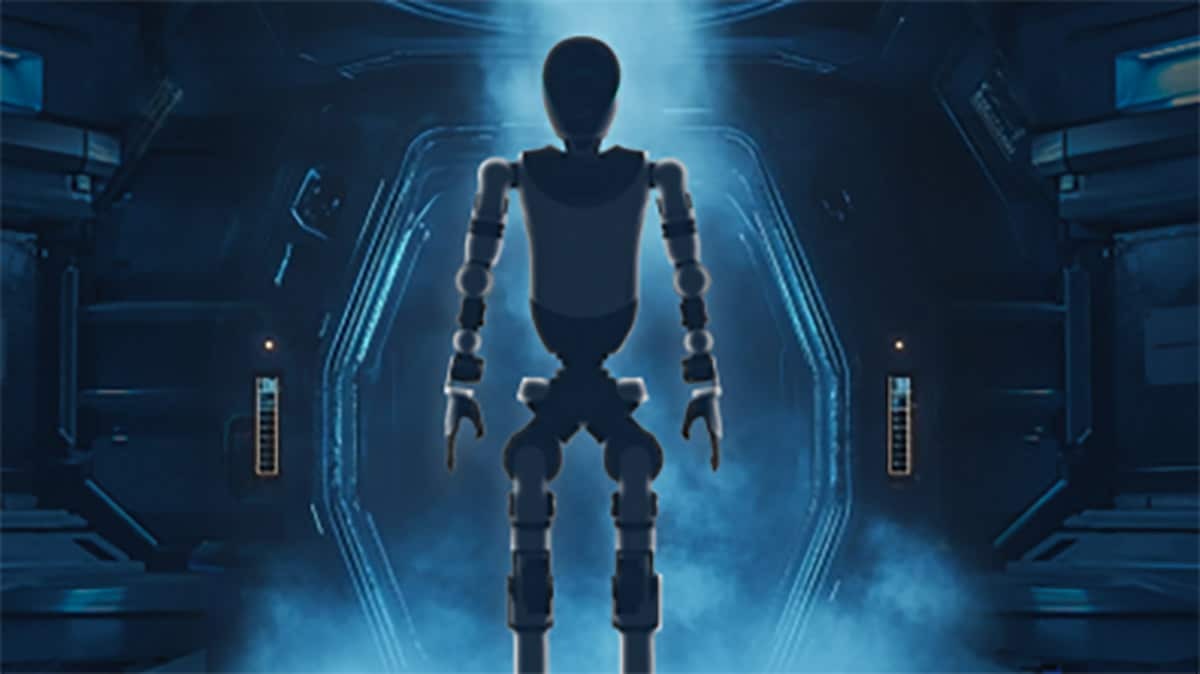
The most consequential robot announcements no longer arrive by press conference. They surface as silhouettes on WeChat. On July 25, the official account of BYD's Di Space experience venue in Zhengzhou posted a teaser poster showing a humanoid robot backlit in blue mist, with copy telling followers that a new friend wants to meet them in early August. If the debut happens as signaled, the world's largest electric vehicle maker is weeks away from its first public humanoid reveal.
The caveats belong up front. Di Space is BYD's network of offline science education and experience venues, and the Zhengzhou account is a local channel rather than the company's main corporate platform. BYD has confirmed neither the timing nor any product details, and a silhouette on a poster proves the existence of a marketing campaign, not a production robot. Specialist electric vehicle outlet CNEVPost, which surfaced the teaser to international readers on July 26, was careful to frame the debut as expected rather than announced.
What makes the signal worth taking seriously is everything BYD has put on the record before it. The company established a dedicated embodied AI team under its 15th Business Division as early as the end of 2024, according to Chinese media reports at the time. Its executive vice president Stella Li said just last month that she wants every BYD store eventually staffed with robots, stating a goal of two or three robots per store to explain products, enliven showrooms, and demonstrate vehicles, and predicting that robot sales consultants could become practical within a year or two. She has also said BYD plans an open robot platform producing both in-house robots and co-developed machines, and argued that automotive AI shares the same technical roots as robotics, giving carmakers a natural advantage. Companies do not tease hardware at hands-on experience venues, as opposed to auto shows or investor days, unless the machine is built to stand next to the public.
Why the venue is the message
For readers outside China, BYD is headquartered in Shenzhen and began in 1995 as a battery maker before conquering first electric buses, then passenger vehicles; it overtook Tesla as the world's largest EV seller and now exports to more than 100 markets. Its core technological identity is vertical integration: BYD designs and manufactures its own blade batteries, power semiconductors, electric motors, and increasingly its own chips, a self-sufficiency doctrine born from founder Wang Chuanfu's conviction that whoever controls components controls cost. Its market niche in any category it enters is the same: acceptable performance at a price incumbents cannot follow.
Zhengzhou is a fitting stage for the reveal. The Henan capital hosts one of BYD's largest manufacturing bases, a complex that hired tens of thousands of workers during the company's production surge, making it simultaneously a showcase city for BYD's employment story and, awkwardly or deliberately, for the automation that may reshape it. Di Space venues are designed for families and school groups to touch the technology, which tells you the debut audience BYD wants: not analysts with cost models but the general public that will meet these machines in showrooms first.
The last giant to move
BYD enters a lane already crowded with its own peers, which is precisely what makes its entry significant. Chinese carmakers have converged on humanoids from every direction this year. XPeng aims to mass-produce its IRON humanoid by the end of 2026 and has begun building trial production capacity, as this publication reported last week. Chery has incubated Aimoga, a brand already selling humanoids to consumers. SAIC-GM has wheeled humanoids working a battery assembly line, and Nio's chip subsidiary launched an embodied intelligence development platform this month even as its founder keeps the parent company focused on cars. Outside China, Hyundai committed this weekend to American production capacity of 30,000 robots a year by 2028, and Tesla continues to develop Optimus on its own lines.
BYD is the last of the truly giant Chinese automakers to show its hand, a delay that reads less like hesitation than like the company's standard practice of entering categories only after its component costs guarantee a pricing weapon, and it arrives with assets none of its domestic rivals can match at scale. It builds more than four million vehicles a year with deep vertical integration, from batteries and semiconductors to motors, precisely the component families a humanoid consumes. It operates the country's largest private manufacturing workforce, nearly a million people, whose tasks form a natural internal market for automation. And it has been a humanoid customer since 2024, when UBTech's Walker S robots began collaborative operations with driverless vehicles inside a BYD plant, giving the company direct data on what factory humanoids can and cannot yet do before committing to build its own. Few robot makers anywhere have had two years of front-row observation of a rival product working their own floors before designing a competitor.
The showroom-first framing suggested by Li's comments and the Di Space venue choice is its own strategy, and a shrewder one than it sounds. Factory humanoids must beat human labor on cost per task, a brutal benchmark that no vendor has publicly cleared. A robot in a car showroom only has to attract families, hold attention, and hand off to a salesperson, a job closer to entertainment than to labor, with tolerance for imperfection that assembly lines lack. Chery's Aimoga has validated the format, and BYD's thousands of stores and Di Space venues in China and abroad give it a captive deployment network where every unit doubles as marketing. Think of it as the automaker's equivalent of a concept car that actually ships: low-stakes environments, high visibility, and a data pipeline from thousands of daily public interactions.
What a silhouette is worth
The teaser rollout itself follows a recognizable BYD choreography. The company previewed its Yangwang premium brand, its blade battery, and its fifth-generation hybrid system the same way: a cryptic image on a regional or subsidiary channel, an amplification wave through China's auto media within a day, and a staged reveal a week or two later with specifications withheld until the last moment. The pattern serves two purposes, testing public reaction at low cost and starving rivals of technical details until the reveal. Its reappearance here suggests the robot program has graduated from research project to product-marketing pipeline, which within BYD is a meaningful internal promotion.
For suppliers and competitors, the practical question is what BYD's entry does to the humanoid cost curve. The company's reputation was built on vertical integration and price wars that reset entire product categories, most recently in electric vehicles, where its scale pushed prices below what incumbents believed possible. A BYD humanoid assembled from in-house batteries, motors, and electronics, sold through its own retail network, would test whether the same playbook applies to robots. Unitree's G1 set the current price reference near RMB85,000, about US$11,900. If BYD decides showroom robots are a volume product, the next reference point could carry a BYD badge, and every startup pricing hardware between US$10,000 and US$50,000 should be modeling that scenario now.
The skeptical case is equally concrete. Automakers have announced robot programs at a pace their deliveries have never matched, and BYD itself has said little officially, leaving open the possibility that August brings a partner's robot wearing BYD branding, a concept mockup, or a limited demo unit rather than an in-house product with a roadmap. The company's core business is also fighting a margin-crushing price war in electric vehicles, which cuts both ways: robots offer a new story for investors, but capital discipline argues against a costly moonshot. Until BYD states specifications, pricing intent, and production plans on a corporate channel, the honest classification of this story is a verified teaser wrapped in well-documented ambition.
There is also a capital-markets subtext that seasoned observers will not miss. Every Chinese automaker that has attached a credible robot narrative to its stock has been rewarded, and BYD's Hong Kong listed shares have lagged its operational dominance this year as EV margins compressed. A humanoid reveal in August, days before the World Humanoid Robot Games open in Beijing and weeks after Unitree's IPO registration became effective, lands into maximum narrative receptivity. That timing may be coincidence. It is, at minimum, convenient, and investors should weigh how much of what they see next month is engineering and how much is equity storytelling.
Even so, the direction of travel is unambiguous, and it compresses into one quotable line: in China's humanoid race, the question is no longer which automakers will build robots, but whether any will resist. A company that sells a vehicle every eight seconds has decided the robot standing beside the car deserves its own reveal. The verification checklist for August is short and concrete: whether the announcement migrates from the Zhengzhou venue account to BYD's corporate channels, whether the machine shown walks untethered in public rather than posing on a plinth, whether BYD names it as in-house engineering or a partnership, and whether anyone states a price band. Each answer will separate product from promise, and this publication will be watching the Zhengzhou venue either way.
Disclaimer: This article is for general information purposes only and does not constitute investment, legal, or procurement advice. Readers should verify details with primary sources before making business decisions.