Aidin Raises KRW 16 Billion for Shipyard Force Control
Aidin Robotics took KRW 16 billion from HD Hyundai Robotics and Samsung Venture Investment to scale force sensors and co-develop hull finishing cells, with a humanoid hand as a later product.

Aidin Robotics, a South Korea force-sensor specialist, said on 11 September 2026 that HD Hyundai Robotics and Samsung Venture Investment had provided KRW 16 billion (approximately US$12 million) in strategic capital. The funds target force and torque sensor production, quality systems, and research hiring. Aidin makes capacitive contact sensors and force-control software for industrial robots.
That combination is the commercial point. HD Hyundai Robotics is not buying a press-release humanoid. It is buying a supplier that already sells contact sensing into defense, semiconductor equipment, and automotive cells, and it wants that stack on hull steel and on a five-finger hand still in development. Procurement teams should read the round as a shipyard automation bet with a humanoid option attached, not as proof that bipedal workers are about to replace grinders in a dry dock.
The Force Control Deal Inside a KRW 16 Billion Check
Aidin Robotics was founded in November 2019 by Choi Hyeok-ryeol, a mechanical engineering professor at Sungkyunkwan University, and Lee Yun-haeng, a laboratory-trained engineer who is now chief executive. The firm sells six-axis force and torque sensors, miniature sensors, joint torque sensors, tactile skins, grippers, and a no-code surface-finishing cell that runs force control on a robot arm. Its public product list is built for collaborative robots and humanoids that need Physical Interaction Intelligence, meaning the robot can measure contact force in three dimensions and change its motion when the load is wrong.
The 11 September announcement names two uses of capital. First, Aidin will build mass-production equipment and a quality-verification system for force and torque sensors, and it will add research staff. Second, it will raise annual sensor output capacity to 30,000 units. That 30,000 figure is a capacity target after the investment, not a disclosed 2025 shipment number. Buyers should treat it as a planning number until the company publishes actual output, yield, and lead times.
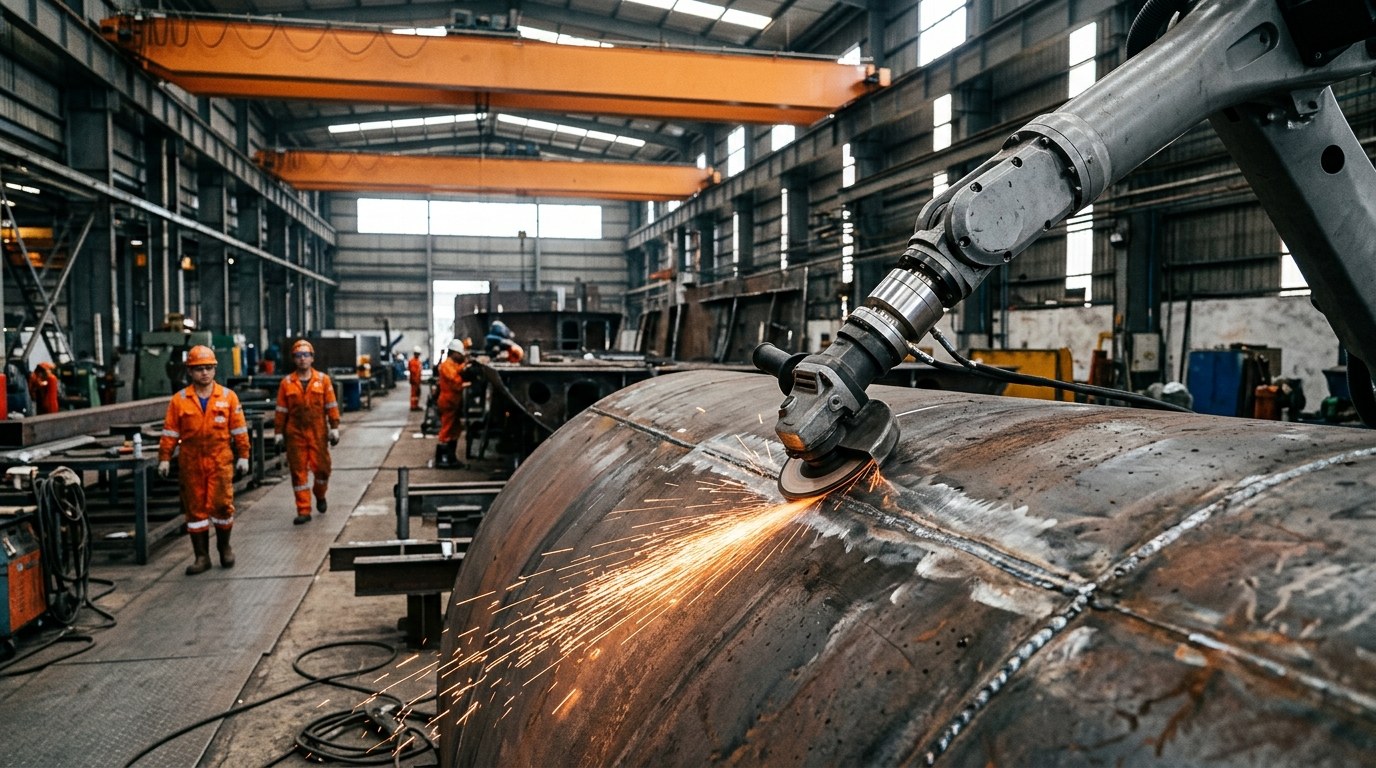
The industrial workstream with HD Hyundai Robotics is more specific than a generic "smart shipyard" slogan. Their first joint task is a force-controlled finishing cell for hull plate and welded-block joints, where the robot must hold contact load on steel that will not sit still. Surface treatment in this context is grinding, blending, and related finishing on large, curved, irregular steel, not a tidy automotive body shop. Shipyards have been a poor fit for conventional programmed cells because the workpieces do not repeat like a stamped door panel, and the volume of finishing is huge. Force control is the difference between a robot that follows a path and a robot that holds a target force while the surface changes under the tool.
The second workstream is a high-load five-finger hand built for yards and heavy industry, intended for the humanoid platform HD Hyundai Robotics already has in development. Aidin said yard force logs and task practice will feed that hand. HD Hyundai has separately been building a shipyard welding humanoid program with partners including Persona AI and HD Korea Shipbuilding and Offshore Engineering. That earlier welding program is background, not today's event. Today's disclosed hardware contribution from Aidin is sensing, force control, and a hand, not a walking platform.
Lee Yun-haeng said Aidin is, in his words, Korea's only firm that owns the stack from the sensor through force-control software. That is a competitive claim by the chief executive, not an independently audited market share finding. What can be verified is the product architecture: Aidin designs and manufactures capacitive force and torque sensors and tactile sensors, then pairs them with its own force-control software so a robot can sense and adjust contact force. The company also said its solutions are already used in defense, semiconductor equipment components, and automobiles. Those verticals matter because they are existing paying applications. They are not the same as a proven, multi-shift hull-grinding cell in a Korean yard.
Lee also said the company would use the new capital and existing customers to prove commercial value and to finish a mass-production system for robot parts. The sentence is useful because it ranks proof and production above a humanoid launch date. There is no disclosed valuation, no disclosed ownership split between HD Hyundai Robotics and Samsung Venture Investment, and no disclosed closing date beyond the Friday announcement. There is also no named Korean yard, no named United States yard, and no contract value for the surface-treatment cell.
Samsung Venture Investment's participation sits beside an earlier Samsung-family relationship. In 2024, Samsung Next joined a KRW 15 billion (approximately US$11.2 million) Series B. Korea Investment Partners led that earlier round. POSCO Investment, CJ Logistics, and GS Ventures also participated. Disclosed cumulative funding at that time was about KRW 20 billion (approximately US$15 million). Aidin was later selected for Samsung Electronics' C-Lab Outside incubation program. Those earlier checks do not make today's KRW 16 billion a Series C by name. The company and Korean business press described it as a strategic investment tied to HD Hyundai Robotics, which is a different instrument from a financial round with a published post-money valuation.
Why Shipyards Pay for Wrist Sensing Before They Pay for Legs
A humanoid is a convenient shape for stairs, scaffolds, and tools designed for people. It is a terrible default specification if the job is to hold 20 to 50 newtons on a weld toe for eight hours. Surface treatment fails when the tool chatters, gouges, under-grinds, or wanders off the seam. Those failures are force problems. Vision can find the weld. A position-controlled arm can approach it. Only a force and torque sensor at the wrist, or a tactile array in the fingers, tells the controller whether the disc is cutting steel or polishing air.
Capacitive sensing is Aidin's stated hardware method. Company comments carried in Korean coverage argue that capacitive designs help with miniaturization and cost when a humanoid needs many sensors in many joints. That is a design thesis, not a published bill of materials. What procurement can use is the integration logic. If you buy a six-axis force and torque sensor as a bolt-on flange, you can put it on an existing industrial arm this quarter. If you wait for a five-finger humanoid hand with embedded tactile arrays, you are buying a development program. HD Hyundai Robotics is doing both, in that order: surface treatment on conventional robots first, a specialized hand on a humanoid later.
That order is the part most humanoid coverage will get wrong. The easy story is that a chaebol robotics unit is stuffing a humanoid into a shipyard because labor is tight. Korean yards do have a labor and safety problem on grinding and welding. The harder story is that HD Hyundai Robotics already knows how to move industrial arms. What it has not commoditized is contact intelligence on non-repeatable geometry. Aidin's cell is already sold into automotive and semiconductor finishing. Porting that stack onto hull blocks is still a new process window: salt, scale, heat, cable reach, fixturing, and classification society quality rules. Domestic yard verification is the gate. Overseas United States shipbuilding is a later ambition, not a purchase order.
For a plant or yard automation buyer, the evaluation list is short. Ask whether the force loop is closed on the robot controller or on Aidin's external box. Ask for the force accuracy, update rate, overload rating, and Ingress Protection rating of the wrist sensor in a grinding plume. Ask whether the 30,000-unit capacity includes calibration, temperature compensation, and traceable quality records, or only machined housings. Ask who owns the force traces from a hull job: the yard, HD Hyundai Robotics, or Aidin. Those traces are the training set for the later hand. If the data stay locked in a vendor cloud, the yard is funding someone else's humanoid dataset.
The same questions apply to safety. A grinding tool on a large arm is not a collaborative robot demo. Force sensing can reduce gouging. It does not, by itself, make a cell safe around people. Korean coverage of Aidin's earlier work also pointed to impedance-based proximity detection as a human-robot collaboration feature. That is relevant to mixed cells. It is not a substitute for guarding, interlocks, and a risk assessment under the yard's safety rules.
Compare the offer with the usual catalog. ATI Industrial Automation, OnRobot, Schunk, and several Japanese and European houses already sell six-axis force and torque sensors for finishing. Aidin's pitch is not that force sensing is new. Its pitch is vertical integration from sensor silicon and mechanics through force-control software, plus a Korean industrial customer that can open shipyard doors. If the HD Hyundai Robotics relationship stays at a memorandum, Aidin is still a component vendor with a larger factory. If the first hull-block cell runs multi-shift with measured force logs, Aidin becomes a process supplier. Those are different buying categories and different price conversations.
The Humanoid Hand Is a Follow-On Product, Not the Asset
The five-finger hand is the headline magnet. It should not be the line item that clears a 2026 capex committee. Heavy-duty hands for shipbuilding must survive impact, grinding dust, and loads far above a warehouse pick. They also need tactile or joint-torque feedback, or they will crush fittings and slip on curved plate. Aidin already lists a robot hand and tactile sensors on its public catalog. Joint development with HD Hyundai Robotics means the shipyard variant is not a stock-keeping unit you can order this month. It is a co-development object whose requirements will come from the same surface-treatment trials.
That is actually the disciplined sequence. Collect force and contact data on a wrist-mounted tool against real blocks. Then encode those contact policies into fingers. Skipping the first step produces a teleoperated demo hand that looks dexterous in a booth and dies on the second shift. HD Hyundai Robotics' broader humanoid welding work, disclosed in earlier 2026 partnership notices, already showed the group prefers on-site testing over lab theater. Aidin's role is to make contact measurable. Without that, a welding or grinding humanoid is a camera on legs.
Capital allocation inside Aidin should be watched the same way. The disclosed uses are production equipment, quality systems, and engineers. That mix is what a component company says when it expects original equipment manufacturer (OEM) demand. It is not what a humanoid complete-machine startup says when it is burning cash on full-body actuators. If later disclosures show most of the KRW 16 billion going into a branded humanoid prototype instead of sensor yield, the thesis has changed. Nothing in Friday's statements supports that shift.
Samsung Venture Investment's presence is a second signal. Samsung Next already underwrote the 2024 round on the thesis that force and torque sensing would widen the jobs robots can do next to people. Samsung Venture Investment now sits alongside HD Hyundai Robotics. That does not mean Samsung Electronics has committed to design-in Aidin sensors on a future Samsung humanoid. It does mean two of Korea's largest industrial groups now have a financial reason to keep Aidin's calibration line alive. For a non-Korean integrator, that can be good (stable supply) or awkward (priority allocation to Korean OEMs when humanoid volumes rise). Put allocation language in the supply contract before you design the sensor into a wrist.
Pricing is undisclosed. Public Aidin pages do not list a 2026 catalog price for a six-axis wrist sensor. Competing industrial sensors in global procurement often span low hundreds to several thousands of United States dollars depending on payload, accuracy, bus (Controller Area Network, EtherCAT, Ethernet), and whether calibration is included. Until Aidin publishes a price book or a named integrator quote, any total-cost model for a hull cell is guesswork. Model the cell on labor hours removed, consumable discs, rework rate, and sensor replacement interval, not on a humanoid hourly wage fantasy.
The geographic expansion path is also still a path. Verify in Korean yards, then other domestic manufacturing, then United States shipbuilding. United States yards have their own union rules, Buy American constraints, and Navy quality regimes. A Korean sensor with Korean force software can still win there if the process data are good. It will not win because a press release mentioned the United States. ASEAN and other Asian yards are not named in the announcement. Do not infer a regional rollout that the companies did not state.
For buyers who purchase automation rather than stocks, Friday's event is a specification change more than a valuation event. Force-aware finishing is moving from automotive and electronics adjacencies into the hardest large-steel environment Korea operates. If the first verified cell holds target force on a real block, every shipyard integrator will have to explain why their grinding robot is still running pure position control. If the cell stays a joint-development slide, you have a well-funded sensor vendor and a humanoid hand on the roadmap, which is a weaker buying signal.
Aidin Robotics raised KRW 16 billion (approximately US$12 million) from HD Hyundai Robotics and Samsung Venture Investment to scale force and torque sensors and to co-develop shipyard surface-treatment automation and a heavy-duty five-finger hand. The round funds contact intelligence for industrial robots first. The humanoid is the later vehicle, not the product you can receive next quarter.
This analysis synthesizes company statements and public market activity.
This article is for informational purposes only and does not constitute investment, procurement, or engineering advice. Confirm commercial claims with the companies and primary documents before any buying or investment decision.
Image credit: Generated editorial photograph for illustration. Not source evidence of an Aidin or HD Hyundai Robotics installation.