Agility Robotics Hires a Wall Street CFO, and the Humanoid Industry Gets Its First Earnings-Call Test
Agility Robotics has appointed Michael Beer, a former Wall Street robotics analyst and Piper Sandler banker, as chief financial officer, the clearest signal yet that its merger with Churchill Capital Corp XI is moving toward completion. The listing would make Agility the first publicly traded American humanoid robot maker, and the coming Form S-4 will give the market its first audited look at humanoid economics: what the robots cost, what they earn, and whether robots-as-a-service revenue from customers like GXO and Schaeffler can anchor a public valuation. Whatever the stock does, the disclosure alone will reset how the entire sector’s claims get priced.
Agility Robotics has appointed Michael Beer as chief financial officer, installing a former public-company finance chief and longtime equity analyst at the top of its finance organization as it prepares to become the first publicly listed pure-play humanoid robotics company in the United States. The appointment, announced Thursday, comes days after Agility unveiled its business combination with Churchill Capital Corp XI, a SPAC deal reported at roughly US$2.5 billion in valuation that is expected to deliver more than US$620 million in gross proceeds.
Beer arrives from Energy Vault Holdings, the NYSE-listed energy storage company, where he served as CFO and head of corporate services. Before his operating career he spent more than a decade as an equity research analyst covering transportation, logistics, and infrastructure at Citigroup, Wolfe Research, and Bear Stearns. At Agility he takes charge of capital markets readiness, financial planning and analysis, accounting, treasury, and investor relations.
The move triggers a second change at the top. Jennifer Hunter, who has been carrying the dual mandate of CFO and chief operating officer, transitions to the COO role exclusively, with responsibility for global operations, manufacturing, and supply chain scaling.
Reading the Hire
Companies do not recruit analysts-turned-CFOs by accident. Beer spent over ten years writing the kind of research reports that will soon be written about Agility, covering precisely the logistics and industrial-technology names that form the comparable set for a humanoid robotics stock. Hiring someone who knows how the sell side will model the company is a statement about what the next eighteen months look like: registration statements, roadshows, quarterly guidance, and the discipline of explaining robot unit economics to generalist investors.
The choice of a CFO with NYSE operating experience also addresses the most common failure mode of SPAC listings. Companies that arrive on public markets through business combinations frequently stumble not on technology but on financial infrastructure: internal controls, audit readiness, and forecasting credibility. Energy Vault, whatever its share price journey, gave Beer a full cycle of exactly that apprenticeship, from de-SPAC through years of public reporting.
The split of the CFO and COO roles is its own signal. A single executive holding both jobs is a startup configuration; separating them is what companies do when both functions are about to get heavier. Hunter’s undivided attention now goes to the physical side of the scaling problem, the factories, suppliers, and deployment logistics, while Beer owns the financial narrative.
Chief executive Peggy Johnson framed the appointment in precisely those terms, saying the company is “scaling customer deployments, expanding production and preparing to operate as a public company,” and calling the leadership addition “a natural step in that evolution.” Beer, for his part, called the opportunity “extraordinary.” The standard executive-transition language matters less than the sequencing: CFO first, S-4 filing next. Churchill Capital Corp XI is preparing to file its Form S-4 registration statement with the US Securities and Exchange Commission, the document that will give the market its first audited look at humanoid robotics economics.
The Revenue Base Behind the Listing
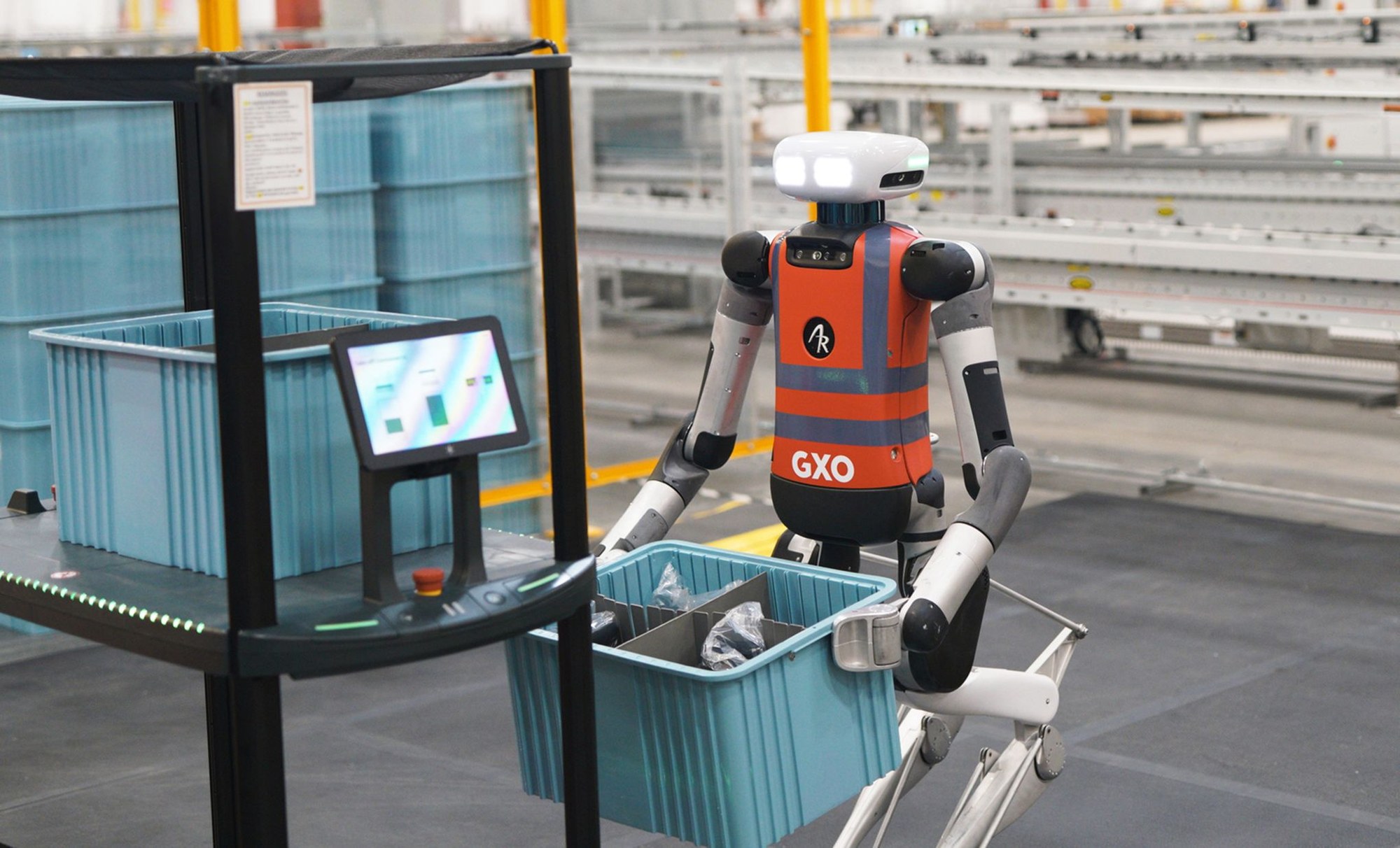
Agility brings more commercial substance to this listing than skeptics of the humanoid category might assume. Its Digit robot is deployed with Schaeffler, GXO Logistics, and Toyota Motor Manufacturing Canada, and the company cites a pipeline of more than thirty enterprise customers across logistics, manufacturing, and the broader supply chain. Its strategic investor list reads like an industrial policy statement: NVIDIA, Amazon, SoftBank Vision Fund 2, Schaeffler, Foxconn, and a set of deep-technology venture firms.
Those are real deployments generating real operating data, which distinguishes Agility from humanoid developers whose public evidence remains demonstration video. GXO has been running Digit units in live warehouse operations since 2024 in what both companies describe as the industry’s first formal robots-as-a-service humanoid deployment.
Still, the honest caveat belongs in the same paragraph as the enthusiasm. No humanoid maker anywhere, in the United States or China, has yet demonstrated profitable unit economics at scale, and American developers shipped on the order of 150 units each last year against thousands from their Chinese counterparts. The S-4, when it lands, will show revenue that is tiny relative to a US$2.5 billion valuation. Public-market investors will be underwriting a trajectory, not a run rate, and trajectories in robotics have a history of arriving late.
The De-SPAC Gauntlet
The listing route Agility has chosen carries its own history, and Beer will know it better than most. The SPAC boom of 2021 carried a generation of electric vehicle and advanced-technology companies onto public markets on projections that subsequently collided with operating reality; the names that survived did so on the strength of their finance functions as much as their engineering. The lesson absorbed by institutional investors was not that SPACs are disqualifying but that the quality of the finance organization, the realism of the projections in the S-4, and the credibility of management’s first few quarters of guidance determine whether a de-SPAC trades as a company or as a cautionary tale.
That context explains the specificity of this hire. An ex-analyst CFO who has personally taken a company through a de-SPAC and years of NYSE reporting is close to a purpose-built profile for the job Agility needs done: constructing projections that survive scrutiny, building the controls infrastructure that auditors and the SEC will test, and setting a guidance philosophy conservative enough to be beaten. Churchill Capital’s franchise, for its part, brings experienced SPAC sponsorship and a track record that includes some of the structure’s most scrutinized deals, which cuts both ways: access to deep institutional networks, and a market that will read the fine print twice.
The redemption dynamics of modern SPACs add one more reason the CFO seat matters now rather than after closing. Gross proceeds of US$620 million are a ceiling, not a floor; the cash that actually arrives depends on how many SPAC shareholders redeem rather than roll into the combined company, and minimizing redemptions is fundamentally an investor-persuasion exercise. That campaign starts with the S-4 and runs through closing, and it is the CFO who fronts it.
Why the Timing Is Not an Accident
The listing push lands in a market that has suddenly turned favorable for robotics paper. In China, AgiBot is preparing a Hong Kong listing with three sponsor banks, Unitree has filed for Shanghai’s STAR Market, and IPO applications from Leju Robotics and Deep Robotics have been accepted by domestic exchanges. Capital markets on both sides of the Pacific are being asked to price humanoid robotics for the first time, within the same few quarters.
The policy backdrop sharpens the moment further. The same week Beer’s appointment was announced, the House of Representatives passed a defense bill barring Pentagon procurement of Chinese humanoid robots, a provision that effectively fences off US government-adjacent demand for domestic suppliers. For a company positioning itself as America’s first public humanoid maker, the timing could hardly be scripted better: the addressable market is being legislatively reserved at the moment the prospectus is being drafted.
Being first on a US exchange carries a specific advantage: index inclusion, analyst coverage, and the default status of “the humanoid stock” for every fund that wants exposure to the theme. It also carries the burden of setting the sector’s public valuation benchmark. If Agility trades well, it opens the window for Figure AI, Apptronik, and the rest of the American cohort. If it trades poorly, the window narrows for everyone.
There is competitive irony in the volume mathematics, and an honest analysis has to hold both facts at once. Chinese manufacturers shipped thousands of humanoids last year to America’s hundreds, and unit costs across the Pacific run as low as one tenth of comparable US hardware. Agility’s public-market pitch cannot be that it wins on volume or price today; it must be that recurring robots-as-a-service revenue from customers like GXO and Schaeffler, plus a legislatively protected government channel, compounds into a durable American franchise while the volume war plays out elsewhere. A publicly listed, Pentagon-eligible humanoid company with an ex-analyst CFO is a portfolio construction built for exactly that argument.
For operators and procurement teams watching from the sidelines, the practical takeaway is that the humanoid sector is about to produce something it has never had: audited financial statements, quarterly disclosure, and a public record of what these machines actually cost and earn. Whatever the stock does, that transparency will do more to discipline the industry’s claims than any demonstration video ever has.
There is a final constituency for whom this appointment matters: the employees and early shareholders of every private humanoid company. Liquidity events set compensation benchmarks across a sector, and a successfully listed Agility would give recruiting teams at Figure, Apptronik, and Boston Dynamics a public reference point for what robotics equity is worth, while giving their venture investors a mark against which every portfolio position gets re-measured. Sectors tend to professionalize in a hurry once one of their number files audited statements, because every rival’s next fundraise is negotiated in the shadow of the public comp.
The first earnings call will be the most informative document in the history of the humanoid business. It now has a CFO to deliver it.
Disclaimer: This article is for general information purposes only and does not constitute investment, legal, or procurement advice. Readers should verify details with primary sources before making business decisions.