A Hangzhou Startup Says the Dexterous Hand Race Is Really a Durability Race, and Investors Just Agreed
Shiyue Technology, a Hangzhou dexterous-hand startup founded just five months ago, has raised nearly CN¥100 million (about US$14 million) in angel funding co-led by ZWC Partners and Twenty Venture. The company is unusual in a crowded segment for having revenue before its Series A: its Lumi-Dex hands are already shipping, with claims of 5,000-hour continuous operation and full-palm tactile sensing at a cost-controlled price point. In a market where dexterous hands are widely seen as the bottleneck between humanoid demos and productive work, Shiyue’s operating-hours-first positioning is a bet that reliability, not anatomical fidelity, decides which suppliers survive the coming consolidation.
Shiyue Tech, the Hangzhou-based dexterous manipulation startup that brands itself LumiBot internationally, has closed an angel round worth tens of millions of yuan (several million US dollars), led by Changzhou Zhirong Changyou, an equity investment partnership under Changyou Tech, with funds from two state-owned investment platforms following, according to Chinese technology media reports published Thursday. Lingjue Capital advised on the deal.
The money is earmarked for team expansion, product iteration, small-batch production line construction, and the data collection and model development behind the company’s manipulation software. Founded in January 2025, with its hardware center in Hangzhou and an algorithm team in Beijing’s Zhongguancun, the eighteen-month-old company has already assembled a four-line product family: Lumi-Dex dexterous hands, Lumi-Tac fingertip vision-tactile sensors, Lumi-Mod micro motor modules, and the Lumi-Mind manipulation model.
In a year when Chinese embodied AI unicorns are minted almost weekly, an angel round of this size would not normally warrant attention. What makes Shiyue worth a closer look is the thesis it is testing: that the dexterous hand market will be won not by the most humanlike fingers but by the hands that survive a factory shift.
Durability Over Dexterity
The company’s founder, Wu Yuwen, came to the problem from the investor side of the table, having previously led investments in AI vision and coffee-robot ventures. His stated conversion moment is telling. The industry assumption, he says, was degrees of freedom, the count of independent joint movements that serves as the sector’s headline specification, would decide the market. Running a company changed his view: in industrial settings, what factories actually ask is how many hours a hand can run without failing.
That reframing drives Shiyue’s most distinctive engineering claim. Dexterous hands overheat; cramming dozens of micro motors into a palm-sized volume generates heat with nowhere to go, forcing duty-cycle limits that make continuous industrial operation impractical. Shiyue says it has built the first micro joint module with active cooling, reworking the motor configuration to free internal space for air ducts, cutting operating temperature by more than 50 degrees Celsius and extending continuous no-load life beyond 5,000 hours. If the numbers hold in customer deployments, the company will have removed the specific engineering barrier between dexterous hands and 24-hour factory work.
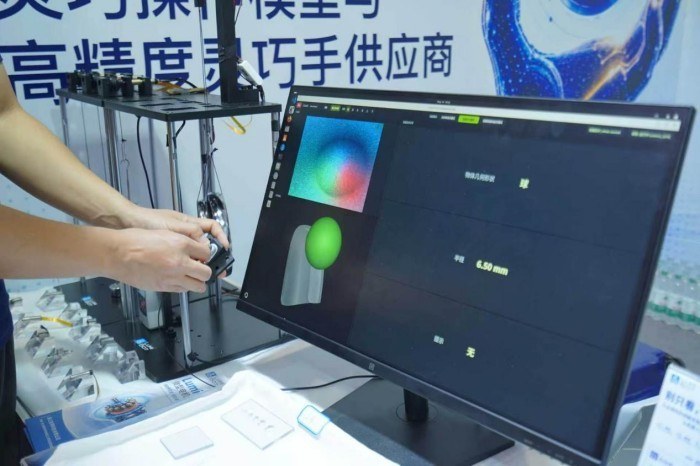
The second differentiator sits at the fingertips. Shiyue’s Lumi-Tac sensor uses a micro camera watching a deformable gel pad, decoupling force, texture, and slip from the gel’s deformation with a claimed 10-micron spatial resolution and 0.02-newton force precision, an approach that mimics how human skin senses through deformation rather than through discrete pressure points. The company describes itself as among the first in China to put vision-tactile sensing into a fingertip, and Wu argues the technology’s contribution to manipulation success rates makes it the inevitable standard for high-end hands.
A Deliberately Split Product Strategy
Shiyue’s commercial architecture separates volume from ambition. Its 11-degree-of-freedom hand, cost-controlled and aimed at handling and sorting work, entered small-batch production and began selling last month; the company projects full-year revenue of CN¥20 million to CN¥30 million (US$2.8 million to US$4.2 million) on shipments of 100 to 200 units. The flagship 23-active-degree-of-freedom hand splits into two variants, one with hollow-cup motor modules arriving shortly and one carrying the active cooling system, expected in October. A 17-degree model with millisecond dynamic response sits between them, and the flagship claims a 60-newton active load with precise mapping of human hand motion.
Revenue in the first year of sales, however modest, separates Shiyue from the majority of a crowded field. The company reports million-yuan-level orders underway with a leading industrial customer, exploring spray-coating work that pairs its hands with industrial robot arms, plus advancing cooperations with China Unicom and electrical equipment maker Sieyuan Electric.
The team behind the claims carries unusual pedigree for a company this young. Technical lead Song Kaiyou trained under academicians Xiong Youlun and Yin Zhouping and led multiple training rounds of Ant Group’s Bailing multimodal model as a senior algorithm expert. The algorithm lead arrived from Baidu’s autonomous driving unit, where he led China’s first production pure-vision advanced driving system, and the product lead previously founded a dexterous hand company that reached mass production.
The Hottest Small Component in Robotics
Shiyue’s raise lands in what has quietly become the most contested component category in Chinese robotics. As humanoid platform valuations inflated through 2025 and 2026, investors hunting for exposure at saner prices moved down the bill of materials, and the dexterous hand, the single most complex and failure-prone assembly on a humanoid, emerged as the favored destination. Established players like Inspire Robot supply hands to much of the domestic humanoid industry; startups spun out of university labs and large-company robotics units now number in the dozens; and humanoid makers themselves, including Unitree and AgiBot, are developing hands in-house to control the one component that most determines what their machines can actually do.
The economics explain the crowding. A capable dexterous hand can account for a meaningful share of a humanoid’s total cost, and unlike torsos and legs, hands have a market beyond humanoids: mounted on conventional industrial arms, they upgrade the installed base of millions of robots that today end in grippers. That retrofit market is where Shiyue’s spray-coating exploration with its industrial customer points, and it is arguably the larger near-term opportunity, since factories that would never buy a walking robot will pay for a hand that automates a task their grippers cannot touch.
The competitive risk runs in the same direction. If hands become the industry’s profit pool, the humanoid platforms will vertically integrate harder, and component specialists will find their customers becoming their competitors, the fate that befell many suppliers in smartphones and electric vehicles. Shiyue’s counter, judging by its product architecture, is to make the hand inseparable from the sensing and the manipulation model, so that what it sells is not a component but a capability.
The Data Loop Is the Actual Product
Underneath the hardware, Shiyue is running the same strategic play that animates the best-funded companies in embodied AI: own the data loop. The company pretrains on purchased open-source simulation data, collects teleoperation data through a self-built vision-tactile glove, and harvests first-person video directly from factory workers, retargeting their motions onto robot hands. Its Lumi-Mind model, built on a vision-tactile-language-action architecture with a layered planning-and-control design, draws on an atomic skill library covering grasping, rotating, and aligning.
Wu is explicit that hardware is the entry point rather than the business: selling hands opens the door, but the durable value is the collect-train-deploy-return cycle that keeps improving manipulation intelligence. His lead investor endorsed exactly that logic, arguing the industry lacks neither hardware nor algorithms but high-quality data assets, and that Shiyue’s full-stack closed loop is what makes it scarce.
The skeptical frame writes itself. Every dexterous hand company in China now claims a proprietary data flywheel, sub-millimeter sensing, and imminent industrial adoption, and the segment has drawn dense funding all year precisely because the claims are cheap to make and expensive to verify. Shiyue’s stated revenue and its 5,000-hour durability figure are company numbers, not audited ones. What distinguishes the company for now is that its differentiation claims are at least falsifiable on a factory floor: either the hands run around the clock without overheating or they do not, and either customers reorder or they do not.
The funding environment gives the timing a further logic. Angel-stage checks in embodied AI are being written faster and larger than at any point in the sector’s history, but the window for component startups may prove shorter than for platforms: once two or three hand suppliers reach reliable volume production, procurement in this category will consolidate around proven reliability records the way it always does in industrial components. Shiyue’s rush to put its cost-controlled model into customers’ hands this year, ahead of the flagship’s October arrival, reads as a race to be inside factories accumulating operating hours before that consolidation begins.
The investor composition reinforces the industrial read. ZWC Partners has built its robotics thesis around cross-border supply chains, while Twenty Venture operates close to the manufacturing floor of southern China’s hardware ecosystem, and both wrote checks after the products had shipped rather than before. In an angel market where embodied AI valuations are routinely set by demonstration videos, backing a company on the strength of purchase orders and thermal test data is itself a small act of contrarianism, and it suggests the diligence conversation centered on reorder probability rather than on resemblance to human anatomy.
For hardware buyers and integrators, Shiyue lands on the watch list rather than the shortlist: a credible team attacking the correct bottleneck, with early revenue and specifications that, if verified, would matter. In a segment where the flagship metric has been how closely a machine resembles a human hand, a startup measuring itself in continuous operating hours is asking the more commercially serious question. October’s flagship launch, and the reorder data that follows it, will supply the first real answer the market can actually verify.
Disclaimer: This article is for general information purposes only and does not constitute investment, legal, or procurement advice. Readers should verify details with primary sources before making business decisions.