The Hidden Supplier Behind Half of China's Humanoid Robots: A Dexterous Hand Pricing Breakdown
Ruiyan Zhikong supplies dexterous hands to over 50 Chinese embodied AI companies, claiming ~80% market share in high-DoF hands. Its RY-H2 at ~USD 1,380 wins on IP67 waterproofing and 24-hour continuous operation. China's dexterous hand market is forecast to grow 266% in 2026 to 70,270 units.
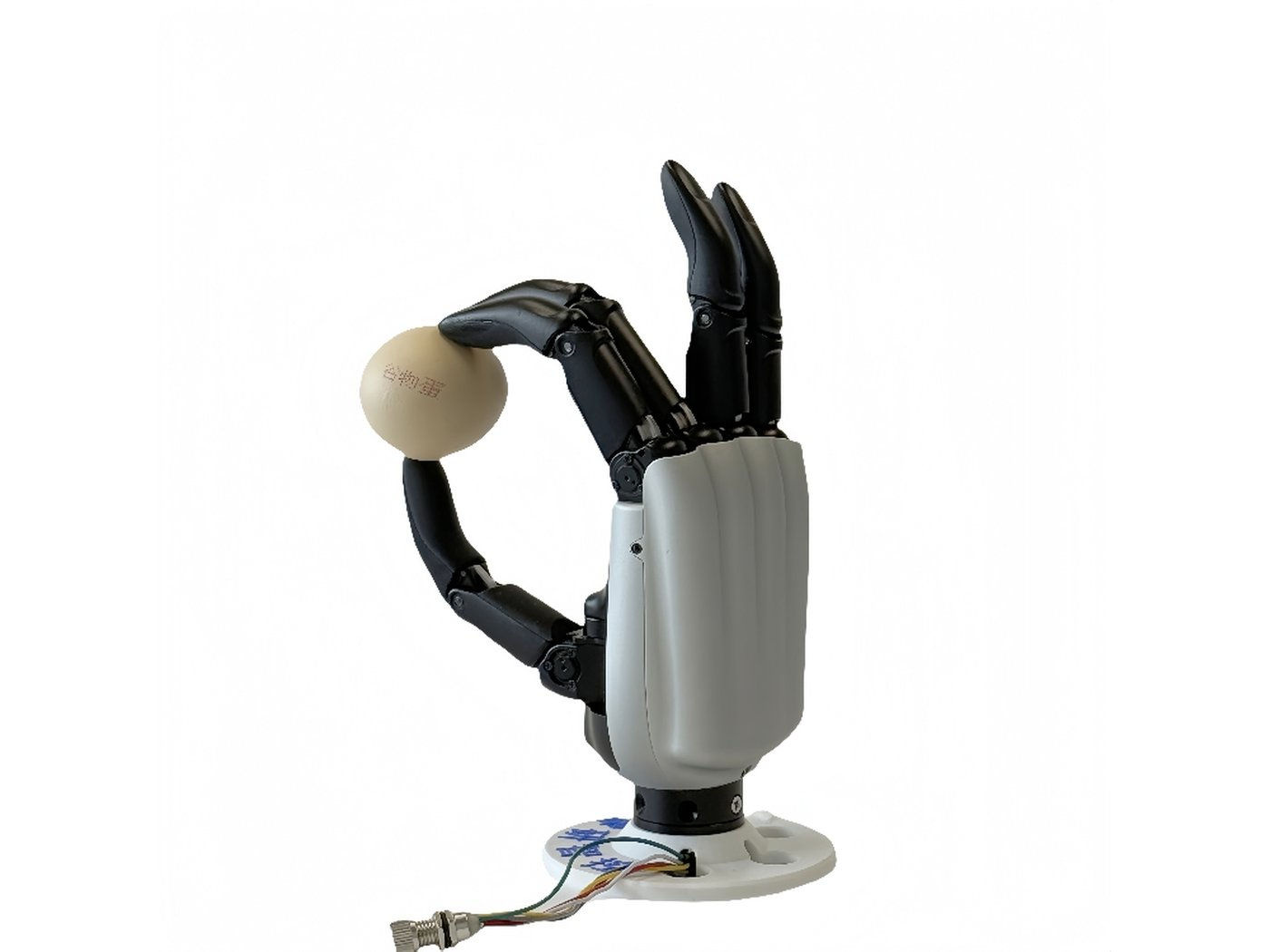
While the industry debates which humanoid robot will win, a quiet Shenzhen company has become the dexterous-hand supplier for more than 50 embodied artificial intelligence (AI) firms. The pricing data tells a more complicated story.
There is a component inside nearly every serious humanoid robot that almost no one talks about in press releases. It is not the brain, not the legs, and not the battery. It is the hand.
Tesla's Optimus production line was halted in late 2024, not because of a software failure or a supply-chain disruption in the usual sense, but because the hands and forearms were not ready. Factories had stacked up body shells waiting for the one part that could not be rushed. That moment, largely underreported at the time, was the clearest signal yet that dexterous hands are the defining bottleneck of the current humanoid robot generation. The company that appears to have understood this earliest is one that most people outside China's robotics industry have never heard of.
Who Is Ruiyan Zhikong?
Ruiyan Zhikong (睿研智控), known commercially as RUIYAN, is a Shenzhen-based robotics component company with roots going back to 2016, when its founding team began research into miniature high-precision actuation systems. The company was formally incorporated in January 2024, a deliberate timing that reflected a decision to commercialise only once the technology was mature enough to meet industrial reliability standards rather than research-grade ones.
The founding team came from backgrounds in precision mechatronics and servo control, and the company's early years were spent solving a problem that most dexterous-hand developers treat as secondary: how to make a hand that works continuously, not just impressively. The distinction matters more than it sounds. A hand that performs flawlessly in a five-minute demonstration but requires cooling breaks, recalibration, or protective handling in between is not a production tool. It is a prototype.
Ruiyan's first public appearance came at the 2024 World Robot Conference (WRC) in Beijing, where it debuted a 15-degree-of-freedom (DoF) prototype that drew attention for its force-position hybrid control and its IP67 waterproof rating, a specification almost no other dexterous hand in the market offered at the time. By March 2025, the company had launched its commercial RY-H2 series at RMB 9,999 per hand, a price point that positioned it squarely in the mid-range of the Chinese domestic market.
What happened next was not the result of a marketing campaign. Ruiyan reports receiving inbound customer inquiries at a rate of approximately one new company every two days, with the customer base now spanning more than 50 embodied foundation-model companies in China. The company claims approximately 80% market share in high-degree-of-freedom dexterous hands for the embodied AI segment. Customers cited in industry reporting include AgiBot, LimX Dynamics, MagicLab, Booster Robotics, EngineAI, Galbot, and PNDbotics, among others.
To understand why that position developed so quickly, and whether it is defensible, it helps to look at what dexterous hands actually cost across the global market.
The Price Ladder: What Dexterous Hands Cost in 2026
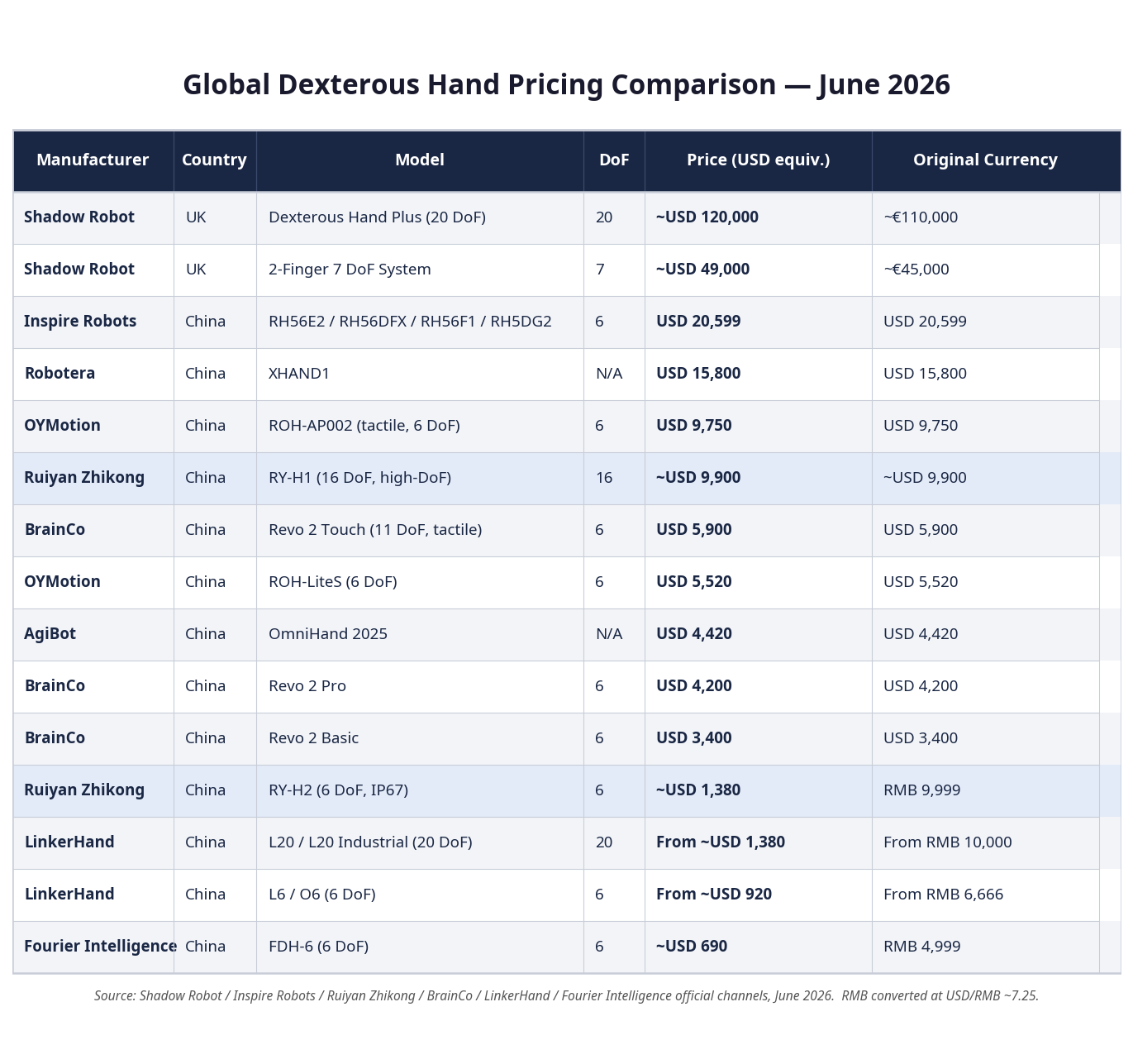
The dexterous-hand market spans roughly four price tiers, each reflecting a different set of engineering trade-offs. The table below covers the major commercially available models, with prices drawn from official manufacturer product pages and authorised reseller storefronts. Models where no public price is available are excluded. All Chinese renminbi (RMB) figures are converted at approximately USD/RMB 7.25, the prevailing rate in June 2026.
What the Price Ladder Reveals
The first thing the table makes clear is that the Western-to-China price gap is not a rounding error. Shadow Robot's full 20-DoF system costs roughly 87 times more than Fourier's FDH-6. Even accounting for the difference in degrees of freedom, the gap is structural. Shadow Robot's hand is built for research and extreme-environment applications, with a level of engineering support and documentation that justifies the price for its target customers. It is not competing in the same market as Ruiyan.
The more interesting comparison is within the Chinese tier. Between RMB 4,999 (Fourier FDH-6) and RMB 9,999 (Ruiyan RY-H2), there is a price difference of exactly RMB 5,000. Both hands offer 6 active degrees of freedom, 5 fingers, and similar weight. The difference comes down to three engineering choices that are invisible in a spec sheet but critical in deployment: IP67 waterproofing, 24-hour continuous operation without thermal shutdown, and a force-position hybrid control algorithm that prevents finger drift during long training sessions.
These are not marketing claims. They are engineering requirements that embodied AI companies discovered through failure. Three specific customer problems have been cited in industry reporting: a company that could not find a waterproof hand anywhere in the market before switching to Ruiyan; a company whose prior hand required 10 to 20 minutes of cooling time between training runs; and a company whose fingers were drifting or physically detaching during operation. All three problems were resolved after switching to Ruiyan.
The BOM Problem That Pricing Alone Cannot Solve
Understanding why dexterous hands cost what they cost requires looking inside the bill of materials (BOM). A standard 6-DoF dexterous hand requires at minimum six miniature motors, six precision reducers or ball-screw assemblies, six encoders, a control board, structural components, and wiring. At current Chinese domestic component prices, the motor alone can cost several hundred renminbi per unit, and that is before integration, testing, or the control software stack.
Fang Hainan, chief marketing officer (CMO) of Inspire Robots, put it directly in a February 2026 interview with Gasgoo: "If a dexterous hand reaches 500 yuan, how much must one motor cost?" The arithmetic is the argument. LinkerHand co-founder Su Yang suggested in September 2024 that dexterous hand prices could fall to RMB 500 within three years. That prediction has generated significant debate in the industry because it implies a motor cost of roughly RMB 80 per unit, which is below the current floor for any motor with the precision and durability required for reliable manipulation.
The BOM structure also explains why Ruiyan's technical differentiation matters commercially. The company uses self-developed frameless torque motors across its product line, rather than sourcing from external suppliers. This is the same vertical-integration logic that allowed Inspire Robots to break below the RMB 100,000 price threshold in 2020 by developing its own micro-servo electric cylinder technology. Self-developed core components allow a company to control yield rates, manage reliability at scale, and reduce per-unit cost as volume grows, none of which is possible when the critical actuator is a commodity purchase.
Ruiyan's full-stack integration also includes self-developed control algorithms, which matters for a reason that is not immediately obvious. Dexterous hands for embodied AI are not primarily used for pick-and-place tasks. They are used for training data collection, which means the hand must operate continuously for hours, maintain consistent force control throughout, and not introduce noise into the data stream through mechanical inconsistency. A hand that drifts, overheats, or requires recalibration mid-session is not just inconvenient. It corrupts the training data and invalidates the run.
Why Ruiyan's Market Position Is Structurally Significant
The claim that Ruiyan supplies more than 50 embodied foundation-model companies is based on company-sourced reporting and has not been independently verified at the individual-company level. What is independently verifiable is the market context in which that claim sits.
According to the Gauss-Grünewald Industrial Intelligence Institute (GGII), China shipped 19,200 dexterous hands in 2025 and is forecast to ship 70,270 units in 2026, a 266% year-on-year increase. Industry revenue in the first quarter of 2026 alone exceeded RMB 500 million, compared to a full-year 2025 total of approximately RMB 300 million. These figures are consistent with the broader embodied AI investment surge documented across multiple sources this year.
Against that backdrop, a company receiving one new customer inquiry every two days without active marketing is a meaningful signal. It suggests that the supply side of the dexterous-hand market is not yet competitive enough to give buyers meaningful choice, and that companies willing to solve the engineering reliability problem rather than the specification-sheet problem are capturing a disproportionate share of demand.
Bloomberg reported in June 2026 that BrainCo, another Chinese dexterous-hand maker, is seeing a similar demand surge, with several dozen mainland robotics firms including Unitree Robotics and Leju Robotics buying its hands. BrainCo partner Nyx He told Bloomberg that Chinese humanoid developers are shifting focus from demonstrating spectacle to finding real-world use for their machines. That shift is exactly the condition under which engineering reliability becomes the primary purchasing criterion, rather than maximum degrees of freedom or the lowest sticker price.
The Comparison That Matters: Ruiyan vs the Field
Setting aside Shadow Robot, which operates in a different market segment entirely, the meaningful competitive comparison for Ruiyan is against Fourier, BrainCo, Inspire Robots, and LinkerHand, the four Chinese players with the most visible commercial traction in 2025 and 2026.
Fourier's FDH-6 is the most aggressive on price at RMB 4,999, roughly half of Ruiyan's RY-H2. Fourier's official product page confirms 6 DoF, 515g weight, 0.5mm fingertip repeatability, and a 300,000-cycle service life. It does not specify IP67 waterproofing or 24-hour continuous operation ratings. For companies that need a cost-effective hand for structured pick-and-place tasks or short training sessions, the FDH-6 is a credible option. For companies running multi-hour uninterrupted training sessions in environments where condensation or cleaning fluids are present, the RMB 5,000 price difference may represent the cheaper option when total cost of ownership is considered.
BrainCo's Revo 2 series occupies the USD 3,400 to USD 5,900 range, which is two to four times the price of Ruiyan's RY-H2 at current exchange rates. The Revo 2 Touch's key differentiator is its integrated tactile sensing suite, which enables force, texture, and proximity perception at the fingertips. This is a different product for a different use case. The Revo 2 Touch is positioned for haptics research and contact-rich manipulation tasks where the tactile data stream itself is the research output. Bloomberg's June 2026 reporting confirms that Unitree and Leju are among BrainCo's customers, suggesting the higher price point is accepted by companies that need the tactile sensing capability.
Inspire Robots sits at the top of the Chinese domestic price range at USD 20,599 per hand, closer to the international tier than the domestic Chinese tier. The company's CMO has stated that its competitive advantage comes from its self-developed micro-servo electric cylinder technology and from cross-industry volume in industrial and medical applications, which spreads R&D costs across a broader customer base. Inspire Robots delivered 10,000 units in 2025, a milestone the company announced in March 2026, suggesting its price point is sustainable at current volumes.
LinkerHand is the most technically ambitious player in the comparison set, with its L30 tendon-driven series offering up to 25 DoF and its R30 direct-drive series offering 21 full-active DoF. Its entry-level price of RMB 6,666 for the L6 series is competitive with Ruiyan, but the high-DoF systems are priced at RMB 10,000 and above. LinkerHand's co-founder has publicly stated that dexterous hand prices could fall to RMB 500 within three years, a claim that has generated significant industry debate given current BOM constraints.
What Happens Next
Ruiyan has teased new products at the 2026 World Artificial Intelligence Conference (WAIC), scheduled for July 17 to 20 in Shanghai. A teaser image shared by the company suggests a new model, appearing to carry the designation H3-D127, will be unveiled at the event. The company's trajectory from 2016 research origins to a January 2024 commercial launch to its current market position follows a pattern seen in other Chinese component champions: a long validation cycle, a deliberate focus on solving engineering reliability rather than headline specifications, and a customer base that discovered the product through word of mouth rather than marketing spend.
The broader question the Ruiyan story raises is not about one company. It is about where the competitive advantages in embodied AI actually sit. The companies attracting the largest funding rounds and the most media coverage are the ones building full humanoid systems. But the companies that may prove hardest to displace are the ones that quietly became the exclusive supplier of a critical component to dozens of those same systems. In the automotive industry, that dynamic produced companies like Bosch and Denso, whose names most consumers never knew but whose components were inside every car on the road.
Whether Ruiyan becomes the Bosch of dexterous hands depends on whether it can maintain its engineering reliability advantage as the market scales from tens of thousands of units to hundreds of thousands. The WAIC launch in July will be the first public test of whether the company's next-generation products can hold the position it has built.
The dexterous-hand market in 2026 is not a price war. It is an engineering reliability war dressed up as a price war. The companies winning customer orders are not the ones with the lowest sticker price or the highest degree-of-freedom count. They are the ones that solved the problems customers discovered after buying the cheaper option: thermal shutdown during training, finger drift corrupting data, and the absence of waterproofing in environments that require it. Ruiyan's position as the quiet supplier to a large share of China's embodied AI industry is the clearest evidence yet that in physical AI, the component layer is where durable competitive advantages are being built.
Disclaimer: This article is for informational purposes only and does not constitute investment advice. Pricing data is sourced from official manufacturer websites and authorised resellers as of June 2026 and is subject to change. Market share and customer figures attributed to Ruiyan Zhikong are based on company-sourced industry reporting and have not been independently verified at the individual-company level. RobotAIGeek makes no representation as to the accuracy of company-stated claims.
SOURCES
1. Robot Lecture Hall (机器人大讲堂) — "The Exclusive Dexterous Hand Supplier to Dozens of Embodied AI Companies: What Did Ruiyan Zhikong Do Right?" | June 29, 2026
WeChat Official Account
2. Ruiyan Zhikong official website — RY-H2 product page | Current
https://www.ruiyanrobot.com/product/hand/35
3. Ruiyan Zhikong official website — RY-H5 product page | Current
https://www.ruiyanrobot.com/product/hand/93
4. Shadow Robot — "How Much does a Robot Hand Cost?" | December 2022
https://shadowrobot.com/how-much-does-a-robot-hand-cost/
5. Inspire Robots official store | Current
6. Fourier Intelligence — FDH-6 official product page | Current
https://www.fftai.com/products-fdh6
7. LinkerHand official website | Current
8. Robots International — BrainCo Revo 2 Touch, Pro, Basic listings | Current
https://www.robotsinternational.com/Brainco-Revo-2-Touch.htm
9. Robots International — Robotera XHAND1 listing | Current
https://www.robotsinternational.com
10. Robots International — AgiBot OmniHand 2025 listing | Current
https://www.robotsinternational.com/AgiBot-OmniHand-2025.htm
11. AIFITLAB — OYMotion ROH-LiteS and ROH-AP002 listings | Current
https://aifitlab.com/collections/oymotion-robotic-hand
12. Gasgoo — "Can a 500-Yuan Dexterous Hand Grasp the Industry's Lifeline?" | February 1, 2026
13. Bloomberg — "China's BrainCo Sees Bionic Hand Sales Boom From Robot Makers" | June 2, 2026
14. Inspire Robots — 10,000 units delivered in 2025 announcement | March 19, 2026
https://en.inspire-robots.com/category/news
15. humanoid.guide — RY-H1 product listing | Current